Global 4K TV Market Highlights
| Market Size (2025) | USD 87.5 Billion |
| Forecast Size (2032) | USD 153.6 Billion |
| CAGR | 6.20% |
| Base Year | 2025 |
| Forecast Period | 2026-2032 |
| Largest Region | Asia-Pacific |
| Fastest Growing Region | LATAM |
| Largest Segment | Above 65 inches |
| Fastest Growing Segment | 52 to 65 inches |
| Leading Companies | Samsung, LG Electronics, Sony, TCL, Hisense |
Global 4K TV Market Size & Growth Rate (2026-2032)
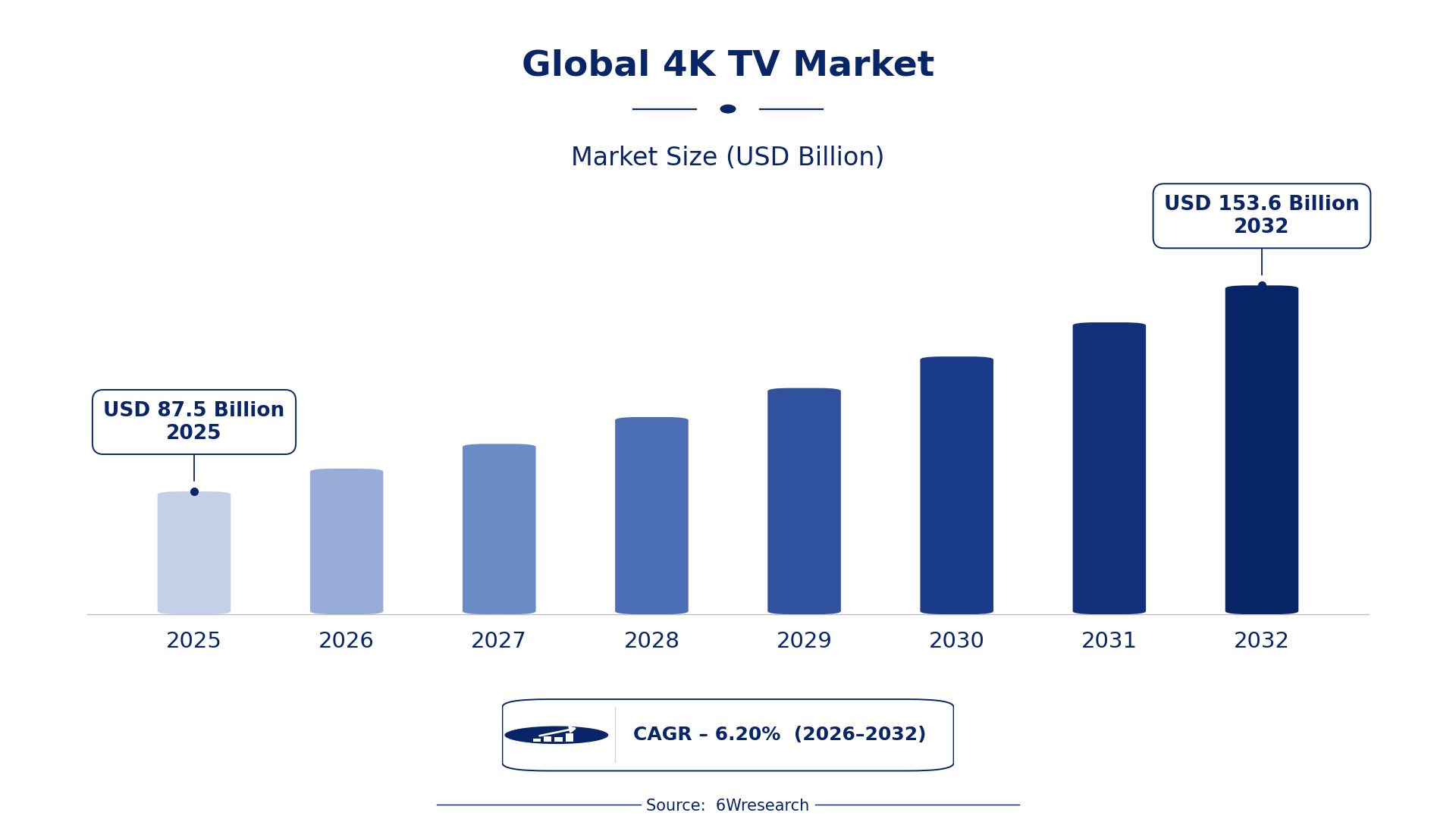
The Global 4K TV Market was estimated at USD 87.5 Billion in 2025 and is projected to reach USD 153.6 Billion by 2032, growing at a CAGR of 6.20% from 2026 to 2032.
Global 4K TV Market Synopsis
A transformation is underway in the Global 4K TV Market, characterized by the shift towards larger screen sizes and enhanced visual technologies. As consumers demand more immersive entertainment experiences, manufacturers are investing heavily in OLED and QLED technologies, which offer superior color accuracy and brightness. This pivot is not only driven by consumer preferences but also influenced by shifts in content availability across streaming platforms.
The market matter significantly to sectors like entertainment, retail, and technology, as enhanced viewing experiences are increasingly correlated with sales growth. As this market evolves, factors like the integration of smart technologies and the rise of 4K content from streaming services contribute to this structural change, differentiating the 4K TV sector from traditional television markets.
Global 4K TV Market Year-wise Growth Rate and Key Drivers
This graph illustrates the annual growth rates of the Global 4K TV Market from 2022 to 2032, highlighting a steady upward trajectory and projected expansion over the forecast period.
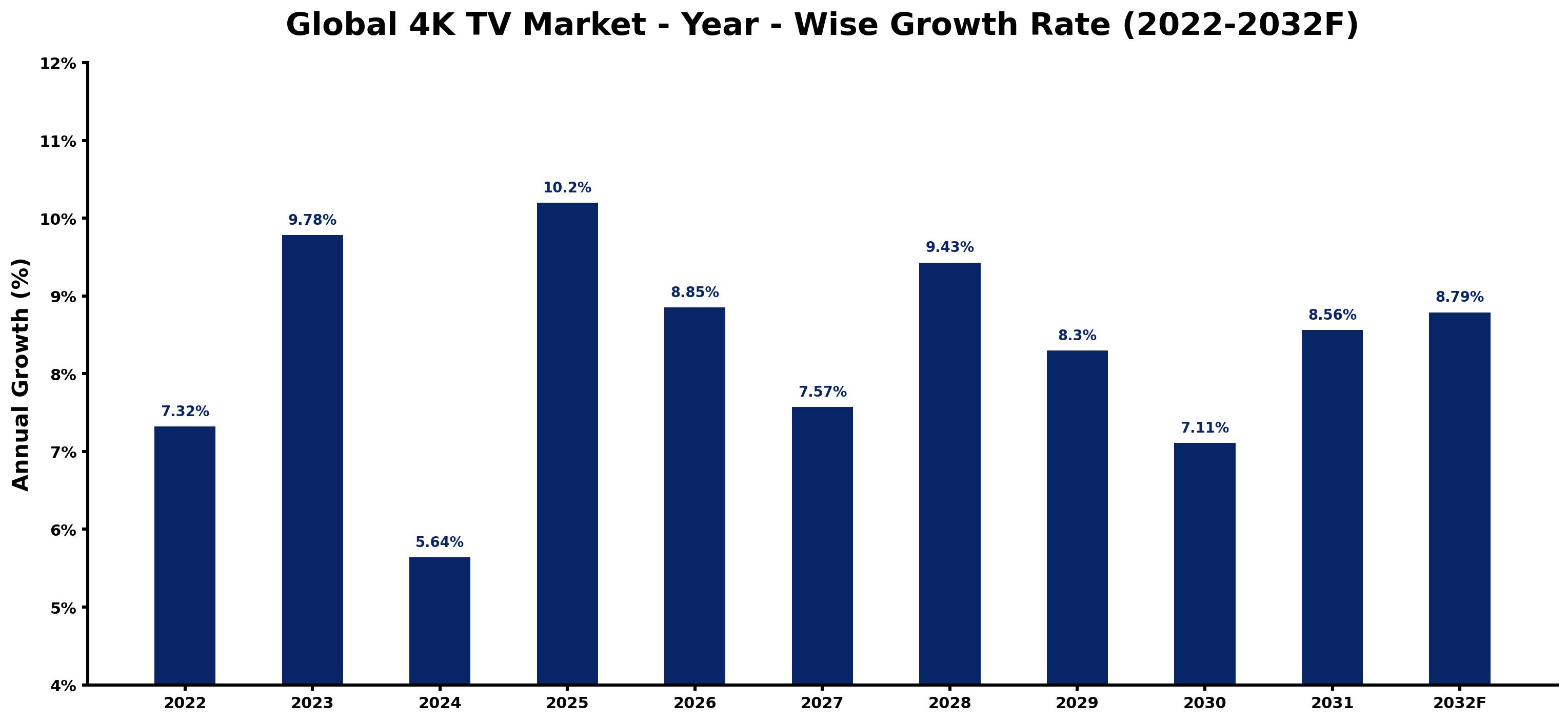
The table below presents the year‑wise growth rates along with the key drivers influencing the market
| Year | Growth Rate (%) | Major Drivers |
| 2022 | 7.32 | Consumers responded to rising raw material costs with increased interest in 4K TVs. |
| 2023 | 9.78 | Manufacturers embraced sustainability practices, enhancing 4K TV offerings amid evolving consumer preferences. |
| 2024 | 5.64 | As 4K TV prices stabilize, end-users are increasingly upgrading their home viewing experiences. |
| 2025 | 10.2 | Telecom infrastructure providers implemented policies that accelerated the deployment of 4K TV services. |
| 2026 | 8.85 | Expanding fiber-optic networks enhances data transfer speeds, benefiting 4K TV streaming capabilities. |
| 2027 | 7.57 | A shift toward cloud migration encourages adoption of 4K TV services in households. |
| 2028 | 9.43 | Improvements in edge computing processes enable smoother 4K TV streaming and reduce latency. |
| 2029 | 8.3 | In North America, supply chain improvements are leading to increased availability of 4K TVs. |
| 2030 | 7.11 | Technological advancements in display technology enhance 4K TVs, attracting more consumers to upgrade. |
| 2031 | 8.56 | Advanced 4K TV models are driving M&A activity among tech companies seeking competitive advantages. |
| 2032 | 8.79 | Consumer enthusiasm for immersive entertainment experiences is transforming the global 4K TV market. |
Note - Market size estimations and growth projections presented in this report are based on 6Wresearch's proprietary research methodology, combining internal industry data, secondary research, and primary validation, updated periodically to reflect current market conditions. As markets evolve rapidly, figures for certain industries may vary slightly and are intended as informed estimates rather than absolute figures. For the most current market sizing, we recommend validating figures with a 6Wresearch analyst.
Global 4K TV Market Key Takeaways
Below are some of the specific key takeaways from the market, including:
- In 2025, the Asia-Pacific region is predicted to hold approximately 45% of the market share, owing to its well-established electronics manufacturers.
- The Above 65 inches segment accounts for the largest share, expected to claim around 40% of total sales in 2025.
- 52 to 65 inches segment is projected to grow at a CAGR of 7.5% from 2026 to 2032, driven by increasing demand for mid-size TV models.
- Samsung and LG battle for leadership, continually innovating with smart features and display technologies.
- By 2032, it is anticipated that ultra-high definition content streaming will reach over 70% of content offerings across major platforms.
Evaluation of Restraints in Global 4K TV Market
The Global 4K TV Market faces notable challenges, primarily the high cost of advanced models, which often exceeds USD 2,500. Such pricing creates market entry barriers for consumers, especially in price-sensitive regions. Furthermore, the limited availability of native 4K content restricts the appeal of these TVs. For example, according to a 2023 survey, only about 25% of the total streaming library on prominent platforms is available in 4K resolution, constraining growth possibilities and consumer confidence in adopting these premium products.
Global 4K TV Market Trends
The market is seeing a distinct trend towards larger screens, particularly those over 65 inches, which are projected to account for 40% of sales by 2025. This shift reflects a consumer preference for immersive experiences, particularly in content-rich environments like home theaters. Companies like Samsung and LG are leveraging this trend by promoting models with innovative designs and enhanced smart capabilities. For example, LG’s 2023 launch of its OLED technology features displays with self-lighting pixels, enabling vibrant contrast and color accuracy.
Additionally, the integration of streaming capabilities into smart TVs continues to rise, with over 60% of 4K TVs expected to be equipped with advanced smart features by 2026. This operational change signifies a shift in how consumers are accessing content, with smart TVs becoming key access points for on-demand programming. This is a pivotal moment, as manufacturers pivot from traditional broadcasting models.
Global 4K TV Market Opportunities
There are several lucrative opportunities in the Global 4K TV Market, particularly in the expansion of affordable 4K models targeting emerging markets. For instance, Hisense plans to launch new models priced below USD 500 in LATAM by 2025, catering to an underserved segment. Moreover, partnerships between television manufacturers and streaming services present significant potential, such as Disney+ and Amazon Prime increasing their 4K content offerings, projected to exceed 1,500 titles by 2026. This boom in content availability can drive adoption rates substantially.
Furthermore, as consumers invest in smart home ecosystems, manufacturers can integrate advanced technologies like AI and voice-activated controls into their offerings. This creates a dual revenue stream—from hardware sales and ongoing service subscriptions, enhancing financial stability for companies operating in the market.
Global 4K TV Market by Screen Size
The Above 65 inches segment leads the Global 4K TV Market, capturing an estimated 40% share in 2025. This segment’s dominance is attributed to its appeal in home entertainment setups, where immersive viewing experiences are prioritized. Conversely, the 52 to 65 inches segment is expected to be the fastest-growing, with a projected CAGR of 7.5% from 2026 to 2032. This growth stems from a rising consumer preference for mid-sized TVs that fit a variety of living spaces without sacrificing viewing quality.
Global 4K TV Market by Region
Asia-Pacific stands as the largest region in the Global 4K TV Market, accounting for approximately 45% share in 2025. This leadership is supported by key manufacturers and a robust electronics supply chain. In contrast, LATAM is projected to be the fastest-growing region, expected to see a CAGR of 8.0% from 2026 to 2032. Factors driving this expansion include increasing disposable incomes and the influx of affordable 4K models catering to diverse consumer needs.
Government Initiatives in the Global 4K TV Market
The regulatory landscape for the Global 4K TV Market is evolving, reflecting the increasing recognition of the role that high-definition content and technology play in economic growth. Governments are implementing various initiatives aimed at promoting the adoption of cutting-edge technology in consumer electronics. These initiatives range from regulatory frameworks designed to encourage investment in digital infrastructure to funding programs for research and development in display technology.
- Ministry of Electronics and Information Technology, India: National Policy on Electronics, announced in 2020, aims to bolster indigenous manufacturing of electronics including 4K TVs, thus enhancing the supply chain in the region.
- Federal Communications Commission (FCC), USA: The 2022 initiative to expand broadband access is crucial for enhancing 4K streaming capabilities, which many consumers now expect from their devices.
- European Commission: Broadcasting Regulation Review, updated in 2023, includes proposals for enhancing the distribution of 4K content across platforms, impacting market dynamics positively.
- Government of South Korea: The Smart TV Promotion Initiative initiated in 2021 provides funding for research into integrating AI technologies into smart TVs, addressing future consumer demands.
Future Insights of the Global 4K TV Market
As the Global 4K TV Market evolves, a shift toward enhanced integration of Artificial Intelligence (AI) is expected to redefine user experiences. Companies like LG are investing in AI-driven features to deliver personalized content recommendations, improving viewer engagement. By 2032, it is anticipated that smart TVs will become interactive hubs in smart home ecosystems, further promoting the adoption of voice control and automation features. This trajectory will not only elevate consumer satisfaction but also create new revenue streams for manufacturers through content and subscription services.
Global 4K TV Market Latest Developments
Recent activities among leading companies indicate a robust focus on technology advancements and market expansion.
- Recently completed (April 2023), Samsung unveiled its QLED model lineup featuring enhanced gaming capabilities, positioning itself advantageously in the gaming segment.
- Ongoing (2023-2024), LG is actively collaborating with streaming platforms to ensure a more comprehensive range of 4K content on its devices, enhancing consumer options.
- Upcoming (early 2024), Sony plans to launch a range of affordable 4K models targeted at budget-conscious consumers, broadening market accessibility.
- Ongoing (2023-2032), TCL is focused on expanding its production facilities in LATAM to tap into the region's emerging consumer base for mid-range 4K TVs.
Global 4K TV Market Key Players and Industry Positioning
The Global 4K TV Market is characterized by a fragmented competitive landscape, with several key players vying for market share through differentiated product offerings and strategic initiatives. As manufacturers focus on technological enhancements and regional expansion, their ability to leverage brand loyalty and innovation will play a crucial role in determining market dynamics.
| Leading Company | Core Strength | Strategic Focus |
|---|---|---|
| Samsung | Market leader in QLED technology | Enhancing gaming capabilities and multimedia features |
| LG Electronics | Leader in OLED technology and smart home integration | Expanding partnerships with streaming services |
| Sony | Strong brand loyalty in high-end models | Focusing on affordability for broader consumer access |
| TCL | Competitive pricing and aggressive market penetration | Increasing production capabilities in emerging markets |
| Hisense | Value-driven product offerings | Targeting affordable models for emerging markets |
With heightened competition, companies are likely to prioritize technological advancements and strategic collaborations, setting the stage for transformative market growth.
Key Attractiveness of the Report
- 10 Years of Market Numbers
- Historical Data Starting from 2022 to 2025
- Base Year: 2025
- Forecast Data until 2032
- Key Performance Indicators Impacting the Market
- Major Upcoming Developments and Projects
Key Highlights of the Report:
- Global 4K TV Market Outlook
- Market Size of Global 4K TV Market, 2025
- Forecast of Global 4K TV Market, 2032
- Historical Data and Forecast of Global 4K TV Revenues & Volume for the Period 2022-2032
- Global 4K TV Market Trend Evolution
- Global 4K TV Market Drivers and Challenges
- Global 4K TV Price Trends
- Global 4K TV Porter's Five Forces
- Global 4K TV Industry Life Cycle
- Historical Data and Forecast of Global 4K TV Market Revenues & Volume
- Historical Data and Forecast of Global 4K TV Market Revenues & Volume By Screen Size for the Period 2022-2032
- Historical Data and Forecast of Global 4K TV Market Revenues & Volume By Below 52 inches for the Period 2022-2032
- Historical Data and Forecast of Global 4K TV Market Revenues & Volume By 52 to 65 inches for the Period 2022-2032
- Historical Data and Forecast of Global 4K TV Market Revenues & Volume By Above 65 inches for the Period 2022-2032
- Historical Data and Forecast of North America 4K TV Market Revenues & Volume By Screen Size for the Period 2022-2032
- Historical Data and Forecast of North America 4K TV Market Revenues & Volume By Below 52 inches for the Period 2022-2032
- Historical Data and Forecast of North America 4K TV Market Revenues & Volume By 52 to 65 inches for the Period 2022-2032
- Historical Data and Forecast of North America 4K TV Market Revenues & Volume By Above 65 inches for the Period 2022-2032
- Historical Data and Forecast of United States of America 4K TV Market Revenues & Volume for the Period 2022-2032
- Historical Data and Forecast of Canada 4K TV Market Revenues & Volume for the Period 2022-2032
- Historical Data and Forecast of Rest of North America 4K TV Market Revenues & Volume for the Period 2022-2032
- Historical Data and Forecast of Latin America (LATAM) 4K TV Market Revenues & Volume By Screen Size for the Period 2022-2032
- Historical Data and Forecast of Latin America (LATAM) 4K TV Market Revenues & Volume By Below 52 inches for the Period 2022-2032
- Historical Data and Forecast of Latin America (LATAM) 4K TV Market Revenues & Volume By 52 to 65 inches for the Period 2022-2032
- Historical Data and Forecast of Latin America (LATAM) 4K TV Market Revenues & Volume By Above 65 inches for the Period 2022-2032
- Historical Data and Forecast of Brazil 4K TV Market Revenues & Volume for the Period 2022-2032
- Historical Data and Forecast of Mexico 4K TV Market Revenues & Volume for the Period 2022-2032
- Historical Data and Forecast of Argentina 4K TV Market Revenues & Volume for the Period 2022-2032
- Historical Data and Forecast of Rest of LATAM 4K TV Market Revenues & Volume for the Period 2022-2032
- Historical Data and Forecast of Asia 4K TV Market Revenues & Volume By Screen Size for the Period 2022-2032
- Historical Data and Forecast of Asia 4K TV Market Revenues & Volume By Below 52 inches for the Period 2022-2032
- Historical Data and Forecast of Asia 4K TV Market Revenues & Volume By 52 to 65 inches for the Period 2022-2032
- Historical Data and Forecast of Asia 4K TV Market Revenues & Volume By Above 65 inches for the Period 2022-2032
- Historical Data and Forecast of China 4K TV Market Revenues & Volume for the Period 2022-2032
- Historical Data and Forecast of India 4K TV Market Revenues & Volume for the Period 2022-2032
- Historical Data and Forecast of Japan 4K TV Market Revenues & Volume for the Period 2022-2032
- Historical Data and Forecast of Rest of Asia 4K TV Market Revenues & Volume for the Period 2022-2032
- Historical Data and Forecast of Africa 4K TV Market Revenues & Volume By Screen Size for the Period 2022-2032
- Historical Data and Forecast of Africa 4K TV Market Revenues & Volume By Below 52 inches for the Period 2022-2032
- Historical Data and Forecast of Africa 4K TV Market Revenues & Volume By 52 to 65 inches for the Period 2022-2032
- Historical Data and Forecast of Africa 4K TV Market Revenues & Volume By Above 65 inches for the Period 2022-2032
- Historical Data and Forecast of South Africa 4K TV Market Revenues & Volume for the Period 2022-2032
- Historical Data and Forecast of Nigeria 4K TV Market Revenues & Volume for the Period 2022-2032
- Historical Data and Forecast of Egypt 4K TV Market Revenues & Volume for the Period 2022-2032
- Historical Data and Forecast of Rest of Africa 4K TV Market Revenues & Volume for the Period 2022-2032
- Historical Data and Forecast of Europe 4K TV Market Revenues & Volume By Screen Size for the Period 2022-2032
- Historical Data and Forecast of Europe 4K TV Market Revenues & Volume By Below 52 inches for the Period 2022-2032
- Historical Data and Forecast of Europe 4K TV Market Revenues & Volume By 52 to 65 inches for the Period 2022-2032
- Historical Data and Forecast of Europe 4K TV Market Revenues & Volume By Above 65 inches for the Period 2022-2032
- Historical Data and Forecast of United Kingdom 4K TV Market Revenues & Volume for the Period 2022-2032
- Historical Data and Forecast of France 4K TV Market Revenues & Volume for the Period 2022-2032
- Historical Data and Forecast of Germany 4K TV Market Revenues & Volume for the Period 2022-2032
- Historical Data and Forecast of Rest of Europe 4K TV Market Revenues & Volume for the Period 2022-2032
- Historical Data and Forecast of Middle East 4K TV Market Revenues & Volume By Screen Size for the Period 2022-2032
- Historical Data and Forecast of Middle East 4K TV Market Revenues & Volume By Below 52 inches for the Period 2022-2032
- Historical Data and Forecast of Middle East 4K TV Market Revenues & Volume By 52 to 65 inches for the Period 2022-2032
- Historical Data and Forecast of Middle East 4K TV Market Revenues & Volume By Above 65 inches for the Period 2022-2032
- Historical Data and Forecast of Saudi Arabia 4K TV Market Revenues & Volume for the Period 2022-2032
- Historical Data and Forecast of UAE 4K TV Market Revenues & Volume for the Period 2022-2032
- Historical Data and Forecast of Turkey 4K TV Market Revenues & Volume for the Period 2022-2032
- Historical Data and Forecast of Rest of Middle East 4K TV Market Revenues & Volume for the Period 2022-2032
- Global 4K TV Market - Key Performance Indicators
- Global 4K TV Market - Import Export Trade Statistics
- Global 4K TV Market - Opportunity Assessment By Countries
- Global 4K TV Market - Opportunity Assessment By Screen Size
- 0
- Global 4K TV Market - Top Companies Market Share
- Global 4K TV Market - Top Companies Profiles
- Global 4K TV Market - Comparison of Players in Technical and Operating Parameters
- Global 4K TV Market - Strategic Recommendations
Markets Covered
The Global 4K TV Market report provides a detailed analysis of the following market segments:
By Regions and Countries:
- North America
- Europe
- LATAM
- Middle East
- Asia
- Africa
By Screen Size:
- Below 52 inches
- 52 to 65 inches
- Above 65 inches






































