Global Automation Market Highlights
| Market Size (2025) | USD 205 Billion |
| Forecast Size (2032) | USD 334.5 Billion |
| CAGR | 7.70% |
| Base Year | 2025 |
| Forecast Period | 2026-2032 |
| Largest Region | Asia Pacific |
| Fastest Growing Region | Asia Pacific |
| Largest Segment | Automated Systems |
| Fastest Growing Segment | Automated Systems |
| Leading Companies | Siemens AG, ABB Ltd., Rockwell Automation Inc., Emerson Electric Co., Honeywell International Inc. |
Global Automation Market Size & Growth Rate (2026-2032)
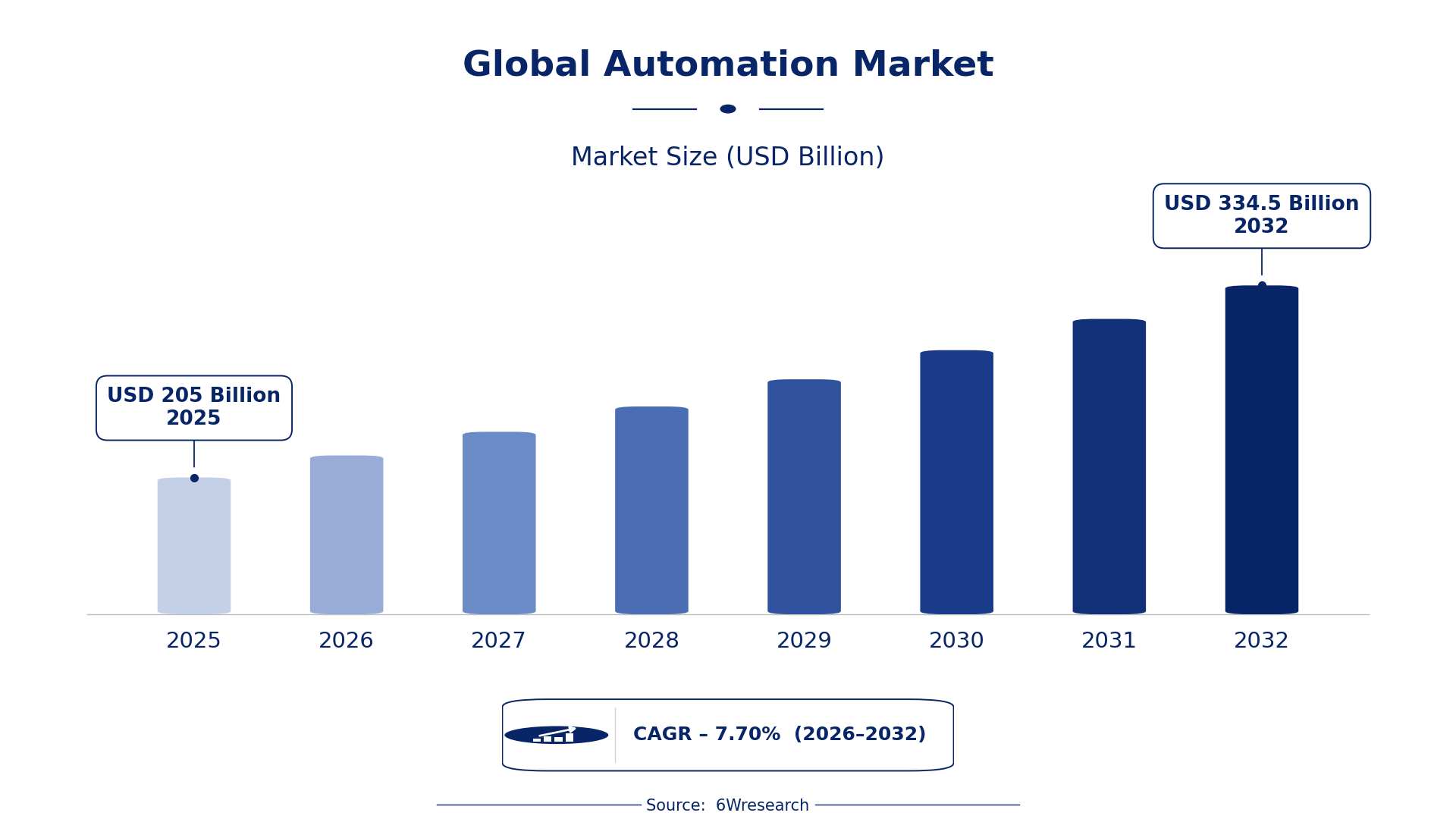
The Global Automation Market was estimated at USD 205 Billion in 2025 and is projected to reach USD 334.5 Billion by 2032, growing at a CAGR of 7.70% from 2026 to 2032.
Global Automation Market Synopsis
The Global Automation Market is undergoing a significant transformation, driven by the integration of advanced technologies such as artificial intelligence (AI), machine learning, and robotics. These innovations are reshaping industries by enhancing operational efficiency, reducing costs, and enabling real-time decision-making. The manufacturing sector, in particular, is witnessing a paradigm shift as companies adopt smart manufacturing processes and the Industrial Internet of Things (IIoT) to stay competitive in a rapidly evolving landscape.
This evolution is not limited to manufacturing; sectors like healthcare, automotive, and retail are also embracing automation to streamline operations and improve service delivery. The convergence of digitalization and Industry 4.0 initiatives is accelerating the adoption of automation solutions, positioning the market for sustained growth in the coming years. As industries continue to digitize, the demand for sophisticated automation systems is expected to rise, presenting both challenges and opportunities for market participants.
Global Automation Market Year-wise Growth Rate and Key Drivers
This graph illustrates the annual growth rates of the Global Automation Market from 2022 to 2032, highlighting a steady upward trajectory and projected expansion over the forecast period.
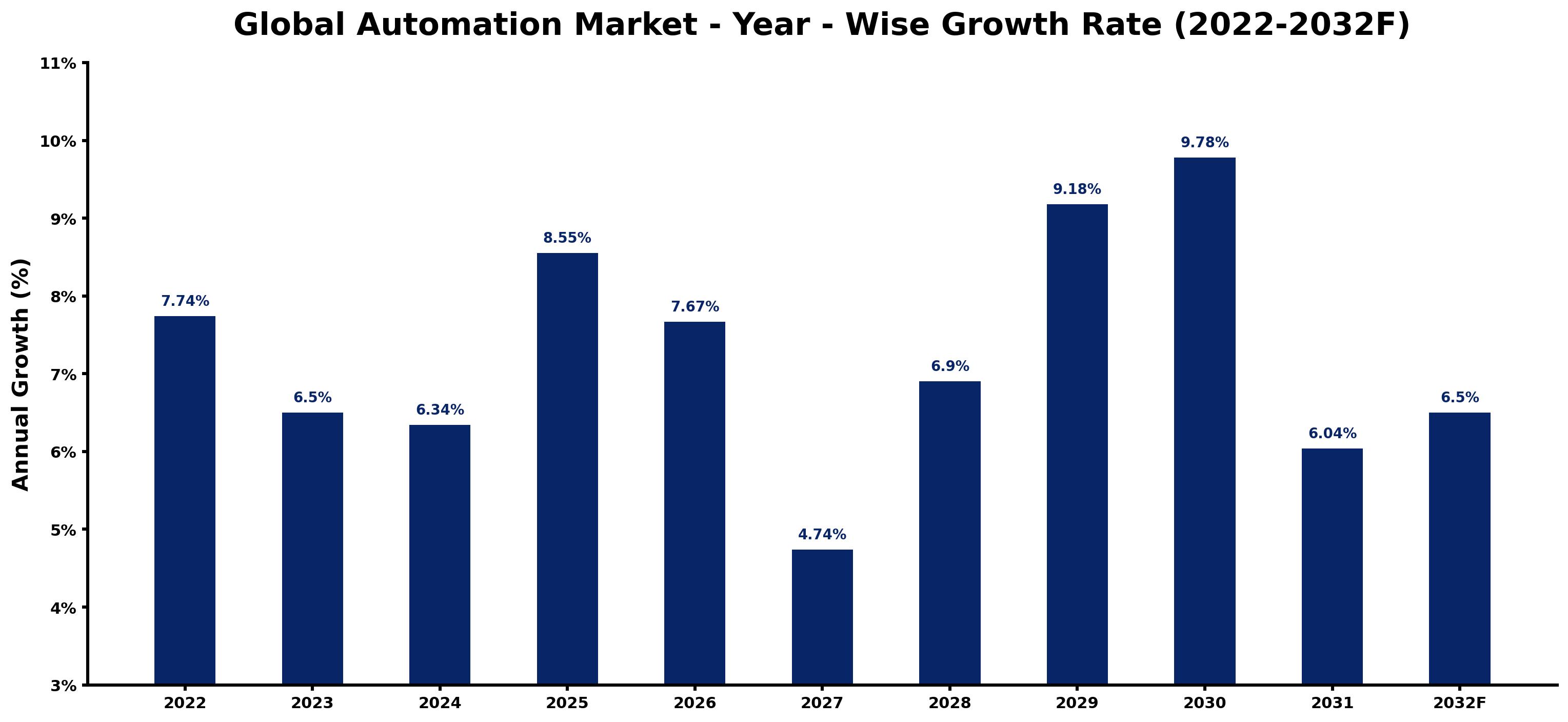
The table below presents the year‑wise growth rates along with the key drivers influencing the market
| Year | Growth Rate (%) | Major Drivers |
| 2022 | 7.74 | Manufacturers face rising raw material costs, impacting automation equipment pricing strategies. |
| 2023 | 6.5 | Supply chain disruptions prompt distributors to diversify their automation product offerings. |
| 2024 | 6.34 | Integrating sustainable practices influences producers to enhance automation technologies for ESG compliance. |
| 2025 | 8.55 | Industrial end-users increasingly adopt advanced automation solutions to drive operational efficiency. |
| 2026 | 7.67 | Collaborative robots lead the automation segment's geographic expansion into new regional markets. |
| 2027 | 4.74 | In North America, a skilled workforce shortage accelerates the demand for automation solutions. |
| 2028 | 6.9 | The movement towards lean manufacturing processes enhances competitive automation tools adoption. |
| 2029 | 9.18 | As acquisition activity intensifies, larger firms expand their automation product portfolios significantly. |
| 2030 | 9.78 | Increasing consumer preference for efficiency drives greater adoption of smart automation technologies. |
| 2031 | 6.04 | A shift toward tailored automation solutions reflects evolving end-user demand for customization. |
| 2032 | 6.5 | A regulatory push toward increased automation compliance changes operational frameworks across industries. |
Note - Market size estimations and growth projections presented in this report are based on 6Wresearch's proprietary research methodology, combining internal industry data, secondary research, and primary validation, updated periodically to reflect current market conditions. As markets evolve rapidly, figures for certain industries may vary slightly and are intended as informed estimates rather than absolute figures. For the most current market sizing, we recommend validating figures with a 6Wresearch analyst.
Global Automation Market Key Takeaways
Below are some of the specific key takeaways from the market, including:
- The Asia Pacific region accounted for approximately 38% of the global industrial automation and control systems market share in 2025, driven by rapid industrialization and government initiatives promoting smart manufacturing.
- The industrial automation and control systems market is projected to grow from USD 250.3 billion in 2026 to USD 504.4 billion by 2033, at a CAGR of 10.5% from 2026 to 2033, indicating robust expansion in the sector.
- The U.S. market for automation was estimated at $10.8 billion in 2020, accounting for 29.5% of the global market share, highlighting its significant role in the global automation landscape.
- The European Commission's new Machine Products Regulation, effective in 2027, will expand regulatory requirements for industrial machinery, including imports from the United States, impacting approximately $7 billion in U.S. industrial machinery exports.
Evaluation of Restraints in Global Automation Market
The Global Automation Market faces several challenges that could impede its growth trajectory. One significant restraint is the high initial investment required for implementing automation solutions, particularly for small and medium-sized enterprises (SMEs). For instance, the European Commission's new Machine Products Regulation, effective in 2027, will expand regulatory requirements for industrial machinery, including imports from the United States, potentially impacting approximately $7 billion in U.S. industrial machinery exports. This regulatory change could necessitate costly compliance measures for exporters, affecting their competitiveness in the European market. Additionally, the complexity of integrating automation technologies with existing systems poses a substantial hurdle for organizations. The resistance to change among employees, who may fear job displacement due to automation, further complicates the adoption process. Ensuring data security and privacy in automated systems also remains a critical concern, especially with the increasing prevalence of cyber threats. Addressing these challenges requires strategic planning, investment in workforce training, and robust cybersecurity measures to facilitate a smooth transition towards automation.
Global Automation Market Trends
The Global Automation Market is experiencing several notable trends that are shaping its future direction. One prominent trend is the increasing adoption of AI-powered industrial automation platforms, which are enhancing operational efficiency and predictive maintenance capabilities. For example, the industrial automation and control systems market is projected to grow from USD 250.3 billion in 2026 to USD 504.4 billion by 2033, at a CAGR of 10.5% from 2026 to 2033, indicating robust expansion in the sector. Another significant trend is the rise of smart manufacturing, fueled by the deployment of IIoT-enabled systems that enable real-time monitoring and optimization of manufacturing processes. This shift is exemplified by the Asia Pacific region, which accounted for approximately 38% of the global industrial automation and control systems market share in 2025, driven by rapid industrialization and government initiatives promoting smart manufacturing. Additionally, the growing emphasis on data analytics and machine learning is enabling manufacturers to gain deeper insights into production processes, leading to improved decision-making and resource allocation. These trends underscore the dynamic evolution of the automation market, driven by technological advancements and the need for enhanced operational performance across industries.
Global Automation Market Opportunities
The Global Automation Market presents several promising opportunities for growth and innovation. One such opportunity lies in the expansion of automation solutions tailored for the healthcare sector, where the integration of automation can lead to improved patient care and operational efficiency. For instance, the warehouse automation market, valued at USD 19.2 billion in 2023, is projected to grow from USD 27.4 billion in 2026 to USD 59.5 billion by 2030, at a CAGR of 18.7% from 2024 to 2030, indicating a significant demand for automation in logistics and supply chain management. Another opportunity is the development of automation technologies for the automotive industry, particularly in the realm of autonomous vehicles and advanced manufacturing processes. The U.S. market for automation was estimated at $10.8 billion in 2020, accounting for 29.5% of the global market share, highlighting its significant role in the global automation landscape. Additionally, the increasing focus on sustainability and energy efficiency is driving the adoption of automation solutions in industries such as energy and utilities, where automation can optimize resource usage and reduce environmental impact. These opportunities reflect the diverse applications of automation technologies across various sectors, offering avenues for growth and innovation in the market.
Global Automation Market by Product Type
In the Global Automation Market, the Automated Systems segment leads with a substantial share of approximately 42% in 2025. This dominance is attributed to the widespread adoption of automation systems across various industries, driven by the need for enhanced efficiency and productivity. The Automated Systems segment is also the fastest-growing, with a projected CAGR of 7.36% from 2026 to 2034. This growth is fueled by technological advancements and the increasing complexity of manufacturing processes that require sophisticated automation solutions. The demand for Automated Systems is particularly strong in sectors such as automotive and electronics manufacturing, where precision and speed are critical. The growth in this segment is also supported by the integration of IIoT and AI technologies, which enable real-time monitoring and optimization of production processes, further driving the adoption of automated systems in the market.
Global Automation Market by End User
The Manufacturing sector is the largest end-user in the Global Automation Market, holding a significant share of approximately 63.4% in 2025. This dominance is due to the sector's extensive adoption of automation technologies to streamline production processes and improve product quality. The Manufacturing sector is also the fastest-growing end-user, with a projected CAGR of 7.36% from 2026 to 2034. This growth is driven by the increasing complexity of manufacturing operations and the need for greater efficiency and flexibility. The adoption of automation in manufacturing is particularly prevalent in industries such as automotive, electronics, and consumer goods, where competitive pressures and demand for customization are high. The Manufacturing sector's rapid growth in automation adoption reflects the broader trend of digital transformation in industrial operations, positioning it as a key driver of the market's expansion.
Global Automation Market by Application
In the Global Automation Market, the Process Control application leads with a substantial share of approximately 45% in 2025. This dominance is attributed to the critical role of process control in industries such as chemicals, pharmaceuticals, and oil & gas, where precise monitoring and regulation of processes are essential for safety and quality. The Process Control application is also the fastest-growing, with a projected CAGR of 7.36% from 2026 to 2034. This growth is driven by the increasing complexity of industrial processes and the need for enhanced control and optimization. The adoption of automation in process control is facilitated by advancements in sensor technologies, data analytics, and AI, which enable real-time monitoring and predictive maintenance, further driving the demand for automated process control solutions in the market.
Global Automation Market by Technology
In the Global Automation Market, the Factory Automation technology leads with a significant share of approximately 50% in 2025. This dominance is due to the widespread implementation of automation technologies in manufacturing facilities to enhance production efficiency and product quality. The Factory Automation technology is also the fastest-growing, with a projected CAGR of 7.36% from 2026 to 2034. This growth is driven by the increasing adoption of robotics, AI, and IIoT in manufacturing processes, enabling real-time monitoring and optimization. The demand for Factory Automation is particularly strong in sectors such as automotive, electronics, and consumer goods, where the need for high-volume production and customization is prevalent. The growth in this segment reflects the broader trend of digital transformation in manufacturing, positioning Factory Automation as a key driver of the market's expansion.
Global Automation Market by Region
The Asia Pacific region is the largest in the Global Automation Market, accounting for approximately 38% of the market share in 2025. This dominance is driven by rapid industrialization, government initiatives promoting smart manufacturing, and a large consumer base. The Asia Pacific region is also the fastest-growing, with a projected CAGR of 10.5% from 2026 to 2033. This growth is fueled by increasing investments in automation technologies, a strong manufacturing ecosystem, and supportive government policies. Countries like China and India are at the forefront of this growth, leveraging automation to enhance their manufacturing capabilities and global competitiveness. The region's rapid adoption of automation technologies underscores its pivotal role in the global market's expansion.
Government Initiatives in the Global Automation Market
The regulatory and policy environment plays a crucial role in shaping the Global Automation Market. Governments worldwide are implementing initiatives to promote the adoption of automation technologies, ensure safety standards, and foster innovation. These initiatives include establishing standards for AI safety, developing regulations for industrial machinery, and supporting public-private partnerships to advance critical and emerging technologies. Such policies aim to create a conducive environment for automation, balancing innovation with safety and ethical considerations.
- In October 2023, the U.S. Department of Commerce undertook key responsibilities in implementing the Executive Order on Artificial Intelligence, focusing on developing industry standards for AI safety and responsible development of frontier AI models.
- In June 2023, the European Commission published the final version of its new Machine Products Regulation, effective in 2027, expanding regulatory requirements for industrial machinery, including imports from the United States, impacting approximately $7 billion in U.S. industrial machinery exports.
- In May 2023, the White House released the U.S. Government National Standards Strategy for Critical and Emerging Technology, committing to continued support for the private sector–led standards system, aligned with the United States Standards Strategy published by the American National Standards Institute (ANSI).
- In May 2023, the Organisation for Economic Co-operation and Development (OECD) highlighted the need for algorithmic accountability in government, emphasizing transparency and explainability to build trust with citizens.
Future Insights of the Global Automation Market
Looking ahead, the Global Automation Market is likely to experience transformative shifts, particularly through the integration of AI and machine learning. Companies such as Siemens AG are investing in AI-driven automation for smart factories, which enhances operational efficiency and reduces downtime. By 2032, the industry is expected to pivot towards more adaptive and predictive systems, enabling real-time adjustments in manufacturing processes. This evolution will not only solidify competitive advantages for early adopters but also redefine traditional supply chain practices as automation becomes central to logistics and inventory management.
Global Automation Market Latest Developments
Recent developments in the Global Automation Market reflect rapid advancements and strategic initiatives undertaken by key players, shaping their competitive positioning and technology landscape.
- In September 2023, ABB Ltd. announced the launch of a new AI-driven automation platform designed to streamline manufacturing operations, enhancing overall efficiency and reducing energy consumption.
- Recently, in August 2023, Rockwell Automation Inc. unveiled an upgraded version of its FactoryTalk software suite, aimed at integrating IoT capabilities for real-time data analysis and process optimization.
- In July 2023, Emerson Electric Co. completed the acquisition of a leading process automation firm, expanding its capabilities in industrial IoT solutions and improving its market reach.
- Honeywell International Inc. began a pilot program in June 2023 to implement advanced robotics in warehouse automation, enhancing operational capacity and reducing labor costs as part of its digital transformation strategy.
Global Automation Market Key Players and Industry Positioning
The competitive structure of the Global Automation Market is characterized by significant consolidation among top players, each specializing in specific industrial automation solutions and technologies. This consolidation enhances their ability to compete effectively on a global scale.
| Leading Company | Core Strength | Strategic Focus |
|---|---|---|
| Siemens AG | Expertise in smart factory solutions with a robust portfolio | Focus on digitalization and IIoT integration |
| ABB Ltd. | Strength in robotics and automation technology | Commitment to sustainable energy solutions |
| Rockwell Automation Inc. | Leadership in industrial software solutions | Emphasis on industrial IoT and analytics |
| Emerson Electric Co. | Integration of process automation with IIoT | Targeting improvements in operational efficiency |
| Honeywell International Inc. | Robust portfolio in automation products and services | Investments in AI and ML technologies for automation |
As these companies continue to invest in automation technologies, their distinct strengths will define their roles in the market, leading to increased collaboration and partnerships that drive innovation.
Key Attractiveness of the Report
- 10 Years of Market Numbers
- Historical Data Starting from 2022 to 2025
- Base Year: 2025
- Forecast Data until 2032
- Key Performance Indicators Impacting the Market
- Major Upcoming Developments and Projects
Key Highlights of the Report:
- Global Automation Market Outlook
- Market Size of Global Automation Market, 2025
- Forecast of Global Automation Market, 2032
- Historical Data and Forecast of Global Automation Revenues & Volume for the Period 2022-2032
- Global Automation Market Trend Evolution
- Global Automation Market Drivers and Challenges
- Global Automation Price Trends
- Global Automation Porter's Five Forces
- Global Automation Industry Life Cycle
- Historical Data and Forecast of Global Automation Market Revenues & Volume
- Historical Data and Forecast of Global Automation Market Revenues & Volume By Product Type for the Period 2022-2032
- Historical Data and Forecast of Global Automation Market Revenues & Volume By Automation Solutions for the Period 2022-2032
- Historical Data and Forecast of Global Automation Market Revenues & Volume By Automated Systems for the Period 2022-2032
- Historical Data and Forecast of Global Automation Market Revenues & Volume By End User for the Period 2022-2032
- Historical Data and Forecast of Global Automation Market Revenues & Volume By Manufacturing for the Period 2022-2032
- Historical Data and Forecast of Global Automation Market Revenues & Volume By Automotive for the Period 2022-2032
- Historical Data and Forecast of Global Automation Market Revenues & Volume By Application for the Period 2022-2032
- Historical Data and Forecast of Global Automation Market Revenues & Volume By Process Control for the Period 2022-2032
- Historical Data and Forecast of Global Automation Market Revenues & Volume By Production Lines for the Period 2022-2032
- Historical Data and Forecast of Global Automation Market Revenues & Volume By Technology for the Period 2022-2032
- Historical Data and Forecast of Global Automation Market Revenues & Volume By Factory Automation for the Period 2022-2032
- Historical Data and Forecast of Global Automation Market Revenues & Volume By Material Handling for the Period 2022-2032
- Historical Data and Forecast of North America Automation Market Revenues & Volume By Product Type for the Period 2022-2032
- Historical Data and Forecast of North America Automation Market Revenues & Volume By Automation Solutions for the Period 2022-2032
- Historical Data and Forecast of North America Automation Market Revenues & Volume By Automated Systems for the Period 2022-2032
- Historical Data and Forecast of North America Automation Market Revenues & Volume By End User for the Period 2022-2032
- Historical Data and Forecast of North America Automation Market Revenues & Volume By Manufacturing for the Period 2022-2032
- Historical Data and Forecast of North America Automation Market Revenues & Volume By Automotive for the Period 2022-2032
- Historical Data and Forecast of North America Automation Market Revenues & Volume By Application for the Period 2022-2032
- Historical Data and Forecast of North America Automation Market Revenues & Volume By Process Control for the Period 2022-2032
- Historical Data and Forecast of North America Automation Market Revenues & Volume By Production Lines for the Period 2022-2032
- Historical Data and Forecast of North America Automation Market Revenues & Volume By Technology for the Period 2022-2032
- Historical Data and Forecast of North America Automation Market Revenues & Volume By Factory Automation for the Period 2022-2032
- Historical Data and Forecast of North America Automation Market Revenues & Volume By Material Handling for the Period 2022-2032
- Historical Data and Forecast of United States of America Automation Market Revenues & Volume for the Period 2022-2032
- Historical Data and Forecast of Canada Automation Market Revenues & Volume for the Period 2022-2032
- Historical Data and Forecast of Rest of North America Automation Market Revenues & Volume for the Period 2022-2032
- Historical Data and Forecast of Latin America (LATAM) Automation Market Revenues & Volume By Product Type for the Period 2022-2032
- Historical Data and Forecast of Latin America (LATAM) Automation Market Revenues & Volume By Automation Solutions for the Period 2022-2032
- Historical Data and Forecast of Latin America (LATAM) Automation Market Revenues & Volume By Automated Systems for the Period 2022-2032
- Historical Data and Forecast of Latin America (LATAM) Automation Market Revenues & Volume By End User for the Period 2022-2032
- Historical Data and Forecast of Latin America (LATAM) Automation Market Revenues & Volume By Manufacturing for the Period 2022-2032
- Historical Data and Forecast of Latin America (LATAM) Automation Market Revenues & Volume By Automotive for the Period 2022-2032
- Historical Data and Forecast of Latin America (LATAM) Automation Market Revenues & Volume By Application for the Period 2022-2032
- Historical Data and Forecast of Latin America (LATAM) Automation Market Revenues & Volume By Process Control for the Period 2022-2032
- Historical Data and Forecast of Latin America (LATAM) Automation Market Revenues & Volume By Production Lines for the Period 2022-2032
- Historical Data and Forecast of Latin America (LATAM) Automation Market Revenues & Volume By Technology for the Period 2022-2032
- Historical Data and Forecast of Latin America (LATAM) Automation Market Revenues & Volume By Factory Automation for the Period 2022-2032
- Historical Data and Forecast of Latin America (LATAM) Automation Market Revenues & Volume By Material Handling for the Period 2022-2032
- Historical Data and Forecast of Brazil Automation Market Revenues & Volume for the Period 2022-2032
- Historical Data and Forecast of Mexico Automation Market Revenues & Volume for the Period 2022-2032
- Historical Data and Forecast of Argentina Automation Market Revenues & Volume for the Period 2022-2032
- Historical Data and Forecast of Rest of LATAM Automation Market Revenues & Volume for the Period 2022-2032
- Historical Data and Forecast of Asia Automation Market Revenues & Volume By Product Type for the Period 2022-2032
- Historical Data and Forecast of Asia Automation Market Revenues & Volume By Automation Solutions for the Period 2022-2032
- Historical Data and Forecast of Asia Automation Market Revenues & Volume By Automated Systems for the Period 2022-2032
- Historical Data and Forecast of Asia Automation Market Revenues & Volume By End User for the Period 2022-2032
- Historical Data and Forecast of Asia Automation Market Revenues & Volume By Manufacturing for the Period 2022-2032
- Historical Data and Forecast of Asia Automation Market Revenues & Volume By Automotive for the Period 2022-2032
- Historical Data and Forecast of Asia Automation Market Revenues & Volume By Application for the Period 2022-2032
- Historical Data and Forecast of Asia Automation Market Revenues & Volume By Process Control for the Period 2022-2032
- Historical Data and Forecast of Asia Automation Market Revenues & Volume By Production Lines for the Period 2022-2032
- Historical Data and Forecast of Asia Automation Market Revenues & Volume By Technology for the Period 2022-2032
- Historical Data and Forecast of Asia Automation Market Revenues & Volume By Factory Automation for the Period 2022-2032
- Historical Data and Forecast of Asia Automation Market Revenues & Volume By Material Handling for the Period 2022-2032
- Historical Data and Forecast of China Automation Market Revenues & Volume for the Period 2022-2032
- Historical Data and Forecast of India Automation Market Revenues & Volume for the Period 2022-2032
- Historical Data and Forecast of Japan Automation Market Revenues & Volume for the Period 2022-2032
- Historical Data and Forecast of Rest of Asia Automation Market Revenues & Volume for the Period 2022-2032
- Historical Data and Forecast of Africa Automation Market Revenues & Volume By Product Type for the Period 2022-2032
- Historical Data and Forecast of Africa Automation Market Revenues & Volume By Automation Solutions for the Period 2022-2032
- Historical Data and Forecast of Africa Automation Market Revenues & Volume By Automated Systems for the Period 2022-2032
- Historical Data and Forecast of Africa Automation Market Revenues & Volume By End User for the Period 2022-2032
- Historical Data and Forecast of Africa Automation Market Revenues & Volume By Manufacturing for the Period 2022-2032
- Historical Data and Forecast of Africa Automation Market Revenues & Volume By Automotive for the Period 2022-2032
- Historical Data and Forecast of Africa Automation Market Revenues & Volume By Application for the Period 2022-2032
- Historical Data and Forecast of Africa Automation Market Revenues & Volume By Process Control for the Period 2022-2032
- Historical Data and Forecast of Africa Automation Market Revenues & Volume By Production Lines for the Period 2022-2032
- Historical Data and Forecast of Africa Automation Market Revenues & Volume By Technology for the Period 2022-2032
- Historical Data and Forecast of Africa Automation Market Revenues & Volume By Factory Automation for the Period 2022-2032
- Historical Data and Forecast of Africa Automation Market Revenues & Volume By Material Handling for the Period 2022-2032
- Historical Data and Forecast of South Africa Automation Market Revenues & Volume for the Period 2022-2032
- Historical Data and Forecast of Nigeria Automation Market Revenues & Volume for the Period 2022-2032
- Historical Data and Forecast of Egypt Automation Market Revenues & Volume for the Period 2022-2032
- Historical Data and Forecast of Rest of Africa Automation Market Revenues & Volume for the Period 2022-2032
- Historical Data and Forecast of Europe Automation Market Revenues & Volume By Product Type for the Period 2022-2032
- Historical Data and Forecast of Europe Automation Market Revenues & Volume By Automation Solutions for the Period 2022-2032
- Historical Data and Forecast of Europe Automation Market Revenues & Volume By Automated Systems for the Period 2022-2032
- Historical Data and Forecast of Europe Automation Market Revenues & Volume By End User for the Period 2022-2032
- Historical Data and Forecast of Europe Automation Market Revenues & Volume By Manufacturing for the Period 2022-2032
- Historical Data and Forecast of Europe Automation Market Revenues & Volume By Automotive for the Period 2022-2032
- Historical Data and Forecast of Europe Automation Market Revenues & Volume By Application for the Period 2022-2032
- Historical Data and Forecast of Europe Automation Market Revenues & Volume By Process Control for the Period 2022-2032
- Historical Data and Forecast of Europe Automation Market Revenues & Volume By Production Lines for the Period 2022-2032
- Historical Data and Forecast of Europe Automation Market Revenues & Volume By Technology for the Period 2022-2032
- Historical Data and Forecast of Europe Automation Market Revenues & Volume By Factory Automation for the Period 2022-2032
- Historical Data and Forecast of Europe Automation Market Revenues & Volume By Material Handling for the Period 2022-2032
- Historical Data and Forecast of United Kingdom Automation Market Revenues & Volume for the Period 2022-2032
- Historical Data and Forecast of France Automation Market Revenues & Volume for the Period 2022-2032
- Historical Data and Forecast of Germany Automation Market Revenues & Volume for the Period 2022-2032
- Historical Data and Forecast of Rest of Europe Automation Market Revenues & Volume for the Period 2022-2032
- Historical Data and Forecast of Middle East Automation Market Revenues & Volume By Product Type for the Period 2022-2032
- Historical Data and Forecast of Middle East Automation Market Revenues & Volume By Automation Solutions for the Period 2022-2032
- Historical Data and Forecast of Middle East Automation Market Revenues & Volume By Automated Systems for the Period 2022-2032
- Historical Data and Forecast of Middle East Automation Market Revenues & Volume By End User for the Period 2022-2032
- Historical Data and Forecast of Middle East Automation Market Revenues & Volume By Manufacturing for the Period 2022-2032
- Historical Data and Forecast of Middle East Automation Market Revenues & Volume By Automotive for the Period 2022-2032
- Historical Data and Forecast of Middle East Automation Market Revenues & Volume By Application for the Period 2022-2032
- Historical Data and Forecast of Middle East Automation Market Revenues & Volume By Process Control for the Period 2022-2032
- Historical Data and Forecast of Middle East Automation Market Revenues & Volume By Production Lines for the Period 2022-2032
- Historical Data and Forecast of Middle East Automation Market Revenues & Volume By Technology for the Period 2022-2032
- Historical Data and Forecast of Middle East Automation Market Revenues & Volume By Factory Automation for the Period 2022-2032
- Historical Data and Forecast of Middle East Automation Market Revenues & Volume By Material Handling for the Period 2022-2032
- Historical Data and Forecast of Saudi Arabia Automation Market Revenues & Volume for the Period 2022-2032
- Historical Data and Forecast of UAE Automation Market Revenues & Volume for the Period 2022-2032
- Historical Data and Forecast of Turkey Automation Market Revenues & Volume for the Period 2022-2032
- Historical Data and Forecast of Rest of Middle East Automation Market Revenues & Volume for the Period 2022-2032
- Global Automation Market - Key Performance Indicators
- Global Automation Market - Import Export Trade Statistics
- Global Automation Market - Opportunity Assessment By Countries
- Global Automation Market - Opportunity Assessment By Product Type
- Global Automation Market - Opportunity Assessment By End User
- Global Automation Market - Opportunity Assessment By Application
- Global Automation Market - Opportunity Assessment By Technology
- Global Automation Market - Top Companies Market Share
- Global Automation Market - Top Companies Profiles
- Global Automation Market - Comparison of Players in Technical and Operating Parameters
- Global Automation Market - Strategic Recommendations
Markets Covered
The Global Automation Market report provides a detailed analysis of the following market segments:
By Regions and Countries:
- North America
- Europe
- LATAM
- Middle East
- Asia
- Africa
By Product Type:
- Automation Solutions
- Automated Systems
By End User:
- Manufacturing
- Automotive
By Application:
- Process Control
- Production Lines
By Technology:
- Factory Automation
- Material Handling






































