Global Brandy Market Highlights
| Market Size (2025) | USD 16 Billion |
| Forecast Size (2032) | USD 23 Billion |
| CAGR | 5.60% |
| Base Year | 2025 |
| Forecast Period | 2026-2032 |
| Largest Region | Europe |
| Fastest Growing Region | Asia |
| Largest Segment | V.S. (Very Special) |
| Fastest Growing Segment | Craft Brandy |
| Leading Companies | Hennessy, Rémy Martin, E & J Gallo, Torres, Paul Masson |
Global Brandy Market Size & Growth Rate (2026-2032)
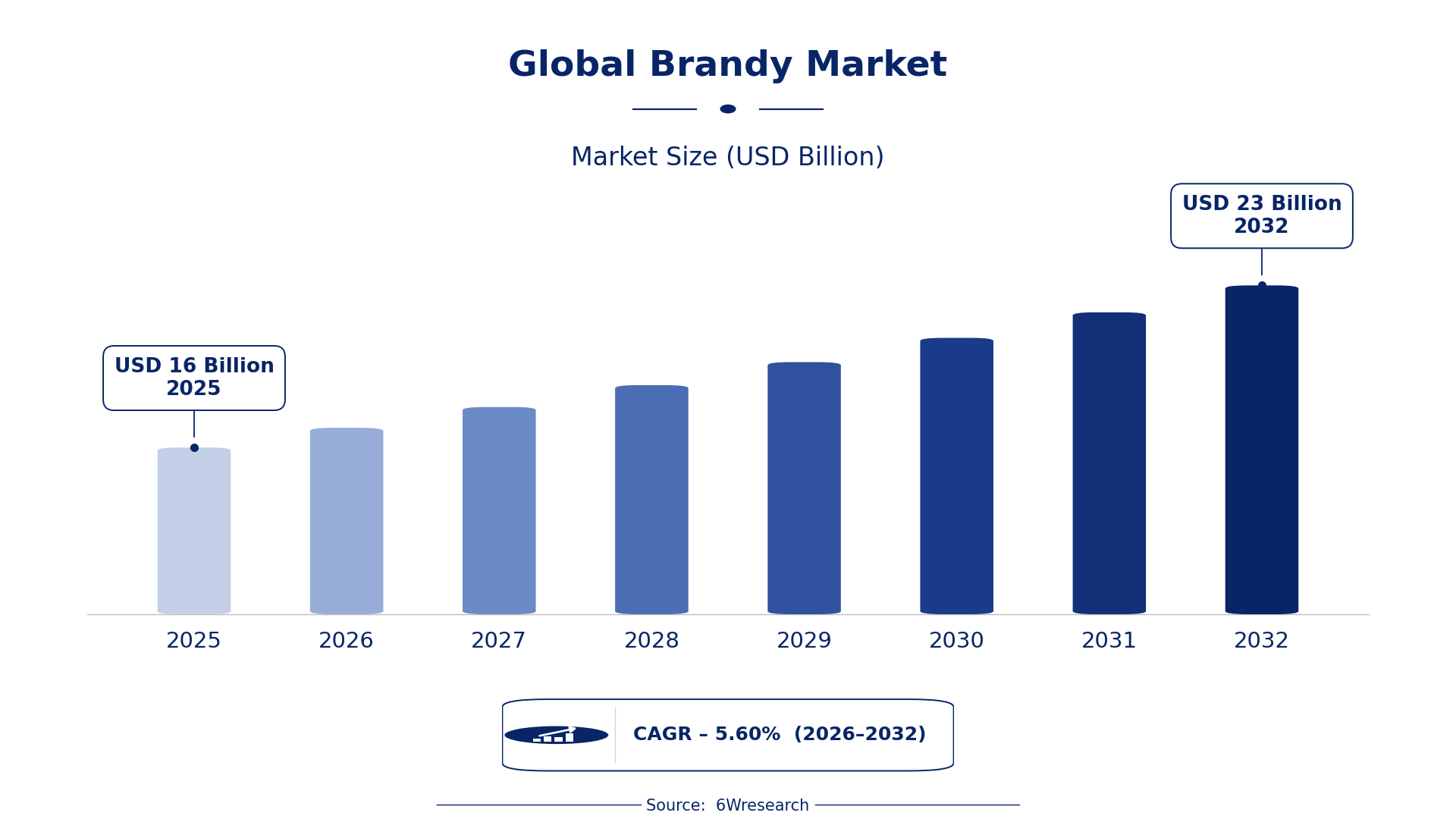
The Global Brandy Market was estimated at USD 16 Billion in 2025 and is projected to reach USD 23 Billion by 2032, growing at a CAGR of 5.60% from 2026 to 2032.
Global Brandy Market Synopsis
Currently, the Global Brandy Market is pivoting towards premium and artisanal products, with consumers gravitating toward sophisticated flavor profiles and quality. This shift is primarily underscored by rising disposable incomes, especially in emerging markets, and a notable trend in mixology that favors craft spirits.
Firms are enhancing product innovation to meet these evolving consumer preferences, focusing on quality ingredients and unique blends. Additionally, the ongoing impact of e-commerce is reshaping distribution channels, allowing brands to engage more directly with consumers and broaden their market reach.
Global Brandy Market Year-wise Growth Rate and Key Drivers
This graph illustrates the annual growth rates of the Global Brandy Market from 2022 to 2032, highlighting a steady upward trajectory and projected expansion over the forecast period.
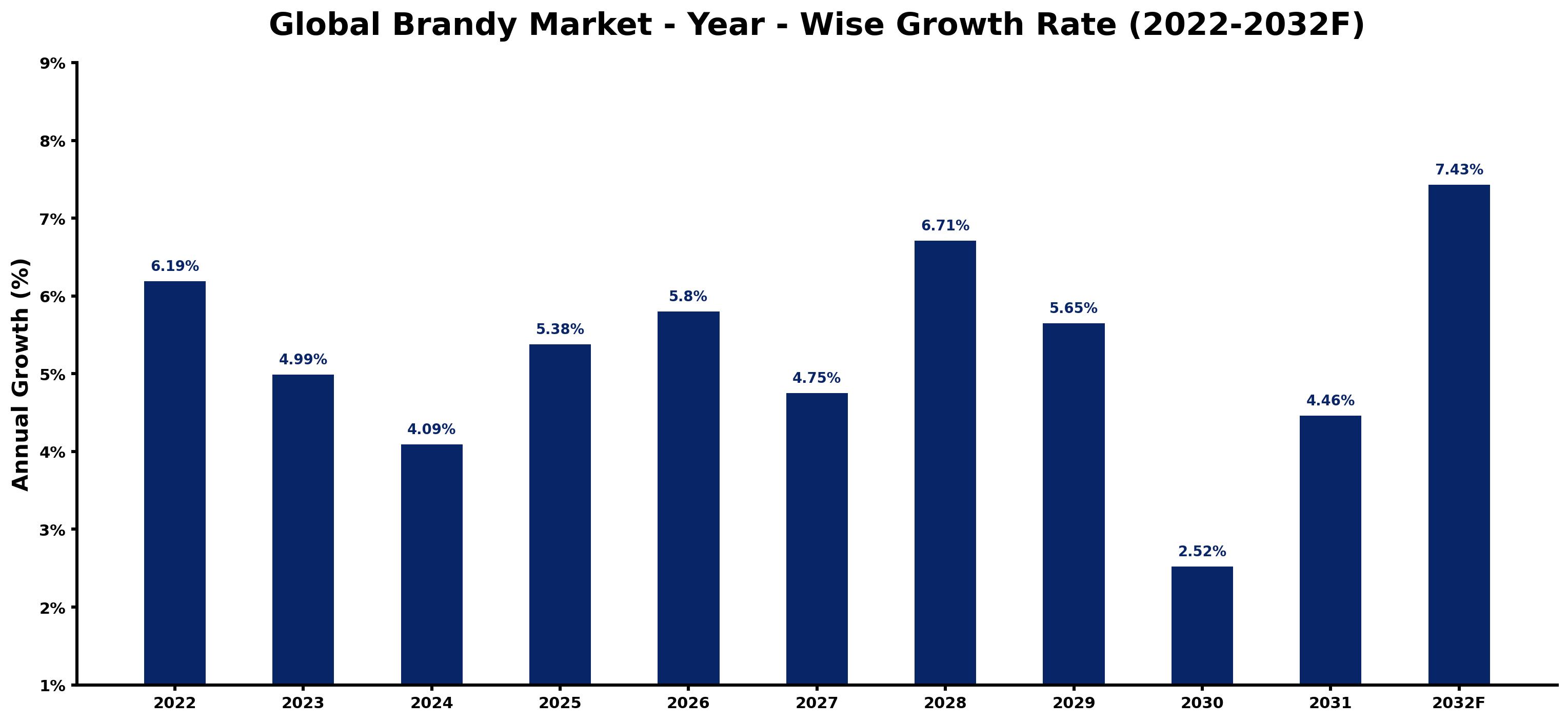
The table below presents the year‑wise growth rates along with the key drivers influencing the market
| Year | Growth Rate (%) | Major Drivers |
| 2022 | 6.19 | Consumers increasingly invested in premium brandy offerings following recent M&A activity. |
| 2023 | 4.99 | Expanding distribution channels across regions boosts access to diverse brandy selections. |
| 2024 | 4.09 | A surge in regulatory changes enhances brandy certification processes, ensuring quality assurance. |
| 2025 | 5.38 | Supply chain improvements in raw materials enhance brandy production efficiency and quality. |
| 2026 | 5.8 | As sustainability initiatives gain traction, brandy producers adopt eco-friendly packaging solutions. |
| 2027 | 4.75 | Among millennials, changing grooming habits correlate with rising brandy consumption trends. |
| 2028 | 6.71 | Retail shelf penetration by leading brands intensifies competition in the brandy sector. |
| 2029 | 5.65 | Increasing costs for raw materials pressure brandy manufacturers to innovate pricing strategies. |
| 2030 | 2.52 | Automated blending technologies streamline brandy production processes and enhance consistency. |
| 2031 | 4.46 | Manufacturers adapt to shifting preferences, focusing on flavored brandy variations to attract consumers. |
| 2032 | 7.43 | A shift toward skilled labor recruitment significantly enhances brandy production capabilities. |
Note - Market size estimations and growth projections presented in this report are based on 6Wresearch's proprietary research methodology, combining internal industry data, secondary research, and primary validation, updated periodically to reflect current market conditions. As markets evolve rapidly, figures for certain industries may vary slightly and are intended as informed estimates rather than absolute figures. For the most current market sizing, we recommend validating figures with a 6Wresearch analyst.
Global Brandy Market Key Takeaways
Below are some of the specific key takeaways from the market, including:
- Hennessy commands approximately 44% of the Global Brandy Market, cementing its position as the largest player in the sector.
- Craft Brandy is positioned as the fastest-growing segment, with an estimated CAGR of 7.2% from 2026 to 2032.
- The European region accounts for around 50% market share, driven by traditional production and high consumer affinity.
- Brandy sales in Asia recorded a year-on-year increase of 10% in 2023, highlighting changing consumer preferences in these emerging economies.
- E-commerce sales are expected to grow by over 30% from 2026 to 2032, transforming the traditional retail landscape.
Evaluation of Restraints in Global Brandy Market
The Global Brandy Market faces significant challenges including stringent regulatory standards and increased competition from other spirit categories like whiskey and vodka. Notably, the European Union imposes high tariffs on imported spirits, raising costs and limiting market access for foreign brands. For example, the EU’s tariff on non-origin brandies can reach up to 26% of the product value, severely impacting pricing strategies and import volumes. Counterfeit products also pose a risk, as they diminish brand reputation and consumer trust, further complicating market dynamics.
Global Brandy Market Trends
The movement towards premiumization in the Global Brandy Market is driven by a consumer base that values heritage and craftsmanship. This trend has spurred companies like Rémy Martin to launch their high-end offerings, such as Rémy Martin XO, which emphasizes quality over mass production. Additionally, there is a burgeoning interest in flavored brandies, influenced by the craft cocktail movement; for instance, E & J Gallo has recently rolled out a range of fruit-infused brandies to cater to adventurous consumers.
Moreover, technology integration, such as the use of blockchain for traceability in brandy production, is emerging as a key factor. This was evidenced in 2021 when Torres implemented blockchain technology to ensure the authenticity of its products, thereby enhancing consumer confidence.
Global Brandy Market Opportunities
Emerging economies, particularly in Asia-Pacific and Latin America, present lucrative opportunities for growth as disposable incomes continue to rise. For example, the Asian market, particularly in countries like Thailand and China, is expected to see brandy sales increase by approximately 15% annually from 2026 to 2032. Investment in innovative packaging solutions targeted at younger consumers seeking authenticity and experience can also yield positive results.
The shift towards sustainable production processes offers additional opportunities, with brands such as Paul Masson exploring eco-friendly practices. By investing in sustainable vineyards and production technology, these companies can attract environmentally conscious consumers and differentiate themselves in a competitive marketplace.
Global Brandy Market by Type
Currently, V.S. (Very Special) brandy holds the largest market share, accounting for approximately 45% in 2025, reflecting its widespread appeal to both casual and seasoned consumers. The Craft Brandy segment is the fastest-growing, anticipated to achieve a CAGR of 7.5% from 2026 to 2032, driven by a rising trend toward unique and artisan products that offer distinct consumer experiences.
Global Brandy Market by Applications
The Shop & Supermarket segment dominates the Global Brandy Market, capturing around 65% share as of 2025, primarily due to the convenience and accessibility they provide. Conversely, the Restaurant & Bar & Club segment is projected to be the fastest-growing, with an estimated CAGR of 6.8% from 2026 to 2032, as establishments increasingly diversify their drink offerings to include premium brandy options that appeal to discerning customers.
Global Brandy Market by Region
Europe remains the largest region for the Global Brandy Market, comprising approximately 50% of total market share in 2025, bolstered by a rich heritage of brandy production and established consumer preferences. Meanwhile, Asia is anticipated to be the fastest-growing region, with a projected CAGR of 7.0% from 2026 to 2032, attributed to changing consumer palates and increasing investments in manufacturing and distribution networks within the region.
Government Initiatives in the Global Brandy Market
The regulatory environment surrounding the Global Brandy Market is shaped by a mix of support for local production, marketing regulations, and standards addressing quality assurance. Government agencies are actively promoting initiatives that encourage sustainable practices and market access for domestic producers.
- U.S. Department of Agriculture, “Sustainable Alcoholic Beverages Initiative,” December 2021 - This program provides funding and resources for producers implementing eco-friendly practices, benefiting domestic brandy manufacturers.
- European Commission, “European Quality Scheme for Agricultural Products,” October 2020 - This regulation supports the protection of traditional brandy production methods, enhancing brand reputation and export potential.
- Indian Ministry of Food Processing Industries, "National Policy on Food Processing," January 2022 - This initiative promotes investment in the spirits sector, including brandy, facilitating growth and modernization of production facilities.
- Food Safety and Standards Authority of India, "Regulatory Guidelines for Alcohol Production," April 2023 - The guidelines ensure adherence to safety standards in brandy production, helping to bolster consumer trust in local products.
Future Insights of the Global Brandy Market
As the Global Brandy Market evolves, shifts toward sustainability and premiumization are becoming pronounced. Companies are increasingly investing in transparent supply chains and eco-friendly production methods to appeal to environmentally conscious consumers. For instance, Torres is actively using blockchain to enhance product traceability, aligning with rising standards for authenticity and quality. The focus on craft and artisanal brandies is driving manufacturers to explore unique aging processes and innovative flavors, catering to the sophisticated palate of the modern consumer through 2032.
Global Brandy Market Latest Developments
Recent activities in the Global Brandy Market illustrate a dynamic landscape where established players are responding to consumer trends and regulatory shifts. Key developments include:
- Hennessy launched a limited-edition V.S.O.P. blend in April 2023, enhancing its product range and strengthening its premium positioning.
- E & J Gallo began expanding its distribution channels in Southeast Asia in early 2023, aiming to capture the growing demand in these emerging markets.
- Rémy Martin recently announced an investment in smart manufacturing technology, which is expected to facilitate process efficiency starting mid-2024.
- Paul Masson introduced an artisanal craft brandy line in January 2023, aligning with consumer interest in unique flavors and small-batch production.
Global Brandy Market Key Players and Industry Positioning
The competitive structure of the Global Brandy Market is relatively consolidated, dominated by a few key players that significantly influence market trends and consumer preferences. These companies leverage their strong brand equity, distribution networks, and innovative product offerings to maintain a competitive edge.
| Leading Company | Core Strength | Strategic Focus |
|---|---|---|
| Hennessy | Market leadership with extensive global reach and heritage. | Focus on premium segments and innovative blends. |
| Rémy Martin | Strong emphasis on quality and craftsmanship. | Invests in sustainable sourcing and smart manufacturing. |
| E & J Gallo | Diverse product portfolio and effective regional expansion. | Targeting younger consumers with unique flavor profiles. |
| Torres | Innovations in product quality and production techniques. | Strong focus on sustainability and eco-friendly practices. |
| Paul Masson | Strong presence in the craft segment. | Investment in artisanal methods and unique offerings. |
The interplay of innovation, heritage, and market demand will continue to shape competitive strategies among these players, solidifying their positions in the Global Brandy Market.
Key Attractiveness of the Report
- 10 Years of Market Numbers
- Historical Data Starting from 2022 to 2025
- Base Year: 2025
- Forecast Data until 2032
- Key Performance Indicators Impacting the Market
- Major Upcoming Developments and Projects
Key Highlights of the Report:
- Global Brandy Market Outlook
- Market Size of Global Brandy Market, 2025
- Forecast of Global Brandy Market, 2032
- Historical Data and Forecast of Global Brandy Revenues & Volume for the Period 2022-2032
- Global Brandy Market Trend Evolution
- Global Brandy Market Drivers and Challenges
- Global Brandy Price Trends
- Global Brandy Porter's Five Forces
- Global Brandy Industry Life Cycle
- Historical Data and Forecast of Global Brandy Market Revenues & Volume
- Historical Data and Forecast of Global Brandy Market Revenues & Volume By Type for the Period 2022-2032
- Historical Data and Forecast of Global Brandy Market Revenues & Volume By V.S. ("very special") for the Period 2022-2032
- Historical Data and Forecast of Global Brandy Market Revenues & Volume By V.S.O.P. ("very superior old pale") for the Period 2022-2032
- Historical Data and Forecast of Global Brandy Market Revenues & Volume By XO ("extra old") for the Period 2022-2032
- Historical Data and Forecast of Global Brandy Market Revenues & Volume By Hors d'age ("beyond age") for the Period 2022-2032
- Historical Data and Forecast of Global Brandy Market Revenues & Volume By Applications for the Period 2022-2032
- Historical Data and Forecast of Global Brandy Market Revenues & Volume By Shop & Supermarket for the Period 2022-2032
- Historical Data and Forecast of Global Brandy Market Revenues & Volume By Restaurant & Bar & Club for the Period 2022-2032
- Historical Data and Forecast of Global Brandy Market Revenues & Volume By Exclusive Store for the Period 2022-2032
- Historical Data and Forecast of Global Brandy Market Revenues & Volume By Others for the Period 2022-2032
- Historical Data and Forecast of North America Brandy Market Revenues & Volume By Type for the Period 2022-2032
- Historical Data and Forecast of North America Brandy Market Revenues & Volume By V.S. ("very special") for the Period 2022-2032
- Historical Data and Forecast of North America Brandy Market Revenues & Volume By V.S.O.P. ("very superior old pale") for the Period 2022-2032
- Historical Data and Forecast of North America Brandy Market Revenues & Volume By XO ("extra old") for the Period 2022-2032
- Historical Data and Forecast of North America Brandy Market Revenues & Volume By Hors d'age ("beyond age") for the Period 2022-2032
- Historical Data and Forecast of North America Brandy Market Revenues & Volume By Applications for the Period 2022-2032
- Historical Data and Forecast of North America Brandy Market Revenues & Volume By Shop & Supermarket for the Period 2022-2032
- Historical Data and Forecast of North America Brandy Market Revenues & Volume By Restaurant & Bar & Club for the Period 2022-2032
- Historical Data and Forecast of North America Brandy Market Revenues & Volume By Exclusive Store for the Period 2022-2032
- Historical Data and Forecast of North America Brandy Market Revenues & Volume By Others for the Period 2022-2032
- Historical Data and Forecast of United States of America Brandy Market Revenues & Volume for the Period 2022-2032
- Historical Data and Forecast of Canada Brandy Market Revenues & Volume for the Period 2022-2032
- Historical Data and Forecast of Rest of North America Brandy Market Revenues & Volume for the Period 2022-2032
- Historical Data and Forecast of Latin America (LATAM) Brandy Market Revenues & Volume By Type for the Period 2022-2032
- Historical Data and Forecast of Latin America (LATAM) Brandy Market Revenues & Volume By V.S. ("very special") for the Period 2022-2032
- Historical Data and Forecast of Latin America (LATAM) Brandy Market Revenues & Volume By V.S.O.P. ("very superior old pale") for the Period 2022-2032
- Historical Data and Forecast of Latin America (LATAM) Brandy Market Revenues & Volume By XO ("extra old") for the Period 2022-2032
- Historical Data and Forecast of Latin America (LATAM) Brandy Market Revenues & Volume By Hors d'age ("beyond age") for the Period 2022-2032
- Historical Data and Forecast of Latin America (LATAM) Brandy Market Revenues & Volume By Applications for the Period 2022-2032
- Historical Data and Forecast of Latin America (LATAM) Brandy Market Revenues & Volume By Shop & Supermarket for the Period 2022-2032
- Historical Data and Forecast of Latin America (LATAM) Brandy Market Revenues & Volume By Restaurant & Bar & Club for the Period 2022-2032
- Historical Data and Forecast of Latin America (LATAM) Brandy Market Revenues & Volume By Exclusive Store for the Period 2022-2032
- Historical Data and Forecast of Latin America (LATAM) Brandy Market Revenues & Volume By Others for the Period 2022-2032
- Historical Data and Forecast of Brazil Brandy Market Revenues & Volume for the Period 2022-2032
- Historical Data and Forecast of Mexico Brandy Market Revenues & Volume for the Period 2022-2032
- Historical Data and Forecast of Argentina Brandy Market Revenues & Volume for the Period 2022-2032
- Historical Data and Forecast of Rest of LATAM Brandy Market Revenues & Volume for the Period 2022-2032
- Historical Data and Forecast of Asia Brandy Market Revenues & Volume By Type for the Period 2022-2032
- Historical Data and Forecast of Asia Brandy Market Revenues & Volume By V.S. ("very special") for the Period 2022-2032
- Historical Data and Forecast of Asia Brandy Market Revenues & Volume By V.S.O.P. ("very superior old pale") for the Period 2022-2032
- Historical Data and Forecast of Asia Brandy Market Revenues & Volume By XO ("extra old") for the Period 2022-2032
- Historical Data and Forecast of Asia Brandy Market Revenues & Volume By Hors d'age ("beyond age") for the Period 2022-2032
- Historical Data and Forecast of Asia Brandy Market Revenues & Volume By Applications for the Period 2022-2032
- Historical Data and Forecast of Asia Brandy Market Revenues & Volume By Shop & Supermarket for the Period 2022-2032
- Historical Data and Forecast of Asia Brandy Market Revenues & Volume By Restaurant & Bar & Club for the Period 2022-2032
- Historical Data and Forecast of Asia Brandy Market Revenues & Volume By Exclusive Store for the Period 2022-2032
- Historical Data and Forecast of Asia Brandy Market Revenues & Volume By Others for the Period 2022-2032
- Historical Data and Forecast of China Brandy Market Revenues & Volume for the Period 2022-2032
- Historical Data and Forecast of India Brandy Market Revenues & Volume for the Period 2022-2032
- Historical Data and Forecast of Japan Brandy Market Revenues & Volume for the Period 2022-2032
- Historical Data and Forecast of Rest of Asia Brandy Market Revenues & Volume for the Period 2022-2032
- Historical Data and Forecast of Africa Brandy Market Revenues & Volume By Type for the Period 2022-2032
- Historical Data and Forecast of Africa Brandy Market Revenues & Volume By V.S. ("very special") for the Period 2022-2032
- Historical Data and Forecast of Africa Brandy Market Revenues & Volume By V.S.O.P. ("very superior old pale") for the Period 2022-2032
- Historical Data and Forecast of Africa Brandy Market Revenues & Volume By XO ("extra old") for the Period 2022-2032
- Historical Data and Forecast of Africa Brandy Market Revenues & Volume By Hors d'age ("beyond age") for the Period 2022-2032
- Historical Data and Forecast of Africa Brandy Market Revenues & Volume By Applications for the Period 2022-2032
- Historical Data and Forecast of Africa Brandy Market Revenues & Volume By Shop & Supermarket for the Period 2022-2032
- Historical Data and Forecast of Africa Brandy Market Revenues & Volume By Restaurant & Bar & Club for the Period 2022-2032
- Historical Data and Forecast of Africa Brandy Market Revenues & Volume By Exclusive Store for the Period 2022-2032
- Historical Data and Forecast of Africa Brandy Market Revenues & Volume By Others for the Period 2022-2032
- Historical Data and Forecast of South Africa Brandy Market Revenues & Volume for the Period 2022-2032
- Historical Data and Forecast of Nigeria Brandy Market Revenues & Volume for the Period 2022-2032
- Historical Data and Forecast of Egypt Brandy Market Revenues & Volume for the Period 2022-2032
- Historical Data and Forecast of Rest of Africa Brandy Market Revenues & Volume for the Period 2022-2032
- Historical Data and Forecast of Europe Brandy Market Revenues & Volume By Type for the Period 2022-2032
- Historical Data and Forecast of Europe Brandy Market Revenues & Volume By V.S. ("very special") for the Period 2022-2032
- Historical Data and Forecast of Europe Brandy Market Revenues & Volume By V.S.O.P. ("very superior old pale") for the Period 2022-2032
- Historical Data and Forecast of Europe Brandy Market Revenues & Volume By XO ("extra old") for the Period 2022-2032
- Historical Data and Forecast of Europe Brandy Market Revenues & Volume By Hors d'age ("beyond age") for the Period 2022-2032
- Historical Data and Forecast of Europe Brandy Market Revenues & Volume By Applications for the Period 2022-2032
- Historical Data and Forecast of Europe Brandy Market Revenues & Volume By Shop & Supermarket for the Period 2022-2032
- Historical Data and Forecast of Europe Brandy Market Revenues & Volume By Restaurant & Bar & Club for the Period 2022-2032
- Historical Data and Forecast of Europe Brandy Market Revenues & Volume By Exclusive Store for the Period 2022-2032
- Historical Data and Forecast of Europe Brandy Market Revenues & Volume By Others for the Period 2022-2032
- Historical Data and Forecast of United Kingdom Brandy Market Revenues & Volume for the Period 2022-2032
- Historical Data and Forecast of France Brandy Market Revenues & Volume for the Period 2022-2032
- Historical Data and Forecast of Germany Brandy Market Revenues & Volume for the Period 2022-2032
- Historical Data and Forecast of Rest of Europe Brandy Market Revenues & Volume for the Period 2022-2032
- Historical Data and Forecast of Middle East Brandy Market Revenues & Volume By Type for the Period 2022-2032
- Historical Data and Forecast of Middle East Brandy Market Revenues & Volume By V.S. ("very special") for the Period 2022-2032
- Historical Data and Forecast of Middle East Brandy Market Revenues & Volume By V.S.O.P. ("very superior old pale") for the Period 2022-2032
- Historical Data and Forecast of Middle East Brandy Market Revenues & Volume By XO ("extra old") for the Period 2022-2032
- Historical Data and Forecast of Middle East Brandy Market Revenues & Volume By Hors d'age ("beyond age") for the Period 2022-2032
- Historical Data and Forecast of Middle East Brandy Market Revenues & Volume By Applications for the Period 2022-2032
- Historical Data and Forecast of Middle East Brandy Market Revenues & Volume By Shop & Supermarket for the Period 2022-2032
- Historical Data and Forecast of Middle East Brandy Market Revenues & Volume By Restaurant & Bar & Club for the Period 2022-2032
- Historical Data and Forecast of Middle East Brandy Market Revenues & Volume By Exclusive Store for the Period 2022-2032
- Historical Data and Forecast of Middle East Brandy Market Revenues & Volume By Others for the Period 2022-2032
- Historical Data and Forecast of Saudi Arabia Brandy Market Revenues & Volume for the Period 2022-2032
- Historical Data and Forecast of UAE Brandy Market Revenues & Volume for the Period 2022-2032
- Historical Data and Forecast of Turkey Brandy Market Revenues & Volume for the Period 2022-2032
- Historical Data and Forecast of Rest of Middle East Brandy Market Revenues & Volume for the Period 2022-2032
- Global Brandy Market - Key Performance Indicators
- Global Brandy Market - Import Export Trade Statistics
- Global Brandy Market - Opportunity Assessment By Countries
- Global Brandy Market - Opportunity Assessment By Type
- Global Brandy Market - Opportunity Assessment By Applications
- Global Brandy Market - Top Companies Market Share
- Global Brandy Market - Top Companies Profiles
- Global Brandy Market - Comparison of Players in Technical and Operating Parameters
- Global Brandy Market - Strategic Recommendations
Markets Covered
The Global Brandy Market report provides a detailed analysis of the following market segments:
By Regions and Countries:
- North America
- Europe
- LATAM
- Middle East
- Asia
- Africa
By Type:
- V.S. ("very special")
- V.S.O.P. ("very superior old pale")
- XO ("extra old")
- Hors d'age ("beyond age")
By Applications:
- Shop & Supermarket
- Restaurant & Bar & Club
- Exclusive Store
- Others






































