Global Construction Bolts Market Highlights
| Market Size (2025) | USD 2.5 Billion |
| Forecast Size (2032) | USD 3.6 Billion |
| CAGR | 4.00% |
| Base Year | 2025 |
| Forecast Period | 2026-2032 |
| Largest Region | North America |
| Fastest Growing Region | Asia |
| Largest Segment | Non-residential |
| Fastest Growing Segment | Residential |
| Leading Companies | Hilti Corporation |
| Leading Companies | Fastenal Company |
| Leading Companies | Simpson Strong-Tie Company, Inc. |
| Leading Companies | Parker Hannifin Corporation |
| Leading Companies | ITW Construction Products |
Global Construction Bolts Market Size & Growth Rate (2026-2032)
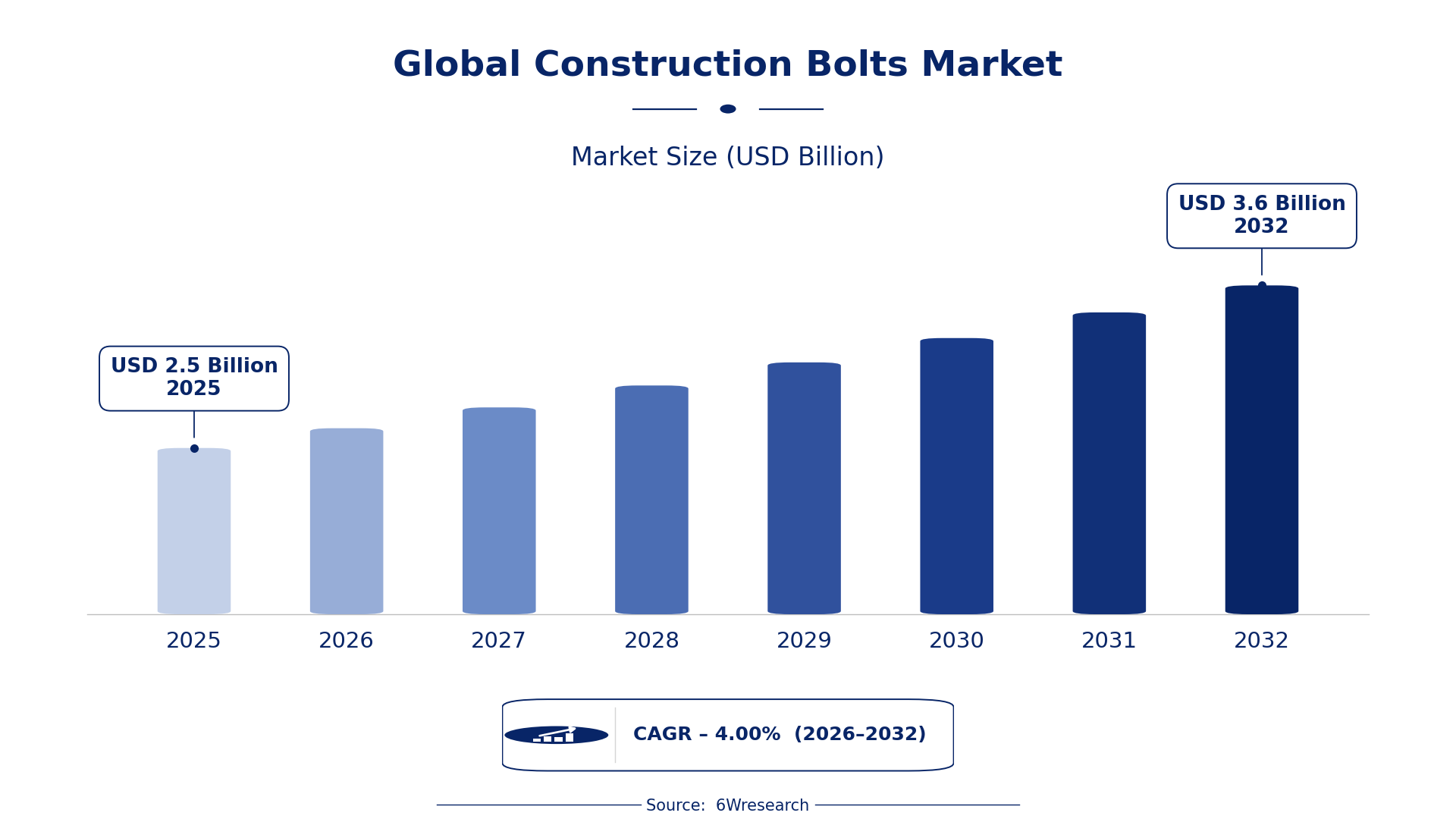
The Global Construction Bolts Market was estimated at USD 2.5 Billion in 2025 and is projected to reach USD 3.6 Billion by 2032, growing at a CAGR of 4.00% from 2026 to 2032.
Global Construction Bolts Market Synopsis
In recent years, the Global Construction Bolts Market has been marked by notable transformations driven by urbanization and expanding infrastructure projects worldwide. As emerging economies increasingly invest in modular and high-strength constructions, the demand for specialized bolts tailored to various applications has surged. This shift underscores the market's importance in supporting not only ongoing projects but also future developments.
Furthermore, the requirement for enhanced structural integrity continues to define market growth, as construction companies seek to use more reliable fastening solutions. This market differentiation sets it apart from adjacent sectors, emphasizing the role of construction bolts in safety, durability, and performance across diverse construction applications.
Global Construction Bolts Market Year-wise Growth Rate and Key Drivers
This graph illustrates the annual growth rates of the Global Construction Bolts Market from 2022 to 2032, highlighting a steady upward trajectory and projected expansion over the forecast period.
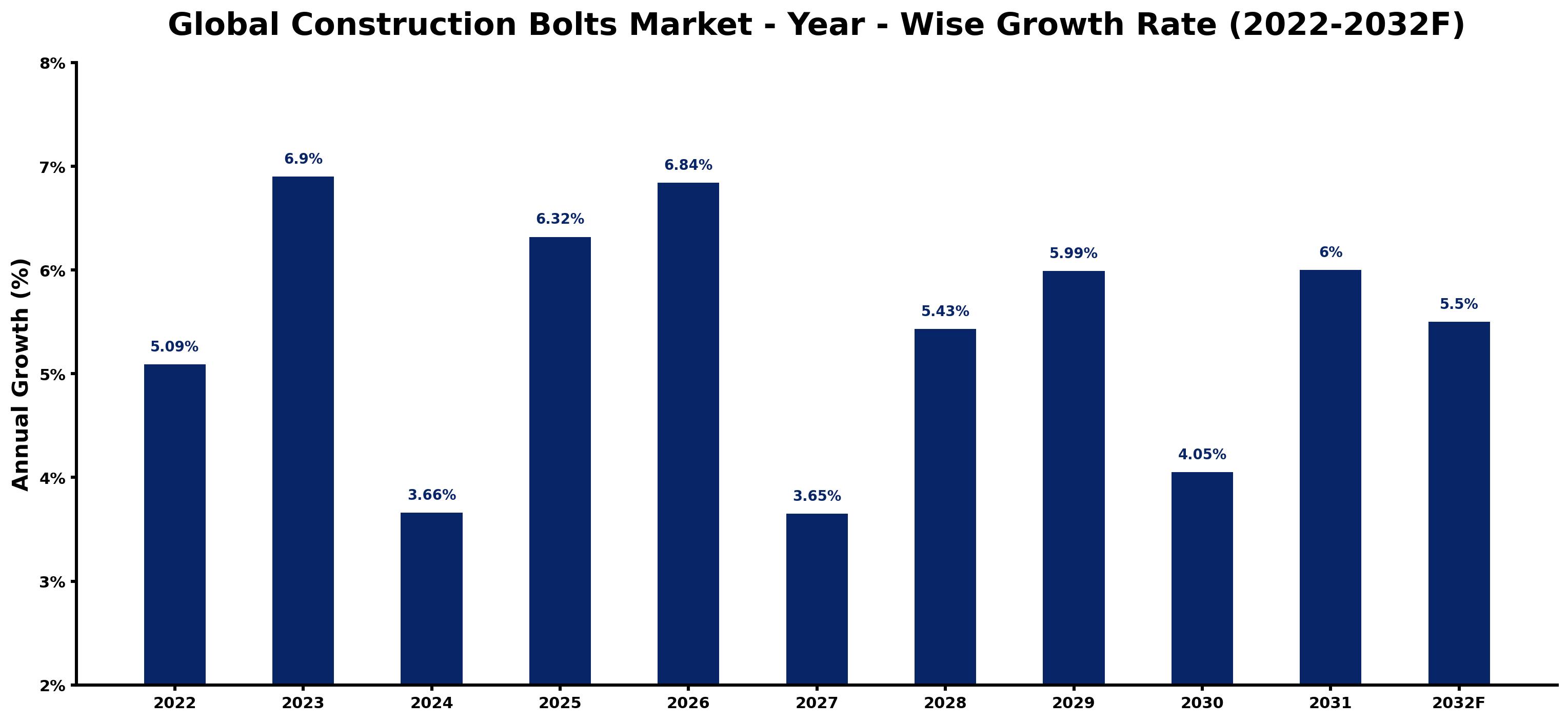
The table below presents the year‑wise growth rates along with the key drivers influencing the market
| Year | Growth Rate (%) | Major Drivers |
| 2022 | 5.09 | Manufacturers faced fluctuating raw material costs, impacting construction bolts pricing strategies. |
| 2023 | 6.9 | Expanding skilled labor availability enhances operational efficiency for construction bolt producers. |
| 2024 | 3.66 | Increased regulatory focus on construction standards shapes the demand for high-quality bolts. |
| 2025 | 6.32 | Sustainability initiatives necessitate eco-friendly materials in the construction bolts sector. |
| 2026 | 6.84 | In North America, evolving supply chain dynamics create new opportunities for construction bolt suppliers. |
| 2027 | 3.65 | Distributors of construction bolts adapt to competitive pricing strategies and enhanced product offerings. |
| 2028 | 5.43 | Manufacturers invest in advanced coating technologies to improve corrosion resistance in construction bolts. |
| 2029 | 5.99 | Self-tapping screws gain popularity among builders, shifting preferences in construction bolt specifications. |
| 2030 | 4.05 | The rising trend of modular construction drives a need for versatile construction bolt solutions. |
| 2031 | 6 | A shift toward strategic mergers and acquisitions consolidates power among leading construction bolt manufacturers. |
| 2032 | 5.5 | As construction projects expand globally, the demand for reliable construction bolts continues to rise. |
Note - Market size estimations and growth projections presented in this report are based on 6Wresearch's proprietary research methodology, combining internal industry data, secondary research, and primary validation, updated periodically to reflect current market conditions. As markets evolve rapidly, figures for certain industries may vary slightly and are intended as informed estimates rather than absolute figures. For the most current market sizing, we recommend validating figures with a 6Wresearch analyst.
Global Construction Bolts Market Key Takeaways
Below are some of the specific key takeaways from the market, including:
- As of 2025, non-residential applications comprise approximately 60% share of the total construction bolts market.
- The fastest-growing segment is residential, projected to expand at a CAGR of 6.5% from 2026 to 2032, driven by increasing housing demands in urban areas.
- Hilti Corporation recently launched a new line of sustainable construction bolts, aligning with increasing environmental standards.
- North America is expected to maintain its status as the largest region for construction bolts, representing about 45% of total market share in 2025.
- The market is witnessing increasing investments in automated fastening technologies, enhancing productivity in construction operations.
Evaluation of Restraints in Global Construction Bolts Market
Despite the positive outlook for the Global Construction Bolts Market, several significant constraints threaten growth. Fluctuating raw material prices pose a considerable challenge, with costs of crucial inputs like steel increasing by approximately 15% over the past year. For example, this volatility can erode profit margins for manufacturers and compel them to reconsider pricing strategies. Moreover, regulatory requirements are tightening, compelling producers to invest in compliance that can further inflate operational costs. With counterfeit bolts still prevalent in the market, maintaining quality control remains critical to ensure safety and integrity in construction applications.
Global Construction Bolts Market Trends
The Global Construction Bolts Market is currently experiencing transformative trends rooted in technological advancements and evolving operational methodologies. A prominent trend is the adoption of advanced automated bolt tightening systems, which enhance assembly efficiency and reduce labor costs. For example, in 2022, Simpson Strong-Tie introduced a new automated tool, resulting in a 25% decrease in installation time across various projects. Additionally, there is a marked shift towards sustainable materials, with companies like Parker Hannifin manufacturing corrosion-resistant bolts using eco-friendly processes, reflecting a growing consumer preference for environmentally responsible products.
Global Construction Bolts Market Opportunities
Future revenue opportunities in the Global Construction Bolts Market lie largely in the renewable energy and infrastructure sectors. The ongoing transition to green energy is driving a demand for specialized bolts used in solar and wind energy installations. For instance, an expected surge in solar farms is likely to generate a requirement for durable, weather-resistant fasteners, projected to be worth USD 500 million by 2030. Another promising area involves custom solutions for data centers, where high-strength, high-performance bolts are critical. Collaborations with technology firms to provide tailored fasteners can further enhance market share and profitability.
Global Construction Bolts Market by Application
In the Global Construction Bolts Market, the non-residential segment is the largest, commanding an approximate 60% share in 2025. This dominance is supported by ongoing commercial developments and infrastructure projects. Conversely, the residential segment is recognized as the fastest-growing area, with an estimated CAGR of 6.5% from 2026 to 2032. This growth stems from increasing investments in residential construction, influenced by favorable government policies and rising urban population densities, which create a sustained demand for innovative fastening solutions.
Global Construction Bolts Market by Region
North America remains the largest region in the Global Construction Bolts Market, capturing around 45% share in 2025, driven by continuous investment in infrastructure and a mature construction environment. However, the Asia region is poised to be the fastest-growing, projecting a significant CAGR of 6.0% from 2026 to 2032. This growth is attributed to rapid urbanization, significant construction projects in countries like India and China, and government-supported initiatives aimed at enhancing infrastructure development, which collectively create a robust demand for high-quality construction bolts.
Government Initiatives in the Global Construction Bolts Market
The regulatory landscape surrounding the Global Construction Bolts Market is shaped by various governmental policies aimed at enhancing safety and environmental standards in construction. These initiatives not only drive compliance within the industry but also stimulate growth by promoting innovation and sustainability practices.
- U.S. Department of Transportation: Infrastructure Investment and Jobs Act, enacted in November 2021; this initiative allocates approximately USD 1.2 trillion to upgrade transportation infrastructure, significantly impacting the demand for construction bolts.
- European Commission: EU Green Deal, initiated in December 2019; this policy aims to make Europe climate neutral by 2050, fostering the development of sustainable construction materials, including construction bolts.
- Indian Ministry of Housing and Urban Affairs: Pradhan Mantri Awas Yojana, launched in 2015; this program aims to provide affordable housing, leading to increased demand for construction bolts in residential projects.
- Canadian Government: National Housing Strategy, introduced in 2017; this strategy invests CAD 70 billion over ten years in housing developments, driving demand for construction materials, including bolts.
Future Insights of the Global Construction Bolts Market
As the Global Construction Bolts Market evolves through 2032, a shift towards automation and advanced material science is expected to redefine manufacturing techniques and operational efficiency. For instance, the integration of smart automation systems in assembly lines is projected to enhance production speed and reduce labor costs, aligning with broader trends in Industry 4.0. Companies like Hilti Corporation, by focusing on sustainable and technologically advanced products, are positioned to capture new opportunities in sectors like renewable energy. These dynamics suggest that firms which prioritize innovation will play a pivotal role in shaping the future landscape.
Global Construction Bolts Market Latest Developments
Several companies are making strides in the Global Construction Bolts Market, reflecting ongoing competitive advancements. These developments highlight the industry's shift towards innovative solutions and sustainability.
- Recently, Hilti Corporation launched a complete range of eco-friendly construction bolts, which are expected to meet emerging environmental standards while enhancing their market share.
- In early 2023, Fastenal Company expanded its distribution network across Europe, aiming to improve service delivery and tap into the growing construction markets in the region.
- Simpson Strong-Tie announced the upcoming release of a new line of high-strength fasteners designed specifically for seismic-resilient construction, targeting markets in earthquake-prone regions.
- In mid-2022, Parker Hannifin Corporation advanced its manufacturing capabilities by investing in automated assembly technologies, which are projected to enhance production efficiency and reduce lead times.
Global Construction Bolts Market Key Players and Industry Positioning
The competitive structure of the Global Construction Bolts Market remains fragmented, characterized by a mix of established players and emerging companies. Competitive strategies emphasize regional strength, product specialization, and technological provisioning to gain market share. This landscape fosters innovation and adaptability among key stakeholders.
| Leading Company | Core Strength | Strategic Focus |
|---|---|---|
| Hilti Corporation | Expertise in high-performance fastening systems | Emphasis on sustainable and smart construction technologies |
| Fastenal Company | Extensive distribution network with strong regional presence | Focus on expanding market reach, particularly in Europe |
| Simpson Strong-Tie Company, Inc. | Leading provider of structural repair and reinforcement products | Investment in innovative solutions for seismic and high-load applications |
| Parker Hannifin Corporation | Advanced automation in manufacturing processes | Development of automated tools for enhanced assembly efficiency |
| ITW Construction Products | Diverse product portfolio covering various construction needs | Strengthening focus on eco-friendly manufacturing practices |
The diverse core competencies among these key players underpin their competitive differentiation, allowing them to respond effectively to market demands and further their strategic objectives.
Key Attractiveness of the Report
- 10 Years of Market Numbers
- Historical Data Starting from 2022 to 2025
- Base Year: 2025
- Forecast Data until 2032
- Key Performance Indicators Impacting the Market
- Major Upcoming Developments and Projects
Key Highlights of the Report:
- Global Construction Bolts Market Outlook
- Market Size of Global Construction Bolts Market, 2025
- Forecast of Global Construction Bolts Market, 2032
- Historical Data and Forecast of Global Construction Bolts Revenues & Volume for the Period 2022-2032
- Global Construction Bolts Market Trend Evolution
- Global Construction Bolts Market Drivers and Challenges
- Global Construction Bolts Price Trends
- Global Construction Bolts Porter's Five Forces
- Global Construction Bolts Industry Life Cycle
- Historical Data and Forecast of Global Construction Bolts Market Revenues & Volume
- Historical Data and Forecast of Global Construction Bolts Market Revenues & Volume By Application for the Period 2022-2032
- Historical Data and Forecast of Global Construction Bolts Market Revenues & Volume By Residential for the Period 2022-2032
- Historical Data and Forecast of Global Construction Bolts Market Revenues & Volume By Non-residential for the Period 2022-2032
- Historical Data and Forecast of North America Construction Bolts Market Revenues & Volume By Application for the Period 2022-2032
- Historical Data and Forecast of North America Construction Bolts Market Revenues & Volume By Residential for the Period 2022-2032
- Historical Data and Forecast of North America Construction Bolts Market Revenues & Volume By Non-residential for the Period 2022-2032
- Historical Data and Forecast of United States of America Construction Bolts Market Revenues & Volume for the Period 2022-2032
- Historical Data and Forecast of Canada Construction Bolts Market Revenues & Volume for the Period 2022-2032
- Historical Data and Forecast of Rest of North America Construction Bolts Market Revenues & Volume for the Period 2022-2032
- Historical Data and Forecast of Latin America (LATAM) Construction Bolts Market Revenues & Volume By Application for the Period 2022-2032
- Historical Data and Forecast of Latin America (LATAM) Construction Bolts Market Revenues & Volume By Residential for the Period 2022-2032
- Historical Data and Forecast of Latin America (LATAM) Construction Bolts Market Revenues & Volume By Non-residential for the Period 2022-2032
- Historical Data and Forecast of Brazil Construction Bolts Market Revenues & Volume for the Period 2022-2032
- Historical Data and Forecast of Mexico Construction Bolts Market Revenues & Volume for the Period 2022-2032
- Historical Data and Forecast of Argentina Construction Bolts Market Revenues & Volume for the Period 2022-2032
- Historical Data and Forecast of Rest of LATAM Construction Bolts Market Revenues & Volume for the Period 2022-2032
- Historical Data and Forecast of Asia Construction Bolts Market Revenues & Volume By Application for the Period 2022-2032
- Historical Data and Forecast of Asia Construction Bolts Market Revenues & Volume By Residential for the Period 2022-2032
- Historical Data and Forecast of Asia Construction Bolts Market Revenues & Volume By Non-residential for the Period 2022-2032
- Historical Data and Forecast of China Construction Bolts Market Revenues & Volume for the Period 2022-2032
- Historical Data and Forecast of India Construction Bolts Market Revenues & Volume for the Period 2022-2032
- Historical Data and Forecast of Japan Construction Bolts Market Revenues & Volume for the Period 2022-2032
- Historical Data and Forecast of Rest of Asia Construction Bolts Market Revenues & Volume for the Period 2022-2032
- Historical Data and Forecast of Africa Construction Bolts Market Revenues & Volume By Application for the Period 2022-2032
- Historical Data and Forecast of Africa Construction Bolts Market Revenues & Volume By Residential for the Period 2022-2032
- Historical Data and Forecast of Africa Construction Bolts Market Revenues & Volume By Non-residential for the Period 2022-2032
- Historical Data and Forecast of South Africa Construction Bolts Market Revenues & Volume for the Period 2022-2032
- Historical Data and Forecast of Nigeria Construction Bolts Market Revenues & Volume for the Period 2022-2032
- Historical Data and Forecast of Egypt Construction Bolts Market Revenues & Volume for the Period 2022-2032
- Historical Data and Forecast of Rest of Africa Construction Bolts Market Revenues & Volume for the Period 2022-2032
- Historical Data and Forecast of Europe Construction Bolts Market Revenues & Volume By Application for the Period 2022-2032
- Historical Data and Forecast of Europe Construction Bolts Market Revenues & Volume By Residential for the Period 2022-2032
- Historical Data and Forecast of Europe Construction Bolts Market Revenues & Volume By Non-residential for the Period 2022-2032
- Historical Data and Forecast of United Kingdom Construction Bolts Market Revenues & Volume for the Period 2022-2032
- Historical Data and Forecast of France Construction Bolts Market Revenues & Volume for the Period 2022-2032
- Historical Data and Forecast of Germany Construction Bolts Market Revenues & Volume for the Period 2022-2032
- Historical Data and Forecast of Rest of Europe Construction Bolts Market Revenues & Volume for the Period 2022-2032
- Historical Data and Forecast of Middle East Construction Bolts Market Revenues & Volume By Application for the Period 2022-2032
- Historical Data and Forecast of Middle East Construction Bolts Market Revenues & Volume By Residential for the Period 2022-2032
- Historical Data and Forecast of Middle East Construction Bolts Market Revenues & Volume By Non-residential for the Period 2022-2032
- Historical Data and Forecast of Saudi Arabia Construction Bolts Market Revenues & Volume for the Period 2022-2032
- Historical Data and Forecast of UAE Construction Bolts Market Revenues & Volume for the Period 2022-2032
- Historical Data and Forecast of Turkey Construction Bolts Market Revenues & Volume for the Period 2022-2032
- Historical Data and Forecast of Rest of Middle East Construction Bolts Market Revenues & Volume for the Period 2022-2032
- Global Construction Bolts Market - Key Performance Indicators
- Global Construction Bolts Market - Import Export Trade Statistics
- Global Construction Bolts Market - Opportunity Assessment By Countries
- Global Construction Bolts Market - Opportunity Assessment By Application
- 0
- Global Construction Bolts Market - Top Companies Market Share
- Global Construction Bolts Market - Top Companies Profiles
- Global Construction Bolts Market - Comparison of Players in Technical and Operating Parameters
- Global Construction Bolts Market - Strategic Recommendations
Markets Covered
The Global Construction Bolts Market report provides a detailed analysis of the following market segments:
By Regions and Countries:
- North America
- Europe
- LATAM
- Middle East
- Asia
- Africa
By Application:
- Residential
- Non-residential






































