Global Curtains and Blinds Market Highlights
| Market Size (2025) | USD 22 Billion |
| Forecast Size (2032) | USD 31.5 Billion |
| CAGR | 5.20% |
| Base Year | 2025 |
| Forecast Period | 2026-2032 |
| Largest Region | North America |
| Fastest Growing Region | Asia |
| Largest Segment | Blinds |
| Fastest Growing Segment | Motorised |
| Leading Companies | Hunter Douglas, IKEA, Lutron Electronics, Graber, Springs Window Fashions |
Global Curtains and Blinds Market Size & Growth Rate (2026-2032)
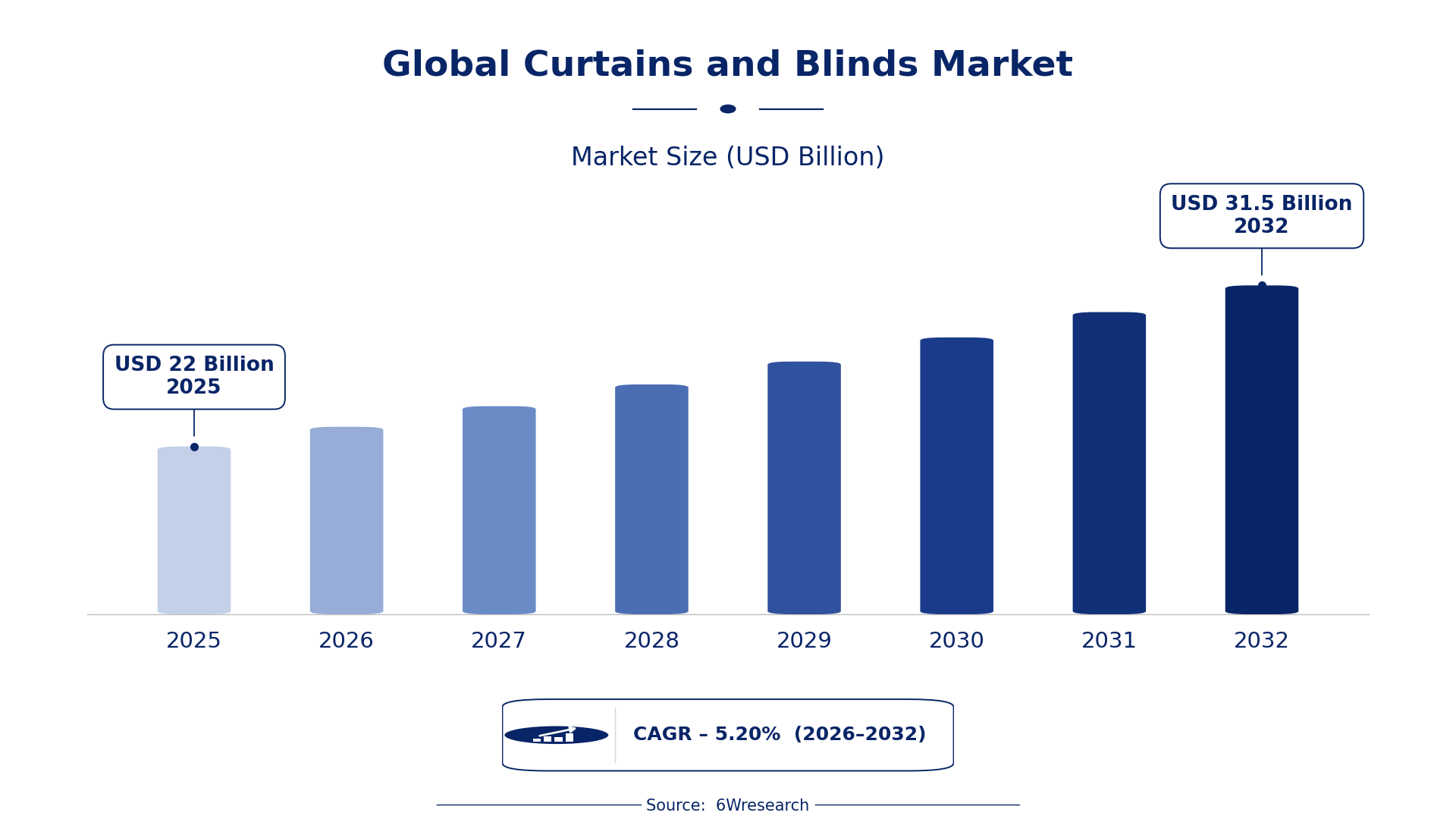
The Global Curtains and Blinds Market was estimated at USD 22 Billion in 2025 and is projected to reach USD 31.5 Billion by 2032, growing at a CAGR of 5.20% from 2026 to 2032.
Global Curtains and Blinds Market Synopsis
The dynamics of the Global Curtains and Blinds Market are evolving, driven by urbanization and renovation trends that prioritize aesthetics and functionality. Increasing disposable incomes have enhanced consumer spending on home decor, leading to an uptick in demand for diverse and customizable curtain and blind options. This market is marked by a significant integration of smart technologies and a shift toward energy-efficient products, catering to environmentally conscious consumers.
As the market expands, it plays a crucial role in related sectors such as construction and interior design by influencing design methodologies and contributing to energy-saving measures. The differentiation of products within the curtains and blinds landscape provides unique opportunities. This market is set apart from adjacent furnishings markets by its specific focus on light control, privacy solutions, and energy efficiency, which are integral in today’s eco-aware environment.
Global Curtains and Blinds Market Year-wise Growth Rate and Key Drivers
This graph illustrates the annual growth rates of the Global Curtains and Blinds Market from 2022 to 2032, highlighting a steady upward trajectory and projected expansion over the forecast period.
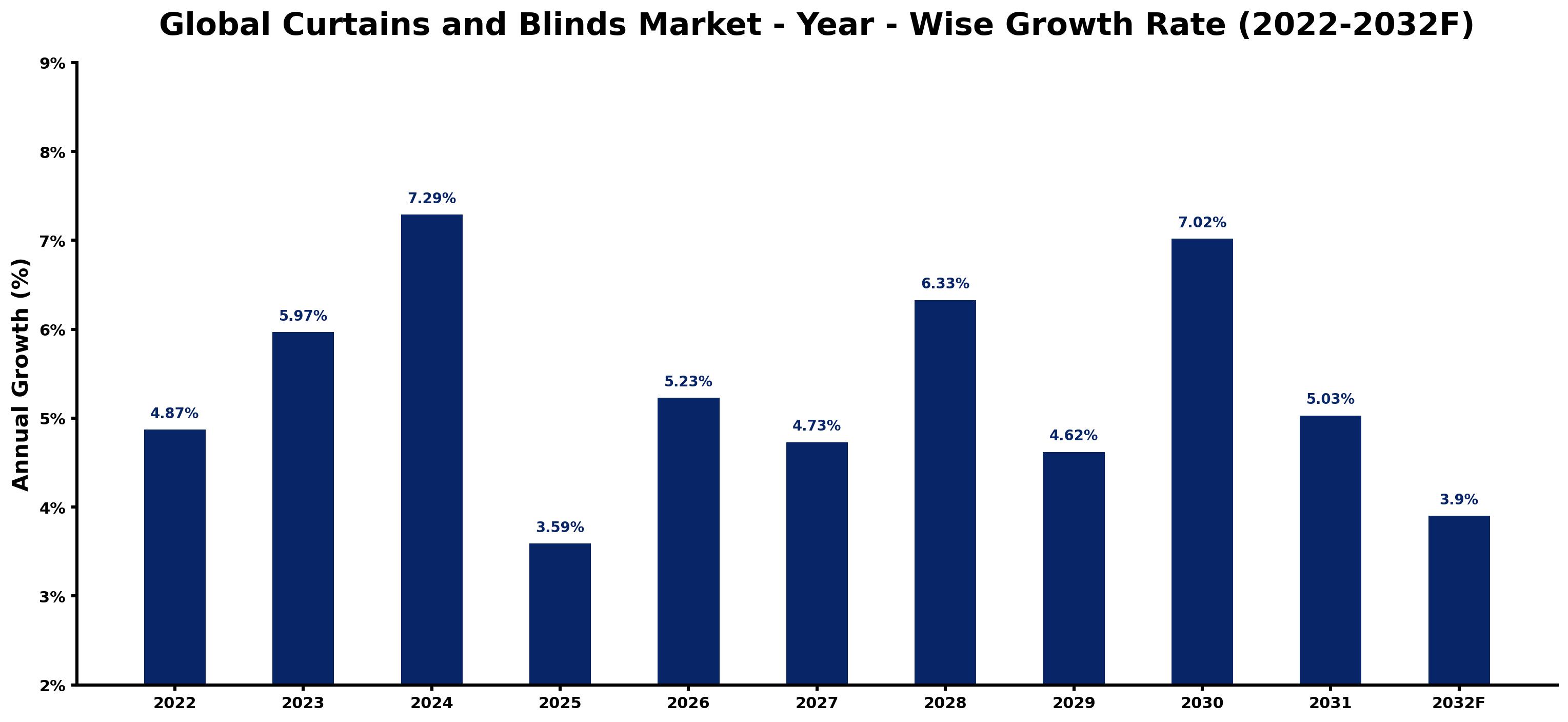
The table below presents the year‑wise growth rates along with the key drivers influencing the market
| Year | Growth Rate (%) | Major Drivers |
| 2022 | 4.87 | Retail channels increasingly cater to diverse end-user preferences for curtains and blinds. |
| 2023 | 5.97 | Growing competition among brands enhances product differentiation in curtains and blinds. |
| 2024 | 7.29 | Regulating energy efficiency standards is influencing the design of curtains and blinds. |
| 2025 | 3.59 | Residential customers increasingly seek bespoke curtains and blinds for unique aesthetics. |
| 2026 | 5.23 | In urban areas, consumer preferences for smart blinds are changing purchasing behavior. |
| 2027 | 4.73 | Heightened product innovation in smart blinds drives consumer interest and market dynamics. |
| 2028 | 6.33 | As brands expand geographically, curtains and blinds reach previously untapped consumer bases. |
| 2029 | 4.62 | Investment activities in manufacturing facilities enhance production capabilities for curtains and blinds. |
| 2030 | 7.02 | Manufacturers prioritize sustainability in sourcing materials for eco-friendly curtains and blinds. |
| 2031 | 5.03 | Premium blinds face pressure from rising raw material costs impacting pricing strategies. |
| 2032 | 3.9 | A shift toward local sourcing changes the supply chain dynamics for curtains and blinds. |
Note - Market size estimations and growth projections presented in this report are based on 6Wresearch's proprietary research methodology, combining internal industry data, secondary research, and primary validation, updated periodically to reflect current market conditions. As markets evolve rapidly, figures for certain industries may vary slightly and are intended as informed estimates rather than absolute figures. For the most current market sizing, we recommend validating figures with a 6Wresearch analyst.
Global Curtains and Blinds Market Key Takeaways
Below are some of the specific key takeaways from the market, including:
- The motorised segment is projected to witness a CAGR of 7.5% from 2026 to 2032, driven by the rising implementation of smart home technologies.
- In 2025, North America is expected to hold approximately 40% of the market share, driven by robust residential construction and renovation activities.
- Hunter Douglas reported a revenue growth of 9% in 2022 as a result of strategic initiatives focusing on sustainable materials.
- The integration of online sales channels is estimated to boost sales by 15% annually, as more consumers prefer the convenience of e-commerce.
- Sustainable products are becoming essential; in 2023, 30% of consumers indicated a willingness to pay a premium for eco-friendly curtains and blinds.
Evaluation of Restraints in Global Curtains and Blinds Market
The Global Curtains and Blinds Market faces several restraints that can inhibit growth. For instance, the rising material costs have put considerable pressure on manufacturers, with prices for textiles increasing by around 10% over the past year due to supply chain disruptions. Competition in the industry has intensified, leading to aggressive pricing strategies that diminish profit margins. For example, smaller businesses are struggling to compete with established brands such as IKEA, which leverage economies of scale to offer lower prices without sacrificing quality.
Global Curtains and Blinds Market Trends
One trend impacting the Global Curtains and Blinds Market is the growing demand for energy-efficient and smart products. Companies like Lutron Electronics have introduced smart motorised blinds that can adjust automatically based on time of day or ambient light, making homes more energy efficient. Additionally, customization of products is gaining traction; fabrics and designs are increasingly tailored to meet consumer preferences. According to recent data, the customization segment is expected to grow by 12% over the next five years. Furthermore, eco-friendly materials are gaining popularity, with a notable increase in consumers willing to invest in sustainable options, such as recycled fabrics.
Global Curtains and Blinds Market Opportunities
Identifying future revenue opportunities within the Global Curtains and Blinds Market reveals promising avenues for growth. One significant opportunity lies in the development of products optimized for the expanding smart home and Internet of Things (IoT) market, where industry giants like Hunter Douglas are investing in R&D. For example, the introduction of integrating sensors into blinds can automatically adjust them based on external weather conditions, significantly enhancing energy savings and user convenience. Another area ripe for exploration is the growing consumer interest in sustainable materials; it is projected that the eco-friendly segment could capture upwards of 25% of market share by 2030, driven by consumer preferences for environmentally responsible products.
Global Curtains and Blinds Market by Types
Blinds lead the global curtains and blinds market, commanding approximately 52% share in 2025. This segment's appeal lies in its functional versatility, ease of use, and aesthetic adaptability to various interior styles. Meanwhile, motorised blinds are identified as the fastest-growing segment, with a CAGR of 7.5% from 2026 to 2032. The demand for motorised options is propelled by increasing consumer adoption of smart home technologies, allowing for more convenient control and enhanced energy efficiency.
Global Curtains and Blinds Market by Application
Traditional window coverings remain the largest segment, holding around 70% market share in 2025. This preference persists due to their versatility and varied design options, catering to different aesthetic preferences. In contrast, motorised curtains and blinds represent the fastest-growing segment, with an estimated CAGR of 7.5% from 2026 to 2032. As home automation continues to proliferate, the attractiveness of motorised options reflects an evolving consumer preference for convenience and innovation in daily life.
Global Curtains and Blinds Market by Region
North America is expected to command the largest share of the Global Curtains and Blinds Market, with approximately 40% share in 2025, driven by high residential construction rates and housing renovations. Simultaneously, Asia is projected as the fastest-growing region, with a CAGR of 6.5% from 2026 to 2032, fueled by rapid urbanization and increasing consumer incomes. This growth is supported by a burgeoning middle class that is increasingly focused on home aesthetics and functionality.
Government Initiatives in the Global Curtains and Blinds Market
The regulatory environment surrounding the Global Curtains and Blinds Market is becoming increasingly dynamic as governments push for greater energy efficiency and sustainability. Various initiatives are aimed at supporting the development of eco-friendly materials and advancing technologies. These policies not only promote innovation but also ensure compliance with emerging environmental standards.
- United States Department of Energy - Energy Efficiency Standards for Window Coverings, 2023. This initiative encourages manufacturers to develop products that meet strict energy-saving criteria.
- European Commission - Eco-Design Directive, that mandates the use of sustainable materials, adopted in 2022. This regulation affects product design and encourages recycling.
- Government of India - PM Awas Yojana (Housing for All Mission), initiated in 2015 and ongoing, provides financial incentives for incorporating energy-efficient window coverings in residential construction.
- Australia’s Department of Industry - Future Energy Systems Initiative, planned for 2025, aims to promote innovative energy-efficient technologies, influencing curtain and blind product offerings.
Future Insights of the Global Curtains and Blinds Market
As the Global Curtains and Blinds Market approaches 2032, a notable shift is expected towards the integration of artificial intelligence in manufacturing and product offerings. Companies like Hunter Douglas are investing in R&D to develop smart blinds that adapt in real-time to environmental conditions, enhancing user experience and energy efficiency. This transition reflects a broader trend of leveraging technology to redefine energy conservation in home decor. The manufacturing landscape will likely witness increased automation, aiming for higher efficiency and reduced lead times, aligning with consumer expectations for rapid delivery.
Global Curtains and Blinds Market Latest Developments
Recent developments within the Global Curtains and Blinds Market illustrate a trend toward technological advancements and sustainability, setting competitive companies apart.
- In early 2023, Lutron Electronics launched a new line of energy-efficient smart blinds that can be controlled through voice commands, positioning the company at the forefront of smart home solutions.
- In late 2022, IKEA completed a project to integrate recycled materials into their curtain product line, aiming to appeal to the growing consumer base that prioritizes sustainability.
- Hunter Douglas announced plans in mid-2023 to expand their manufacturing capabilities in North America by investing in new technology that improves production efficiency.
- Recently, Springs Window Fashions entered a partnership with tech firms to develop IoT-enabled window treatment solutions, enhancing their competitive positioning in a tech-savvy market.
Global Curtains and Blinds Market Key Players and Industry Positioning
The Global Curtains and Blinds Market is characterized by a fragmented competitive structure, with several established players seeking to differentiate themselves through technology, sustainability, and design innovation. The presence of both global and regional players allows for varied product offerings and competitive pricing strategies.
| Leading Company | Core Strength | Strategic Focus |
|---|---|---|
| Hunter Douglas | Expert in premium window coverings with a focus on sustainability. | Investing in smart technologies and eco-friendly materials. |
| IKEA | Strong global presence with efficient supply chains and design capabilities. | Emphasis on affordability and eco-conscious products. |
| Lutron Electronics | Pioneers in smart home technology and energy-efficient solutions. | Focus on innovations that integrate with home automation systems. |
| Graber | Known for custom window treatment solutions. | Strategic partnerships for expanding product customization capabilities. |
| Springs Window Fashions | Diverse product range with a focus on retail and commercial markets. | Recently pivoted towards smart window treatments to capture tech-savvy consumers. |
With the increase in consumer focus on technology and sustainability, these companies are well-positioned to adapt and thrive in a competitive environment, shaping the future direction of the market.
Key Attractiveness of the Report
- 10 Years of Market Numbers
- Historical Data Starting from 2022 to 2025
- Base Year: 2025
- Forecast Data until 2032
- Key Performance Indicators Impacting the Market
- Major Upcoming Developments and Projects
Key Highlights of the Report:
- Global Curtains and Blinds Market Outlook
- Market Size of Global Curtains and Blinds Market, 2025
- Forecast of Global Curtains and Blinds Market, 2032
- Historical Data and Forecast of Global Curtains and Blinds Revenues & Volume for the Period 2022-2032
- Global Curtains and Blinds Market Trend Evolution
- Global Curtains and Blinds Market Drivers and Challenges
- Global Curtains and Blinds Price Trends
- Global Curtains and Blinds Porter's Five Forces
- Global Curtains and Blinds Industry Life Cycle
- Historical Data and Forecast of Global Curtains and Blinds Market Revenues & Volume
- Historical Data and Forecast of Global Curtains and Blinds Market Revenues & Volume By Types for the Period 2022-2032
- Historical Data and Forecast of Global Curtains and Blinds Market Revenues & Volume By Curtain for the Period 2022-2032
- Historical Data and Forecast of Global Curtains and Blinds Market Revenues & Volume By Blinds for the Period 2022-2032
- Historical Data and Forecast of Global Curtains and Blinds Market Revenues & Volume By Application for the Period 2022-2032
- Historical Data and Forecast of Global Curtains and Blinds Market Revenues & Volume By Traditional for the Period 2022-2032
- Historical Data and Forecast of Global Curtains and Blinds Market Revenues & Volume By Motorised for the Period 2022-2032
- Historical Data and Forecast of North America Curtains and Blinds Market Revenues & Volume By Types for the Period 2022-2032
- Historical Data and Forecast of North America Curtains and Blinds Market Revenues & Volume By Curtain for the Period 2022-2032
- Historical Data and Forecast of North America Curtains and Blinds Market Revenues & Volume By Blinds for the Period 2022-2032
- Historical Data and Forecast of North America Curtains and Blinds Market Revenues & Volume By Application for the Period 2022-2032
- Historical Data and Forecast of North America Curtains and Blinds Market Revenues & Volume By Traditional for the Period 2022-2032
- Historical Data and Forecast of North America Curtains and Blinds Market Revenues & Volume By Motorised for the Period 2022-2032
- Historical Data and Forecast of United States of America Curtains and Blinds Market Revenues & Volume for the Period 2022-2032
- Historical Data and Forecast of Canada Curtains and Blinds Market Revenues & Volume for the Period 2022-2032
- Historical Data and Forecast of Rest of North America Curtains and Blinds Market Revenues & Volume for the Period 2022-2032
- Historical Data and Forecast of Latin America (LATAM) Curtains and Blinds Market Revenues & Volume By Types for the Period 2022-2032
- Historical Data and Forecast of Latin America (LATAM) Curtains and Blinds Market Revenues & Volume By Curtain for the Period 2022-2032
- Historical Data and Forecast of Latin America (LATAM) Curtains and Blinds Market Revenues & Volume By Blinds for the Period 2022-2032
- Historical Data and Forecast of Latin America (LATAM) Curtains and Blinds Market Revenues & Volume By Application for the Period 2022-2032
- Historical Data and Forecast of Latin America (LATAM) Curtains and Blinds Market Revenues & Volume By Traditional for the Period 2022-2032
- Historical Data and Forecast of Latin America (LATAM) Curtains and Blinds Market Revenues & Volume By Motorised for the Period 2022-2032
- Historical Data and Forecast of Brazil Curtains and Blinds Market Revenues & Volume for the Period 2022-2032
- Historical Data and Forecast of Mexico Curtains and Blinds Market Revenues & Volume for the Period 2022-2032
- Historical Data and Forecast of Argentina Curtains and Blinds Market Revenues & Volume for the Period 2022-2032
- Historical Data and Forecast of Rest of LATAM Curtains and Blinds Market Revenues & Volume for the Period 2022-2032
- Historical Data and Forecast of Asia Curtains and Blinds Market Revenues & Volume By Types for the Period 2022-2032
- Historical Data and Forecast of Asia Curtains and Blinds Market Revenues & Volume By Curtain for the Period 2022-2032
- Historical Data and Forecast of Asia Curtains and Blinds Market Revenues & Volume By Blinds for the Period 2022-2032
- Historical Data and Forecast of Asia Curtains and Blinds Market Revenues & Volume By Application for the Period 2022-2032
- Historical Data and Forecast of Asia Curtains and Blinds Market Revenues & Volume By Traditional for the Period 2022-2032
- Historical Data and Forecast of Asia Curtains and Blinds Market Revenues & Volume By Motorised for the Period 2022-2032
- Historical Data and Forecast of China Curtains and Blinds Market Revenues & Volume for the Period 2022-2032
- Historical Data and Forecast of India Curtains and Blinds Market Revenues & Volume for the Period 2022-2032
- Historical Data and Forecast of Japan Curtains and Blinds Market Revenues & Volume for the Period 2022-2032
- Historical Data and Forecast of Rest of Asia Curtains and Blinds Market Revenues & Volume for the Period 2022-2032
- Historical Data and Forecast of Africa Curtains and Blinds Market Revenues & Volume By Types for the Period 2022-2032
- Historical Data and Forecast of Africa Curtains and Blinds Market Revenues & Volume By Curtain for the Period 2022-2032
- Historical Data and Forecast of Africa Curtains and Blinds Market Revenues & Volume By Blinds for the Period 2022-2032
- Historical Data and Forecast of Africa Curtains and Blinds Market Revenues & Volume By Application for the Period 2022-2032
- Historical Data and Forecast of Africa Curtains and Blinds Market Revenues & Volume By Traditional for the Period 2022-2032
- Historical Data and Forecast of Africa Curtains and Blinds Market Revenues & Volume By Motorised for the Period 2022-2032
- Historical Data and Forecast of South Africa Curtains and Blinds Market Revenues & Volume for the Period 2022-2032
- Historical Data and Forecast of Nigeria Curtains and Blinds Market Revenues & Volume for the Period 2022-2032
- Historical Data and Forecast of Egypt Curtains and Blinds Market Revenues & Volume for the Period 2022-2032
- Historical Data and Forecast of Rest of Africa Curtains and Blinds Market Revenues & Volume for the Period 2022-2032
- Historical Data and Forecast of Europe Curtains and Blinds Market Revenues & Volume By Types for the Period 2022-2032
- Historical Data and Forecast of Europe Curtains and Blinds Market Revenues & Volume By Curtain for the Period 2022-2032
- Historical Data and Forecast of Europe Curtains and Blinds Market Revenues & Volume By Blinds for the Period 2022-2032
- Historical Data and Forecast of Europe Curtains and Blinds Market Revenues & Volume By Application for the Period 2022-2032
- Historical Data and Forecast of Europe Curtains and Blinds Market Revenues & Volume By Traditional for the Period 2022-2032
- Historical Data and Forecast of Europe Curtains and Blinds Market Revenues & Volume By Motorised for the Period 2022-2032
- Historical Data and Forecast of United Kingdom Curtains and Blinds Market Revenues & Volume for the Period 2022-2032
- Historical Data and Forecast of France Curtains and Blinds Market Revenues & Volume for the Period 2022-2032
- Historical Data and Forecast of Germany Curtains and Blinds Market Revenues & Volume for the Period 2022-2032
- Historical Data and Forecast of Rest of Europe Curtains and Blinds Market Revenues & Volume for the Period 2022-2032
- Historical Data and Forecast of Middle East Curtains and Blinds Market Revenues & Volume By Types for the Period 2022-2032
- Historical Data and Forecast of Middle East Curtains and Blinds Market Revenues & Volume By Curtain for the Period 2022-2032
- Historical Data and Forecast of Middle East Curtains and Blinds Market Revenues & Volume By Blinds for the Period 2022-2032
- Historical Data and Forecast of Middle East Curtains and Blinds Market Revenues & Volume By Application for the Period 2022-2032
- Historical Data and Forecast of Middle East Curtains and Blinds Market Revenues & Volume By Traditional for the Period 2022-2032
- Historical Data and Forecast of Middle East Curtains and Blinds Market Revenues & Volume By Motorised for the Period 2022-2032
- Historical Data and Forecast of Saudi Arabia Curtains and Blinds Market Revenues & Volume for the Period 2022-2032
- Historical Data and Forecast of UAE Curtains and Blinds Market Revenues & Volume for the Period 2022-2032
- Historical Data and Forecast of Turkey Curtains and Blinds Market Revenues & Volume for the Period 2022-2032
- Historical Data and Forecast of Rest of Middle East Curtains and Blinds Market Revenues & Volume for the Period 2022-2032
- Global Curtains and Blinds Market - Key Performance Indicators
- Global Curtains and Blinds Market - Import Export Trade Statistics
- Global Curtains and Blinds Market - Opportunity Assessment By Countries
- Global Curtains and Blinds Market - Opportunity Assessment By Types
- Global Curtains and Blinds Market - Opportunity Assessment By Application
- Global Curtains and Blinds Market - Top Companies Market Share
- Global Curtains and Blinds Market - Top Companies Profiles
- Global Curtains and Blinds Market - Comparison of Players in Technical and Operating Parameters
- Global Curtains and Blinds Market - Strategic Recommendations
Markets Covered
The Global Curtains and Blinds Market report provides a detailed analysis of the following market segments:
By Regions and Countries:
- North America
- Europe
- LATAM
- Middle East
- Asia
- Africa
By Types:
- Curtain
- Blinds
By Application:
- Traditional
- Motorised






































