Saudi Arabia Curtains and Blinds Market Summary
The saudi arabia curtains and blinds market was estimated at USD 719 Million in 2025 and is projected to reach USD 1064 Million by 2032, growing at a CAGR of 7.5% from 2026 to 2032.
Saudi Arabia Curtains and Blinds Market Year-wise Growth Rate and Key Drivers
This graph highlights how the Saudi Arabia Curtains and Blinds Market has steadily grown over the past five years, supported by major growth factors.
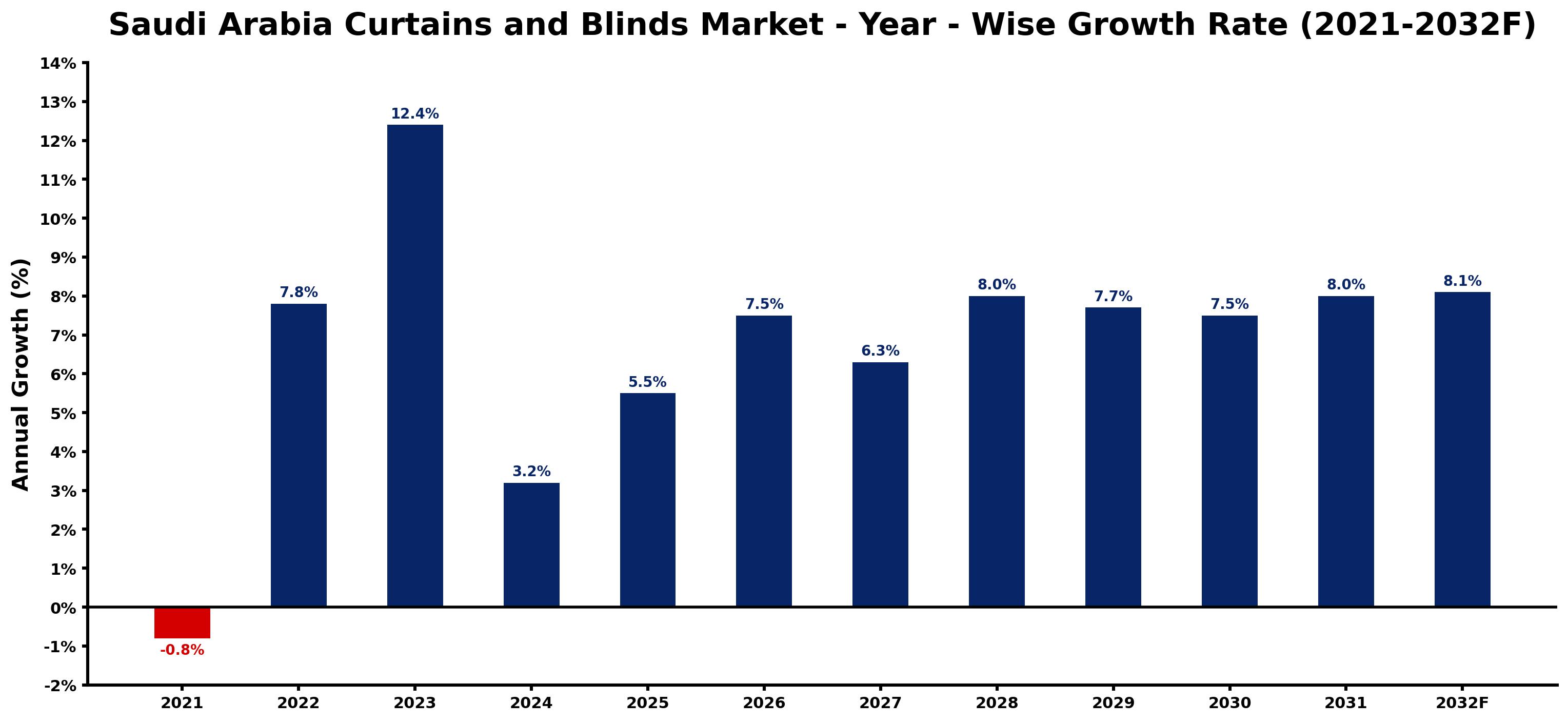
The table below presents the year wise growth rates along with the key drivers influencing the market
| Year | Growth Rate | Major Drivers |
| 2021 | -0.8% | Economic uncertainties stemming from global oil price fluctuations dampened consumer spending on home decor improvements. |
| 2022 | 7.8% | Increased construction activity in Neom fostered demand for modern curtain solutions. |
| 2023 | 12.4% | Local manufacturers began enhancing product quality to compete with imports effectively. |
| 2024 | 3.2% | Homeowners increasingly sought energy-efficient blinds to combat rising electricity costs. |
| 2025 | 5.5% | Urbanization trends pushed households to invest in innovative interior design solutions. |
| 2026 | 7.5% | Emerging online retailers introduced customizable curtain options appealing to tech-savvy consumers. |
| 2027 | 6.3% | Luxury renovations gained traction, boosting demand for high-end curtain and blind designs. |
| 2028 | 8.0% | Sustainability trends encouraged consumers to select eco-friendly materials for window coverings. |
| 2029 | 7.7% | Smart home technologies integrated seamlessly with innovative window treatments, enhancing user experience. |
| 2030 | 7.5% | Regional trade agreements facilitated easier access to diverse global curtain styles. |
| 2031 | 8.0% | Cultural shifts emphasized home personalization, driving demand for unique, bespoke designs. |
| 2032 | 8.1% | Rising disposable incomes among consumers allowed for premium product investments in homes. |
Note - Market size estimations and growth projections presented in this report are based on 6Wresearch's advanced forecasting approach, validated with industry datasets as of June 2026.
Saudi Arabia Curtains and Blinds Market Synopsis
The Saudi Arabia Curtains and Blinds Market is projected to reach 7.5% and witness significant growth during the forecast period (2026-2032). The increasing demand for energy-efficient window treatments that feature advanced functionalities such as light filtering, heat insulation, dust resistance, and sound absorption is encouraging greater adoption of curtains and blinds within both residential and commercial sectors. Moreover, an uplift in disposable incomes, alongside heightened consumer awareness regarding premium quality products, is substantially driving the demand for sophisticated window coverings, including motorized and automated curtain systems across the nation.
Saudi Arabia Curtains and Blinds Market Growth Drivers
Several pivotal factors are responsible for the robust expansion of the Saudi Arabia curtains and blinds market. These include:
- Urbanization trends are significantly influencing the construction sector, leading to a surge in new residential and commercial projects that require advanced window treatment solutions.
- Rising disposable incomes are enabling consumers to allocate a larger portion of their budgets to lifestyle products, reflecting a willingness to invest in premium curtains and blinds.
- Government initiatives promoting investment in home décor significantly contribute to market growth, creating an environment conducive to the uptake of innovative window treatments.
- The proliferation of technological advancements, including automation and motorization in curtain systems, is enhancing consumer preferences for convenient and smart home solutions.
- Heightened awareness around environmentally friendly solutions is facilitating the incorporation of eco-friendly fabrics and sustainable materials in product offerings, appealing to a more conscientious consumer base.
Saudi Arabia Curtains and Blinds Market Challenges and Restraints
Despite the promising growth, the Saudi Arabia curtains and blinds market faces several challenges that could impede progress. The most notable include:
- Volatility in raw material prices can lead to increased production costs for manufacturers, potentially impacting profit margins.
- Rapid digital transformation has shifted consumer focus toward online platforms, leading to decreased footfalls in physical retail spaces and posing challenges for traditional store-based sales models.
- Economic fluctuations, including those stemming from global events, can adversely affect consumer spending power, leading to hesitance in discretionary purchases.
- Competition from emerging markets offering lower-priced alternatives may challenge the market share of established brands, forcing price adjustments.
- Supply chain disruptions, exacerbated by global crises, may hinder timely product deliveries and affect overall service levels in the industry.
Saudi Arabia Curtains and Blinds Market Government Investment and Initiatives
The Saudi government has implemented various investment initiatives and incentives aimed at bolstering the domestic curtains and blinds market. Public spending on infrastructure and housing projects is expected to catalyze demand for window treatment products. Regulations are also being put in place to promote green building practices, encouraging the incorporation of energy-efficient window coverings in new constructions. Tax incentives for businesses investing in eco-friendly materials further enhance the attractiveness of the market. Additionally, collaborations between the public and private sectors are being explored to increase innovation within the home décor industry, which is vital for the advancement of modern curtains and blinds solutions.
Saudi Arabia Curtains and Blinds Market Latest Developments (May 2025 - June 2026)
The recent period from May 2025 to June 2026 has seen a notable shift in the Saudi Arabia curtains and blinds market landscape. Increased emphasis has been placed on the adoption of automation within window treatment solutions, with a growing number of manufacturers unveiling innovative products featuring smart home compatibility. This trend is reflecting consumer preferences for easy-to-use and technologically advanced home furnishings. Furthermore, sustainability has emerged as a key focus, with companies increasingly sourcing eco-friendly materials to meet the rising consumer demand for green products. Efforts to reduce manufacturing costs through automation and efficient production techniques are also underway, highlighting the industry's adaptability in response to market challenges.
Saudi Arabia Curtains and Blinds Market - Key Attractiveness of the Report
- 10 Years of Market Numbers
- Historical Data Starting from 2022 to 2025
- Base Year: 2025
- Forecast Data until 2032
- Key Performance Indicators Impacting the Market
- Major Upcoming Developments and Projects
Key Highlights of the Report:
- Saudi Arabia Curtains and Blinds Market Outlook
- Market Size of Saudi Arabia Curtains and Blinds Market, 2025
- Forecast of Saudi Arabia Curtains and Blinds Market, 2032
- Historical Data and Forecast of Saudi Arabia Curtains and Blinds Revenues & Volume for the Period 2022-2032F
- Saudi Arabia Curtains and Blinds Market Trend Evolution
- Saudi Arabia Curtains and Blinds Market Drivers and Challenges
- Saudi Arabia Curtains and Blinds Price Trends
- Saudi Arabia Curtains and Blinds Porter's Five Forces
- Saudi Arabia Curtains and Blinds Industry Life Cycle
- Historical Data and Forecast of Saudi Arabia Curtains and Blinds Market Revenues & Volume By Types for the Period 2022-2032F
- Historical Data and Forecast of Saudi Arabia Curtains and Blinds Market Revenues & Volume By Curtain for the Period 2022-2032F
- Historical Data and Forecast of Saudi Arabia Curtains and Blinds Market Revenues & Volume By Blinds for the Period 2022-2032F
- Historical Data and Forecast of Saudi Arabia Curtains and Blinds Market Revenues & Volume By Application for the Period 2022-2032F
- Historical Data and Forecast of Saudi Arabia Curtains and Blinds Market Revenues & Volume By Traditional for the Period 2022-2032F
- Historical Data and Forecast of Saudi Arabia Curtains and Blinds Market Revenues & Volume By Motorised for the Period 2022-2032F
- Saudi Arabia Curtains and Blinds Import Export Trade Statistics
- Market Opportunity Assessment By Types
- Market Opportunity Assessment By Application
- Saudi Arabia Curtains and Blinds Top Companies Market Share
- Saudi Arabia Curtains and Blinds Competitive Benchmarking By Technical and Operational Parameters
- Saudi Arabia Curtains and Blinds Company Profiles
- Saudi Arabia Curtains and Blinds Key Strategic Recommendations






































