Global Flexible Pipe Market Highlights
| Market Size (2025) | USD 1.1 Billion |
| Forecast Size (2032) | USD 1.7 Billion |
| CAGR | 7.20% |
| Base Year | 2025 |
| Forecast Period | 2026-2032 |
| Largest Region | North America |
| Fastest Growing Region | Middle East |
| Largest Segment | Offshore |
| Fastest Growing Segment | Onshore |
| Leading Companies | TechnipFMC, Prysmian Group, Sumitomo Electric, Aker Solutions, Schlumberger |
Global Flexible Pipe Market Size & Growth Rate (2026-2032)
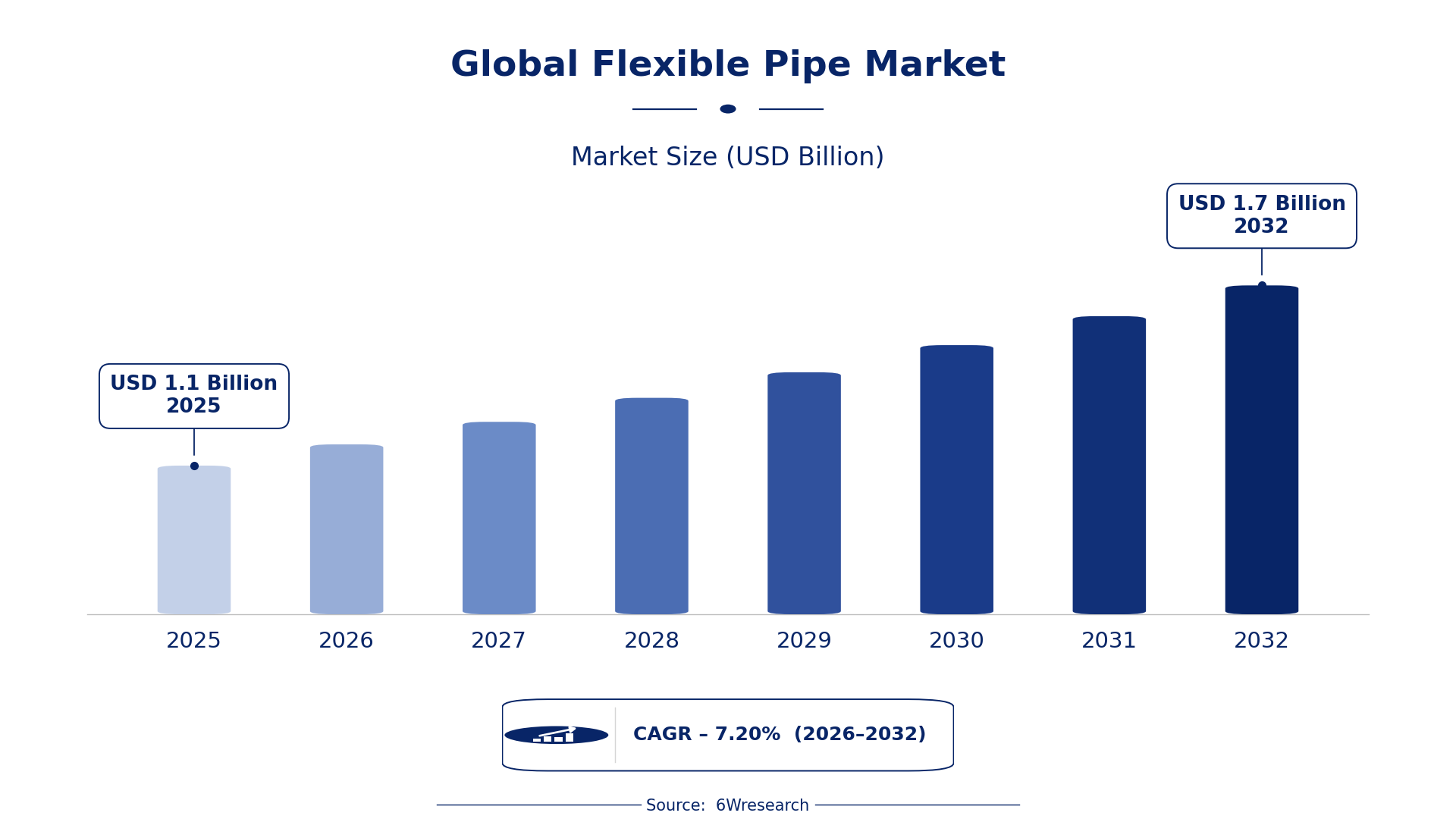
The Global Flexible Pipe Market was estimated at USD 1.1 Billion in 2025 and is projected to reach USD 1.7 Billion by 2032, growing at a CAGR of 7.20% from 2026 to 2032.
Global Flexible Pipe Market Synopsis
The Global Flexible Pipe Market is currently experiencing transformative shifts, primarily fueled by rising offshore oil exploration endeavors. Notably, the shift towards deepwater and ultra-deepwater projects necessitates adaptable piping solutions to maintain efficiency amidst challenging environments. Industry stakeholders are increasingly prioritizing durable materials to withstand harsh conditions, which sets flexible pipes apart from traditional rigid alternatives.
This market's importance extends beyond merely meeting current energy demands; it plays a pivotal role in shaping sustainable energy solutions. As the depletion of conventional reserves continues, investment in subsea infrastructure is surging, compelling companies to seek out reliable and innovative flexible pipe solutions. The concerted efforts of key players in R&D further enhance product resilience and performance, safeguarding against potential operational disruptions.
Global Flexible Pipe Market Year-wise Growth Rate and Key Drivers
This graph illustrates the annual growth rates of the Global Flexible Pipe Market from 2022 to 2032, highlighting a steady upward trajectory and projected expansion over the forecast period.
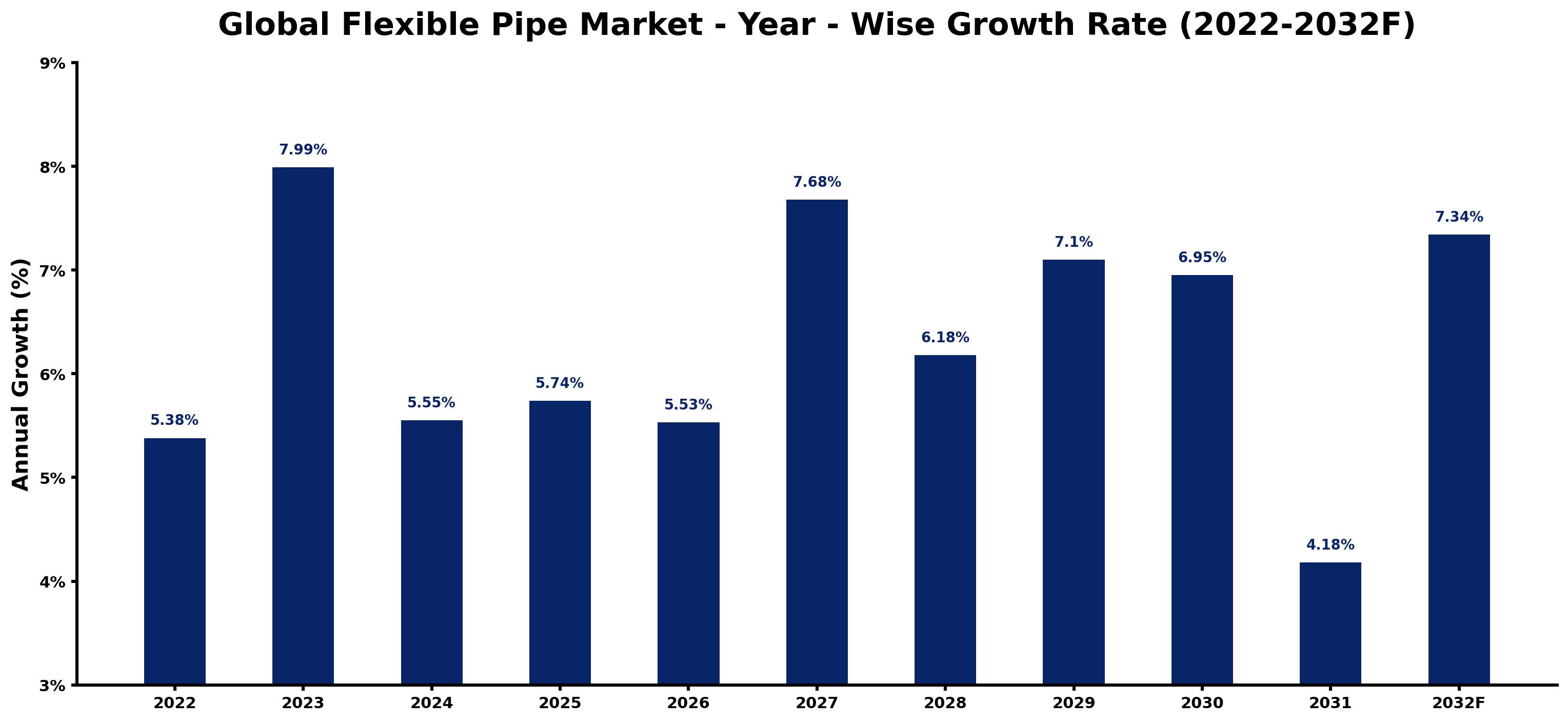
The table below presents the year‑wise growth rates along with the key drivers influencing the market
| Year | Growth Rate (%) | Major Drivers |
| 2022 | 5.38 | In the oil and gas sector, shifts in end-user demand shape flexible pipe adoption. |
| 2023 | 7.99 | Increasing workforce training enhances skilled labor availability for flexible pipe installation. |
| 2024 | 5.55 | Expansion of transmission infrastructure promotes flexible pipe usage in emerging markets. |
| 2025 | 5.74 | Smart metering technologies enhance the integration of flexible pipe systems across industries. |
| 2026 | 5.53 | Oil refining companies pursue strategic acquisitions to enhance flexible pipe supply chains. |
| 2027 | 7.68 | Energy companies focus on sustainability initiatives, boosting the use of flexible pipes. |
| 2028 | 6.18 | The move towards green energy has prompted operators to seek flexible pipe solutions. |
| 2029 | 7.1 | Manufacturers of flexible pipes innovate to improve durability and efficiency in various applications. |
| 2030 | 6.95 | Rising costs of conventional materials compel utilities to adopt flexible pipe alternatives. |
| 2031 | 4.18 | As regulatory pressures increase, companies prioritize flexible pipe solutions for compliance. |
| 2032 | 7.34 | A shift toward increased competition enhances the development of flexible pipe technologies. |
Note - Market size estimations and growth projections presented in this report are based on 6Wresearch's proprietary research methodology, combining internal industry data, secondary research, and primary validation, updated periodically to reflect current market conditions. As markets evolve rapidly, figures for certain industries may vary slightly and are intended as informed estimates rather than absolute figures. For the most current market sizing, we recommend validating figures with a 6Wresearch analyst.
Global Flexible Pipe Market Key Takeaways
Below are some of the specific key takeaways from the market, including:
- Offshore applications will continue to dominate the market, expected to account for approximately 60% of market share in 2025.
- The Middle East is projected to experience a rapid growth rate of nearly 10% CAGR from 2026 to 2032, driven by substantial investments in offshore oil fields.
- TechnipFMC has recently launched an advanced flexible pipe solution, enhancing flow assurance and operational efficiency.
- Prysmian Group's research indicates a push towards composite pipes, improving performance with an estimated market uptake of over 20% by 2030.
Evaluation of Restraints in Global Flexible Pipe Market
The Global Flexible Pipe Market faces notable constraints including fluctuating raw material prices, which can increase production costs significantly. For instance, the price of High-Density Polyethylene (HDPE), a primary raw material, has surged by approximately 15% over the past year, pressing manufacturers to reassess cost structures. Additionally, stringent regulatory compliance for environmental protection poses a hurdle; achieving consistent manufacturing quality in line with ISO certification requirements intensifies the competitive landscape. Companies struggle to balance innovation with these regulatory demands, resulting in potential delays in product development.
Global Flexible Pipe Market Trends
Several operational and technological trends are shaping the Global Flexible Pipe Market. An increasing focus on automation in manufacturing processes enhances efficiency and reduces lead times. Companies like Sumitomo Electric are incorporating smart manufacturing technologies, which have shown to reduce production times by 20%. Furthermore, the introduction of biodegradable materials for flexible pipes is rapidly gaining traction. For example, a project launched in 2022 aims to produce flexible pipes that can decompose in marine environments, thereby addressing environmental concerns associated with traditional alternatives.
Global Flexible Pipe Market Opportunities
The evolving landscape presents lucrative opportunities in various segments. With the global push towards renewable energy solutions, innovative applications for flexible pipes in wind and solar projects are burgeoning. For instance, a major initiative in Australia estimates an investment of USD 500 million over the next five years to develop flexible piping systems for offshore wind farms. Moreover, as mining operations expand in remote areas, onshore flexible pipe applications are expected to surge, with projected revenue growth of 15% from 2026 to 2032. These developments signal a commitment to efficiency and resource optimization within these industries.
Global Flexible Pipe Market by Raw Material
As of 2025, High-Density Polyethylene (HDPE) leads the Global Flexible Pipe Market, commanding approximately 45% of the market share. This material’s flexibility and resistance to corrosion make it a preferred choice among manufacturers. In contrast, Polyamide (PA) is anticipated to be the fastest-growing material, with a projected CAGR of 8.5% from 2026 to 2032. The growing adoption of PA in flexible pipeline applications is due to its superior mechanical properties, particularly in demanding environmental conditions, making it an attractive alternative to traditional materials.
Global Flexible Pipe Market by Application
The offshore application segment is currently the largest in the Global Flexible Pipe Market, accounting for approximately 60% of total market share in 2025. As offshore drilling activities intensify, particularly in the North Sea and Gulf of Mexico, the demand for robust flexible pipes is expected to escalate. Conversely, onshore applications are predicted to grow at a remarkable CAGR of 9.0% from 2026 to 2032. This rise is attributed to increased investment in natural gas infrastructure, where flexible pipes are favored for their adaptability and cost-effectiveness.
Global Flexible Pipe Market by Region
North America is the largest region in the Global Flexible Pipe Market, capturing an estimated 42% of the market share in 2025. This dominance is underpinned by an established oil and gas sector with extensive offshore activities. In contrast, the Middle East is projected to be the fastest-growing region, with a CAGR of 9.5% from 2026 to 2032, driven by government investments in offshore oil exploration and increasing production capacities within the region.
Government Initiatives in the Global Flexible Pipe Market
The regulatory environment impacting the Global Flexible Pipe Market is continually evolving, with various initiatives aimed at enhancing safety standards and promoting sustainable practices. Many countries are implementing policies that favor the adoption of advanced piping technologies that address environmental concerns and improve operational efficiency.
- U.S. Department of Energy: Offshore Technology Research and Development Program, 2021 - This initiative aims to fund research on advanced materials and technologies in offshore drilling applications, driving innovation in flexible pipe development.
- European Commission: Circular Economy Action Plan, 2020 - This ongoing initiative promotes the use of sustainable materials in all sectors, including flexible pipe manufacturing, thereby enhancing market resilience.
- Ministry of Petroleum and Natural Gas, India: National Policy on Biofuels, 2022 - This upcoming policy incentivizes the integration of bio-based materials in plumbing and pipeline applications, which could foster opportunities for flexible pipe manufacturers.
- National Offshore Safety Advisory Committee, USA: Regulatory Framework for Offshore Operations, 2023 - A newly established framework focusing on safety standards specifically for offshore flexible pipe installations, aiming to enhance operational safety in marine environments.
Future Insights of the Global Flexible Pipe Market
The Global Flexible Pipe Market is expected to undergo significant transformation over the coming years, particularly as the demand for sustainable energy solutions intensifies. For instance, the recent Australian initiative, which entails USD 500 million in investment for offshore wind farm flexible piping systems, highlights the market's adaptability to integrate with renewable projects. Advances in material technology, particularly the use of composite pipes, will not only enhance performance but also align with emerging regulatory frameworks aimed at sustainability.
Global Flexible Pipe Market Latest Developments
Recent industry actions reflect the dynamic nature of the Global Flexible Pipe Market, with key players making strategic moves to enhance their competitive edge. These developments signal an ongoing commitment to innovation and regional expansion.
- TechnipFMC announced a new partnership with a prominent offshore oil producer in March 2023 to supply advanced flexible pipes, aiming to streamline operations in ultra-deepwater projects.
- Prysmian Group initiated an extensive research program in early 2023 focused on the development of bio-based flexible pipe materials to enhance environmental sustainability.
- Sumitomo Electric expanded its manufacturing facility in North America in May 2023 to boost production capacity for flexible pipes, capitalizing on the growing demand in the region.
- Aker Solutions is set to launch a new flexible pipe system in Q4 2023 focused on reducing installation time by 30%, enhancing operational efficiency for offshore projects.
Global Flexible Pipe Market Key Players and Industry Positioning
The competitive structure of the Global Flexible Pipe Market is relatively consolidated, with several key players controlling a substantial market share. These companies leverage their technological expertise and market positioning to cater to diverse applications within the oil and gas sector.
| Leading Company | Core Strength | Strategic Focus |
|---|---|---|
| TechnipFMC | Advanced material technologies for offshore applications | Enhancing operational efficiency in ultra-deepwater projects |
| Prysmian Group | Expertise in composite pipe development | Focusing on sustainable and bio-based materials |
| Sumitomo Electric | Strong manufacturing capabilities in North America | Expanding production capacity to meet regional demand |
| Aker Solutions | Innovation in flexible pipe systems | Investing in efficiency improvements for offshore installations |
| Schlumberger | Leading supplier of oilfield services and products | Integrating flexible pipes with advanced offshore technologies |
This strategic positioning facilitates robust competition, driving continuous improvement and responsiveness to market trends, thus further nurturing innovation across the sector.
Key Attractiveness of the Report
- 10 Years of Market Numbers
- Historical Data Starting from 2022 to 2025
- Base Year: 2025
- Forecast Data until 2032
- Key Performance Indicators Impacting the Market
- Major Upcoming Developments and Projects
Key Highlights of the Report:
- Global Flexible Pipe Market Outlook
- Market Size of Global Flexible Pipe Market, 2025
- Forecast of Global Flexible Pipe Market, 2032
- Historical Data and Forecast of Global Flexible Pipe Revenues & Volume for the Period 2022-2032
- Global Flexible Pipe Market Trend Evolution
- Global Flexible Pipe Market Drivers and Challenges
- Global Flexible Pipe Price Trends
- Global Flexible Pipe Porter's Five Forces
- Global Flexible Pipe Industry Life Cycle
- Historical Data and Forecast of Global Flexible Pipe Market Revenues & Volume
- Historical Data and Forecast of Global Flexible Pipe Market Revenues & Volume By Raw Material for the Period 2022-2032
- Historical Data and Forecast of Global Flexible Pipe Market Revenues & Volume By HDPE for the Period 2022-2032
- Historical Data and Forecast of Global Flexible Pipe Market Revenues & Volume By PA for the Period 2022-2032
- Historical Data and Forecast of Global Flexible Pipe Market Revenues & Volume By PVDF for the Period 2022-2032
- Historical Data and Forecast of Global Flexible Pipe Market Revenues & Volume By Application for the Period 2022-2032
- Historical Data and Forecast of Global Flexible Pipe Market Revenues & Volume By Offshore for the Period 2022-2032
- Historical Data and Forecast of Global Flexible Pipe Market Revenues & Volume By Onshore for the Period 2022-2032
- Historical Data and Forecast of North America Flexible Pipe Market Revenues & Volume By Raw Material for the Period 2022-2032
- Historical Data and Forecast of North America Flexible Pipe Market Revenues & Volume By HDPE for the Period 2022-2032
- Historical Data and Forecast of North America Flexible Pipe Market Revenues & Volume By PA for the Period 2022-2032
- Historical Data and Forecast of North America Flexible Pipe Market Revenues & Volume By PVDF for the Period 2022-2032
- Historical Data and Forecast of North America Flexible Pipe Market Revenues & Volume By Application for the Period 2022-2032
- Historical Data and Forecast of North America Flexible Pipe Market Revenues & Volume By Offshore for the Period 2022-2032
- Historical Data and Forecast of North America Flexible Pipe Market Revenues & Volume By Onshore for the Period 2022-2032
- Historical Data and Forecast of United States of America Flexible Pipe Market Revenues & Volume for the Period 2022-2032
- Historical Data and Forecast of Canada Flexible Pipe Market Revenues & Volume for the Period 2022-2032
- Historical Data and Forecast of Rest of North America Flexible Pipe Market Revenues & Volume for the Period 2022-2032
- Historical Data and Forecast of Latin America (LATAM) Flexible Pipe Market Revenues & Volume By Raw Material for the Period 2022-2032
- Historical Data and Forecast of Latin America (LATAM) Flexible Pipe Market Revenues & Volume By HDPE for the Period 2022-2032
- Historical Data and Forecast of Latin America (LATAM) Flexible Pipe Market Revenues & Volume By PA for the Period 2022-2032
- Historical Data and Forecast of Latin America (LATAM) Flexible Pipe Market Revenues & Volume By PVDF for the Period 2022-2032
- Historical Data and Forecast of Latin America (LATAM) Flexible Pipe Market Revenues & Volume By Application for the Period 2022-2032
- Historical Data and Forecast of Latin America (LATAM) Flexible Pipe Market Revenues & Volume By Offshore for the Period 2022-2032
- Historical Data and Forecast of Latin America (LATAM) Flexible Pipe Market Revenues & Volume By Onshore for the Period 2022-2032
- Historical Data and Forecast of Brazil Flexible Pipe Market Revenues & Volume for the Period 2022-2032
- Historical Data and Forecast of Mexico Flexible Pipe Market Revenues & Volume for the Period 2022-2032
- Historical Data and Forecast of Argentina Flexible Pipe Market Revenues & Volume for the Period 2022-2032
- Historical Data and Forecast of Rest of LATAM Flexible Pipe Market Revenues & Volume for the Period 2022-2032
- Historical Data and Forecast of Asia Flexible Pipe Market Revenues & Volume By Raw Material for the Period 2022-2032
- Historical Data and Forecast of Asia Flexible Pipe Market Revenues & Volume By HDPE for the Period 2022-2032
- Historical Data and Forecast of Asia Flexible Pipe Market Revenues & Volume By PA for the Period 2022-2032
- Historical Data and Forecast of Asia Flexible Pipe Market Revenues & Volume By PVDF for the Period 2022-2032
- Historical Data and Forecast of Asia Flexible Pipe Market Revenues & Volume By Application for the Period 2022-2032
- Historical Data and Forecast of Asia Flexible Pipe Market Revenues & Volume By Offshore for the Period 2022-2032
- Historical Data and Forecast of Asia Flexible Pipe Market Revenues & Volume By Onshore for the Period 2022-2032
- Historical Data and Forecast of China Flexible Pipe Market Revenues & Volume for the Period 2022-2032
- Historical Data and Forecast of India Flexible Pipe Market Revenues & Volume for the Period 2022-2032
- Historical Data and Forecast of Japan Flexible Pipe Market Revenues & Volume for the Period 2022-2032
- Historical Data and Forecast of Rest of Asia Flexible Pipe Market Revenues & Volume for the Period 2022-2032
- Historical Data and Forecast of Africa Flexible Pipe Market Revenues & Volume By Raw Material for the Period 2022-2032
- Historical Data and Forecast of Africa Flexible Pipe Market Revenues & Volume By HDPE for the Period 2022-2032
- Historical Data and Forecast of Africa Flexible Pipe Market Revenues & Volume By PA for the Period 2022-2032
- Historical Data and Forecast of Africa Flexible Pipe Market Revenues & Volume By PVDF for the Period 2022-2032
- Historical Data and Forecast of Africa Flexible Pipe Market Revenues & Volume By Application for the Period 2022-2032
- Historical Data and Forecast of Africa Flexible Pipe Market Revenues & Volume By Offshore for the Period 2022-2032
- Historical Data and Forecast of Africa Flexible Pipe Market Revenues & Volume By Onshore for the Period 2022-2032
- Historical Data and Forecast of South Africa Flexible Pipe Market Revenues & Volume for the Period 2022-2032
- Historical Data and Forecast of Nigeria Flexible Pipe Market Revenues & Volume for the Period 2022-2032
- Historical Data and Forecast of Egypt Flexible Pipe Market Revenues & Volume for the Period 2022-2032
- Historical Data and Forecast of Rest of Africa Flexible Pipe Market Revenues & Volume for the Period 2022-2032
- Historical Data and Forecast of Europe Flexible Pipe Market Revenues & Volume By Raw Material for the Period 2022-2032
- Historical Data and Forecast of Europe Flexible Pipe Market Revenues & Volume By HDPE for the Period 2022-2032
- Historical Data and Forecast of Europe Flexible Pipe Market Revenues & Volume By PA for the Period 2022-2032
- Historical Data and Forecast of Europe Flexible Pipe Market Revenues & Volume By PVDF for the Period 2022-2032
- Historical Data and Forecast of Europe Flexible Pipe Market Revenues & Volume By Application for the Period 2022-2032
- Historical Data and Forecast of Europe Flexible Pipe Market Revenues & Volume By Offshore for the Period 2022-2032
- Historical Data and Forecast of Europe Flexible Pipe Market Revenues & Volume By Onshore for the Period 2022-2032
- Historical Data and Forecast of United Kingdom Flexible Pipe Market Revenues & Volume for the Period 2022-2032
- Historical Data and Forecast of France Flexible Pipe Market Revenues & Volume for the Period 2022-2032
- Historical Data and Forecast of Germany Flexible Pipe Market Revenues & Volume for the Period 2022-2032
- Historical Data and Forecast of Rest of Europe Flexible Pipe Market Revenues & Volume for the Period 2022-2032
- Historical Data and Forecast of Middle East Flexible Pipe Market Revenues & Volume By Raw Material for the Period 2022-2032
- Historical Data and Forecast of Middle East Flexible Pipe Market Revenues & Volume By HDPE for the Period 2022-2032
- Historical Data and Forecast of Middle East Flexible Pipe Market Revenues & Volume By PA for the Period 2022-2032
- Historical Data and Forecast of Middle East Flexible Pipe Market Revenues & Volume By PVDF for the Period 2022-2032
- Historical Data and Forecast of Middle East Flexible Pipe Market Revenues & Volume By Application for the Period 2022-2032
- Historical Data and Forecast of Middle East Flexible Pipe Market Revenues & Volume By Offshore for the Period 2022-2032
- Historical Data and Forecast of Middle East Flexible Pipe Market Revenues & Volume By Onshore for the Period 2022-2032
- Historical Data and Forecast of Saudi Arabia Flexible Pipe Market Revenues & Volume for the Period 2022-2032
- Historical Data and Forecast of UAE Flexible Pipe Market Revenues & Volume for the Period 2022-2032
- Historical Data and Forecast of Turkey Flexible Pipe Market Revenues & Volume for the Period 2022-2032
- Historical Data and Forecast of Rest of Middle East Flexible Pipe Market Revenues & Volume for the Period 2022-2032
- Global Flexible Pipe Market - Key Performance Indicators
- Global Flexible Pipe Market - Import Export Trade Statistics
- Global Flexible Pipe Market - Opportunity Assessment By Countries
- Global Flexible Pipe Market - Opportunity Assessment By Raw Material
- Global Flexible Pipe Market - Opportunity Assessment By Application
- Global Flexible Pipe Market - Top Companies Market Share
- Global Flexible Pipe Market - Top Companies Profiles
- Global Flexible Pipe Market - Comparison of Players in Technical and Operating Parameters
- Global Flexible Pipe Market - Strategic Recommendations
Markets Covered
The Global Flexible Pipe Market report provides a detailed analysis of the following market segments:
By Regions and Countries:
- North America
- Europe
- LATAM
- Middle East
- Asia
- Africa
By Raw Material:
- HDPE
- PA
- PVDF
By Application:
- Offshore
- Onshore






































