Global Halal Meat Market Highlights
| Market Size (2025) | USD 202.3 Billion |
| Forecast Size (2032) | USD 276.5 Billion |
| CAGR | 5.00% |
| Base Year | 2025 |
| Forecast Period | 2026-2032 |
| Largest Region | Middle East |
| Fastest Growing Region | Asia |
| Largest Segment | Fresh Food |
| Fastest Growing Segment | Processed Food |
| Leading Companies | Nestlé, Tyson Foods, Al-Safa, BRF S.A., and Dubai Invest |
Global Halal Meat Market Size & Growth Rate (2026-2032)
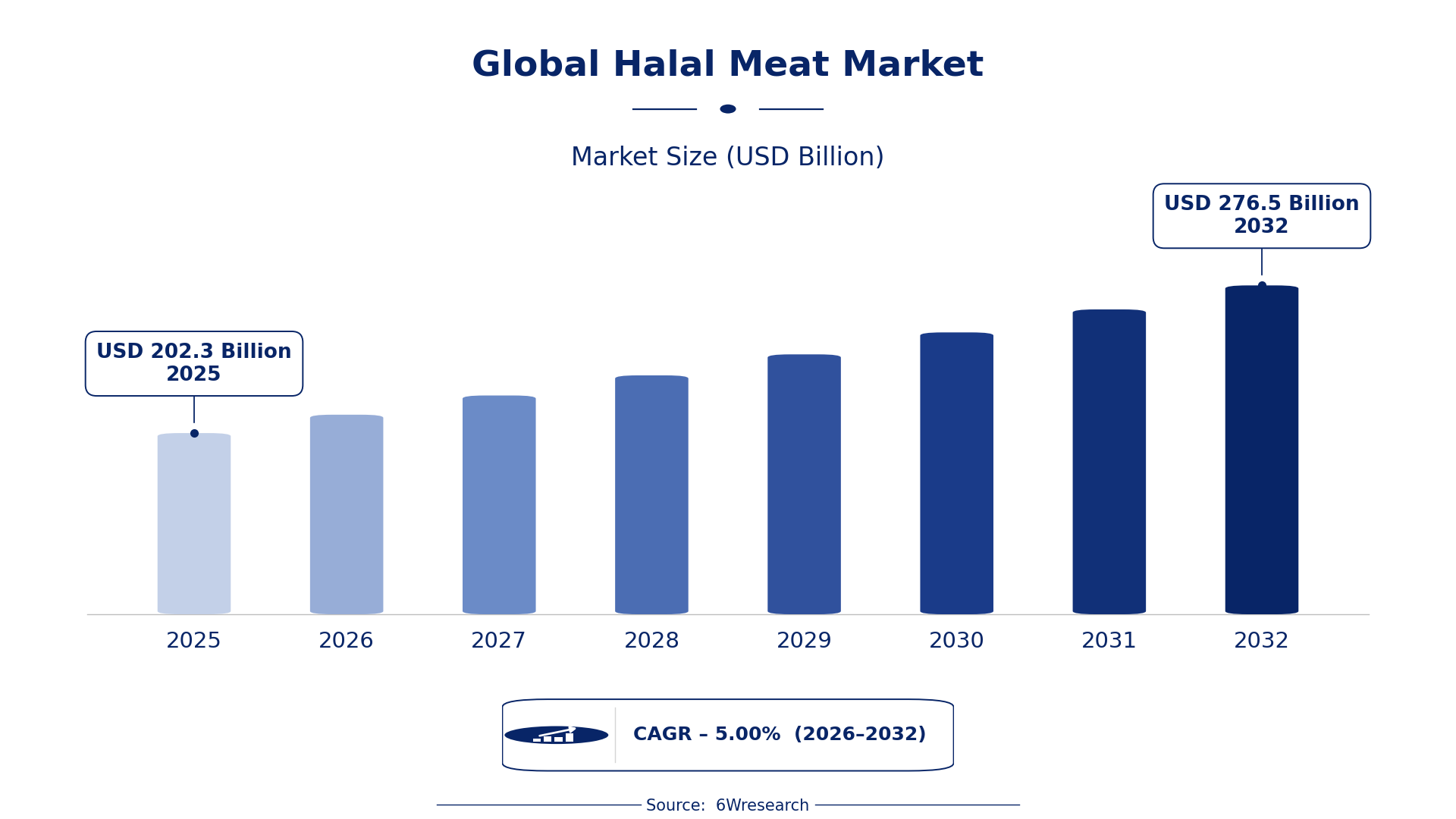
The Global Halal Meat Market was estimated at USD 202.3 Billion in 2025 and is projected to reach USD 276.5 Billion by 2032, growing at a CAGR of 5.00% from 2026 to 2032.
Global Halal Meat Market Synopsis
The Global Halal Meat Market is witnessing fundamental shifts largely influenced by demographic trends and evolving consumer behaviors. The rising Muslim population and growing interest from non-Muslim consumers create a dual demand landscape. This market plays a vital role in the food industry, intersecting ethical sourcing with compliance to dietary laws, presenting opportunities for manufacturers and retailers alike.
Current shifts in supply chains and certification standards are reshaping market dynamics. Manufacturers are focusing on compliance with Halal regulations, essential for accessing both traditional and innovative distribution channels. Efforts to improve quality and transparency throughout the production process are also critical, as they enhance product appeal and consumer trust.
Global Halal Meat Market Year-wise Growth Rate and Key Drivers
This graph illustrates the annual growth rates of the Global Halal Meat Market from 2022 to 2032, highlighting a steady upward trajectory and projected expansion over the forecast period.
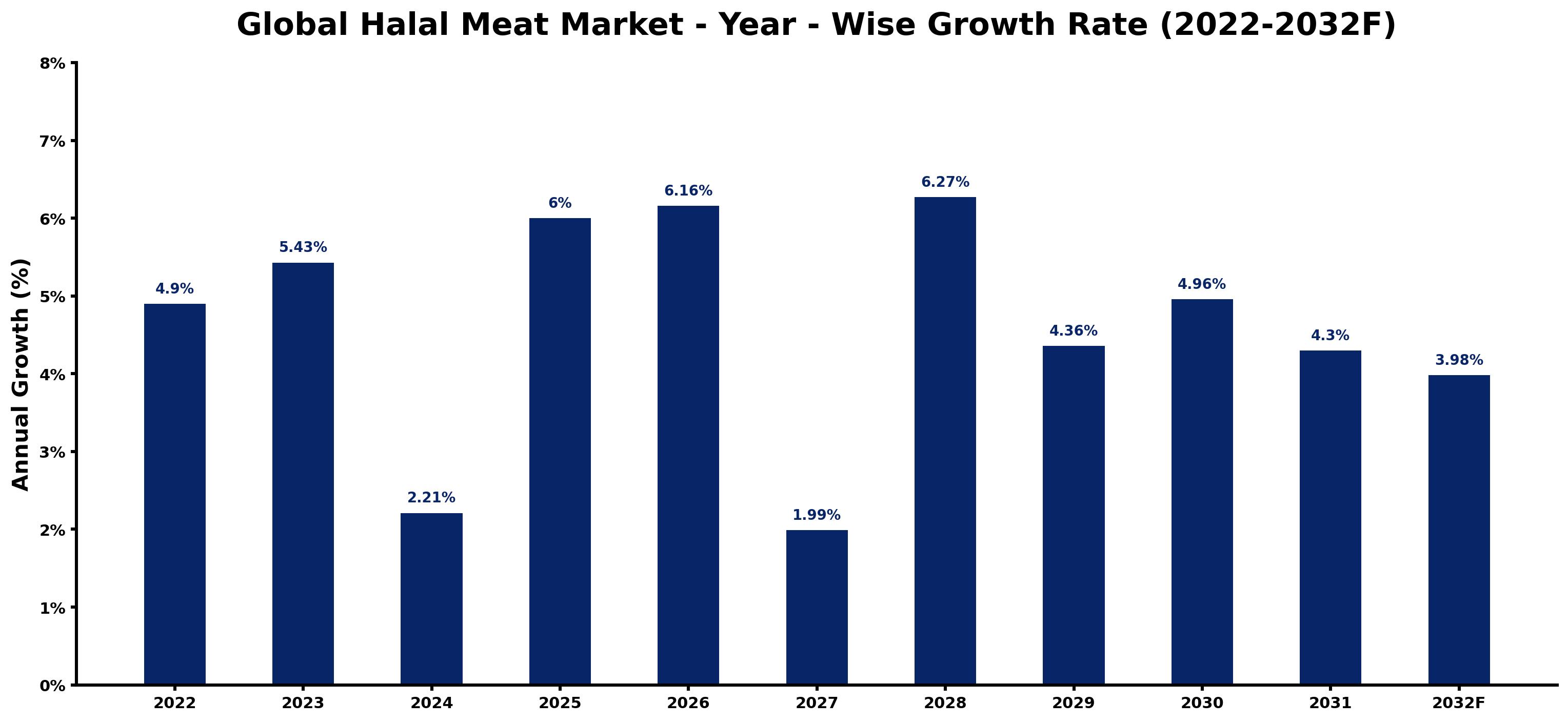
The table below presents the year‑wise growth rates along with the key drivers influencing the market
| Year | Growth Rate (%) | Major Drivers |
| 2022 | 4.9 | Amid emerging competitive dynamics, halal meat options gain consumer attention globally. |
| 2023 | 5.43 | A constrained workforce skilled in halal practices limits rapid expansion potential. |
| 2024 | 2.21 | Increasing consumer interest in clean-label formulations drives halal meat purchases. |
| 2025 | 6 | As technology evolves, automated halal processing enhances quality and efficiency. |
| 2026 | 6.16 | Regulatory compliance with halal standards ensures higher quality and consumer trust. |
| 2027 | 1.99 | Farmers implementing sustainable practices see increased demand for eco-friendly halal meat. |
| 2028 | 6.27 | A shift toward urban markets accelerates halal meat penetration across new regions. |
| 2029 | 4.36 | Innovative packaging solutions for halal meat improve supply chain efficiency and freshness. |
| 2030 | 4.96 | Retail chains investing in halal meat offerings expand market presence significantly. |
| 2031 | 4.3 | Rising raw material costs constrain pricing strategies for halal meat producers. |
| 2032 | 3.98 | Health-conscious consumers increasingly prefer halal meat as part of their diets. |
Note - Market size estimations and growth projections presented in this report are based on 6Wresearch's proprietary research methodology, combining internal industry data, secondary research, and primary validation, updated periodically to reflect current market conditions. As markets evolve rapidly, figures for certain industries may vary slightly and are intended as informed estimates rather than absolute figures. For the most current market sizing, we recommend validating figures with a 6Wresearch analyst.
Global Halal Meat Market Key Takeaways
Below are some of the specific key takeaways from the market, including:
- As of 2025, the Middle East is estimated to command nearly 40% of the Global Halal Meat Market.
- According to the Halal Monitoring Committee, the number of Halal certifications awarded globally reached over 2,800 in 2023, showcasing industry growth.
- The processed food segment is expected to grow at a CAGR of 7.2% from 2026 to 2032, reflecting increasing innovation in product offerings.
- In 2022, Tyson Foods launched a new line of Halal-certified chicken products in response to growing consumer demand in Western markets.
Evaluation of Restraints in Global Halal Meat Market
Several challenges are hindering the growth of the Global Halal Meat Market. Standardization issues surrounding Halal certification remain a significant hurdle, especially in non-Muslim-majority countries where there may be no regulatory framework for Halal meat. For instance, the cost of obtaining certifications can reach up to $30,000, a figure that poses considerable pressure on smaller meat producers. Additionally, discrepancies in Halal certification processes can lead to consumer distrust, impacting sales and market expansion efforts.
Global Halal Meat Market Trends
Emerging trends in the Global Halal Meat Market reflect a broader push for operational efficiency and consumer engagement. Firstly, companies like Al-Safa have adopted AI and blockchain technologies for traceability and transparency within their supply chains, enhancing consumer confidence. This operational shift aims to improve product safety and authenticity, vital for appealing to health-conscious buyers. For example, collaboration between meat producers and tech firms has resulted in solutions that map meat sourcing directly to suppliers, simplifying the verification process for consumers.
Secondly, a surge in online platforms specifically for Halal products has transformed distribution channels. E-commerce giants have reported a 25% increase in Halal product sales, attributed to younger consumers' preferences for convenient shopping experiences. Retailers are now investing in tailored marketing strategies to leverage this trend, aligning product offerings with the ethical values consumers prioritize.
Global Halal Meat Market Opportunities
Opportunities within the Global Halal Meat Market are abundant, particularly in the premium product segment. A notable trend is the push towards organic Halal offerings, as consumers increasingly seek high-quality meat options. For instance, BRF S.A. plans to launch an organic Halal range in 2025, targeting environmentally conscious buyers. Additionally, trade agreements in regions like Southeast Asia provide avenues for exporters, enhancing market access in rapidly developing economies.
Furthermore, the integration of sustainability practices within supply chains not only meets regulatory demands but also resonates with consumer values. Companies investing in eco-friendly practices can benefit from favorable consumer perceptions and potentially higher sales. The exploration of meat alternatives and plant-based offerings within the Halal context is another growing opportunity, capturing a broader audience as dietary preferences evolve.
Global Halal Meat Market by Product Type
Within the Global Halal Meat Market, the Fresh Food segment is expected to dominate, holding approximately 60% share in 2025. In contrast, the Processed Food segment is projected to grow at a CAGR of 7.0% from 2026 to 2032, driven by increasing consumer preferences for ready-to-eat meals and convenience foods. This shift is propelled by busy lifestyles and the rising demand for tasty yet compliant food options, further empowering manufacturers to innovate specific product lines that cater to diverse needs.
Global Halal Meat Market by Region
The Middle East stands as the largest region within the Global Halal Meat Market, commanding approximately a 40% share in 2025 due to its significant Muslim population and cultural integration of Halal practices. Asia is projected to be the fastest-growing region, with a CAGR of 6.5% from 2026 to 2032, largely attributed to rising disposable incomes and a growing appetite for Halal products among the non-Muslim demographic. The region benefits from a robust supply chain ecosystem and increasing investment in Halal certification, augmenting market growth potential.
Government Initiatives in the Global Halal Meat Market
The regulatory environment surrounding the Global Halal Meat Market is complex, with various government initiatives aiming to promote Halal standards and enhance market access. These regulations play a crucial role in ensuring product integrity, consumer safety, and international trade facilitation.
- The Malaysian Islamic Development Department (JAKIM) launched a Halal Certification Scheme in 2021 to enhance international recognition of Malaysian Halal products.
- In 2022, the Saudi Food and Drug Authority introduced a new regulation mandating Halal certification for all meat imports, ensuring compliance with Islamic dietary laws.
- The European Commission's Draft Regulation on Halal Certification, proposed in 2023, seeks to standardize Halal meat definitions and certification throughout EU member states.
- In 2024, the Indonesian Ministry of Religious Affairs plans to implement a comprehensive Halal certification system aimed at boosting local production and exports of Halal meat.
Future Insights of the Global Halal Meat Market
As the Global Halal Meat Market evolves, a notable shift towards premium offerings is taking shape, driven by an increasing consumer emphasis on quality and ethical sourcing. Companies like Nestlé are exploring innovations in organic Halal products to cater to health-conscious consumers. This is expected to reshape competitive dynamics, particularly as the market anticipates a rise in collaborations between producers and tech firms aimed at enhancing supply chain transparency. By 2032, a significant portion of market growth will stem from these efforts to align with consumer values, affirming the sector’s commitment to rigorous Halal standards.
Global Halal Meat Market Latest Developments
Recent developments in the Global Halal Meat Market highlight the ongoing efforts of key players to enhance their product offerings and meet evolving consumer demands.
- In late 2023, Tyson Foods announced an expansion of its Halal product line, introducing new frozen meal options aimed at the busy consumer market.
- During early 2024, Al-Safa launched a blockchain traceability system to assure customers of their meat’s ethical sourcing, thereby boosting consumer confidence.
- In mid-2024, BRF S.A. introduced a new packaging initiative designed to highlight sustainability attributes, aligning with rising consumer preferences for eco-friendly products.
- Recently, Dubai Invest initiated a partnership with local farms to diversify its meat sourcing capabilities, ensuring access to quality Halal meats in the region.
Global Halal Meat Market Key Players and Industry Positioning
The Global Halal Meat Market features a competitive landscape that is moderately consolidated, with several industry leaders dominating market share while numerous smaller players cater to niche segments. This presents opportunities for differentiation through innovation, quality, and compliance.
| Leading Company | Core Strength | Strategic Focus |
|---|---|---|
| Nestlé | Diverse product portfolio | Premium organic Halal offerings |
| Tyson Foods | Strong distribution network | Expansion of frozen Halal products |
| Al-Safa | Innovative supply chain solutions | Blockchain for traceability |
| BRF S.A. | Sustainability initiatives | Focus on eco-friendly packaging |
| Dubai Invest | Regional sourcing partnerships | Strengthening local supply chains |
As the market landscape continues to adapt, companies that harness technology and consumer insights will likely gain a competitive edge and capture emerging opportunities in the expanding Global Halal Meat Market.
Key Attractiveness of the Report
- 10 Years of Market Numbers
- Historical Data Starting from 2022 to 2025
- Base Year: 2025
- Forecast Data until 2032
- Key Performance Indicators Impacting the Market
- Major Upcoming Developments and Projects
Key Highlights of the Report:
- Global Halal Meat Market Outlook
- Market Size of Global Halal Meat Market, 2025
- Forecast of Global Halal Meat Market, 2032
- Historical Data and Forecast of Global Halal Meat Revenues & Volume for the Period 2022-2032
- Global Halal Meat Market Trend Evolution
- Global Halal Meat Market Drivers and Challenges
- Global Halal Meat Price Trends
- Global Halal Meat Porter's Five Forces
- Global Halal Meat Industry Life Cycle
- Historical Data and Forecast of Global Halal Meat Market Revenues & Volume
- Historical Data and Forecast of Global Halal Meat Market Revenues & Volume By Product Type for the Period 2022-2032
- Historical Data and Forecast of Global Halal Meat Market Revenues & Volume By Fresh Food for the Period 2022-2032
- Historical Data and Forecast of Global Halal Meat Market Revenues & Volume By Processed Food for the Period 2022-2032
- Historical Data and Forecast of North America Halal Meat Market Revenues & Volume By Product Type for the Period 2022-2032
- Historical Data and Forecast of North America Halal Meat Market Revenues & Volume By Fresh Food for the Period 2022-2032
- Historical Data and Forecast of North America Halal Meat Market Revenues & Volume By Processed Food for the Period 2022-2032
- Historical Data and Forecast of United States of America Halal Meat Market Revenues & Volume for the Period 2022-2032
- Historical Data and Forecast of Canada Halal Meat Market Revenues & Volume for the Period 2022-2032
- Historical Data and Forecast of Rest of North America Halal Meat Market Revenues & Volume for the Period 2022-2032
- Historical Data and Forecast of Latin America (LATAM) Halal Meat Market Revenues & Volume By Product Type for the Period 2022-2032
- Historical Data and Forecast of Latin America (LATAM) Halal Meat Market Revenues & Volume By Fresh Food for the Period 2022-2032
- Historical Data and Forecast of Latin America (LATAM) Halal Meat Market Revenues & Volume By Processed Food for the Period 2022-2032
- Historical Data and Forecast of Brazil Halal Meat Market Revenues & Volume for the Period 2022-2032
- Historical Data and Forecast of Mexico Halal Meat Market Revenues & Volume for the Period 2022-2032
- Historical Data and Forecast of Argentina Halal Meat Market Revenues & Volume for the Period 2022-2032
- Historical Data and Forecast of Rest of LATAM Halal Meat Market Revenues & Volume for the Period 2022-2032
- Historical Data and Forecast of Asia Halal Meat Market Revenues & Volume By Product Type for the Period 2022-2032
- Historical Data and Forecast of Asia Halal Meat Market Revenues & Volume By Fresh Food for the Period 2022-2032
- Historical Data and Forecast of Asia Halal Meat Market Revenues & Volume By Processed Food for the Period 2022-2032
- Historical Data and Forecast of China Halal Meat Market Revenues & Volume for the Period 2022-2032
- Historical Data and Forecast of India Halal Meat Market Revenues & Volume for the Period 2022-2032
- Historical Data and Forecast of Japan Halal Meat Market Revenues & Volume for the Period 2022-2032
- Historical Data and Forecast of Rest of Asia Halal Meat Market Revenues & Volume for the Period 2022-2032
- Historical Data and Forecast of Africa Halal Meat Market Revenues & Volume By Product Type for the Period 2022-2032
- Historical Data and Forecast of Africa Halal Meat Market Revenues & Volume By Fresh Food for the Period 2022-2032
- Historical Data and Forecast of Africa Halal Meat Market Revenues & Volume By Processed Food for the Period 2022-2032
- Historical Data and Forecast of South Africa Halal Meat Market Revenues & Volume for the Period 2022-2032
- Historical Data and Forecast of Nigeria Halal Meat Market Revenues & Volume for the Period 2022-2032
- Historical Data and Forecast of Egypt Halal Meat Market Revenues & Volume for the Period 2022-2032
- Historical Data and Forecast of Rest of Africa Halal Meat Market Revenues & Volume for the Period 2022-2032
- Historical Data and Forecast of Europe Halal Meat Market Revenues & Volume By Product Type for the Period 2022-2032
- Historical Data and Forecast of Europe Halal Meat Market Revenues & Volume By Fresh Food for the Period 2022-2032
- Historical Data and Forecast of Europe Halal Meat Market Revenues & Volume By Processed Food for the Period 2022-2032
- Historical Data and Forecast of United Kingdom Halal Meat Market Revenues & Volume for the Period 2022-2032
- Historical Data and Forecast of France Halal Meat Market Revenues & Volume for the Period 2022-2032
- Historical Data and Forecast of Germany Halal Meat Market Revenues & Volume for the Period 2022-2032
- Historical Data and Forecast of Rest of Europe Halal Meat Market Revenues & Volume for the Period 2022-2032
- Historical Data and Forecast of Middle East Halal Meat Market Revenues & Volume By Product Type for the Period 2022-2032
- Historical Data and Forecast of Middle East Halal Meat Market Revenues & Volume By Fresh Food for the Period 2022-2032
- Historical Data and Forecast of Middle East Halal Meat Market Revenues & Volume By Processed Food for the Period 2022-2032
- Historical Data and Forecast of Saudi Arabia Halal Meat Market Revenues & Volume for the Period 2022-2032
- Historical Data and Forecast of UAE Halal Meat Market Revenues & Volume for the Period 2022-2032
- Historical Data and Forecast of Turkey Halal Meat Market Revenues & Volume for the Period 2022-2032
- Historical Data and Forecast of Rest of Middle East Halal Meat Market Revenues & Volume for the Period 2022-2032
- Global Halal Meat Market - Key Performance Indicators
- Global Halal Meat Market - Import Export Trade Statistics
- Global Halal Meat Market - Opportunity Assessment By Countries
- Global Halal Meat Market - Opportunity Assessment By Product Type
- 0
- Global Halal Meat Market - Top Companies Market Share
- Global Halal Meat Market - Top Companies Profiles
- Global Halal Meat Market - Comparison of Players in Technical and Operating Parameters
- Global Halal Meat Market - Strategic Recommendations
Markets Covered
The Global Halal Meat Market report provides a detailed analysis of the following market segments:
By Regions and Countries:
- North America
- Europe
- LATAM
- Middle East
- Asia
- Africa
By Product Type:
- Fresh Food
- Processed Food






































