China Halal Meat Market Top 5 Importing Countries and Market Competition (HHI) Analysis
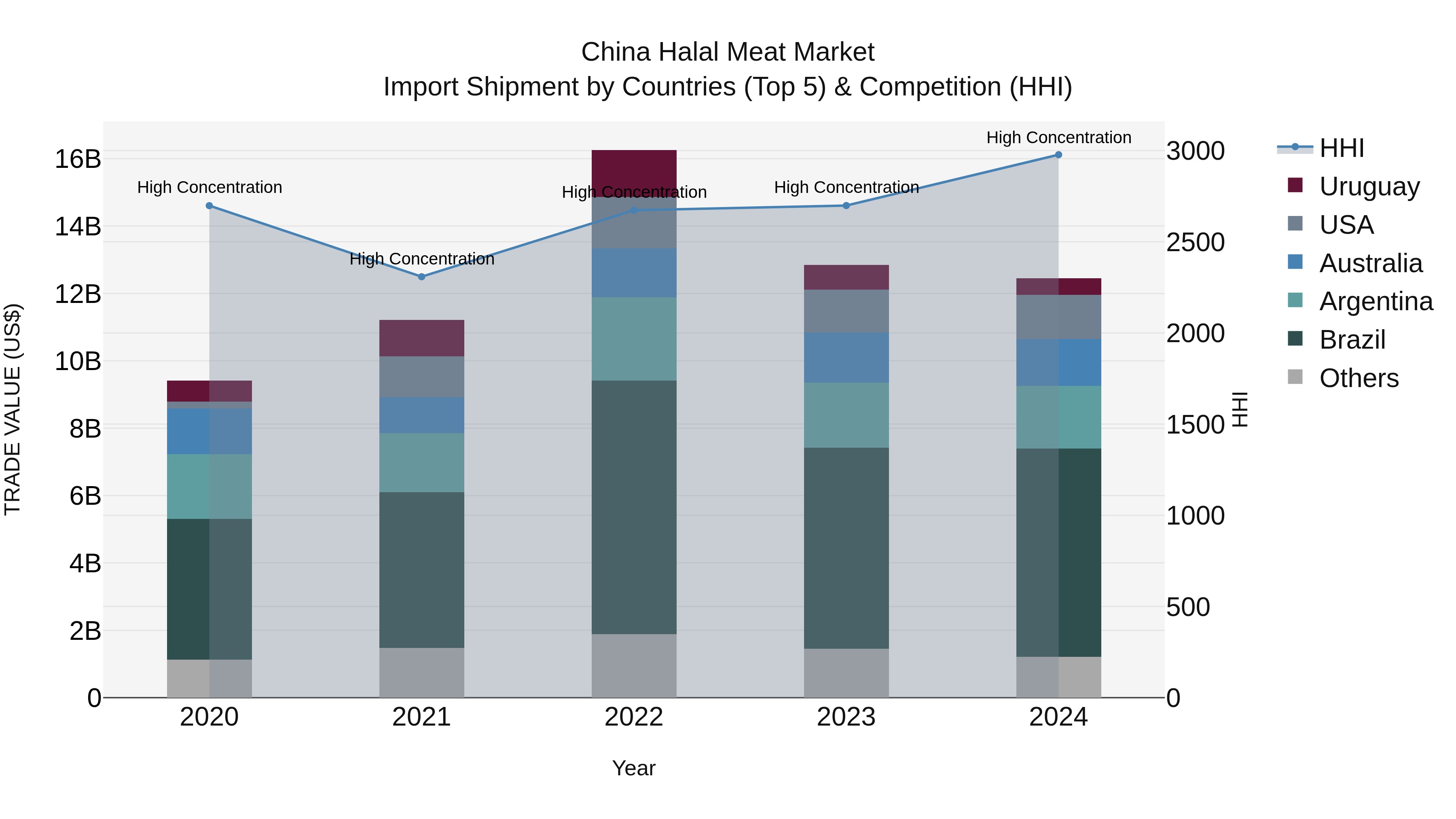
China halal meat import market in 2024 continued to be dominated by key players such as Brazil, Argentina, Australia, USA, and Uruguay. The Herfindahl-Hirschman Index (HHI) indicated a high concentration within the market. Despite a slight decline in growth rate from 2023 to 2024, the compound annual growth rate (CAGR) from 2020 to 2024 remained strong at 7.24%. This data suggests a stable and growing demand for halal meat imports in China, with established suppliers maintaining their foothold in the market.
China Halal Meat Market Overview
The Halal Meat Market in China is experiencing growth due to the rising demand for meat products that comply with Islamic dietary laws. Halal meat is produced according to specific slaughtering and processing practices, and the market expansion is driven by the increasing Muslim population, growing awareness of halal standards, and the rise in consumer preference for ethically produced and high-quality meat products. The market is supported by the development of halal meat supply chains, including processing facilities, distribution networks, and retail outlets, as well as the growing availability of halal meat in various forms and cuts.
Drivers of the market
The halal meat market in China is driven by the growing demand for halal-certified meat products among the country`s Muslim population and the increasing awareness of halal dietary practices among non-Muslim consumers. Halal meat is prepared and processed according to Islamic dietary laws, ensuring quality and safety standards. The expansion of the meat processing industry, coupled with rising disposable incomes and changing consumer preferences, supports market growth. Additionally, advancements in halal certification and the development of a wide range of halal meat products further drive market expansion.
Challenges of the market
The halal meat market in China faces challenges related to supply chain management and certification. Ensuring that meat products meet halal standards throughout the supply chain requires strict oversight and certification, which can be resource-intensive. Additionally, fluctuations in meat prices and competition from both local and international suppliers can impact profitability and market dynamics.
Government Policy of the market
The Halal Meat market in China is influenced by government policies that aim to enhance meat production and promote adherence to cultural dietary practices. The government`s focus on improving livestock management and supporting the development of high-quality halal meat products drives the demand in this market. Policies that encourage the adoption of halal meat in various applications, including supermarkets, butchers, and foodservice, also contribute to market growth. Additionally, initiatives aimed at fostering innovation in meat processing and supporting the growth of the halal food and agricultural sectors further support the expansion of the halal meat market.
Key Highlights of the Report:
- China Halal Meat Market Outlook
- Market Size of China Halal Meat Market, 2024
- Forecast of China Halal Meat Market, 2031
- Historical Data and Forecast of China Halal Meat Revenues & Volume for the Period 2018 - 2031
- China Halal Meat Market Trend Evolution
- China Halal Meat Market Drivers and Challenges
- China Halal Meat Price Trends
- China Halal Meat Porter's Five Forces
- China Halal Meat Industry Life Cycle
- Historical Data and Forecast of China Halal Meat Market Revenues & Volume By Product Type for the Period 2018 - 2031
- Historical Data and Forecast of China Halal Meat Market Revenues & Volume By Fresh Food for the Period 2018 - 2031
- Historical Data and Forecast of China Halal Meat Market Revenues & Volume By Processed Food for the Period 2018 - 2031
- China Halal Meat Import Export Trade Statistics
- Market Opportunity Assessment By Product Type
- China Halal Meat Top Companies Market Share
- China Halal Meat Competitive Benchmarking By Technical and Operational Parameters
- China Halal Meat Company Profiles
- China Halal Meat Key Strategic Recommendations






































