Global IT Outsourcing Market Highlights
| Market Size (2025) | USD 580 Billion |
| Forecast Size (2032) | USD 800 Billion |
| CAGR | 4.70% |
| Base Year | 2025 |
| Forecast Period | 2026-2032 |
| Largest Region | North America |
| Fastest Growing Region | Asia-Pacific |
| Largest Segment | Software as a Service (SaaS) |
| Fastest Growing Segment | Infrastructure as a Service (IaaS) |
| Leading Companies | IBM, Accenture, TCS, Infosys, Wipro |
Global IT Outsourcing Market Size & Growth Rate (2026-2032)
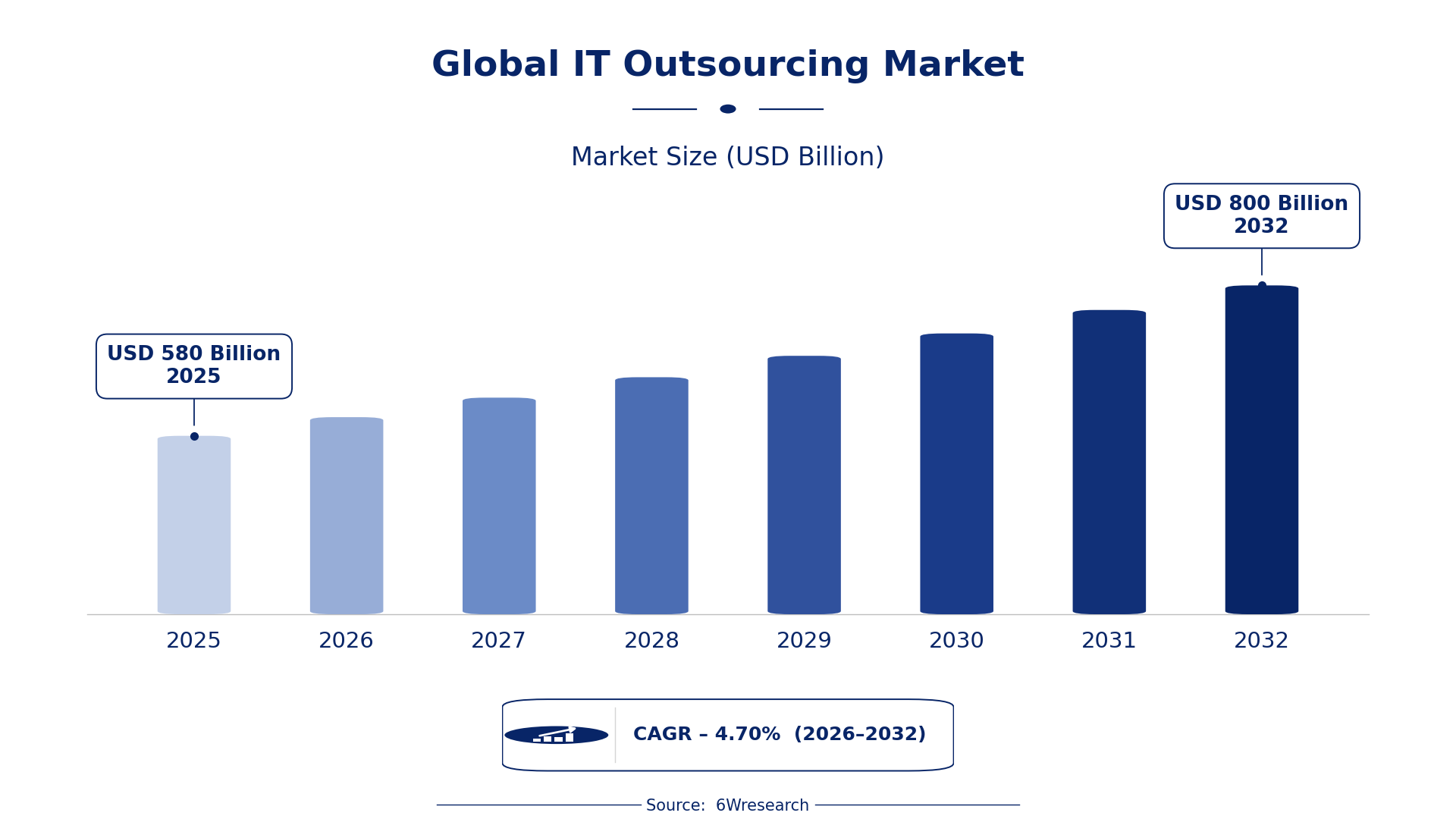
The Global IT Outsourcing Market was estimated at USD 580 Billion in 2025 and is projected to reach USD 800 Billion by 2032, growing at a CAGR of 4.70% from 2026 to 2032.
Global IT Outsourcing Market Synopsis
The Global IT Outsourcing Market is undergoing a profound transformation, characterized by an increasing reliance on external vendors for critical IT functions. This shift empowers organizations to optimize their operational efficiencies and focus on core business objectives. Businesses from various verticals, particularly BFSI and healthcare, are seeking specialized skills in emerging technologies, reinforcing the need for outsourcing partners.
Moreover, the market is seeing enhanced strategic collaborations, as companies leverage outsourcing to foster innovation. This trend indicates a move towards long-term partnerships rather than transactional relationships, signaling a maturing market where the integration of services plays a vital role in achieving competitive advantages.
Global IT Outsourcing Market Year-wise Growth Rate and Key Drivers
This graph illustrates the annual growth rates of the Global IT Outsourcing Market from 2022 to 2032, highlighting a steady upward trajectory and projected expansion over the forecast period.
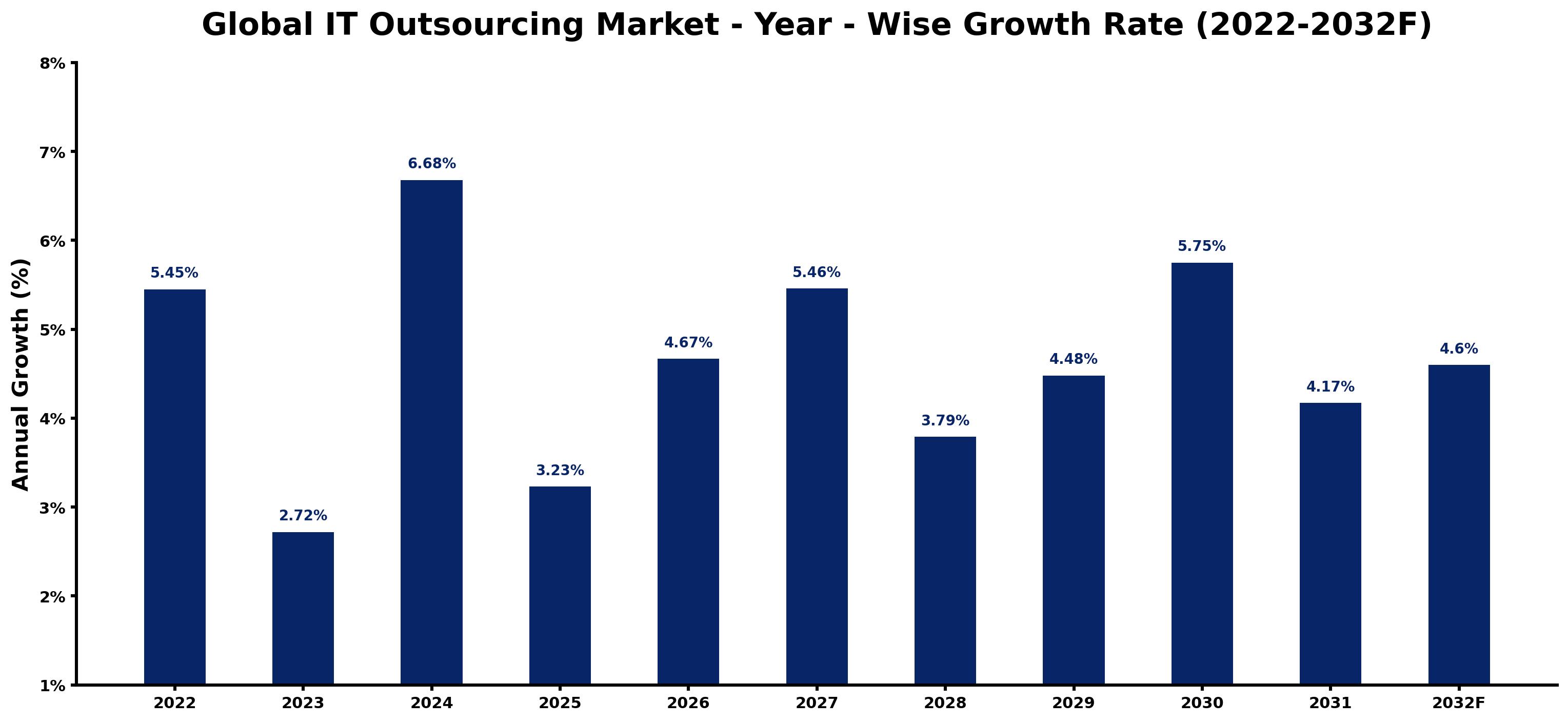
The table below presents the year‑wise growth rates along with the key drivers influencing the market
| Year | Growth Rate (%) | Major Drivers |
| 2022 | 5.45 | Sustainability initiatives are prompting companies to enhance their IT outsourcing strategies. |
| 2023 | 2.72 | Enterprises are increasingly seeking skilled professionals to optimize IT outsourcing operations. |
| 2024 | 6.68 | As supply chain challenges lessen, IT outsourcing becomes more integral for efficiency. |
| 2025 | 3.23 | Telecom companies expand their IT outsourcing capabilities to enhance regional network infrastructure. |
| 2026 | 4.67 | Cloud migration drives customers to rethink their IT outsourcing partnerships and strategies. |
| 2027 | 5.46 | As enterprises demand more agile services, IT outsourcing adapts to meet evolving needs. |
| 2028 | 3.79 | A shift toward higher raw material prices for IT services limits outsourcing affordability. |
| 2029 | 4.48 | Gaining competitive advantages, businesses are enhancing their IT outsourcing frameworks significantly. |
| 2030 | 5.75 | In response to changing market conditions, advanced cybersecurity frameworks are shaping IT outsourcing. |
| 2031 | 4.17 | Investors are pushing telecom firms to acquire innovative IT outsourcing solutions and services. |
| 2032 | 4.6 | 6G technologies demand updated IT outsourcing agreements to comply with new regulations. |
Note - Market size estimations and growth projections presented in this report are based on 6Wresearch's proprietary research methodology, combining internal industry data, secondary research, and primary validation, updated periodically to reflect current market conditions. As markets evolve rapidly, figures for certain industries may vary slightly and are intended as informed estimates rather than absolute figures. For the most current market sizing, we recommend validating figures with a 6Wresearch analyst.
Global IT Outsourcing Market Key Takeaways
Below are some of the specific key takeaways from the market, including:
- North America accounted for approximately ~45% share in 2025, establishing itself as the top region for IT outsourcing.
- Infrastructure as a Service (IaaS) is projected to grow at a remarkable CAGR of 7.8% from 2026 to 2032, highlighting its increasing relevance.
- IBM's investment of $5 billion in cloud services showcases a targeted strategy to enhance its outsourcing capabilities.
- Healthcare and BFSI sectors are anticipated to drive significant growth, given their ongoing digital transformation efforts.
- In 2021, Accenture announced its plans to hire an additional 150,000 employees to meet growing demand for outsourcing services.
Evaluation of Restraints in Global IT Outsourcing Market
Despite its promising outlook, the Global IT Outsourcing Market faces significant restraints. A notable concern is the increasing data security expenditure, projected to surpass $150 billion by 2025, which many organizations now encounter due to heightened cyber threats. These costs can reduce the overall profitability of outsourcing initiatives.
For example, regulatory barriers such as the General Data Protection Regulation (GDPR) impose stringent compliance requirements that complicate outsourcing contracts and challenge service providers to ensure data safety, impacting their operational frameworks.
Global IT Outsourcing Market Trends
Several key trends are reshaping the Global IT Outsourcing Market. Firstly, the surge in cloud adoption has propelled organizations to favor Software as a Service (SaaS) solutions, with the market increasingly trending towards subscription models. Companies like Microsoft have reported a 20% increase in revenue from its Azure cloud services in 2022, showcasing the substantial growth potential in this segment.
Secondly, automation is becoming a cornerstone of IT outsourcing, as organizations strive to mitigate operational costs while increasing efficiency. For example, UiPath’s robotic process automation (RPA) solutions have helped clients reduce costs by up to 50%, underscoring automation's importance in driving outsourcing services. Moreover, the integration of AI technologies is paving the way for advanced analytics-driven decision-making processes, enhancing overall service delivery.
Global IT Outsourcing Market Opportunities
The Global IT Outsourcing Market offers numerous future revenue opportunities. Among these, the increased demand for cybersecurity solutions stands out, with expected market growth to reach $345 billion by 2026, driven by companies seeking to enhance their security posture while outsourcing. For instance, CyberArk has reported steady growth in client adoption of its security solutions, proving that organizations are keen to invest in outsourced initiatives.
Additionally, the rise of the Internet of Things (IoT) presents a rich vein for outsourcing agreements, as organizations look for specialized skills to manage vast amounts of data generated by connected devices. The partnership of Siemens with various IT firms for developing smart factories heralds yet another potential revenue stream in this thriving sector.
Global IT Outsourcing Market by Service Model
In the Global IT Outsourcing Market, Software as a Service (SaaS) commands the largest share, accounting for approximately ~35% in 2025. This dominance stems from its inherent flexibility and scalability, which align perfectly with business needs. On the other hand, Infrastructure as a Service (IaaS) is anticipated to be the fastest-growing segment, projected to expand at a CAGR of 7.8% from 2026 to 2032, as companies continuously shift infrastructure responsibilities to specialized providers for enhanced operational efficiency.
Global IT Outsourcing Market by Organization Size
Large Enterprises lead the Global IT Outsourcing Market, holding a substantial share of around ~60% in 2025, facilitated by their capacity to invest in comprehensive outsourcing projects. Meanwhile, Small and Medium-sized Enterprises (SMEs) are emerging as the fastest-growing segment, with an expected CAGR of 6.5% from 2026 to 2032. This growth results from increasing digital transformation initiatives among SMEs, allowing them to leverage outsourcing for enhanced operational agility without the long-term investments typically associated with in-house solutions.
Global IT Outsourcing Market by End User
The BFSI sector dominates the Global IT Outsourcing Market, claiming a share of approximately ~30% in 2025 due to its significant investment in technology to enhance customer experience and compliance. Meanwhile, the Media and Telecommunications sector is projected to be the fastest-growing end user, with a CAGR of 7.2% from 2026 to 2032, as companies seek innovative outsourcing solutions to manage the increasing data demands and improve network efficiencies in a highly competitive environment.
Global IT Outsourcing Market by Region
North America remains the largest region in the Global IT Outsourcing Market, capturing approximately ~45% of the market share in 2025, largely due to its established technology ecosystem and presence of major outsourcing firms. In contrast, the Asia-Pacific region is anticipated to be the fastest growing, with a CAGR of 6.3% from 2026 to 2032, bolstered by rising digital transformation efforts in emerging economies and government support that fosters IT outsourcing initiatives.
Government Initiatives in the Global IT Outsourcing Market
The regulatory landscape for the Global IT Outsourcing Market is dynamic, characterized by government initiatives aimed at fostering growth and ensuring compliance. Various countries are implementing programs to attract foreign investments while enhancing local capabilities in technology services.
- Department of Commerce, Australia - Digital Economy Strategy, launched in 2021, aims to support tech startups and improve businesses’ access to IT outsourcing.
- European Commission - EU Digital Strategy, established in January 2020, focuses on creating a digital single market that enhances the competitiveness of European IT service firms.
- Ministry of Electronics and Information Technology, India - National Policy on Software Products, initiated in 2021, encourages local software development, supporting outsourcing firms in scaling operations.
- Government of Canada - Canada Digital Adoption Program, introduced in 2022, provides funding for small businesses to adopt digital technologies, thus boosting demand for IT outsourcing.
- National Development and Reform Commission, China - Made in China 2025 Policy, announced in 2015, focuses on increasing domestic capabilities in IT services, impacting foreign outsourcing dynamics.
Future Insights of the Global IT Outsourcing Market
The Global IT Outsourcing Market is set to evolve, with increasing investments in automation and AI technologies reshaping service delivery. For instance, companies are projected to channel substantial budgets into AI-driven analytics and process automation, given that UiPath and Automation Anywhere have reported increased client demand for efficiency solutions. By 2032, such technologies are anticipated to become integral in optimizing service models, fostering deeper operational collaboration and enhancing value creation within outsourcing contracts.
Global IT Outsourcing Market Latest Developments
Recent strategic moves by major players underline their commitment to enhancing capabilities in the Global IT Outsourcing Market. These developments are reshaping competitive dynamics and service offerings.
- In early 2023, IBM integrated advanced AI tools into its cloud services to enable smarter data management, enhancing service efficiency and positioning itself as a leader in intelligent outsourcing solutions.
- Accenture recently expanded its cybersecurity offerings, now collaborating with several leading tech firms to better safeguard client data, which fortifies its market position amidst rising security concerns.
- TCS announced plans in late 2023 to open new Innovation Centers in Asia-Pacific, aiming to localize services and tap into emerging market needs, significantly boosting its regional footprint.
- Infosys is set to roll out a new suite of automation tools by mid-2024, which promises to enhance operational efficiencies for clients, directly responding to the growing demand for cost-effective outsourcing solutions.
Global IT Outsourcing Market Key Players and Industry Positioning
The competitive structure of the Global IT Outsourcing Market is largely consolidated, dominated by a few key players who hold significant shares. While top companies leverage established reputations, smaller firms innovate rapidly, contributing to a dynamic environment where advanced technologies and specialized services are essential for competitiveness.
| Leading Company | Core Strength | Strategic Focus |
|---|---|---|
| IBM | Leading in cloud solutions with integrated AI capabilities. | Focus on intelligent automation and data analytics. |
| Accenture | Extensive expertise in consulting and technology integration. | Strengthening cybersecurity and digital transformation services. |
| TCS | Strong presence in IT services with a robust delivery model. | Investing in regional expansion and local partnerships. |
| Infosys | Expertise in automation and AI-driven solutions. | Enhancing operational efficiency through new technology rollouts. |
| Wipro | Diverse IT services offering and deep industry knowledge. | Adapting to digital trends with tailored outsourcing strategies. |
As industry dynamics shift, continuous investment in technology and strategic collaboration will be critical for companies aiming for long-term success in the Global IT Outsourcing Market.
Key Attractiveness of the Report
- 10 Years of Market Numbers
- Historical Data Starting from 2022 to 2025
- Base Year: 2025
- Forecast Data until 2032
- Key Performance Indicators Impacting the Market
- Major Upcoming Developments and Projects
Key Highlights of the Report:
- Global IT Outsourcing Market Outlook
- Market Size of Global IT Outsourcing Market, 2025
- Forecast of Global IT Outsourcing Market, 2032
- Historical Data and Forecast of Global IT Outsourcing Revenues & Volume for the Period 2022-2032
- Global IT Outsourcing Market Trend Evolution
- Global IT Outsourcing Market Drivers and Challenges
- Global IT Outsourcing Price Trends
- Global IT Outsourcing Porter's Five Forces
- Global IT Outsourcing Industry Life Cycle
- Historical Data and Forecast of Global IT Outsourcing Market Revenues & Volume
- Historical Data and Forecast of Global IT Outsourcing Market Revenues & Volume By Service Model for the Period 2022-2032
- Historical Data and Forecast of Global IT Outsourcing Market Revenues & Volume By Software as a Service (SaaS) for the Period 2022-2032
- Historical Data and Forecast of Global IT Outsourcing Market Revenues & Volume By Platform as a Service (PaaS) for the Period 2022-2032
- Historical Data and Forecast of Global IT Outsourcing Market Revenues & Volume By Infrastructure as a Service (IaaS) for the Period 2022-2032
- Historical Data and Forecast of Global IT Outsourcing Market Revenues & Volume By Organization Size for the Period 2022-2032
- Historical Data and Forecast of Global IT Outsourcing Market Revenues & Volume By Small and Medium-sized Enterprises for the Period 2022-2032
- Historical Data and Forecast of Global IT Outsourcing Market Revenues & Volume By Large Enterprises for the Period 2022-2032
- Historical Data and Forecast of Global IT Outsourcing Market Revenues & Volume By End User for the Period 2022-2032
- Historical Data and Forecast of Global IT Outsourcing Market Revenues & Volume By BFSI for the Period 2022-2032
- Historical Data and Forecast of Global IT Outsourcing Market Revenues & Volume By Healthcare for the Period 2022-2032
- Historical Data and Forecast of Global IT Outsourcing Market Revenues & Volume By Media and Telecommunications for the Period 2022-2032
- Historical Data and Forecast of Global IT Outsourcing Market Revenues & Volume By Retail and E-commerce for the Period 2022-2032
- Historical Data and Forecast of Global IT Outsourcing Market Revenues & Volume By Manufacturing for the Period 2022-2032
- Historical Data and Forecast of Global IT Outsourcing Market Revenues & Volume By Others for the Period 2022-2032
- Historical Data and Forecast of North America IT Outsourcing Market Revenues & Volume By Service Model for the Period 2022-2032
- Historical Data and Forecast of North America IT Outsourcing Market Revenues & Volume By Software as a Service (SaaS) for the Period 2022-2032
- Historical Data and Forecast of North America IT Outsourcing Market Revenues & Volume By Platform as a Service (PaaS) for the Period 2022-2032
- Historical Data and Forecast of North America IT Outsourcing Market Revenues & Volume By Infrastructure as a Service (IaaS) for the Period 2022-2032
- Historical Data and Forecast of North America IT Outsourcing Market Revenues & Volume By Organization Size for the Period 2022-2032
- Historical Data and Forecast of North America IT Outsourcing Market Revenues & Volume By Small and Medium-sized Enterprises for the Period 2022-2032
- Historical Data and Forecast of North America IT Outsourcing Market Revenues & Volume By Large Enterprises for the Period 2022-2032
- Historical Data and Forecast of North America IT Outsourcing Market Revenues & Volume By End User for the Period 2022-2032
- Historical Data and Forecast of North America IT Outsourcing Market Revenues & Volume By BFSI for the Period 2022-2032
- Historical Data and Forecast of North America IT Outsourcing Market Revenues & Volume By Healthcare for the Period 2022-2032
- Historical Data and Forecast of North America IT Outsourcing Market Revenues & Volume By Media and Telecommunications for the Period 2022-2032
- Historical Data and Forecast of North America IT Outsourcing Market Revenues & Volume By Retail and E-commerce for the Period 2022-2032
- Historical Data and Forecast of North America IT Outsourcing Market Revenues & Volume By Manufacturing for the Period 2022-2032
- Historical Data and Forecast of North America IT Outsourcing Market Revenues & Volume By Others for the Period 2022-2032
- Historical Data and Forecast of United States of America IT Outsourcing Market Revenues & Volume for the Period 2022-2032
- Historical Data and Forecast of Canada IT Outsourcing Market Revenues & Volume for the Period 2022-2032
- Historical Data and Forecast of Rest of North America IT Outsourcing Market Revenues & Volume for the Period 2022-2032
- Historical Data and Forecast of Latin America (LATAM) IT Outsourcing Market Revenues & Volume By Service Model for the Period 2022-2032
- Historical Data and Forecast of Latin America (LATAM) IT Outsourcing Market Revenues & Volume By Software as a Service (SaaS) for the Period 2022-2032
- Historical Data and Forecast of Latin America (LATAM) IT Outsourcing Market Revenues & Volume By Platform as a Service (PaaS) for the Period 2022-2032
- Historical Data and Forecast of Latin America (LATAM) IT Outsourcing Market Revenues & Volume By Infrastructure as a Service (IaaS) for the Period 2022-2032
- Historical Data and Forecast of Latin America (LATAM) IT Outsourcing Market Revenues & Volume By Organization Size for the Period 2022-2032
- Historical Data and Forecast of Latin America (LATAM) IT Outsourcing Market Revenues & Volume By Small and Medium-sized Enterprises for the Period 2022-2032
- Historical Data and Forecast of Latin America (LATAM) IT Outsourcing Market Revenues & Volume By Large Enterprises for the Period 2022-2032
- Historical Data and Forecast of Latin America (LATAM) IT Outsourcing Market Revenues & Volume By End User for the Period 2022-2032
- Historical Data and Forecast of Latin America (LATAM) IT Outsourcing Market Revenues & Volume By BFSI for the Period 2022-2032
- Historical Data and Forecast of Latin America (LATAM) IT Outsourcing Market Revenues & Volume By Healthcare for the Period 2022-2032
- Historical Data and Forecast of Latin America (LATAM) IT Outsourcing Market Revenues & Volume By Media and Telecommunications for the Period 2022-2032
- Historical Data and Forecast of Latin America (LATAM) IT Outsourcing Market Revenues & Volume By Retail and E-commerce for the Period 2022-2032
- Historical Data and Forecast of Latin America (LATAM) IT Outsourcing Market Revenues & Volume By Manufacturing for the Period 2022-2032
- Historical Data and Forecast of Latin America (LATAM) IT Outsourcing Market Revenues & Volume By Others for the Period 2022-2032
- Historical Data and Forecast of Brazil IT Outsourcing Market Revenues & Volume for the Period 2022-2032
- Historical Data and Forecast of Mexico IT Outsourcing Market Revenues & Volume for the Period 2022-2032
- Historical Data and Forecast of Argentina IT Outsourcing Market Revenues & Volume for the Period 2022-2032
- Historical Data and Forecast of Rest of LATAM IT Outsourcing Market Revenues & Volume for the Period 2022-2032
- Historical Data and Forecast of Asia IT Outsourcing Market Revenues & Volume By Service Model for the Period 2022-2032
- Historical Data and Forecast of Asia IT Outsourcing Market Revenues & Volume By Software as a Service (SaaS) for the Period 2022-2032
- Historical Data and Forecast of Asia IT Outsourcing Market Revenues & Volume By Platform as a Service (PaaS) for the Period 2022-2032
- Historical Data and Forecast of Asia IT Outsourcing Market Revenues & Volume By Infrastructure as a Service (IaaS) for the Period 2022-2032
- Historical Data and Forecast of Asia IT Outsourcing Market Revenues & Volume By Organization Size for the Period 2022-2032
- Historical Data and Forecast of Asia IT Outsourcing Market Revenues & Volume By Small and Medium-sized Enterprises for the Period 2022-2032
- Historical Data and Forecast of Asia IT Outsourcing Market Revenues & Volume By Large Enterprises for the Period 2022-2032
- Historical Data and Forecast of Asia IT Outsourcing Market Revenues & Volume By End User for the Period 2022-2032
- Historical Data and Forecast of Asia IT Outsourcing Market Revenues & Volume By BFSI for the Period 2022-2032
- Historical Data and Forecast of Asia IT Outsourcing Market Revenues & Volume By Healthcare for the Period 2022-2032
- Historical Data and Forecast of Asia IT Outsourcing Market Revenues & Volume By Media and Telecommunications for the Period 2022-2032
- Historical Data and Forecast of Asia IT Outsourcing Market Revenues & Volume By Retail and E-commerce for the Period 2022-2032
- Historical Data and Forecast of Asia IT Outsourcing Market Revenues & Volume By Manufacturing for the Period 2022-2032
- Historical Data and Forecast of Asia IT Outsourcing Market Revenues & Volume By Others for the Period 2022-2032
- Historical Data and Forecast of China IT Outsourcing Market Revenues & Volume for the Period 2022-2032
- Historical Data and Forecast of India IT Outsourcing Market Revenues & Volume for the Period 2022-2032
- Historical Data and Forecast of Japan IT Outsourcing Market Revenues & Volume for the Period 2022-2032
- Historical Data and Forecast of Rest of Asia IT Outsourcing Market Revenues & Volume for the Period 2022-2032
- Historical Data and Forecast of Africa IT Outsourcing Market Revenues & Volume By Service Model for the Period 2022-2032
- Historical Data and Forecast of Africa IT Outsourcing Market Revenues & Volume By Software as a Service (SaaS) for the Period 2022-2032
- Historical Data and Forecast of Africa IT Outsourcing Market Revenues & Volume By Platform as a Service (PaaS) for the Period 2022-2032
- Historical Data and Forecast of Africa IT Outsourcing Market Revenues & Volume By Infrastructure as a Service (IaaS) for the Period 2022-2032
- Historical Data and Forecast of Africa IT Outsourcing Market Revenues & Volume By Organization Size for the Period 2022-2032
- Historical Data and Forecast of Africa IT Outsourcing Market Revenues & Volume By Small and Medium-sized Enterprises for the Period 2022-2032
- Historical Data and Forecast of Africa IT Outsourcing Market Revenues & Volume By Large Enterprises for the Period 2022-2032
- Historical Data and Forecast of Africa IT Outsourcing Market Revenues & Volume By End User for the Period 2022-2032
- Historical Data and Forecast of Africa IT Outsourcing Market Revenues & Volume By BFSI for the Period 2022-2032
- Historical Data and Forecast of Africa IT Outsourcing Market Revenues & Volume By Healthcare for the Period 2022-2032
- Historical Data and Forecast of Africa IT Outsourcing Market Revenues & Volume By Media and Telecommunications for the Period 2022-2032
- Historical Data and Forecast of Africa IT Outsourcing Market Revenues & Volume By Retail and E-commerce for the Period 2022-2032
- Historical Data and Forecast of Africa IT Outsourcing Market Revenues & Volume By Manufacturing for the Period 2022-2032
- Historical Data and Forecast of Africa IT Outsourcing Market Revenues & Volume By Others for the Period 2022-2032
- Historical Data and Forecast of South Africa IT Outsourcing Market Revenues & Volume for the Period 2022-2032
- Historical Data and Forecast of Nigeria IT Outsourcing Market Revenues & Volume for the Period 2022-2032
- Historical Data and Forecast of Egypt IT Outsourcing Market Revenues & Volume for the Period 2022-2032
- Historical Data and Forecast of Rest of Africa IT Outsourcing Market Revenues & Volume for the Period 2022-2032
- Historical Data and Forecast of Europe IT Outsourcing Market Revenues & Volume By Service Model for the Period 2022-2032
- Historical Data and Forecast of Europe IT Outsourcing Market Revenues & Volume By Software as a Service (SaaS) for the Period 2022-2032
- Historical Data and Forecast of Europe IT Outsourcing Market Revenues & Volume By Platform as a Service (PaaS) for the Period 2022-2032
- Historical Data and Forecast of Europe IT Outsourcing Market Revenues & Volume By Infrastructure as a Service (IaaS) for the Period 2022-2032
- Historical Data and Forecast of Europe IT Outsourcing Market Revenues & Volume By Organization Size for the Period 2022-2032
- Historical Data and Forecast of Europe IT Outsourcing Market Revenues & Volume By Small and Medium-sized Enterprises for the Period 2022-2032
- Historical Data and Forecast of Europe IT Outsourcing Market Revenues & Volume By Large Enterprises for the Period 2022-2032
- Historical Data and Forecast of Europe IT Outsourcing Market Revenues & Volume By End User for the Period 2022-2032
- Historical Data and Forecast of Europe IT Outsourcing Market Revenues & Volume By BFSI for the Period 2022-2032
- Historical Data and Forecast of Europe IT Outsourcing Market Revenues & Volume By Healthcare for the Period 2022-2032
- Historical Data and Forecast of Europe IT Outsourcing Market Revenues & Volume By Media and Telecommunications for the Period 2022-2032
- Historical Data and Forecast of Europe IT Outsourcing Market Revenues & Volume By Retail and E-commerce for the Period 2022-2032
- Historical Data and Forecast of Europe IT Outsourcing Market Revenues & Volume By Manufacturing for the Period 2022-2032
- Historical Data and Forecast of Europe IT Outsourcing Market Revenues & Volume By Others for the Period 2022-2032
- Historical Data and Forecast of United Kingdom IT Outsourcing Market Revenues & Volume for the Period 2022-2032
- Historical Data and Forecast of France IT Outsourcing Market Revenues & Volume for the Period 2022-2032
- Historical Data and Forecast of Germany IT Outsourcing Market Revenues & Volume for the Period 2022-2032
- Historical Data and Forecast of Rest of Europe IT Outsourcing Market Revenues & Volume for the Period 2022-2032
- Historical Data and Forecast of Middle East IT Outsourcing Market Revenues & Volume By Service Model for the Period 2022-2032
- Historical Data and Forecast of Middle East IT Outsourcing Market Revenues & Volume By Software as a Service (SaaS) for the Period 2022-2032
- Historical Data and Forecast of Middle East IT Outsourcing Market Revenues & Volume By Platform as a Service (PaaS) for the Period 2022-2032
- Historical Data and Forecast of Middle East IT Outsourcing Market Revenues & Volume By Infrastructure as a Service (IaaS) for the Period 2022-2032
- Historical Data and Forecast of Middle East IT Outsourcing Market Revenues & Volume By Organization Size for the Period 2022-2032
- Historical Data and Forecast of Middle East IT Outsourcing Market Revenues & Volume By Small and Medium-sized Enterprises for the Period 2022-2032
- Historical Data and Forecast of Middle East IT Outsourcing Market Revenues & Volume By Large Enterprises for the Period 2022-2032
- Historical Data and Forecast of Middle East IT Outsourcing Market Revenues & Volume By End User for the Period 2022-2032
- Historical Data and Forecast of Middle East IT Outsourcing Market Revenues & Volume By BFSI for the Period 2022-2032
- Historical Data and Forecast of Middle East IT Outsourcing Market Revenues & Volume By Healthcare for the Period 2022-2032
- Historical Data and Forecast of Middle East IT Outsourcing Market Revenues & Volume By Media and Telecommunications for the Period 2022-2032
- Historical Data and Forecast of Middle East IT Outsourcing Market Revenues & Volume By Retail and E-commerce for the Period 2022-2032
- Historical Data and Forecast of Middle East IT Outsourcing Market Revenues & Volume By Manufacturing for the Period 2022-2032
- Historical Data and Forecast of Middle East IT Outsourcing Market Revenues & Volume By Others for the Period 2022-2032
- Historical Data and Forecast of Saudi Arabia IT Outsourcing Market Revenues & Volume for the Period 2022-2032
- Historical Data and Forecast of UAE IT Outsourcing Market Revenues & Volume for the Period 2022-2032
- Historical Data and Forecast of Turkey IT Outsourcing Market Revenues & Volume for the Period 2022-2032
- Historical Data and Forecast of Rest of Middle East IT Outsourcing Market Revenues & Volume for the Period 2022-2032
- Global IT Outsourcing Market - Key Performance Indicators
- Global IT Outsourcing Market - Import Export Trade Statistics
- Global IT Outsourcing Market - Opportunity Assessment By Countries
- Global IT Outsourcing Market - Opportunity Assessment By Service Model
- Global IT Outsourcing Market - Opportunity Assessment By Organization Size
- Global IT Outsourcing Market - Opportunity Assessment By End User
- Global IT Outsourcing Market - Top Companies Market Share
- Global IT Outsourcing Market - Top Companies Profiles
- Global IT Outsourcing Market - Comparison of Players in Technical and Operating Parameters
- Global IT Outsourcing Market - Strategic Recommendations
Markets Covered
The Global IT Outsourcing Market report provides a detailed analysis of the following market segments:
By Regions and Countries:
- North America
- Europe
- LATAM
- Middle East
- Asia
- Africa
By Service Model:
- Software as a Service (SaaS)
- Platform as a Service (PaaS)
- Infrastructure as a Service (IaaS)
By Organization Size:
- Small
- Medium-sized Enterprises
- Large Enterprises
By End User:
- BFSI
- Healthcare
- Media
- Telecommunications
- Retail
- E-commerce
- Manufacturing
- Others






































