Global Luxury Apparel Market Highlights
| Market Size (2025) | USD 335.7 Billion |
| Forecast Size (2032) | USD 468.4 Billion |
| CAGR | 6.50% |
| Base Year | 2025 |
| Forecast Period | 2026-2032 |
| Largest Region | North America |
| Fastest Growing Region | Asia |
| Largest Segment | Women |
| Fastest Growing Segment | Athleisure |
| Leading Companies | Gucci, Louis Vuitton, Chanel, Prada, Burberry |
Global Luxury Apparel Market Size & Growth Rate (2026-2032)
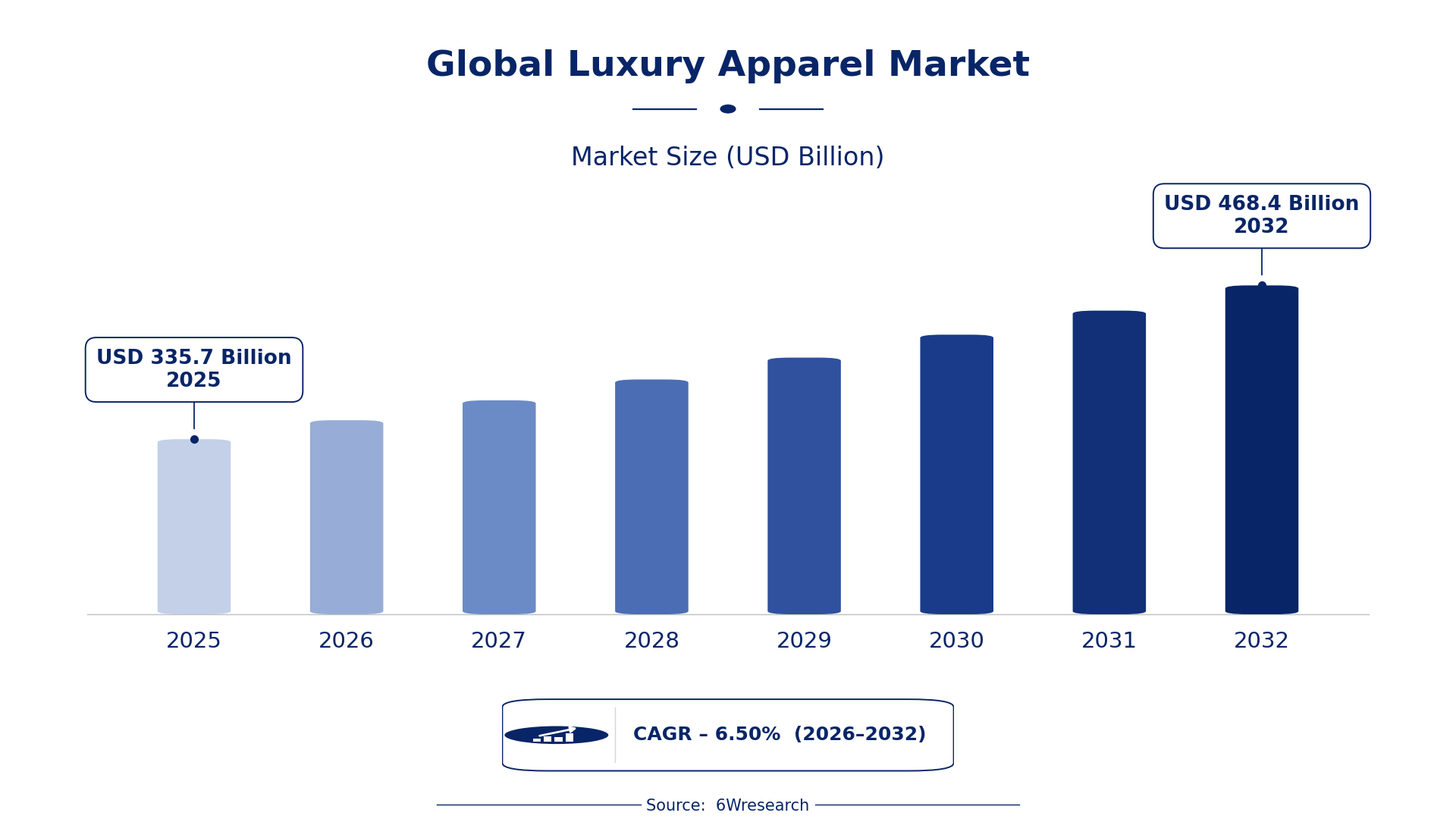
The Global Luxury Apparel Market was estimated at USD 335.7 Billion in 2025 and is projected to reach USD 468.4 Billion by 2032, growing at a CAGR of 6.50% from 2026 to 2032.
Global Luxury Apparel Market Synopsis
The Global Luxury Apparel Market is undergoing a significant transformation as consumer preferences shift towards sustainable luxury and personalized experiences. This market, characterized by exclusive high-end brands, is capitalizing on the rising interconnectedness of digital platforms and consumer engagement, enhancing direct-to-consumer strategies that cater to discerning clients.
Moreover, luxury brands are increasingly investing in supply chain transparency and ethical manufacturing practices to cater to the environmentally conscious consumer. The convergence of fashion with technology is not only influencing design but also redefining marketing strategies, thus positioning the Global Luxury Apparel Market for robust future growth amid evolving consumer expectations.
Global Luxury Apparel Market Year-wise Growth Rate and Key Drivers
This graph illustrates the annual growth rates of the Global Luxury Apparel Market from 2022 to 2032, highlighting a steady upward trajectory and projected expansion over the forecast period.
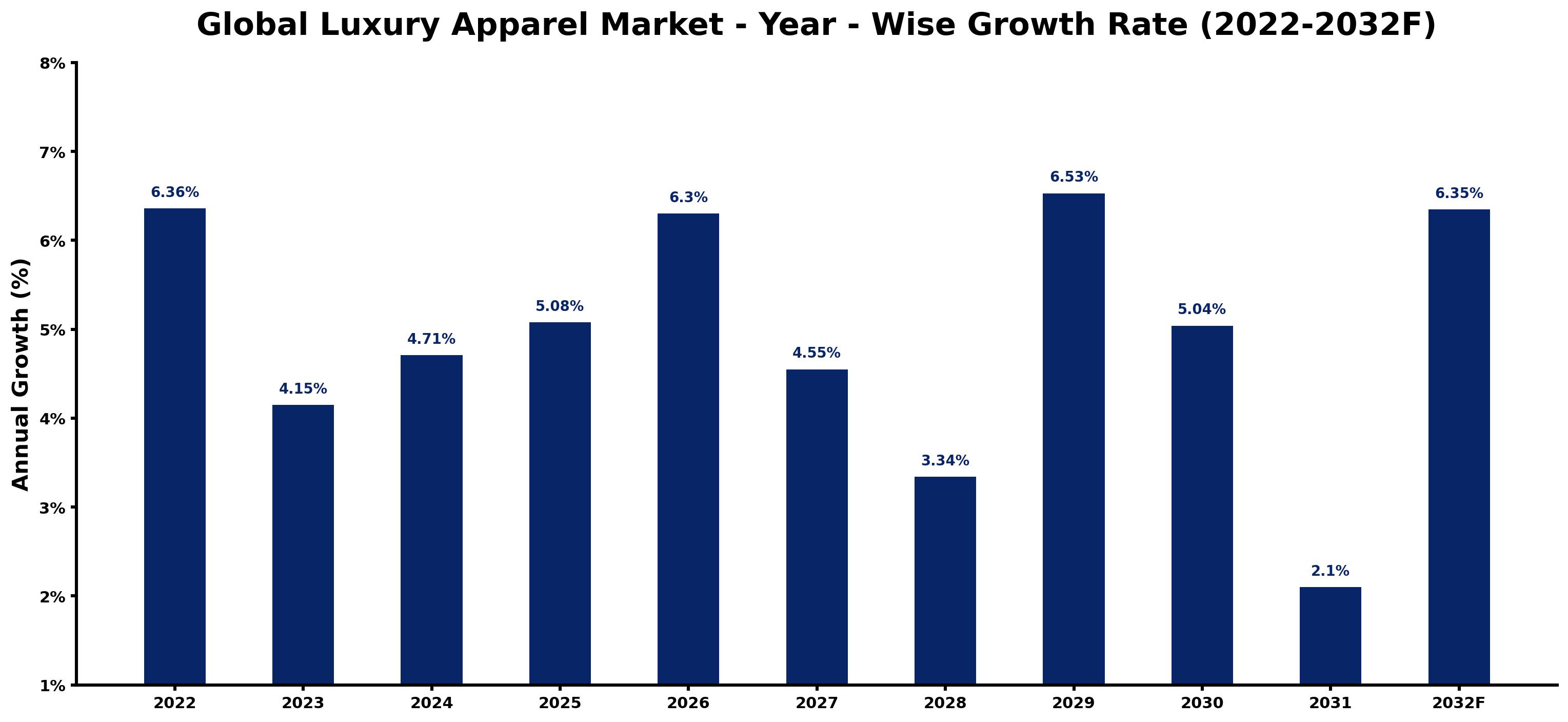
The table below presents the year‑wise growth rates along with the key drivers influencing the market
| Year | Growth Rate (%) | Major Drivers |
| 2022 | 6.36 | E-commerce platforms rapidly enhance sales channels for luxury apparel brands. |
| 2023 | 4.15 | A shift toward skilled craftsmanship elevates luxury apparel manufacturing standards. |
| 2024 | 4.71 | Disruptions in supply chains lead to increased pricing for luxury apparel materials. |
| 2025 | 5.08 | While private-label competition intensifies, brand loyalty programs retain key luxury buyers. |
| 2026 | 6.3 | Sustainable practices increasingly attract eco-conscious consumers in luxury apparel. |
| 2027 | 4.55 | In Europe, new regulations enforce sustainability standards within luxury apparel production. |
| 2028 | 3.34 | Changing consumer preferences emphasize unique luxury apparel experiences over mass production. |
| 2029 | 6.53 | Premium luxury collaborations elevate brand prestige and market share in apparel. |
| 2030 | 5.04 | Rising raw material costs challenge luxury apparel brands to innovate pricing strategies. |
| 2031 | 2.1 | Integrating more personalized shopping experiences enhances luxury apparel brand loyalty. |
| 2032 | 6.35 | Manufacturers expand their reach into emerging markets, boosting luxury apparel sales. |
Note - Market size estimations and growth projections presented in this report are based on 6Wresearch's proprietary research methodology, combining internal industry data, secondary research, and primary validation, updated periodically to reflect current market conditions. As markets evolve rapidly, figures for certain industries may vary slightly and are intended as informed estimates rather than absolute figures. For the most current market sizing, we recommend validating figures with a 6Wresearch analyst.
Global Luxury Apparel Market Key Takeaways
Below are some of the specific key takeaways from the market, including:
- As of 2025, the Women's segment commands approximately 52% share of the Global Luxury Apparel Market.
- Athleisure is projected to grow at a remarkable CAGR of 7.5% from 2026 to 2032, showcasing a significant shift in luxury consumer preferences.
- Gucci reported a year-on-year increase of 15% in online sales in 2023, reflecting the shift toward digital retail in the luxury sector.
- In 2023, the Asia-Pacific region accounted for a notable 30% of the total luxury apparel sales, highlighting its growing importance in the market.
Evaluation of Restraints in Global Luxury Apparel Market
The Global Luxury Apparel Market continues to face challenges that hinder its expansion. A significant barrier is the soaring production costs, which have increased by an average of 20% over the last two years due to heightened raw material prices and transportation expenses. For example, luxury textiles like cashmere have surged in price, creating a direct impact on retail margins. Additionally, the growing competition from fast fashion brands puts pressure on luxury labels to maintain exclusivity while appealing to cost-sensitive consumers. Navigating these complexities requires strategic planning and an adaptive business model.
Global Luxury Apparel Market Trends
Several trends are reshaping the Global Luxury Apparel Market today. A shift towards sustainability has resulted in many luxury brands, such as Stella McCartney, focusing on circular fashion initiatives. For instance, it was reported in 2022 that Stella McCartney implemented a program aiming to reduce waste by 50% over five years. On the technology front, brands are integrating augmented reality features in online shopping to enhance consumer experiences, significantly growing their online platforms.
E-commerce has surged as a vital channel for luxury apparel, with various brands reporting that up to 40% of their sales now occur online. This trend underscores a fundamental change in consumer shopping behavior, where convenience and accessibility are prioritized. In parallel, collaborations with influencers drive marketing reach, making social media partnerships crucial for brand visibility and engagement, especially among younger consumers.
Global Luxury Apparel Market Opportunities
The Global Luxury Apparel Market presents several lucrative opportunities moving forward. One notable avenue is the integration of advanced materials like bio-fabric leather alternatives, which could reshape product offerings. Companies like Bolt Threads are pioneering such initiatives, making strides towards sustainable fashion by producing alternatives within the $20 per square foot range. Furthermore, advancements in personalization technologies allow brands to cater to specific tastes, thereby enhancing customer loyalty and driving sales.
The rise of the omnichannel model also represents a revenue opportunity, merging the best of online and offline experiences. Retailers that effectively implement this strategy stand to benefit significantly; reports suggest that companies adopting such models saw a revenue increase of 30% year-on-year in 2023. This trend highlights a growing demand for flexibility and an integrated shopping experience among affluent consumers.
Global Luxury Apparel Market by End-User
Within the Global Luxury Apparel Market, the Women segment leads with an estimated 52% share as of 2025. This dominance is driven by a high demand for premium garments that blend fashion with functionality. In contrast, the Athleisure segment is anticipated to exhibit accelerated growth, showing a CAGR of 7.5% from 2026 to 2032. This is attributed to the evolving lifestyle preferences among consumers, who increasingly seek versatility in their wardrobes that transitions seamlessly from casual settings to luxurious environments, thereby entrenching athleisure's position in the luxury segment.
Global Luxury Apparel Market by Distribution Channel
In the realm of distribution channels for the Global Luxury Apparel Market, Offline Retail continues to command the largest share, approximating 63% in 2025. The traditional retail footprint remains vital for luxury brands, providing an exclusive and immersive shopping experience. However, Online Retail is set to become the fastest-growing channel, projected to achieve a CAGR of 9.2% from 2026 to 2032. The surge in e-commerce is stimulated by the changing shopping behaviors propelled by the pandemic and the need for convenience among affluent consumers, driving many luxury brands to enhance their digital presence alongside their brick-and-mortar operations.
Global Luxury Apparel Market by Region
North America is currently the largest region in the Global Luxury Apparel Market, holding an estimated 42% share as of 2025. The region benefits from a strong retail infrastructure and substantial consumer spending. Meanwhile, Asia is identified as the fastest-growing region, expected to register a CAGR of 8.1% from 2026 to 2032. This growth is attributed to a rise in disposable income, a burgeoning middle class, and an increasing appetite for luxury goods, especially in markets like China and India where brand expansion is aggressive.
Government Initiatives in the Global Luxury Apparel Market
The regulatory and policy landscape surrounding the Global Luxury Apparel Market plays a critical role in shaping market dynamics. Various government initiatives aim to enhance competitiveness and sustainability while addressing environmental concerns. Notably, these initiatives often aim to support local manufacturing and promote ethical sourcing practices in the luxury sector.
- U.S. Department of Commerce, "Manufacturing Revitalization Initiative," launched in 2023, aims to grant $50 million to local manufacturers emphasizing sustainable practices.
- European Commission, "Green Deal," introduced in 2020, mandates textile and apparel producers to reduce carbon emissions by 30% by 2025, fostering environmentally friendly practices.
- Ministry of Commerce, India, launched "Make in India" program in 2014, ongoing efforts to position India as a manufacturing hub for luxury goods, providing significant incentives for foreign investments.
- Fashion Industry Charter for Climate Action, established by the United Nations in 2019, aims to ensure that participating brands commit to sustainable practices within a framework of accountability and transparency.
Future Insights of the Global Luxury Apparel Market
As the Global Luxury Apparel Market evolves, brands will witness a pronounced shift towards sustainability and innovation. Incorporating technologies such as artificial intelligence for inventory management and consumer personalization will become critical, as seen in initiatives by major players like Burberry, which is exploring AI to enhance customer interactions. Moreover, collaboration with sustainable material providers will reshape product designs, targeting eco-conscious consumers who demand more transparency in sourcing. Retailers are likely to increase their focus on omnichannel strategies that seamlessly integrate online and offline experiences, reflecting the diverse shopping preferences of affluent consumers.
Global Luxury Apparel Market Latest Developments
Major players in the Global Luxury Apparel Market are actively pursuing strategic initiatives to capitalize on emerging trends and consumer preferences. The following developments are noteworthy:
- Gucci recently announced an upcoming collaboration with an AI fashion tech startup aimed at enhancing custom apparel experiences, slated for 2024. This initiative demonstrates a push towards personalization, aligning with customer desires.
- Louis Vuitton is in the process of expanding its production facility in Italy, expected to be completed by late 2025, aimed at boosting manufacturing capacity for their artisan-crafted products.
- Chanel is implementing a new supply chain program focused on sustainability, which is ongoing through 2026 with the goal of reducing carbon emissions by 30% across its product lines.
- Prada has launched an initiative to explore biodegradable fabrics, with initial trials wrapping up in mid-2025, reflecting the brand’s commitment to innovation in sustainable materials.
Global Luxury Apparel Market Key Players and Industry Positioning
The competitive structure of the Global Luxury Apparel Market remains fragmented yet marked by a few dominant players that leverage their heritage and innovation to maintain market share. Collaboration with suppliers and advanced technology adoption are key strategies that these brands employ to differentiate themselves and capture consumer interest.
| Leading Company | Core Strength | Strategic Focus |
|---|---|---|
| Gucci | Brand heritage and unique, avant-garde designs | Fostering personalization through technology integration |
| Louis Vuitton | Luxury leather goods and craftsmanship | Expansion in global markets and artisan manufacturing |
| Chanel | Timeless elegance and high-quality skincare & fashion | Sustainability initiatives and digital transformation |
| Prada | Innovative design and avant-garde approach | Investment in sustainable materials and circular fashion |
| Burberry | Strong brand loyalty and commitment to craftsmanship | Heavy investment in digital marketing strategies |
In summary, competitive dynamics in the Global Luxury Apparel Market are characterized by innovation and responsiveness to changing consumer behaviors, setting the stage for significant shifts in market leadership and growth strategies.
Key Attractiveness of the Report
- 10 Years of Market Numbers
- Historical Data Starting from 2022 to 2025
- Base Year: 2025
- Forecast Data until 2032
- Key Performance Indicators Impacting the Market
- Major Upcoming Developments and Projects
Key Highlights of the Report:
- Global Luxury Apparel Market Outlook
- Market Size of Global Luxury Apparel Market, 2025
- Forecast of Global Luxury Apparel Market, 2032
- Historical Data and Forecast of Global Luxury Apparel Revenues & Volume for the Period 2022-2032
- Global Luxury Apparel Market Trend Evolution
- Global Luxury Apparel Market Drivers and Challenges
- Global Luxury Apparel Price Trends
- Global Luxury Apparel Porter's Five Forces
- Global Luxury Apparel Industry Life Cycle
- Historical Data and Forecast of Global Luxury Apparel Market Revenues & Volume
- Historical Data and Forecast of Global Luxury Apparel Market Revenues & Volume By End-User for the Period 2022-2032
- Historical Data and Forecast of Global Luxury Apparel Market Revenues & Volume By Men for the Period 2022-2032
- Historical Data and Forecast of Global Luxury Apparel Market Revenues & Volume By Women for the Period 2022-2032
- Historical Data and Forecast of Global Luxury Apparel Market Revenues & Volume By Distribution Channel for the Period 2022-2032
- Historical Data and Forecast of Global Luxury Apparel Market Revenues & Volume By Offline Retail for the Period 2022-2032
- Historical Data and Forecast of Global Luxury Apparel Market Revenues & Volume By Online Retail for the Period 2022-2032
- Historical Data and Forecast of North America Luxury Apparel Market Revenues & Volume By End-User for the Period 2022-2032
- Historical Data and Forecast of North America Luxury Apparel Market Revenues & Volume By Men for the Period 2022-2032
- Historical Data and Forecast of North America Luxury Apparel Market Revenues & Volume By Women for the Period 2022-2032
- Historical Data and Forecast of North America Luxury Apparel Market Revenues & Volume By Distribution Channel for the Period 2022-2032
- Historical Data and Forecast of North America Luxury Apparel Market Revenues & Volume By Offline Retail for the Period 2022-2032
- Historical Data and Forecast of North America Luxury Apparel Market Revenues & Volume By Online Retail for the Period 2022-2032
- Historical Data and Forecast of United States of America Luxury Apparel Market Revenues & Volume for the Period 2022-2032
- Historical Data and Forecast of Canada Luxury Apparel Market Revenues & Volume for the Period 2022-2032
- Historical Data and Forecast of Rest of North America Luxury Apparel Market Revenues & Volume for the Period 2022-2032
- Historical Data and Forecast of Latin America (LATAM) Luxury Apparel Market Revenues & Volume By End-User for the Period 2022-2032
- Historical Data and Forecast of Latin America (LATAM) Luxury Apparel Market Revenues & Volume By Men for the Period 2022-2032
- Historical Data and Forecast of Latin America (LATAM) Luxury Apparel Market Revenues & Volume By Women for the Period 2022-2032
- Historical Data and Forecast of Latin America (LATAM) Luxury Apparel Market Revenues & Volume By Distribution Channel for the Period 2022-2032
- Historical Data and Forecast of Latin America (LATAM) Luxury Apparel Market Revenues & Volume By Offline Retail for the Period 2022-2032
- Historical Data and Forecast of Latin America (LATAM) Luxury Apparel Market Revenues & Volume By Online Retail for the Period 2022-2032
- Historical Data and Forecast of Brazil Luxury Apparel Market Revenues & Volume for the Period 2022-2032
- Historical Data and Forecast of Mexico Luxury Apparel Market Revenues & Volume for the Period 2022-2032
- Historical Data and Forecast of Argentina Luxury Apparel Market Revenues & Volume for the Period 2022-2032
- Historical Data and Forecast of Rest of LATAM Luxury Apparel Market Revenues & Volume for the Period 2022-2032
- Historical Data and Forecast of Asia Luxury Apparel Market Revenues & Volume By End-User for the Period 2022-2032
- Historical Data and Forecast of Asia Luxury Apparel Market Revenues & Volume By Men for the Period 2022-2032
- Historical Data and Forecast of Asia Luxury Apparel Market Revenues & Volume By Women for the Period 2022-2032
- Historical Data and Forecast of Asia Luxury Apparel Market Revenues & Volume By Distribution Channel for the Period 2022-2032
- Historical Data and Forecast of Asia Luxury Apparel Market Revenues & Volume By Offline Retail for the Period 2022-2032
- Historical Data and Forecast of Asia Luxury Apparel Market Revenues & Volume By Online Retail for the Period 2022-2032
- Historical Data and Forecast of China Luxury Apparel Market Revenues & Volume for the Period 2022-2032
- Historical Data and Forecast of India Luxury Apparel Market Revenues & Volume for the Period 2022-2032
- Historical Data and Forecast of Japan Luxury Apparel Market Revenues & Volume for the Period 2022-2032
- Historical Data and Forecast of Rest of Asia Luxury Apparel Market Revenues & Volume for the Period 2022-2032
- Historical Data and Forecast of Africa Luxury Apparel Market Revenues & Volume By End-User for the Period 2022-2032
- Historical Data and Forecast of Africa Luxury Apparel Market Revenues & Volume By Men for the Period 2022-2032
- Historical Data and Forecast of Africa Luxury Apparel Market Revenues & Volume By Women for the Period 2022-2032
- Historical Data and Forecast of Africa Luxury Apparel Market Revenues & Volume By Distribution Channel for the Period 2022-2032
- Historical Data and Forecast of Africa Luxury Apparel Market Revenues & Volume By Offline Retail for the Period 2022-2032
- Historical Data and Forecast of Africa Luxury Apparel Market Revenues & Volume By Online Retail for the Period 2022-2032
- Historical Data and Forecast of South Africa Luxury Apparel Market Revenues & Volume for the Period 2022-2032
- Historical Data and Forecast of Nigeria Luxury Apparel Market Revenues & Volume for the Period 2022-2032
- Historical Data and Forecast of Egypt Luxury Apparel Market Revenues & Volume for the Period 2022-2032
- Historical Data and Forecast of Rest of Africa Luxury Apparel Market Revenues & Volume for the Period 2022-2032
- Historical Data and Forecast of Europe Luxury Apparel Market Revenues & Volume By End-User for the Period 2022-2032
- Historical Data and Forecast of Europe Luxury Apparel Market Revenues & Volume By Men for the Period 2022-2032
- Historical Data and Forecast of Europe Luxury Apparel Market Revenues & Volume By Women for the Period 2022-2032
- Historical Data and Forecast of Europe Luxury Apparel Market Revenues & Volume By Distribution Channel for the Period 2022-2032
- Historical Data and Forecast of Europe Luxury Apparel Market Revenues & Volume By Offline Retail for the Period 2022-2032
- Historical Data and Forecast of Europe Luxury Apparel Market Revenues & Volume By Online Retail for the Period 2022-2032
- Historical Data and Forecast of United Kingdom Luxury Apparel Market Revenues & Volume for the Period 2022-2032
- Historical Data and Forecast of France Luxury Apparel Market Revenues & Volume for the Period 2022-2032
- Historical Data and Forecast of Germany Luxury Apparel Market Revenues & Volume for the Period 2022-2032
- Historical Data and Forecast of Rest of Europe Luxury Apparel Market Revenues & Volume for the Period 2022-2032
- Historical Data and Forecast of Middle East Luxury Apparel Market Revenues & Volume By End-User for the Period 2022-2032
- Historical Data and Forecast of Middle East Luxury Apparel Market Revenues & Volume By Men for the Period 2022-2032
- Historical Data and Forecast of Middle East Luxury Apparel Market Revenues & Volume By Women for the Period 2022-2032
- Historical Data and Forecast of Middle East Luxury Apparel Market Revenues & Volume By Distribution Channel for the Period 2022-2032
- Historical Data and Forecast of Middle East Luxury Apparel Market Revenues & Volume By Offline Retail for the Period 2022-2032
- Historical Data and Forecast of Middle East Luxury Apparel Market Revenues & Volume By Online Retail for the Period 2022-2032
- Historical Data and Forecast of Saudi Arabia Luxury Apparel Market Revenues & Volume for the Period 2022-2032
- Historical Data and Forecast of UAE Luxury Apparel Market Revenues & Volume for the Period 2022-2032
- Historical Data and Forecast of Turkey Luxury Apparel Market Revenues & Volume for the Period 2022-2032
- Historical Data and Forecast of Rest of Middle East Luxury Apparel Market Revenues & Volume for the Period 2022-2032
- Global Luxury Apparel Market - Key Performance Indicators
- Global Luxury Apparel Market - Import Export Trade Statistics
- Global Luxury Apparel Market - Opportunity Assessment By Countries
- Global Luxury Apparel Market - Opportunity Assessment By End-User
- Global Luxury Apparel Market - Opportunity Assessment By Distribution Channel
- Global Luxury Apparel Market - Top Companies Market Share
- Global Luxury Apparel Market - Top Companies Profiles
- Global Luxury Apparel Market - Comparison of Players in Technical and Operating Parameters
- Global Luxury Apparel Market - Strategic Recommendations
Markets Covered
The Global Luxury Apparel Market report provides a detailed analysis of the following market segments:
By Regions and Countries:
- North America
- Europe
- LATAM
- Middle East
- Asia
- Africa
By End-User:
- Men
- Women
By Distribution Channel:
- Offline Retail
- Online Retail






































