Global Military Robotic and Autonomous Systems Market Highlights
| Market Size (2025) | USD 16.3 Billion |
| Forecast Size (2032) | USD 28 Billion |
| CAGR | 8.10% |
| Base Year | 2025 |
| Forecast Period | 2026-2032 |
| Largest Region | North America |
| Fastest Growing Region | Asia-Pacific |
| Largest Segment | Airborne Military Robots |
| Fastest Growing Segment | Naval Military Robots |
| Leading Companies | Northrop Grumman, General Dynamics, Boeing, Lockheed Martin, Thales Group |
Global Military Robotic and Autonomous Systems Market Size & Growth Rate (2026-2032)
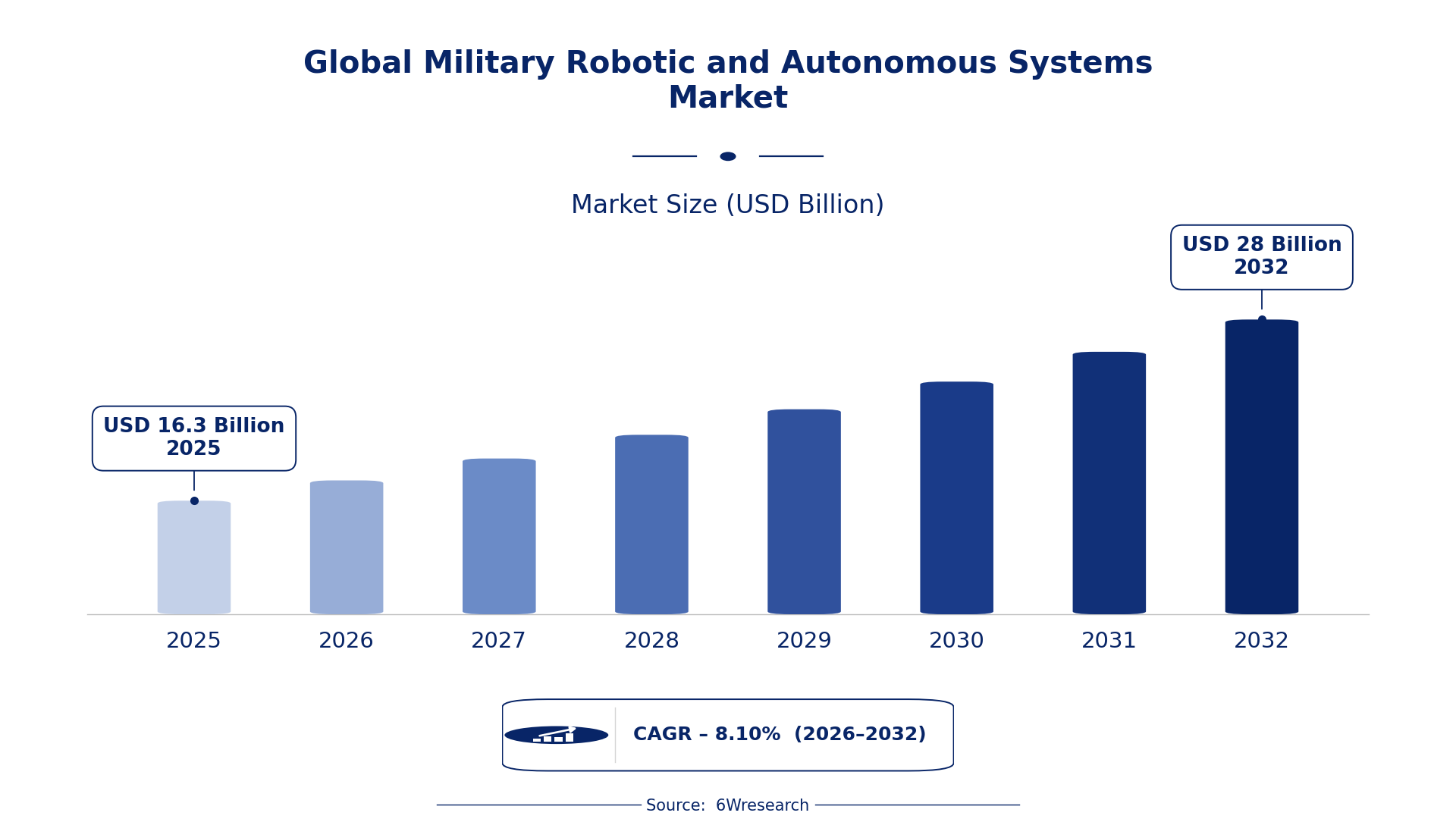
The Global Military Robotic and Autonomous Systems Market was estimated at USD 16.3 Billion in 2025 and is projected to reach USD 28 Billion by 2032, growing at a CAGR of 8.10% from 2026 to 2032.
Global Military Robotic and Autonomous Systems Market Synopsis
The landscape of military operations is shifting dramatically with the integration of robotic and autonomous systems. Innovations in unmanned technologies are reshaping traditional strategies, enabling defense forces to enhance their operational effectiveness while minimizing human risk in hostile environments. This evolution is particularly relevant in applications such as reconnaissance, combat support, and logistical operations.
A confluence of factors is precipitating this change, including the pressing need for increased situational awareness and rapid deployment capabilities on the battlefield. Countries are investing heavily not just in conventional military upgrades but in advanced robotics that offer greater autonomy. This market represents a critical bridge between existing capabilities and the future of defense technology.
Global Military Robotic and Autonomous Systems Market Year-wise Growth Rate and Key Drivers
This graph illustrates the annual growth rates of the Global Military Robotic and Autonomous Systems Market from 2022 to 2032, highlighting a steady upward trajectory and projected expansion over the forecast period.
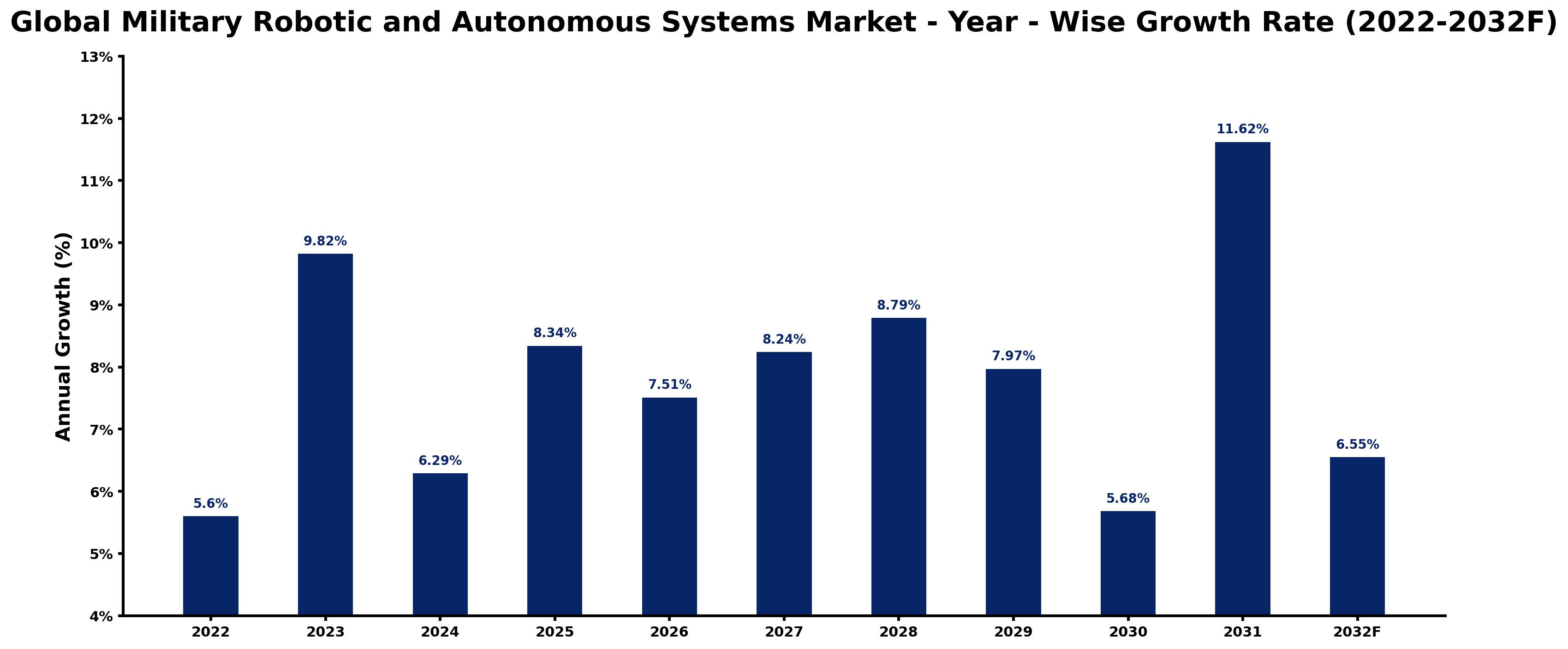
The table below presents the year‑wise growth rates along with the key drivers influencing the market
| Year | Growth Rate (%) | Major Drivers |
| 2022 | 5.6 | As military robotic systems evolve, sustainability compliance becomes a critical focus area. |
| 2023 | 9.82 | Adoption of UAV systems among defense agencies is significantly increasing post-pandemic. |
| 2024 | 6.29 | Composite materials utilized in defense robotics enhance operational efficiency and workforce capacity. |
| 2025 | 8.34 | Defense procurement cycles are accelerating the integration of autonomous systems in military operations. |
| 2026 | 7.51 | Major defense contractors are expanding their portfolios to include robotic autonomous solutions. |
| 2027 | 8.24 | Governments worldwide are investing more in autonomous systems for national security applications. |
| 2028 | 8.79 | Expanding satellite constellations support improved communication for military robotic systems. |
| 2029 | 7.97 | A shift toward strategic mergers and acquisitions enhances capabilities in robotic technology sectors. |
| 2030 | 5.68 | Increased emphasis on interoperability within NATO is influencing military robotic system standards. |
| 2031 | 11.62 | Rising raw material costs are prompting manufacturers to innovate military robotic system designs. |
| 2032 | 6.55 | New regulations concerning autonomous military systems are reshaping compliance strategies for developers. |
Note - Market size estimations and growth projections presented in this report are based on 6Wresearch's proprietary research methodology, combining internal industry data, secondary research, and primary validation, updated periodically to reflect current market conditions. As markets evolve rapidly, figures for certain industries may vary slightly and are intended as informed estimates rather than absolute figures. For the most current market sizing, we recommend validating figures with a 6Wresearch analyst.
Global Military Robotic and Autonomous Systems Market Key Takeaways
Below are some of the specific key takeaways from the market, including:
- Sixty-three percent of defense budgets in the U.S. are allocated toward advanced technologies, highlighting strategic investments in robotic systems.
- Top players like Northrop Grumman hold over 15% market share, focusing on UAV technology and combat systems.
- The Naval Military Robots segment is projected to experience a CAGR of 9.5% from 2026 to 2032, surpassing the overall market growth rate.
- Asia-Pacific nations, driven by increased defense spending, are forecasted to capture a growing share of the market, particularly in unmanned systems.
Evaluation of Restraints in Global Military Robotic and Autonomous Systems Market
The Global Military Robotic and Autonomous Systems Market is confronted with several specific challenges. Regulatory hurdles, particularly concerning the deployment of autonomous systems in combat, pose a significant barrier. For instance, implementing International Humanitarian Law requires human oversight in critical decision-making which could delay development timelines. Additionally, companies may face increased costs due to compliance with safety certifications. For example, the estimated regulatory compliance cost can exceed $1 million for advanced weaponized drones, which complicates time-to-market strategies for manufacturers.
Global Military Robotic and Autonomous Systems Market Trends
Several key trends are currently reshaping the operational theatre for military robotic systems. First, there’s a pronounced shift towards the incorporation of artificial intelligence to enhance the decision-making capabilities of UAVs and ground robots. Notably, Northrop Grumman recently integrated AI algorithms in their RQ-4 Global Hawk to allow for real-time data analysis.
Moreover, the emphasis on collaboration between autonomous and manned platforms is increasingly prevalent. This hybrid operational model ensures flexibility and expanded capabilities in various mission scenarios. An example is the U.S. Army’s Project Convergence, which aims to synchronize unmanned systems with traditional units to improve overall mission success. Consequently, these trends are driving investments in sensor integration and communication infrastructures.
Global Military Robotic and Autonomous Systems Market Opportunities
Amidst the evolving landscape, several lucrative opportunities are emerging in the Global Military Robotic and Autonomous Systems Market. The growing demand for autonomous naval vessels presents a particularly promising avenue, with the U.S. Navy planning a $600 million investment in unmanned surface vessels by 2026.
Additionally, advancements in sensor technologies are paving the way for enhanced UAV capabilities. For instance, the integration of LIDAR with drones is expected to accelerate air reconnaissance missions, offering better data collection at lower operational costs. This next-gen technology demonstrates significant potential for applications in surveillance and logistics, contributing to efficiencies rarely seen in traditional systems.
Global Military Robotic and Autonomous Systems Market by Products
The segment of Airborne Military Robots is currently the largest in the Global Military Robotic and Autonomous Systems Market, commanding a share of approximately 42% in 2025. This is attributed to their extensive use in aerial surveillance and intelligence missions. Conversely, Naval Military Robots represent the fastest-growing segment, with a projected CAGR of 9.5% from 2026 to 2032. The increasing focus on naval security and defense against maritime threats is fueling this growth, making such systems an essential element of modern military capabilities.
Global Military Robotic and Autonomous Systems Market by Region
North America is the largest region for the Global Military Robotic and Autonomous Systems Market, holding a significant share of approximately 48% in 2025. This dominance is largely due to the high military expenditure by the U.S. government and the presence of leading technology firms. In contrast, the Asia-Pacific region is expected to be the fastest growing, with a projected CAGR of 9.0% from 2026 to 2032. The surge in defense budgets among countries like India and Japan, alongside regional security concerns, are catalysts driving this rapid growth.
Government Initiatives in the Global Military Robotic and Autonomous Systems Market
Governments worldwide are actively implementing initiatives and policies to foster the development and integration of robotic systems in military applications. These measures not only focus on funding but also encompass regulatory frameworks designed to support operational advancements.
- U.S. Department of Defense, Unmanned Systems Integrated Roadmap, 2021: This roadmap emphasizes advancing autonomous systems in military operations to enhance strategic capabilities and operational efficiency.
- European Commission, Horizon Europe Grant for Robotic Systems, 2022: Funding of €1.5 billion aims to promote research and development in military robotics, seeking to bolster defense innovation across EU member states.
- London Office of Defence, Defence and Security Industrial Strategy (DSIS), 2023: This initiative encourages partnerships among UK companies focused on developing unmanned technologies with a planned investment of £800 million through 2025.
- Ministry of Defence of India, Defence Production Policy, 2020: Aimed to enhance indigenous production of unmanned systems, this policy has allocated $200 million in funding to attract private investment in defense startups.
Future Insights of the Global Military Robotic and Autonomous Systems Market
By 2032, the Global Military Robotic and Autonomous Systems Market is expected to see transformative shifts driven by advancements in artificial intelligence and machine learning. These technologies are anticipated to enhance autonomous decision-making processes, particularly within the naval and airborne segments. For instance, Northrop Grumman's ongoing developments in UAV capabilities are likely to define new operational standards. The increasing focus on networked systems will also facilitate real-time data sharing, significantly impacting joint operational effectiveness and changing strategic military engagements.
Global Military Robotic and Autonomous Systems Market Latest Developments
Recent developments in the Global Military Robotic and Autonomous Systems Market reflect heightened investment in new technologies and collaborations among leading defense firms. The implications of these actions extend to improved operational efficiencies and enhanced competitiveness.
- In August 2023, Boeing announced the upcoming launch of the MQ-28 Ghost Bat, an autonomous next-generation combat drone designed for collaboration with manned aircraft, enhancing mission effectiveness.
- Lockheed Martin is rolling out advanced upgrades to the PAC-3 missile interceptors, incorporating drone technology to improve threat detection and response, expected to be completed by early 2024.
- Thales Group is actively involved in a multi-year project to develop smart munitions aimed at increasing operational efficiency in naval engagements, with initial testing set for mid-2025.
- General Dynamics recently secured a contract for a series of robotic systems scheduled for deployment in multiple military exercises throughout 2026, aimed at improving logistics and support capabilities.
Global Military Robotic and Autonomous Systems Market Key Players and Industry Positioning
The competitive structure within the Global Military Robotic and Autonomous Systems Market remains consolidated, with several key players dominating the landscape. These companies leverage advanced technology, significant resources, and longstanding relationships with government agencies to maintain their leading positions. Each firm focuses on specialized areas, which range from unmanned aerial systems to comprehensive robotics solutions for ground and naval operations.
| Leading Company | Core Strength | Strategic Focus |
|---|---|---|
| Northrop Grumman | Expertise in UAV technology and integration. | Enhancing autonomous systems for reconnaissance and combat. |
| General Dynamics | Strong capabilities in ground robotic systems. | Expanding logistics and tactical support applications. |
| Boeing | Leadership in airborne military technology. | Developing next-gen autonomous combat drones. |
| Lockheed Martin | Advanced missile systems and drone integration. | Focus on joint operations and threat mitigation. |
| Thales Group | Strong emphasis on advanced electronic systems. | Innovating smart munitions for naval applications. |
This concentration of expertise among key players fosters resilience in the market, enabling consistent technological advancements and strategic collaborations that will further shape military capabilities.
Key Attractiveness of the Report
- 10 Years of Market Numbers
- Historical Data Starting from 2022 to 2025
- Base Year: 2025
- Forecast Data until 2032
- Key Performance Indicators Impacting the Market
- Major Upcoming Developments and Projects
Key Highlights of the Report:
- Global Military Robotic and Autonomous (RAS) Systems Market Outlook
- Market Size of Global Military Robotic and Autonomous (RAS) Systems Market, 2025
- Forecast of Global Military Robotic and Autonomous (RAS) Systems Market, 2032
- Historical Data and Forecast of Global Military Robotic and Autonomous (RAS) Systems Revenues & Volume for the Period 2022-2032
- Global Military Robotic and Autonomous (RAS) Systems Market Trend Evolution
- Global Military Robotic and Autonomous (RAS) Systems Market Drivers and Challenges
- Global Military Robotic and Autonomous (RAS) Systems Price Trends
- Global Military Robotic and Autonomous (RAS) Systems Porter's Five Forces
- Global Military Robotic and Autonomous (RAS) Systems Industry Life Cycle
- Historical Data and Forecast of Global Military Robotic and Autonomous (RAS) Systems Market Revenues & Volume
- Historical Data and Forecast of Global Military Robotic and Autonomous (RAS) Systems Market Revenues & Volume By Products for the Period 2022-2032
- Historical Data and Forecast of Global Military Robotic and Autonomous (RAS) Systems Market Revenues & Volume By Naval Military Robots for the Period 2022-2032
- Historical Data and Forecast of Global Military Robotic and Autonomous (RAS) Systems Market Revenues & Volume By Land-based Military Robots for the Period 2022-2032
- Historical Data and Forecast of Global Military Robotic and Autonomous (RAS) Systems Market Revenues & Volume By Airborne Military Robots for the Period 2022-2032
- Historical Data and Forecast of North America Military Robotic and Autonomous (RAS) Systems Market Revenues & Volume By Products for the Period 2022-2032
- Historical Data and Forecast of North America Military Robotic and Autonomous (RAS) Systems Market Revenues & Volume By Naval Military Robots for the Period 2022-2032
- Historical Data and Forecast of North America Military Robotic and Autonomous (RAS) Systems Market Revenues & Volume By Land-based Military Robots for the Period 2022-2032
- Historical Data and Forecast of North America Military Robotic and Autonomous (RAS) Systems Market Revenues & Volume By Airborne Military Robots for the Period 2022-2032
- Historical Data and Forecast of United States of America Military Robotic and Autonomous (RAS) Systems Market Revenues & Volume for the Period 2022-2032
- Historical Data and Forecast of Canada Military Robotic and Autonomous (RAS) Systems Market Revenues & Volume for the Period 2022-2032
- Historical Data and Forecast of Rest of North America Military Robotic and Autonomous (RAS) Systems Market Revenues & Volume for the Period 2022-2032
- Historical Data and Forecast of Latin America (LATAM) Military Robotic and Autonomous (RAS) Systems Market Revenues & Volume By Products for the Period 2022-2032
- Historical Data and Forecast of Latin America (LATAM) Military Robotic and Autonomous (RAS) Systems Market Revenues & Volume By Naval Military Robots for the Period 2022-2032
- Historical Data and Forecast of Latin America (LATAM) Military Robotic and Autonomous (RAS) Systems Market Revenues & Volume By Land-based Military Robots for the Period 2022-2032
- Historical Data and Forecast of Latin America (LATAM) Military Robotic and Autonomous (RAS) Systems Market Revenues & Volume By Airborne Military Robots for the Period 2022-2032
- Historical Data and Forecast of Brazil Military Robotic and Autonomous (RAS) Systems Market Revenues & Volume for the Period 2022-2032
- Historical Data and Forecast of Mexico Military Robotic and Autonomous (RAS) Systems Market Revenues & Volume for the Period 2022-2032
- Historical Data and Forecast of Argentina Military Robotic and Autonomous (RAS) Systems Market Revenues & Volume for the Period 2022-2032
- Historical Data and Forecast of Rest of LATAM Military Robotic and Autonomous (RAS) Systems Market Revenues & Volume for the Period 2022-2032
- Historical Data and Forecast of Asia Military Robotic and Autonomous (RAS) Systems Market Revenues & Volume By Products for the Period 2022-2032
- Historical Data and Forecast of Asia Military Robotic and Autonomous (RAS) Systems Market Revenues & Volume By Naval Military Robots for the Period 2022-2032
- Historical Data and Forecast of Asia Military Robotic and Autonomous (RAS) Systems Market Revenues & Volume By Land-based Military Robots for the Period 2022-2032
- Historical Data and Forecast of Asia Military Robotic and Autonomous (RAS) Systems Market Revenues & Volume By Airborne Military Robots for the Period 2022-2032
- Historical Data and Forecast of China Military Robotic and Autonomous (RAS) Systems Market Revenues & Volume for the Period 2022-2032
- Historical Data and Forecast of India Military Robotic and Autonomous (RAS) Systems Market Revenues & Volume for the Period 2022-2032
- Historical Data and Forecast of Japan Military Robotic and Autonomous (RAS) Systems Market Revenues & Volume for the Period 2022-2032
- Historical Data and Forecast of Rest of Asia Military Robotic and Autonomous (RAS) Systems Market Revenues & Volume for the Period 2022-2032
- Historical Data and Forecast of Africa Military Robotic and Autonomous (RAS) Systems Market Revenues & Volume By Products for the Period 2022-2032
- Historical Data and Forecast of Africa Military Robotic and Autonomous (RAS) Systems Market Revenues & Volume By Naval Military Robots for the Period 2022-2032
- Historical Data and Forecast of Africa Military Robotic and Autonomous (RAS) Systems Market Revenues & Volume By Land-based Military Robots for the Period 2022-2032
- Historical Data and Forecast of Africa Military Robotic and Autonomous (RAS) Systems Market Revenues & Volume By Airborne Military Robots for the Period 2022-2032
- Historical Data and Forecast of South Africa Military Robotic and Autonomous (RAS) Systems Market Revenues & Volume for the Period 2022-2032
- Historical Data and Forecast of Nigeria Military Robotic and Autonomous (RAS) Systems Market Revenues & Volume for the Period 2022-2032
- Historical Data and Forecast of Egypt Military Robotic and Autonomous (RAS) Systems Market Revenues & Volume for the Period 2022-2032
- Historical Data and Forecast of Rest of Africa Military Robotic and Autonomous (RAS) Systems Market Revenues & Volume for the Period 2022-2032
- Historical Data and Forecast of Europe Military Robotic and Autonomous (RAS) Systems Market Revenues & Volume By Products for the Period 2022-2032
- Historical Data and Forecast of Europe Military Robotic and Autonomous (RAS) Systems Market Revenues & Volume By Naval Military Robots for the Period 2022-2032
- Historical Data and Forecast of Europe Military Robotic and Autonomous (RAS) Systems Market Revenues & Volume By Land-based Military Robots for the Period 2022-2032
- Historical Data and Forecast of Europe Military Robotic and Autonomous (RAS) Systems Market Revenues & Volume By Airborne Military Robots for the Period 2022-2032
- Historical Data and Forecast of United Kingdom Military Robotic and Autonomous (RAS) Systems Market Revenues & Volume for the Period 2022-2032
- Historical Data and Forecast of France Military Robotic and Autonomous (RAS) Systems Market Revenues & Volume for the Period 2022-2032
- Historical Data and Forecast of Germany Military Robotic and Autonomous (RAS) Systems Market Revenues & Volume for the Period 2022-2032
- Historical Data and Forecast of Rest of Europe Military Robotic and Autonomous (RAS) Systems Market Revenues & Volume for the Period 2022-2032
- Historical Data and Forecast of Middle East Military Robotic and Autonomous (RAS) Systems Market Revenues & Volume By Products for the Period 2022-2032
- Historical Data and Forecast of Middle East Military Robotic and Autonomous (RAS) Systems Market Revenues & Volume By Naval Military Robots for the Period 2022-2032
- Historical Data and Forecast of Middle East Military Robotic and Autonomous (RAS) Systems Market Revenues & Volume By Land-based Military Robots for the Period 2022-2032
- Historical Data and Forecast of Middle East Military Robotic and Autonomous (RAS) Systems Market Revenues & Volume By Airborne Military Robots for the Period 2022-2032
- Historical Data and Forecast of Saudi Arabia Military Robotic and Autonomous (RAS) Systems Market Revenues & Volume for the Period 2022-2032
- Historical Data and Forecast of UAE Military Robotic and Autonomous (RAS) Systems Market Revenues & Volume for the Period 2022-2032
- Historical Data and Forecast of Turkey Military Robotic and Autonomous (RAS) Systems Market Revenues & Volume for the Period 2022-2032
- Historical Data and Forecast of Rest of Middle East Military Robotic and Autonomous (RAS) Systems Market Revenues & Volume for the Period 2022-2032
- Global Military Robotic and Autonomous (RAS) Systems Market - Key Performance Indicators
- Global Military Robotic and Autonomous (RAS) Systems Market - Import Export Trade Statistics
- Global Military Robotic and Autonomous (RAS) Systems Market - Opportunity Assessment By Countries
- Global Military Robotic and Autonomous (RAS) Systems Market - Opportunity Assessment By Products
- 0
- Global Military Robotic and Autonomous (RAS) Systems Market - Top Companies Market Share
- Global Military Robotic and Autonomous (RAS) Systems Market - Top Companies Profiles
- Global Military Robotic and Autonomous (RAS) Systems Market - Comparison of Players in Technical and Operating Parameters
- Global Military Robotic and Autonomous (RAS) Systems Market - Strategic Recommendations
Markets Covered
The Global Military Robotic and Autonomous (RAS) Systems Market report provides a detailed analysis of the following market segments:
By Regions and Countries:
- North America
- Europe
- LATAM
- Middle East
- Asia
- Africa
By Products:
- Naval Military Robots
- Land-based Military Robots
- Airborne Military Robots






































