Global Public Transportation Market Highlights
| Market Size (2025) | USD 2900 Billion |
| Forecast Size (2032) | USD 4100 Billion |
| CAGR | 5.50% |
| Base Year | 2025 |
| Forecast Period | 2026-2032 |
| Largest Region | North America |
| Fastest Growing Region | Asia |
| Largest Segment | Road |
| Fastest Growing Segment | Rail |
| Leading Companies | Transport for London, Deutsche Bahn, SNCF, MTA, FirstGroup |
Global Public Transportation Market Size & Growth Rate (2026-2032)
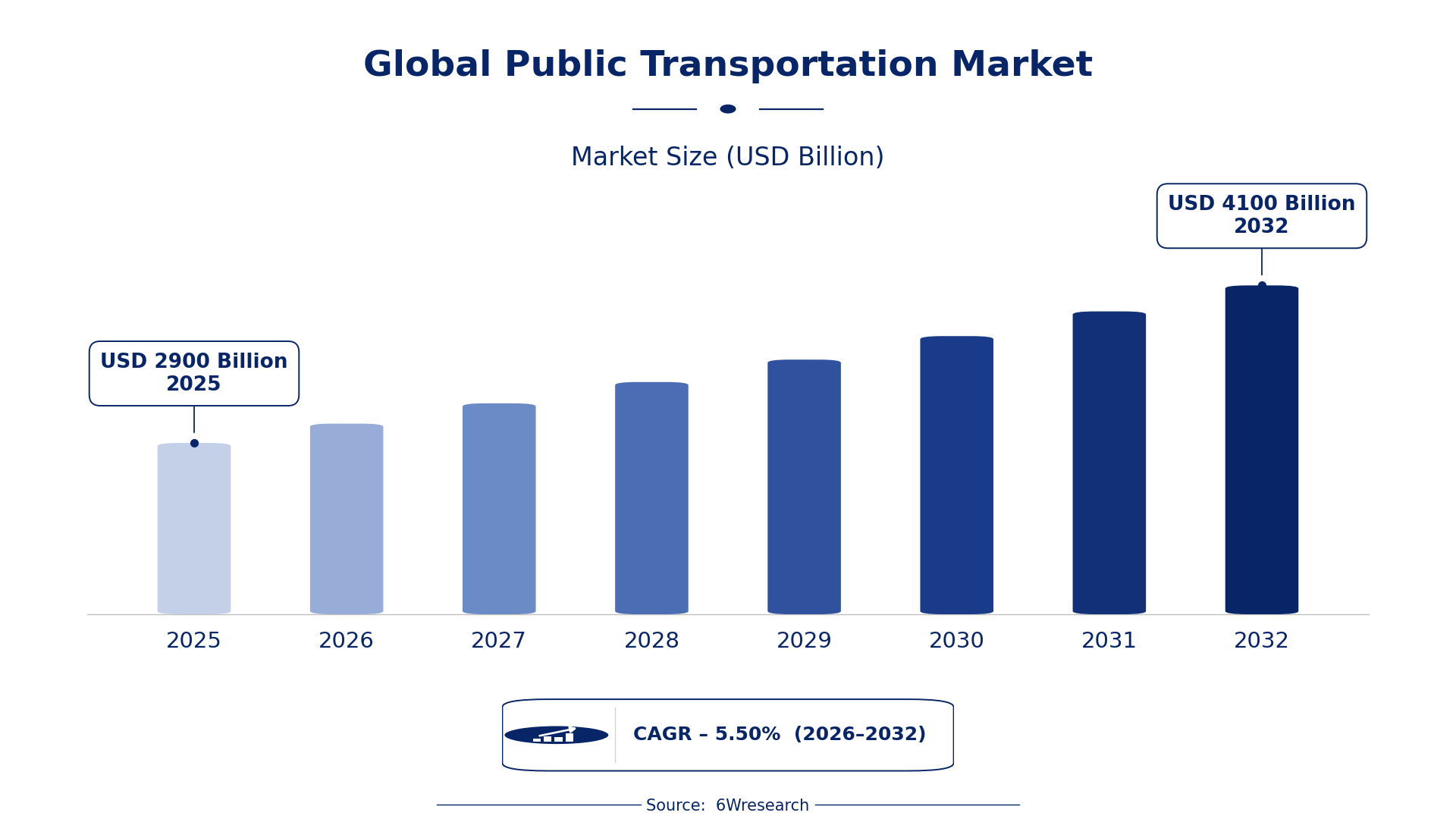
The Global Public Transportation Market was estimated at USD 2900 Billion in 2025 and is projected to reach USD 4100 Billion by 2032, growing at a CAGR of 5.50% from 2026 to 2032.
Global Public Transportation Market Synopsis
The Global Public Transportation Market is currently undergoing a transformative phase, characterized by substantial shifts in user preferences and operational frameworks. This evolution is fueled mainly by rising urbanization rates and significant environmental concerns, compelling governments and organizations to modernize their transportation infrastructures. Notably, technologies like electric vehicles and smart system integrations are playing pivotal roles in reshaping public transport landscape.
The focus on sustainability is driving investment towards alternative fuels and efficient mass transit options. As populations swell in urban regions, there is an increasing urgency to develop robust public transportation systems that can handle the growing rider volumes. This demand is expected to prompt collaborations across public and private entities, creating new dynamics in how transportation services are delivered and perceived.
Global Public Transportation Market Year-wise Growth Rate and Key Drivers
This graph illustrates the annual growth rates of the Global Public Transportation Market from 2022 to 2032, highlighting a steady upward trajectory and projected expansion over the forecast period.
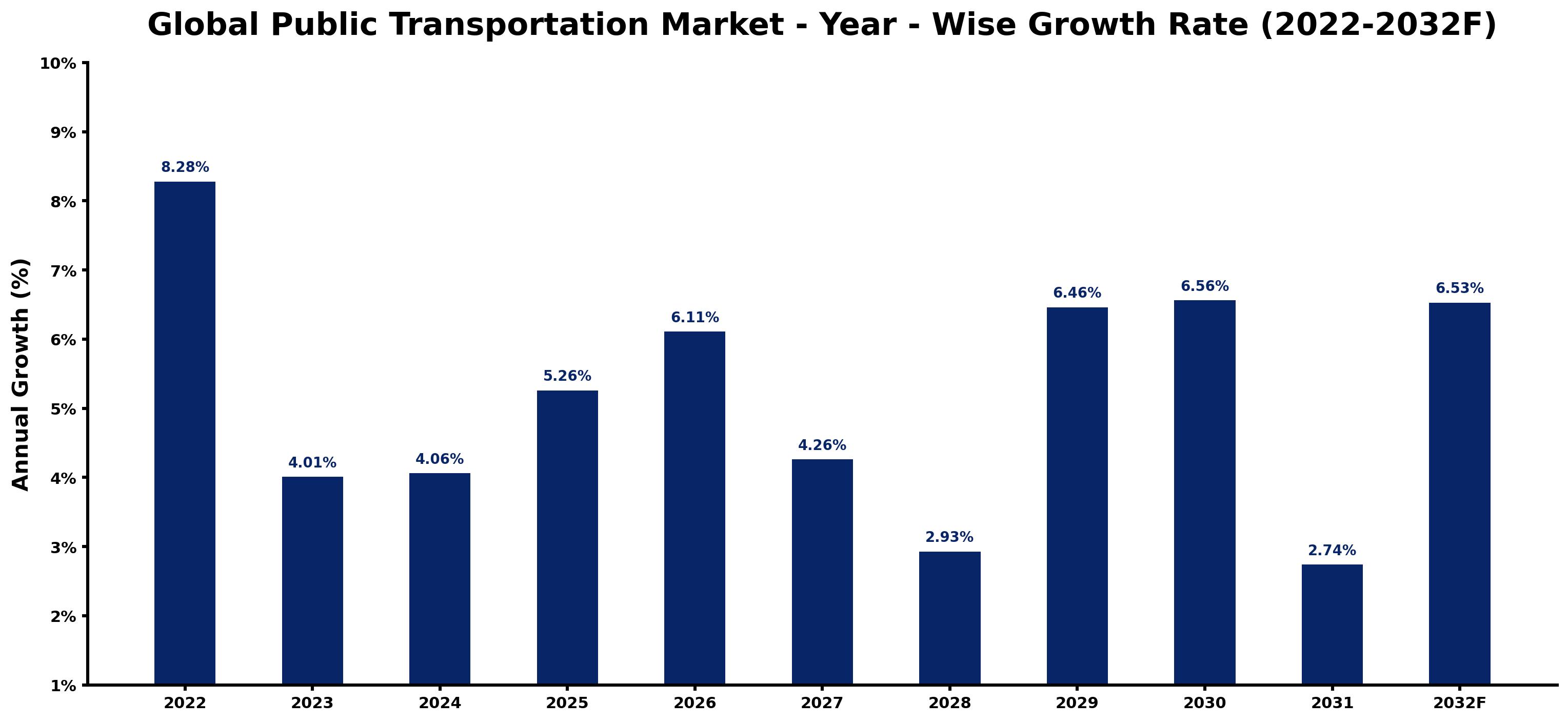
The table below presents the year‑wise growth rates along with the key drivers influencing the market
| Year | Growth Rate (%) | Major Drivers |
| 2022 | 8.28 | Electric buses are witnessing heightened adoption among urban public transportation systems. |
| 2023 | 4.01 | Transport regulators increasingly emphasize sustainability initiatives in public transportation frameworks. |
| 2024 | 4.06 | As supply chain disruptions persist, public transportation investments are adapting to new realities. |
| 2025 | 5.26 | Public transport companies are experiencing intensified competition from shared mobility service providers. |
| 2026 | 6.11 | Investing in advanced ticketing technologies enhances the efficiency of public transportation networks. |
| 2027 | 4.26 | Expanding regional public transportation infrastructure addresses urban sprawl challenges effectively. |
| 2028 | 2.93 | Rising raw material costs are compelling public transportation operators to optimize resource allocation. |
| 2029 | 6.46 | A growing emphasis on skilled labor in public transportation enhances service delivery standards. |
| 2030 | 6.56 | Cities are increasingly adopting smart technology innovations to improve public transportation operations. |
| 2031 | 2.74 | In urban areas, changing commuter preferences are reshaping public transportation usage patterns. |
| 2032 | 6.53 | A shift toward stricter emissions regulations changes operational strategies for public transportation providers. |
Note - Market size estimations and growth projections presented in this report are based on 6Wresearch's proprietary research methodology, combining internal industry data, secondary research, and primary validation, updated periodically to reflect current market conditions. As markets evolve rapidly, figures for certain industries may vary slightly and are intended as informed estimates rather than absolute figures. For the most current market sizing, we recommend validating figures with a 6Wresearch analyst.
Global Public Transportation Market Key Takeaways
Below are some of the specific key takeaways from the market, including:
- Public transportation carries approximately 55% of urban commuters globally, underscoring its critical role in urban mobility.
- The U.S. public transport sector sees annual investments exceeding USD 20 billion, focused on modernization and system upgrades.
- Rail transportation is anticipated to exhibit a CAGR of 6% from 2026 to 2032, reflecting a shift towards greener alternatives.
- Innovative payment systems, such as contactless methods, have enhanced user experience, driving ridership up by 10% year-on-year in major cities.
Evaluation of Restraints in Global Public Transportation Market
A significant challenge in the Global Public Transportation Market is the substantial investment required for infrastructure upgrades, estimated at around USD 3 trillion to address aging systems in developed regions. Regulatory hurdles also prove problematic; for example, emissions regulations impose stringent criteria that can delay project launches as cities scramble to meet compliance deadlines. The emergence of ride-sharing services adds competitive pressure, forcing public transport providers to innovate or lose ridership. As cities pivot towards on-demand mobility, the traditional scheduling approaches of many public transit systems are increasingly coming under scrutiny.
Global Public Transportation Market Trends
Multiple trends are actively shaping the Global Public Transportation Market. A major shift is the integration of smart technologies; for instance, companies like Siemens Mobility deployed contactless payment systems that have gained traction since their release in 2021, improving transaction efficiency and rider convenience. Another trend is the pivot towards greener alternatives, with electric buses projected to account for 30% of new orders by 2026. This movement is evident in city initiatives, such as Los Angeles’ plan to electrify its entire bus fleet by 2030, showcasing a broader commitment to environmental sustainability.
Global Public Transportation Market Opportunities
Several areas represent lucrative opportunities within the Global Public Transportation Market. The rise of hydrogen fuel technologies, for one, offers a promising pathway for reducing emissions; for instance, Alstom’s hydrogen-powered trains are being tested across Europe, with potential sales estimated in the hundreds of millions by 2025. Furthermore, investments in data analytics for operational efficiency can yield considerable returns, enhancing route optimization. As cities embrace smart city initiatives, the connectivity between public transport and digital platforms is becoming increasingly essential, creating a niche for technology firms to enter and collaborate with transit authorities.
Global Public Transportation Market by Distribution Channel
In the Global Public Transportation Market, the Offline channel leads, commanding approximately 70% share in 2025, primarily driven by traditional ticketing methods at stations and terminals. However, the Online distribution channel is expected to experience rapid growth, with a CAGR of 8.2% from 2026 to 2032. This growth results from increasing smartphone penetration and demand for convenient booking solutions, allowing transit operators to cater to tech-savvy consumers effectively. The shift toward mobile applications offers competitive advantages by enhancing customer experience and reducing operational costs.
Global Public Transportation Market by Mode Type
Within the Global Public Transportation Market, the Road mode segment currently dominates, representing around 62% share in 2025, driven by the extensive use of buses in urban settings. Conversely, the Rail segment is projected to be the fastest-growing, with a CAGR of 6.5% from 2026 to 2032, largely due to substantial investments in electrification projects and infrastructure developments worldwide. Enhanced efficiency and reduced carbon footprints associated with rail systems make them attractive alternatives for expanding transit networks, attracting both public and private sector funding.
Global Public Transportation Market by Region
North America currently holds the largest share of the Global Public Transportation Market, accounting for approximately 45% in 2025, driven by established transit networks and governmental support for infrastructure projects. Meanwhile, the Asia region is anticipated to be the fastest-growing, projected to grow at a CAGR of 7% from 2026 to 2032. Rapid urbanization, particularly in countries like India and China, fuels this growth, as these nations invest heavily in developing efficient and modern transit solutions to relieve congestion in burgeoning metropolises.
Government Initiatives in the Global Public Transportation Market
Governments worldwide are actively implementing policies and initiatives to bolster the Global Public Transportation Market. These regulations not only promote sustainable practices but also aim to streamline infrastructure development and enhance riding experiences.
- U.S. Department of Transportation, "Infrastructure Investment and Jobs Act," 2021: This initiative allocates over USD 39 billion for public transit modernization, enabling significant investments in updating infrastructure.
- European Commission, "European Green Deal," 2019: Aimed at achieving climate neutrality, this initiative includes financing for expanding electric and sustainable public transport options across EU member states.
- Ministry of Railways, India, "National Rail Plan," 2020: This long-term strategy aims to create a future-ready railway system by investing USD 27 billion in enhancing capacity and services.
- Transport for London, "Mayor’s Transport Strategy," 2018: This ongoing initiative aims to improve the entire public transport system, with a focus on expanding bus services and promoting cycling.
Future Insights of the Global Public Transportation Market
In the coming years, the Global Public Transportation Market is expected to witness profound transformations, driven by the integration of advanced technologies and sustainability initiatives. By 2026, the deployment of AI and data analytics for route optimization is projected to enhance operational efficiencies significantly. Initiatives like Bengaluru's metro rail expansion highlight the commitment towards efficient public transport, reflecting a broader trend aimed at addressing environmental concerns while enhancing user experience. A marked shift towards electric and hydrogen-fueled vehicles is anticipated, further propelling investments across various regions.
Global Public Transportation Market Latest Developments
Recent initiatives in the Global Public Transportation Market indicate a strong alignment towards sustainability and technology integration. These developments underscore the industry's response to evolving commuter needs and environmental regulations.
- SNCF has recently completed electrification projects for key rail routes, contributing to reduced carbon emissions and improved service efficiency.
- Transport for London is currently implementing advanced AI systems to optimize traffic flow, set to enhance bus schedules by late 2023.
- MTA announced an upcoming initiative to introduce a fleet of hydrogen-powered buses, projected for rollout in 2024, aimed at advancing cleaner mobility.
- FirstGroup recently unveiled a plan for extensive investments in electric vehicle charging infrastructure, forecasted to expand service capabilities by 2025.
Global Public Transportation Market Key Players and Industry Positioning
The Global Public Transportation Market features a mix of consolidated and fragmented players, each leveraging unique strengths to capture market opportunities. Leading firms include established transit authorities and private operators, collaborating on technological advancements and sustainable practices to enhance competitive position.
| Leading Company | Core Strength | Strategic Focus |
|---|---|---|
| Transport for London | Extensive public transport network | Enhancing user experience through technology |
| Deutsche Bahn | Strong rail infrastructure | Investing in sustainable rail solutions |
| SNCF | Diverse service offerings across various transit modes | Electrification and operational efficiencies |
| MTA | Robust metropolitan transportation services | Innovating cleaner transit options |
| FirstGroup | Large fleet management capabilities | Expanding electric vehicle services |
The competitive dynamics in the market are shaped by continuous efforts to integrate advanced technology solutions and sustain operational effectiveness, ensuring that public transport continues to evolve in alignment with growing environmental expectations.
Key Attractiveness of the Report
- 10 Years of Market Numbers
- Historical Data Starting from 2022 to 2025
- Base Year: 2025
- Forecast Data until 2032
- Key Performance Indicators Impacting the Market
- Major Upcoming Developments and Projects
Key Highlights of the Report:
- Global Public Transportation Market Outlook
- Market Size of Global Public Transportation Market, 2025
- Forecast of Global Public Transportation Market, 2032
- Historical Data and Forecast of Global Public Transportation Revenues & Volume for the Period 2022-2032
- Global Public Transportation Market Trend Evolution
- Global Public Transportation Market Drivers and Challenges
- Global Public Transportation Price Trends
- Global Public Transportation Porter's Five Forces
- Global Public Transportation Industry Life Cycle
- Historical Data and Forecast of Global Public Transportation Market Revenues & Volume
- Historical Data and Forecast of Global Public Transportation Market Revenues & Volume By Distribution Channel for the Period 2022-2032
- Historical Data and Forecast of Global Public Transportation Market Revenues & Volume By Online for the Period 2022-2032
- Historical Data and Forecast of Global Public Transportation Market Revenues & Volume By Offline for the Period 2022-2032
- Historical Data and Forecast of Global Public Transportation Market Revenues & Volume By Mode Type for the Period 2022-2032
- Historical Data and Forecast of Global Public Transportation Market Revenues & Volume By Road for the Period 2022-2032
- Historical Data and Forecast of Global Public Transportation Market Revenues & Volume By Rail for the Period 2022-2032
- Historical Data and Forecast of North America Public Transportation Market Revenues & Volume By Distribution Channel for the Period 2022-2032
- Historical Data and Forecast of North America Public Transportation Market Revenues & Volume By Online for the Period 2022-2032
- Historical Data and Forecast of North America Public Transportation Market Revenues & Volume By Offline for the Period 2022-2032
- Historical Data and Forecast of North America Public Transportation Market Revenues & Volume By Mode Type for the Period 2022-2032
- Historical Data and Forecast of North America Public Transportation Market Revenues & Volume By Road for the Period 2022-2032
- Historical Data and Forecast of North America Public Transportation Market Revenues & Volume By Rail for the Period 2022-2032
- Historical Data and Forecast of United States of America Public Transportation Market Revenues & Volume for the Period 2022-2032
- Historical Data and Forecast of Canada Public Transportation Market Revenues & Volume for the Period 2022-2032
- Historical Data and Forecast of Rest of North America Public Transportation Market Revenues & Volume for the Period 2022-2032
- Historical Data and Forecast of Latin America (LATAM) Public Transportation Market Revenues & Volume By Distribution Channel for the Period 2022-2032
- Historical Data and Forecast of Latin America (LATAM) Public Transportation Market Revenues & Volume By Online for the Period 2022-2032
- Historical Data and Forecast of Latin America (LATAM) Public Transportation Market Revenues & Volume By Offline for the Period 2022-2032
- Historical Data and Forecast of Latin America (LATAM) Public Transportation Market Revenues & Volume By Mode Type for the Period 2022-2032
- Historical Data and Forecast of Latin America (LATAM) Public Transportation Market Revenues & Volume By Road for the Period 2022-2032
- Historical Data and Forecast of Latin America (LATAM) Public Transportation Market Revenues & Volume By Rail for the Period 2022-2032
- Historical Data and Forecast of Brazil Public Transportation Market Revenues & Volume for the Period 2022-2032
- Historical Data and Forecast of Mexico Public Transportation Market Revenues & Volume for the Period 2022-2032
- Historical Data and Forecast of Argentina Public Transportation Market Revenues & Volume for the Period 2022-2032
- Historical Data and Forecast of Rest of LATAM Public Transportation Market Revenues & Volume for the Period 2022-2032
- Historical Data and Forecast of Asia Public Transportation Market Revenues & Volume By Distribution Channel for the Period 2022-2032
- Historical Data and Forecast of Asia Public Transportation Market Revenues & Volume By Online for the Period 2022-2032
- Historical Data and Forecast of Asia Public Transportation Market Revenues & Volume By Offline for the Period 2022-2032
- Historical Data and Forecast of Asia Public Transportation Market Revenues & Volume By Mode Type for the Period 2022-2032
- Historical Data and Forecast of Asia Public Transportation Market Revenues & Volume By Road for the Period 2022-2032
- Historical Data and Forecast of Asia Public Transportation Market Revenues & Volume By Rail for the Period 2022-2032
- Historical Data and Forecast of China Public Transportation Market Revenues & Volume for the Period 2022-2032
- Historical Data and Forecast of India Public Transportation Market Revenues & Volume for the Period 2022-2032
- Historical Data and Forecast of Japan Public Transportation Market Revenues & Volume for the Period 2022-2032
- Historical Data and Forecast of Rest of Asia Public Transportation Market Revenues & Volume for the Period 2022-2032
- Historical Data and Forecast of Africa Public Transportation Market Revenues & Volume By Distribution Channel for the Period 2022-2032
- Historical Data and Forecast of Africa Public Transportation Market Revenues & Volume By Online for the Period 2022-2032
- Historical Data and Forecast of Africa Public Transportation Market Revenues & Volume By Offline for the Period 2022-2032
- Historical Data and Forecast of Africa Public Transportation Market Revenues & Volume By Mode Type for the Period 2022-2032
- Historical Data and Forecast of Africa Public Transportation Market Revenues & Volume By Road for the Period 2022-2032
- Historical Data and Forecast of Africa Public Transportation Market Revenues & Volume By Rail for the Period 2022-2032
- Historical Data and Forecast of South Africa Public Transportation Market Revenues & Volume for the Period 2022-2032
- Historical Data and Forecast of Nigeria Public Transportation Market Revenues & Volume for the Period 2022-2032
- Historical Data and Forecast of Egypt Public Transportation Market Revenues & Volume for the Period 2022-2032
- Historical Data and Forecast of Rest of Africa Public Transportation Market Revenues & Volume for the Period 2022-2032
- Historical Data and Forecast of Europe Public Transportation Market Revenues & Volume By Distribution Channel for the Period 2022-2032
- Historical Data and Forecast of Europe Public Transportation Market Revenues & Volume By Online for the Period 2022-2032
- Historical Data and Forecast of Europe Public Transportation Market Revenues & Volume By Offline for the Period 2022-2032
- Historical Data and Forecast of Europe Public Transportation Market Revenues & Volume By Mode Type for the Period 2022-2032
- Historical Data and Forecast of Europe Public Transportation Market Revenues & Volume By Road for the Period 2022-2032
- Historical Data and Forecast of Europe Public Transportation Market Revenues & Volume By Rail for the Period 2022-2032
- Historical Data and Forecast of United Kingdom Public Transportation Market Revenues & Volume for the Period 2022-2032
- Historical Data and Forecast of France Public Transportation Market Revenues & Volume for the Period 2022-2032
- Historical Data and Forecast of Germany Public Transportation Market Revenues & Volume for the Period 2022-2032
- Historical Data and Forecast of Rest of Europe Public Transportation Market Revenues & Volume for the Period 2022-2032
- Historical Data and Forecast of Middle East Public Transportation Market Revenues & Volume By Distribution Channel for the Period 2022-2032
- Historical Data and Forecast of Middle East Public Transportation Market Revenues & Volume By Online for the Period 2022-2032
- Historical Data and Forecast of Middle East Public Transportation Market Revenues & Volume By Offline for the Period 2022-2032
- Historical Data and Forecast of Middle East Public Transportation Market Revenues & Volume By Mode Type for the Period 2022-2032
- Historical Data and Forecast of Middle East Public Transportation Market Revenues & Volume By Road for the Period 2022-2032
- Historical Data and Forecast of Middle East Public Transportation Market Revenues & Volume By Rail for the Period 2022-2032
- Historical Data and Forecast of Saudi Arabia Public Transportation Market Revenues & Volume for the Period 2022-2032
- Historical Data and Forecast of UAE Public Transportation Market Revenues & Volume for the Period 2022-2032
- Historical Data and Forecast of Turkey Public Transportation Market Revenues & Volume for the Period 2022-2032
- Historical Data and Forecast of Rest of Middle East Public Transportation Market Revenues & Volume for the Period 2022-2032
- Global Public Transportation Market - Key Performance Indicators
- Global Public Transportation Market - Import Export Trade Statistics
- Global Public Transportation Market - Opportunity Assessment By Countries
- Global Public Transportation Market - Opportunity Assessment By Distribution Channel
- Global Public Transportation Market - Opportunity Assessment By Mode Type
- Global Public Transportation Market - Top Companies Market Share
- Global Public Transportation Market - Top Companies Profiles
- Global Public Transportation Market - Comparison of Players in Technical and Operating Parameters
- Global Public Transportation Market - Strategic Recommendations
Markets Covered
The Global Public Transportation Market report provides a detailed analysis of the following market segments:
By Regions and Countries:
- North America
- Europe
- LATAM
- Middle East
- Asia
- Africa
By Distribution Channel:
- Online
- Offline
By Mode Type:
- Road
- Rail






































