Global Smart And Connected Offices Market Highlights
| Market Size (2025) | USD 24 Billion |
| Forecast Size (2032) | USD 34 Billion |
| CAGR | 5.50% |
| Base Year | 2025 |
| Forecast Period | 2026-2032 |
| Largest Region | North America |
| Fastest Growing Region | Asia-Pacific |
| Largest Segment | Corporate Offices |
| Fastest Growing Segment | Energy Management Systems |
| Leading Companies | Siemens, Honeywell, Cisco, Schneider Electric, Johnson Controls |
Global Smart And Connected Offices Market Size & Growth Rate (2026-2032)
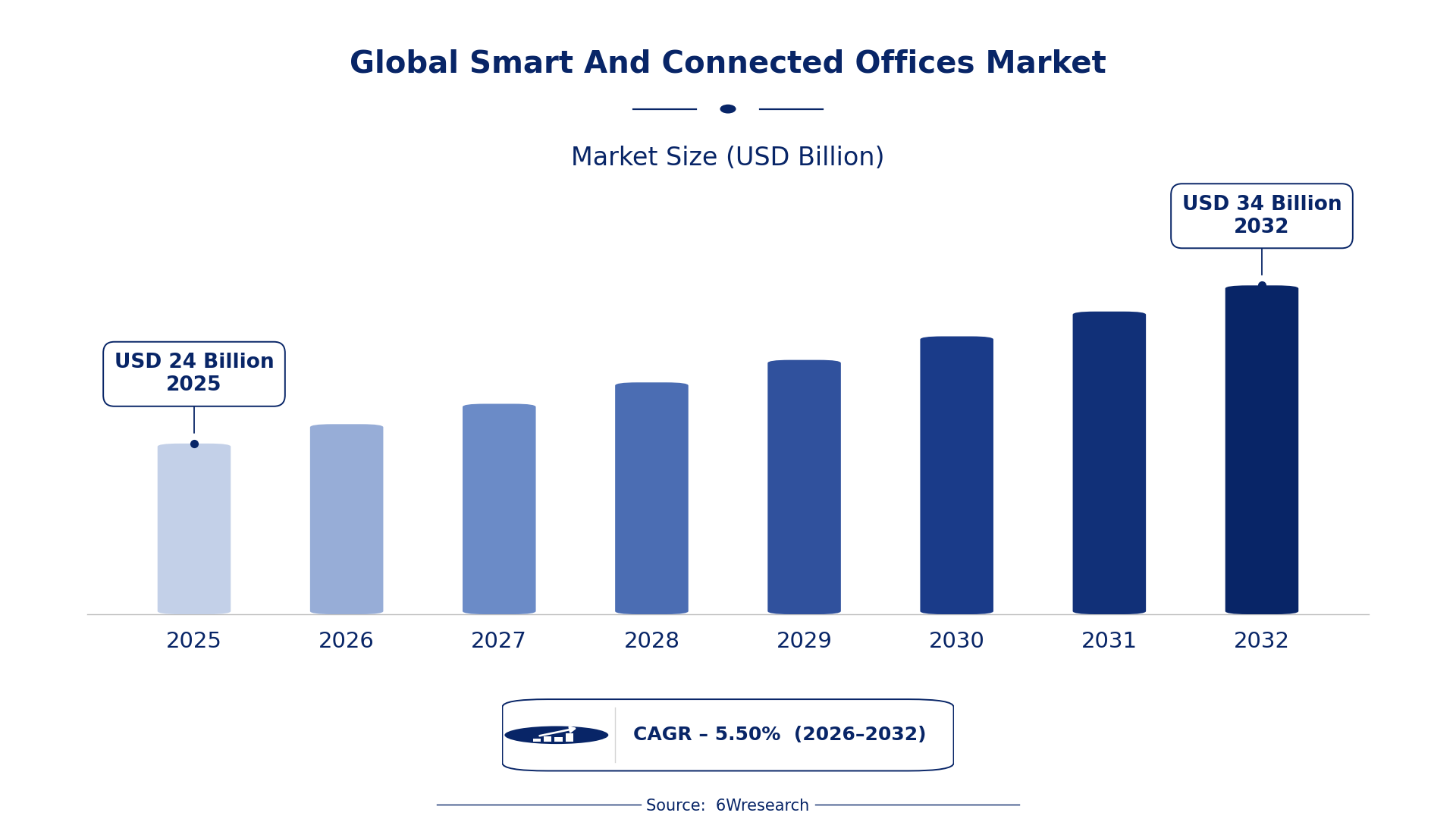
The Global Smart And Connected Offices Market was estimated at USD 24 Billion in 2025 and is projected to reach USD 34 Billion by 2032, growing at a CAGR of 5.50% from 2026 to 2032.
Global Smart And Connected Offices Market Synopsis
The Global Smart And Connected Offices Market is undergoing a significant transformation, driven by the integration of advanced technologies into workplace environments. This evolution is reshaping how businesses operate, aiming to enhance efficiency, sustainability, and employee well-being. The market's growth is propelled by the increasing adoption of Internet of Things (IoT) devices, artificial intelligence (AI), and data analytics, which collectively contribute to the creation of intelligent and responsive office spaces.
As organizations strive to optimize resource utilization and reduce operational costs, smart office solutions have become a strategic imperative. The emphasis on energy efficiency, coupled with the need for flexible work environments, has accelerated the demand for connected office technologies. This shift is not only transforming traditional office layouts but also influencing corporate real estate strategies and urban development plans.
Global Smart And Connected Offices Market Year-wise Growth Rate and Key Drivers
This graph illustrates the annual growth rates of the Global Smart And Connected Offices Market from 2022 to 2032, highlighting a steady upward trajectory and projected expansion over the forecast period.
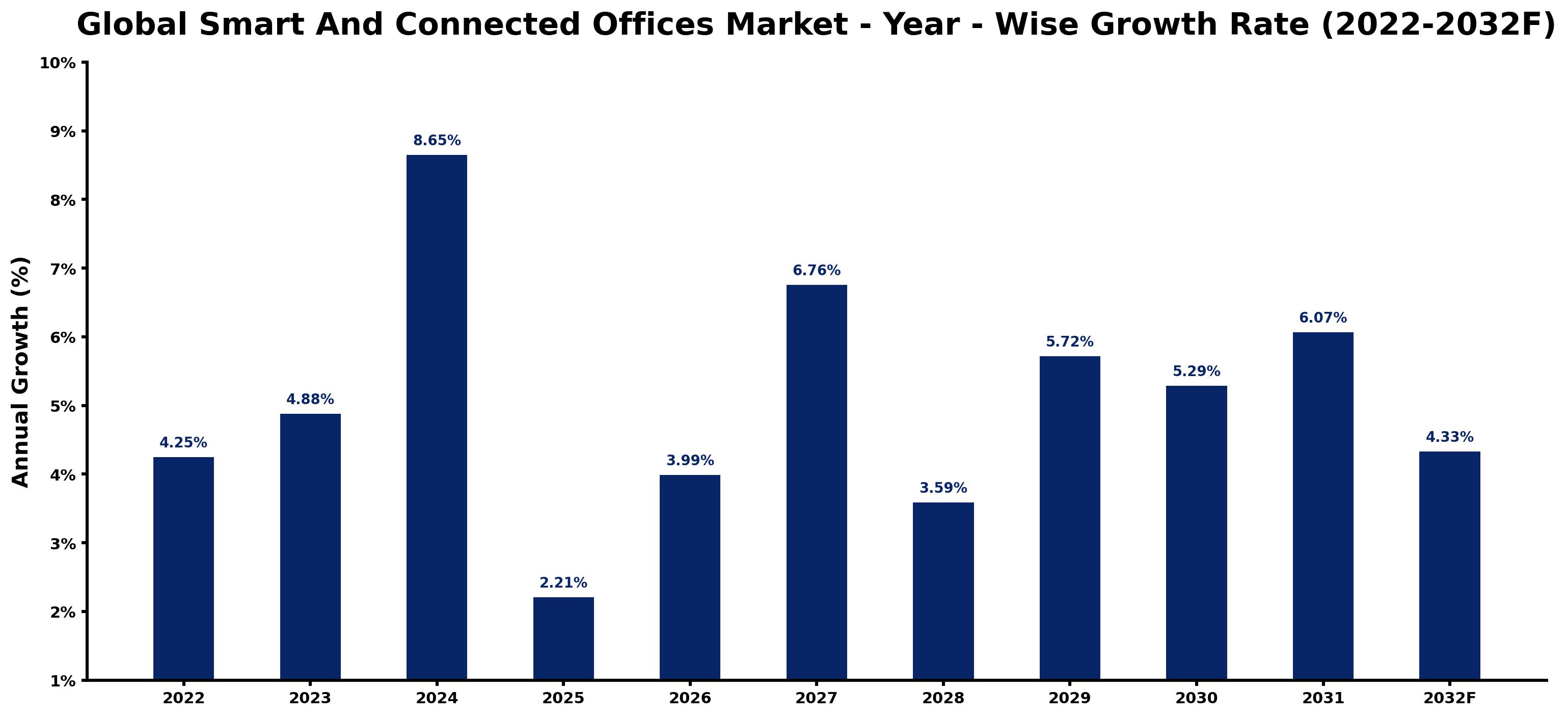
The table below presents the year‑wise growth rates along with the key drivers influencing the market
| Year | Growth Rate (%) | Major Drivers |
| 2022 | 4.25 | Expanding skilled workforce in tech roles enhances capabilities for Smart and Connected Offices. |
| 2023 | 4.88 | Investment in cloud migration technologies accelerates the development of Smart Offices. |
| 2024 | 8.65 | A shift toward remote work increases demand for Connected Office solutions and technologies. |
| 2025 | 2.21 | Establishing efficient network infrastructure facilitates competition among Smart Office providers. |
| 2026 | 3.99 | Increased demand for quality fiber-optic buildout improves connectivity in Connected Offices. |
| 2027 | 6.76 | Employees in corporate sectors increasingly prefer Smart Office functionalities for enhanced productivity. |
| 2028 | 3.59 | Telecom companies are expanding 5G networks, driving Connected Office installations across regions. |
| 2029 | 5.72 | As API ecosystems evolve, Smart Offices integrate more technologies to streamline operations. |
| 2030 | 5.29 | Regulators are implementing cybersecurity frameworks to enhance protection for Smart Offices. |
| 2031 | 6.07 | Supply chain disruptions influence the availability of components for Smart Office technologies. |
| 2032 | 4.33 | In North America, sustainability trends push for greener solutions in Smart and Connected Offices. |
Note - Market size estimations and growth projections presented in this report are based on 6Wresearch's proprietary research methodology, combining internal industry data, secondary research, and primary validation, updated periodically to reflect current market conditions. As markets evolve rapidly, figures for certain industries may vary slightly and are intended as informed estimates rather than absolute figures. For the most current market sizing, we recommend validating figures with a 6Wresearch analyst.
Global Smart And Connected Offices Market Key Takeaways
Below are some of the specific key takeaways from the market, including:
- The market is projected to reach USD 34 Billion by 2032, growing at a CAGR of 5.50% from 2026 to 2032.
- North America is the largest region, accounting for approximately 36.8% of the market share in 2024.
- Corporate Offices represent the largest application segment, holding a significant share in the market.
- Energy Management Systems are the fastest-growing segment, with a projected CAGR of 15.3% over the forecast period.
- Leading companies in the market include Siemens, Honeywell, Cisco, Schneider Electric, and Johnson Controls.
Evaluation of Restraints in Global Smart And Connected Offices Market
Despite the promising growth trajectory, the Global Smart And Connected Offices Market faces several challenges that could impede its expansion. One significant restraint is the high initial investment required for implementing smart technologies. For instance, the integration of advanced energy management systems and IoT devices can necessitate substantial capital expenditure, which may deter smaller enterprises from adopting these solutions. Additionally, concerns related to data privacy and cybersecurity pose risks to the widespread adoption of connected office technologies. The complexity of integrating diverse systems and ensuring interoperability among various devices also presents technical challenges. Moreover, the lack of standardized protocols for smart office solutions can lead to compatibility issues, further hindering market growth. Addressing these challenges requires strategic planning, investment in robust infrastructure, and the development of industry standards to facilitate seamless integration and operation of smart office systems.
Global Smart And Connected Offices Market Trends
The Global Smart And Connected Offices Market is witnessing several notable trends that are shaping its future direction. One prominent trend is the increasing integration of artificial intelligence (AI) and machine learning (ML) algorithms into office management systems. These technologies enable predictive maintenance, energy optimization, and enhanced security measures, thereby improving operational efficiency. For example, Siemens' Building X platform utilizes AI to analyze building data and optimize energy consumption, leading to significant cost savings. Another trend is the growing emphasis on employee well-being and productivity through smart office solutions. Features such as adjustable lighting, personalized climate control, and ergonomic furniture are being incorporated to create healthier and more comfortable work environments. Additionally, the adoption of cloud-based platforms for smart office management is on the rise, offering scalability and flexibility to organizations. These platforms facilitate remote monitoring and control of office systems, enhancing operational agility and responsiveness to changing business needs.
Global Smart And Connected Offices Market Opportunities
The Global Smart And Connected Offices Market presents several opportunities for growth and innovation. One significant opportunity lies in the development of integrated solutions that combine multiple smart office technologies into cohesive platforms. This approach can simplify deployment and management for organizations, making smart office adoption more accessible. For instance, Honeywell's Forge for Buildings platform integrates various building systems, providing a unified interface for facility managers. Another opportunity is the expansion of smart office solutions into emerging markets, where rapid urbanization and economic development are driving demand for modern office infrastructures. Companies can capitalize on this trend by offering scalable and cost-effective smart office solutions tailored to the specific needs of these regions. Additionally, the increasing focus on sustainability and energy efficiency presents opportunities for smart office technologies that contribute to green building certifications and compliance with environmental regulations. By aligning product offerings with sustainability goals, companies can enhance their market appeal and meet the growing demand for eco-friendly office solutions.
Global Smart And Connected Offices Market by Application
In the Global Smart And Connected Offices Market, the 'Corporate Offices' application segment leads with a substantial share of approximately 71.3% in 2025. This dominance is attributed to the widespread adoption of smart office technologies by large enterprises seeking to enhance operational efficiency and employee productivity. The 'Energy Efficiency' application segment is the fastest-growing, with a projected CAGR of 15.3% from 2026 to 2032. This growth is driven by increasing regulatory pressures and corporate sustainability initiatives that prioritize energy conservation and cost reduction. The integration of energy management systems and IoT-enabled devices enables real-time monitoring and optimization of energy usage, aligning with both environmental goals and financial objectives.
Global Smart And Connected Offices Market by Product
Within the Global Smart And Connected Offices Market, 'Energy Management Systems' are the largest product segment, accounting for approximately 28.9% of the market share in 2025. This prominence is due to the growing emphasis on reducing energy consumption and operational costs. The 'Energy Management Systems' segment is also the fastest-growing, with a projected CAGR of 15.3% from 2026 to 2032. This rapid growth is fueled by advancements in IoT technologies and the increasing availability of data analytics tools that enable organizations to implement sophisticated energy management strategies. The adoption of these systems not only contributes to sustainability goals but also offers a competitive advantage through cost savings and enhanced operational performance.
Global Smart And Connected Offices Market by Region
In the Global Smart And Connected Offices Market, North America is the largest region, holding approximately 36.8% of the market share in 2024. This dominance is driven by early adoption of smart technologies, a strong emphasis on digital transformation, and significant investments in infrastructure. The Asia-Pacific region is the fastest-growing, with a projected CAGR of 15.3% from 2026 to 2032. This rapid growth is attributed to rapid urbanization, increasing commercial construction activities, and supportive government initiatives promoting smart building technologies. Countries like China and Japan are leading the adoption of smart office solutions, driven by their focus on technological innovation and sustainable development. The expansion of smart office technologies in these regions is also supported by favorable economic conditions and a growing middle class seeking modern workplace environments.
Government Initiatives in the Global Smart And Connected Offices Market
Government policies and initiatives play a pivotal role in shaping the adoption and growth of smart office technologies. Various ministries and agencies worldwide are implementing regulations and programs to promote energy efficiency, sustainability, and technological innovation in office environments. These initiatives often include financial incentives, regulatory frameworks, and support for research and development, aiming to accelerate the transition towards smarter and more connected workplaces. The impact of these government actions varies by region and can significantly influence market dynamics, investment decisions, and the overall pace of adoption of smart office solutions.
- In December 2022, the U.S. Department of Energy announced the Federal Building Performance Standard, aiming to reduce energy consumption and electrify equipment in 30% of federal buildings by 2030. This initiative is expected to drive the adoption of smart building technologies across federal facilities, promoting energy efficiency and sustainability.
- In January 2023, New York City Mayor Eric Adams unveiled recommendations to convert underused office spaces into housing, highlighting the city's commitment to adaptive reuse and urban revitalization. This policy could influence the demand for smart office solutions in repurposed buildings, integrating modern technologies to enhance functionality and appeal.
- In March 2024, the U.S. House of Representatives passed the Utilization of Space Efficiently and Improving Technologies (USE IT) Act of 2023, which sets space occupancy standards and incentivizes federal workers to return to the office or lose office space. This legislation may impact the utilization and modernization of federal office spaces, potentially increasing the demand for smart office technologies to optimize space and improve operational efficiency.
- In 2023, the Florida Legislature enacted the SMART Schools program, aiming to provide functional, safe, and adequate learning environments for K-12 students. While primarily focused on educational facilities, the principles of the SMART Schools program could influence the adoption of smart building technologies in other sectors, including commercial office spaces, by promoting standards for efficiency and sustainability.
Future Insights of the Global Smart And Connected Offices Market
In the coming years, the Global Smart And Connected Offices Market is expected to witness structural changes as organizations increasingly prioritize hybrid working models. Companies are investing in technologies that facilitate seamless collaboration among remote and in-office employees. For instance, Cisco is enhancing its Webex platform to support dynamic workplace solutions tailored for this new era. These shifts indicate that smart technologies will evolve to meet user needs for flexibility, security, and real-time data analytics, fundamentally changing office dynamics through 2032.
Global Smart And Connected Offices Market Latest Developments
Several recent developments are shaping the Global Smart And Connected Offices Market, emphasizing innovation and addressing emerging market needs:
- In February 2023, Siemens launched a new energy management solution aimed at optimizing power consumption in corporate offices. This solution allows for real-time energy monitoring, enhancing efficiency, which is essential for businesses looking to reduce operational costs.
- Honeywell announced in January 2023 its acquisition of a IoT-based asset management firm, enhancing its portfolio in the smart building space. This strategic move strengthens Honeywell's market position by enabling better service integration across its product line.
- In March 2023, Schneider Electric introduced an upgraded version of its EcoStruxure platform, focusing on sustainability reporting. This new feature simplifies compliance with environmental regulations, making it easier for corporate offices to achieve their sustainability targets.
- Johnson Controls has been actively rolling out a series of smart building pilot projects across North America, set to conclude by mid-2024. These pilots aim to demonstrate the benefits of integrated building technologies and their impact on employee productivity.
Global Smart And Connected Offices Market Key Players and Industry Positioning
The competitive structure of the Global Smart And Connected Offices Market is moderately consolidated, with a few key players dominating the landscape while several smaller firms innovate niche solutions. Each company leverages unique strengths to enhance their market positioning.
| Leading Company | Core Strength | Strategic Focus |
|---|---|---|
| Siemens | Extensive experience in building technologies | Integration of AI in energy management |
| Honeywell | Broad product portfolio tailored for sustainability | Strategic acquisitions to enhance smart solutions |
| Cisco | Leadership in network solutions for remote work | Enhancement of collaboration tools for hybrid work environments |
| Schneider Electric | Expertise in energy management technologies | Developing advanced sustainability reporting tools |
| Johnson Controls | Innovative solutions for integrated building systems | Launching pilot projects to illustrate smart technology value |
As companies explore smart office technologies, the unique strengths and strategies of these key players will shape the market's future landscape significantly.
Key Attractiveness of the Report
- 10 Years of Market Numbers
- Historical Data Starting from 2022 to 2025
- Base Year: 2025
- Forecast Data until 2032
- Key Performance Indicators Impacting the Market
- Major Upcoming Developments and Projects
Key Highlights of the Report:
- Global Smart And Connected Offices Market Outlook
- Market Size of Global Smart And Connected Offices Market, 2025
- Forecast of Global Smart And Connected Offices Market, 2032
- Historical Data and Forecast of Global Smart And Connected Offices Revenues & Volume for the Period 2022-2032
- Global Smart And Connected Offices Market Trend Evolution
- Global Smart And Connected Offices Market Drivers and Challenges
- Global Smart And Connected Offices Price Trends
- Global Smart And Connected Offices Porter's Five Forces
- Global Smart And Connected Offices Industry Life Cycle
- Historical Data and Forecast of Global Smart And Connected Offices Market Revenues & Volume
- Historical Data and Forecast of Global Smart And Connected Offices Market Revenues & Volume By Application for the Period 2022-2032
- Historical Data and Forecast of Global Smart And Connected Offices Market Revenues & Volume By Workplace Optimization for the Period 2022-2032
- Historical Data and Forecast of Global Smart And Connected Offices Market Revenues & Volume By Energy Efficiency for the Period 2022-2032
- Historical Data and Forecast of Global Smart And Connected Offices Market Revenues & Volume By Employee Productivity for the Period 2022-2032
- Historical Data and Forecast of Global Smart And Connected Offices Market Revenues & Volume By Product for the Period 2022-2032
- Historical Data and Forecast of Global Smart And Connected Offices Market Revenues & Volume By IoT Sensors for the Period 2022-2032
- Historical Data and Forecast of Global Smart And Connected Offices Market Revenues & Volume By Smart Lighting Systems for the Period 2022-2032
- Historical Data and Forecast of Global Smart And Connected Offices Market Revenues & Volume By Building Management Systems for the Period 2022-2032
- Historical Data and Forecast of North America Smart And Connected Offices Market Revenues & Volume By Application for the Period 2022-2032
- Historical Data and Forecast of North America Smart And Connected Offices Market Revenues & Volume By Workplace Optimization for the Period 2022-2032
- Historical Data and Forecast of North America Smart And Connected Offices Market Revenues & Volume By Energy Efficiency for the Period 2022-2032
- Historical Data and Forecast of North America Smart And Connected Offices Market Revenues & Volume By Employee Productivity for the Period 2022-2032
- Historical Data and Forecast of North America Smart And Connected Offices Market Revenues & Volume By Product for the Period 2022-2032
- Historical Data and Forecast of North America Smart And Connected Offices Market Revenues & Volume By IoT Sensors for the Period 2022-2032
- Historical Data and Forecast of North America Smart And Connected Offices Market Revenues & Volume By Smart Lighting Systems for the Period 2022-2032
- Historical Data and Forecast of North America Smart And Connected Offices Market Revenues & Volume By Building Management Systems for the Period 2022-2032
- Historical Data and Forecast of United States of America Smart And Connected Offices Market Revenues & Volume for the Period 2022-2032
- Historical Data and Forecast of Canada Smart And Connected Offices Market Revenues & Volume for the Period 2022-2032
- Historical Data and Forecast of Rest of North America Smart And Connected Offices Market Revenues & Volume for the Period 2022-2032
- Historical Data and Forecast of Latin America (LATAM) Smart And Connected Offices Market Revenues & Volume By Application for the Period 2022-2032
- Historical Data and Forecast of Latin America (LATAM) Smart And Connected Offices Market Revenues & Volume By Workplace Optimization for the Period 2022-2032
- Historical Data and Forecast of Latin America (LATAM) Smart And Connected Offices Market Revenues & Volume By Energy Efficiency for the Period 2022-2032
- Historical Data and Forecast of Latin America (LATAM) Smart And Connected Offices Market Revenues & Volume By Employee Productivity for the Period 2022-2032
- Historical Data and Forecast of Latin America (LATAM) Smart And Connected Offices Market Revenues & Volume By Product for the Period 2022-2032
- Historical Data and Forecast of Latin America (LATAM) Smart And Connected Offices Market Revenues & Volume By IoT Sensors for the Period 2022-2032
- Historical Data and Forecast of Latin America (LATAM) Smart And Connected Offices Market Revenues & Volume By Smart Lighting Systems for the Period 2022-2032
- Historical Data and Forecast of Latin America (LATAM) Smart And Connected Offices Market Revenues & Volume By Building Management Systems for the Period 2022-2032
- Historical Data and Forecast of Brazil Smart And Connected Offices Market Revenues & Volume for the Period 2022-2032
- Historical Data and Forecast of Mexico Smart And Connected Offices Market Revenues & Volume for the Period 2022-2032
- Historical Data and Forecast of Argentina Smart And Connected Offices Market Revenues & Volume for the Period 2022-2032
- Historical Data and Forecast of Rest of LATAM Smart And Connected Offices Market Revenues & Volume for the Period 2022-2032
- Historical Data and Forecast of Asia Smart And Connected Offices Market Revenues & Volume By Application for the Period 2022-2032
- Historical Data and Forecast of Asia Smart And Connected Offices Market Revenues & Volume By Workplace Optimization for the Period 2022-2032
- Historical Data and Forecast of Asia Smart And Connected Offices Market Revenues & Volume By Energy Efficiency for the Period 2022-2032
- Historical Data and Forecast of Asia Smart And Connected Offices Market Revenues & Volume By Employee Productivity for the Period 2022-2032
- Historical Data and Forecast of Asia Smart And Connected Offices Market Revenues & Volume By Product for the Period 2022-2032
- Historical Data and Forecast of Asia Smart And Connected Offices Market Revenues & Volume By IoT Sensors for the Period 2022-2032
- Historical Data and Forecast of Asia Smart And Connected Offices Market Revenues & Volume By Smart Lighting Systems for the Period 2022-2032
- Historical Data and Forecast of Asia Smart And Connected Offices Market Revenues & Volume By Building Management Systems for the Period 2022-2032
- Historical Data and Forecast of China Smart And Connected Offices Market Revenues & Volume for the Period 2022-2032
- Historical Data and Forecast of India Smart And Connected Offices Market Revenues & Volume for the Period 2022-2032
- Historical Data and Forecast of Japan Smart And Connected Offices Market Revenues & Volume for the Period 2022-2032
- Historical Data and Forecast of Rest of Asia Smart And Connected Offices Market Revenues & Volume for the Period 2022-2032
- Historical Data and Forecast of Africa Smart And Connected Offices Market Revenues & Volume By Application for the Period 2022-2032
- Historical Data and Forecast of Africa Smart And Connected Offices Market Revenues & Volume By Workplace Optimization for the Period 2022-2032
- Historical Data and Forecast of Africa Smart And Connected Offices Market Revenues & Volume By Energy Efficiency for the Period 2022-2032
- Historical Data and Forecast of Africa Smart And Connected Offices Market Revenues & Volume By Employee Productivity for the Period 2022-2032
- Historical Data and Forecast of Africa Smart And Connected Offices Market Revenues & Volume By Product for the Period 2022-2032
- Historical Data and Forecast of Africa Smart And Connected Offices Market Revenues & Volume By IoT Sensors for the Period 2022-2032
- Historical Data and Forecast of Africa Smart And Connected Offices Market Revenues & Volume By Smart Lighting Systems for the Period 2022-2032
- Historical Data and Forecast of Africa Smart And Connected Offices Market Revenues & Volume By Building Management Systems for the Period 2022-2032
- Historical Data and Forecast of South Africa Smart And Connected Offices Market Revenues & Volume for the Period 2022-2032
- Historical Data and Forecast of Nigeria Smart And Connected Offices Market Revenues & Volume for the Period 2022-2032
- Historical Data and Forecast of Egypt Smart And Connected Offices Market Revenues & Volume for the Period 2022-2032
- Historical Data and Forecast of Rest of Africa Smart And Connected Offices Market Revenues & Volume for the Period 2022-2032
- Historical Data and Forecast of Europe Smart And Connected Offices Market Revenues & Volume By Application for the Period 2022-2032
- Historical Data and Forecast of Europe Smart And Connected Offices Market Revenues & Volume By Workplace Optimization for the Period 2022-2032
- Historical Data and Forecast of Europe Smart And Connected Offices Market Revenues & Volume By Energy Efficiency for the Period 2022-2032
- Historical Data and Forecast of Europe Smart And Connected Offices Market Revenues & Volume By Employee Productivity for the Period 2022-2032
- Historical Data and Forecast of Europe Smart And Connected Offices Market Revenues & Volume By Product for the Period 2022-2032
- Historical Data and Forecast of Europe Smart And Connected Offices Market Revenues & Volume By IoT Sensors for the Period 2022-2032
- Historical Data and Forecast of Europe Smart And Connected Offices Market Revenues & Volume By Smart Lighting Systems for the Period 2022-2032
- Historical Data and Forecast of Europe Smart And Connected Offices Market Revenues & Volume By Building Management Systems for the Period 2022-2032
- Historical Data and Forecast of United Kingdom Smart And Connected Offices Market Revenues & Volume for the Period 2022-2032
- Historical Data and Forecast of France Smart And Connected Offices Market Revenues & Volume for the Period 2022-2032
- Historical Data and Forecast of Germany Smart And Connected Offices Market Revenues & Volume for the Period 2022-2032
- Historical Data and Forecast of Rest of Europe Smart And Connected Offices Market Revenues & Volume for the Period 2022-2032
- Historical Data and Forecast of Middle East Smart And Connected Offices Market Revenues & Volume By Application for the Period 2022-2032
- Historical Data and Forecast of Middle East Smart And Connected Offices Market Revenues & Volume By Workplace Optimization for the Period 2022-2032
- Historical Data and Forecast of Middle East Smart And Connected Offices Market Revenues & Volume By Energy Efficiency for the Period 2022-2032
- Historical Data and Forecast of Middle East Smart And Connected Offices Market Revenues & Volume By Employee Productivity for the Period 2022-2032
- Historical Data and Forecast of Middle East Smart And Connected Offices Market Revenues & Volume By Product for the Period 2022-2032
- Historical Data and Forecast of Middle East Smart And Connected Offices Market Revenues & Volume By IoT Sensors for the Period 2022-2032
- Historical Data and Forecast of Middle East Smart And Connected Offices Market Revenues & Volume By Smart Lighting Systems for the Period 2022-2032
- Historical Data and Forecast of Middle East Smart And Connected Offices Market Revenues & Volume By Building Management Systems for the Period 2022-2032
- Historical Data and Forecast of Saudi Arabia Smart And Connected Offices Market Revenues & Volume for the Period 2022-2032
- Historical Data and Forecast of UAE Smart And Connected Offices Market Revenues & Volume for the Period 2022-2032
- Historical Data and Forecast of Turkey Smart And Connected Offices Market Revenues & Volume for the Period 2022-2032
- Historical Data and Forecast of Rest of Middle East Smart And Connected Offices Market Revenues & Volume for the Period 2022-2032
- Global Smart And Connected Offices Market - Key Performance Indicators
- Global Smart And Connected Offices Market - Import Export Trade Statistics
- Global Smart And Connected Offices Market - Opportunity Assessment By Countries
- Global Smart And Connected Offices Market - Opportunity Assessment By Application
- Global Smart And Connected Offices Market - Opportunity Assessment By Product
- Global Smart And Connected Offices Market - Top Companies Market Share
- Global Smart And Connected Offices Market - Top Companies Profiles
- Global Smart And Connected Offices Market - Comparison of Players in Technical and Operating Parameters
- Global Smart And Connected Offices Market - Strategic Recommendations
Markets Covered
The Global Smart And Connected Offices Market report provides a detailed analysis of the following market segments:
By Regions and Countries:
- North America
- Europe
- LATAM
- Middle East
- Asia
- Africa
By Application:
- Workplace Optimization
- Energy Efficiency
- Employee Productivity
By Product:
- IoT Sensors
- Smart Lighting Systems
- Building Management Systems






































