Global Stainless Steel Round Bar Market Highlights
| Market Size (2025) | USD 11.9 Billion |
| Forecast Size (2032) | USD 16.4 Billion |
| CAGR | 5.56% |
| Base Year | 2025 |
| Forecast Period | 2026-2032 |
| Largest Region | Asia-Pacific |
| Fastest Growing Region | Latin America |
| Largest Segment | Cr-Ni |
| Fastest Growing Segment | High Nickel Alloys |
| Leading Companies | AISI, Thyssenkrupp, Outokumpu, Acerinox, Nippon Steel |
Global Stainless Steel Round Bar Market Size & Growth Rate (2026-2032)
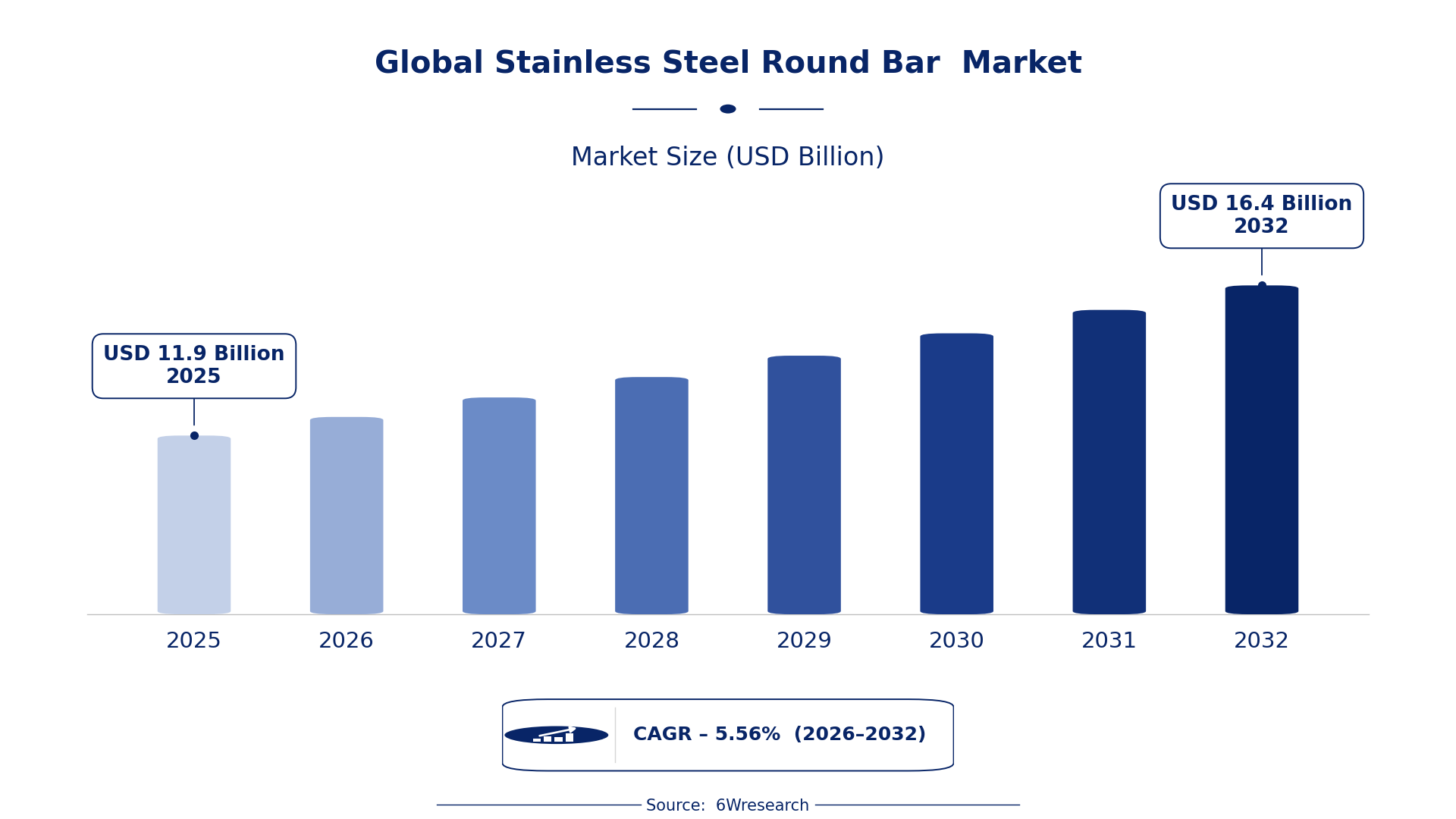
The Global Stainless Steel Round Bar Market was estimated at USD 11.9 Billion in 2025 and is projected to reach USD 16.4 Billion by 2032, growing at a CAGR of 5.56% from 2026 to 2032.
Global Stainless Steel Round Bar Market Synopsis
The Global Stainless Steel Round Bar Market represents a pivotal segment of the metal production landscape, significantly influenced by growth in end-use industries like construction and automotive. With the increasing preference for corrosion resistance and tensile strength in applications ranging from architectural components to automotive parts, the market is witnessing strategic movements toward product innovation.
Particularly in emerging economies, investments in infrastructure are spurring demand for high-quality stainless steel products. This surge is distinguished by rising performance standards and technological advancements in manufacturing processes, propelling the market forward. Such shifts indicate a transformation not only in demand metrics but also in supply chain dynamics, necessitating a reevaluation of existing manufacturing ecosystems.
Global Stainless Steel Round Bar Market Year-wise Growth Rate and Key Drivers
This graph illustrates the annual growth rates of the Global Stainless Steel Round Bar Market from 2022 to 2032, highlighting a steady upward trajectory and projected expansion over the forecast period.
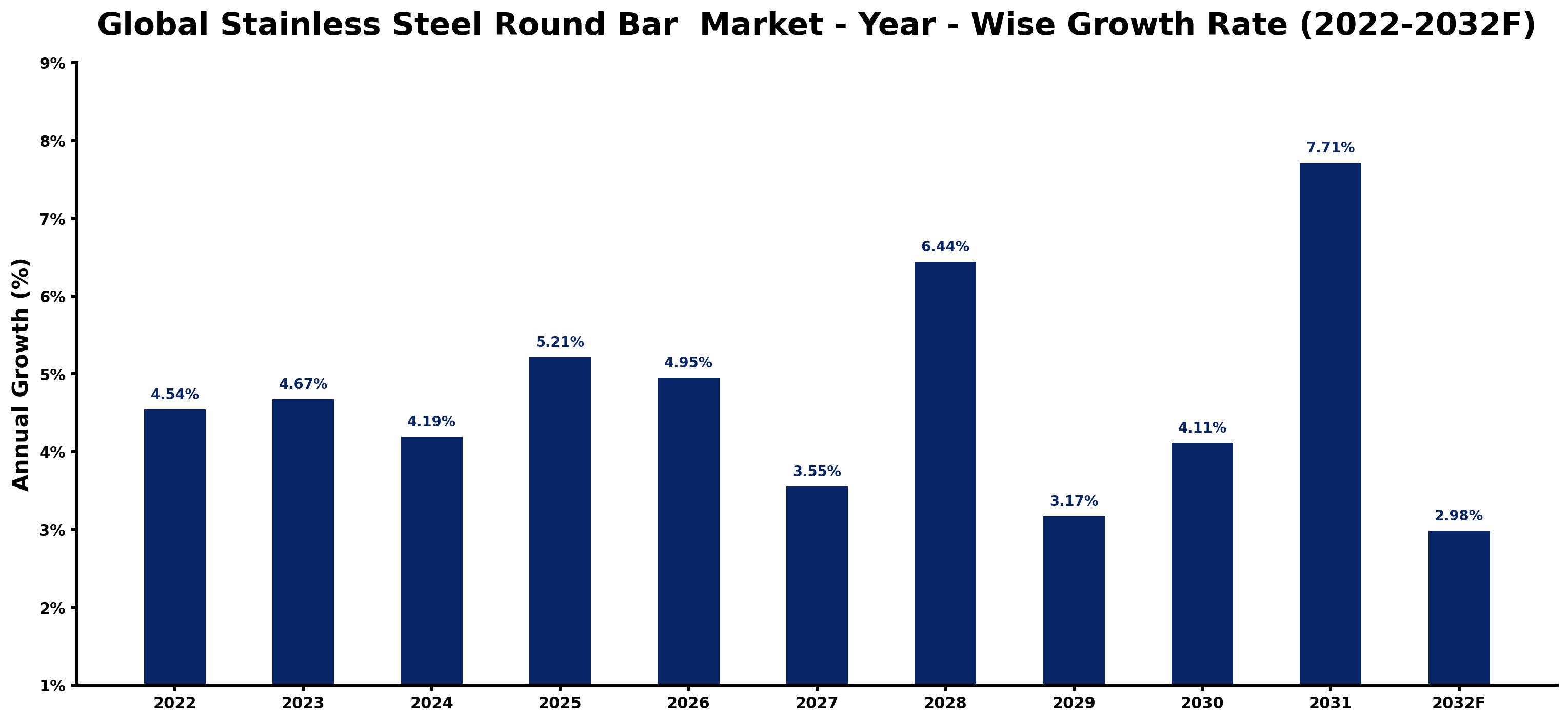
The table below presents the year‑wise growth rates along with the key drivers influencing the market
| Year | Growth Rate (%) | Major Drivers |
| 2022 | 4.54 | Geographic expansion in regions like Asia Pacific encourages stainless steel round bar production. |
| 2023 | 4.67 | Manufacturers are pursuing strategic mergers to enhance stainless steel round bar outputs. |
| 2024 | 4.19 | A shift toward localized sourcing changes the dynamics of stainless steel round bar supply chains. |
| 2025 | 5.21 | Expanding manufacturing capacity enables increased consumption of stainless steel round bars. |
| 2026 | 4.95 | Advanced metallurgical processing techniques streamline operations, enhancing stainless steel round bar quality. |
| 2027 | 3.55 | Construction companies are increasingly choosing stainless steel round bars for their durability and strength. |
| 2028 | 6.44 | As end-user preferences shift, demand for stainless steel round bars escalates significantly. |
| 2029 | 3.17 | In Europe, sustainability requirements push for higher recycling rates of stainless steel round bars. |
| 2030 | 4.11 | Innovations in alloy development optimize stainless steel round bar performance for specialized applications. |
| 2031 | 7.71 | Rising input costs for raw materials lead to fluctuations in stainless steel round bar pricing. |
| 2032 | 2.98 | Steel manufacturers must comply with evolving regulations affecting stainless steel round bar production. |
Note - Market size estimations and growth projections presented in this report are based on 6Wresearch's proprietary research methodology, combining internal industry data, secondary research, and primary validation, updated periodically to reflect current market conditions. As markets evolve rapidly, figures for certain industries may vary slightly and are intended as informed estimates rather than absolute figures. For the most current market sizing, we recommend validating figures with a 6Wresearch analyst.
Global Stainless Steel Round Bar Market Key Takeaways
Below are some of the specific key takeaways from the market, including:
- Asia-Pacific is expected to hold around 42% share in 2025, driven by rapid industrialization and urbanization.
- The Cr-Ni segment commanded a significant market presence, valued at approximately USD 6.4 Billion in 2025, reflecting its wide applicability in numerous sectors.
- Recent trends show a CAGR of 6.2% for High Nickel Alloys from 2026 to 2032, attributed to increased demand in aerospace applications.
- Acerinox has initiated capacity expansion projects, aiming for a 10% increase in production by 2026, enhancing market competitiveness.
Evaluation of Restraints in Global Stainless Steel Round Bar Market
One of the significant restraints facing the Global Stainless Steel Round Bar Market is the volatility in raw material prices, particularly nickel and chromium, which account for about 60% of total manufacturing costs. For instance, fluctuations in nickel prices have seen increases of up to 50% in recent years, directly affecting input costs and profit margins for manufacturers. This situation is exacerbated by tariffs imposed on imported stainless steel products, which can rise as high as 25% in certain markets. Such regulatory hurdles complicate pricing strategies and may deter potential investments, impacting growth trajectories.
Global Stainless Steel Round Bar Market Trends
The Global Stainless Steel Round Bar Market is experiencing a notable shift towards sustainability, particularly through the implementation of circular economy principles. Companies are increasingly adopting recycled materials in their production lines, thus reducing environmental footprints. For example, Thyssenkrupp has committed to a target of transitioning 50% of their steel production to recycled materials by 2030. This aligns with the broader industry trend towards sustainable practices, impacting customer preferences and guiding purchasing decisions. Additionally, advancements in AI and automation in manufacturing processes have transformed operational efficiencies, with some manufacturers reporting cost reductions of up to 30% due to optimized production schedules and waste minimization strategies. Furthermore, regulatory evolution towards stricter environmental compliance drives investment in cleaner technologies, ensuring alignment with international sustainability goals.
Global Stainless Steel Round Bar Market Opportunities
There are considerable future revenue opportunities within the Global Stainless Steel Round Bar Market, particularly in sectors like renewable energy and water management. Companies like Outokumpu are investing heavily in materials tailored for hydrogen production systems, targeting a projected market worth USD 70 Billion by 2030. For instance, their new range of corrosion-resistant bars aims at applications within electrolysis, emphasizing advancements in energy efficiency. Another area growing significantly is the aerospace sector, where the demand for lightweight and durable components is rising, estimated to expand at a CAGR of 7.5% from 2026 to 2032. This trend drives strategic partnerships for product development, as evidenced by Nippon Steel's collaboration with major aerospace manufacturers, propelling innovation in lightweight materials that meet stringent industry specifications.
Global Stainless Steel Round Bar Market by Product
The leading product segment in the Global Stainless Steel Round Bar Market is Cr-Ni, holding an estimated 45% share as of 2025, largely due to its extensive use in automotive and construction applications where durability and corrosion resistance are paramount. Conversely, High Nickel Alloys are highlighted as the fastest-growing segment, anticipated to experience a CAGR of 7.2% from 2026 to 2032, propelled by their critical applications in aerospace, particularly for parts subjected to extreme environments. The growing preference for High Nickel Alloys can be attributed to their superior mechanical properties, making them increasingly favorable for manufacturers aiming to improve component longevity and performance.
Global Stainless Steel Round Bar Market by Region
The Asia-Pacific region stands as the largest market for stainless steel round bars, commanding approximately 50% share in 2025, driven primarily by robust industrial activity and increasing urban infrastructure development. In contrast, Latin America is projected to be the fastest-growing region, expected to achieve a CAGR of 8.1% from 2026 to 2032, fueled by ongoing investments in mining and construction sectors. This growth is further supported by government initiatives aimed at boosting local manufacturing and exports, coupled with an expanding middle-class population that is driving demand for improved infrastructure and appliances.
Government Initiatives in the Global Stainless Steel Round Bar Market
Governmental regulations and initiatives play a pivotal role in shaping the competitive landscape of the Global Stainless Steel Round Bar Market. Policymakers are increasingly aware of the need to support sustainable practices and innovation within the sector, driving investments and incentivizing companies to enhance their operational capabilities.
- The U.S. Department of Energy launched the Advanced Manufacturing Office (AMO) initiative in 2021, promoting funding over USD 40 Million to develop energy-efficient technologies in metal production, benefiting domestic stainless steel manufacturers.
- The European Union's Green Deal, initiated in 2020, mandates stricter emissions reductions in manufacturing, incentivizing companies that enhance production sustainability through grants amounting to EUR 1.2 Billion.
- The Government of India announced the National Steel Policy 2022, aiming to achieve 300 Million tons of production capacity by 2030, promoting investment in sustainability and technological upgrades.
- The Australian Department of Industry, Science, Energy and Resources published the "Steel Manufacturing Industry Profile" in 2023, outlining funding strategies and support mechanisms for innovation in stainless steel production.
Future Insights of the Global Stainless Steel Round Bar Market
As the Global Stainless Steel Round Bar Market approaches 2032, structural shifts are anticipated within manufacturing and competitive strategies. A growing emphasis on eco-friendly practices is prompting companies like Thyssenkrupp to further invest in sustainable production techniques. Their commitment to recycling aims for 50% of their steel output to be derived from recycled materials by 2030. Moreover, advancements in additive manufacturing are projected to evolve product capabilities, fostering customized solutions that meet specific demands in sectors like aerospace and energy. These trends indicate not only significant advancements in technology but also a reshaping of supply chains to adapt to evolving industry standards.
Global Stainless Steel Round Bar Market Latest Developments
Recent initiatives across leading companies in the Global Stainless Steel Round Bar Market are redefining industry capabilities and competitiveness. These developments include:
- Acerinox has recently completed a capacity increase at their facility in Spain, enhancing production efficiency by 15%, aimed at fulfilling rising regional demands.
- Outokumpu is ongoing with a major project launching a new series of high-performance stainless steel round bars tailored for the automotive sector, scheduled for mid-2026.
- Thyssenkrupp has announced an upcoming introduction of a new line of corrosion-resistant bars designed specifically for construction applications, set to hit the market in early 2027.
- Nippon Steel is currently expanding its R&D facilities to focus on lightweight alloys, aiming to develop products that cater to the aerospace industry's technical requirements, expected to be fully operational by late 2025.
Global Stainless Steel Round Bar Market Key Players and Industry Positioning
The competitive structure of the Global Stainless Steel Round Bar Market is moderately consolidated, with several key players dominating market share while facing competition from smaller niche manufacturers. The leaders are actively engaging in strategic partnerships, technological innovations, and capacity enhancements to maintain their positions amid evolving market demands.
| Leading Company | Core Strength | Strategic Focus |
|---|---|---|
| AISI | Strong technical expertise in stainless steel production with a robust supply chain. | Enhancing domestic steel manufacturing capabilities. |
| Thyssenkrupp | Innovation in manufacturing processes, particularly in sustainable practices. | Focus on transitioning to recycled materials for future production. |
| Outokumpu | Expertise in high-performance alloys and tailored solutions. | Aggressive R&D for specialized applications, especially in energy sectors. |
| Acerinox | Extensive manufacturing capacity with low operational costs. | Regional market penetration and capacity expansion initiatives. |
| Nippon Steel | Strong foothold in both domestic and international markets. | Collaboration with aerospace industries to develop lightweight materials. |
Focus within the sector is shifting towards technological advancement and sustainable practices, which are critical to maintaining competitive advantage in the Global Stainless Steel Round Bar Market.
Global Stainless Steel Round Bar Market - Key Attractiveness of the Report
- 10 Years of Market Numbers
- Historical Data Starting from 2022 to 2025
- Base Year: 2025
- Forecast Data until 2032
- Key Performance Indicators Impacting the Market
- Major Upcoming Developments and Projects
Key Highlights of the Report:
- Global Stainless Steel Round Bar Market Outlook
- Market Size of Global Stainless Steel Round Bar Market, 2025
- Forecast of Global Stainless Steel Round Bar Market, 2032
- Historical Data and Forecast of Global Stainless Steel Round Bar Revenues & Volume for the Period 2022-2032
- Global Stainless Steel Round Bar Market Trend Evolution
- Global Stainless Steel Round Bar Market Drivers and Challenges
- Global Stainless Steel Round Bar Price Trends
- Global Stainless Steel Round Bar Porter's Five Forces
- Global Stainless Steel Round Bar Industry Life Cycle
- Historical Data and Forecast of Global Stainless Steel Round Bar Market Revenues & Volume
- Historical Data and Forecast of Global Stainless Steel Round Bar Market Revenues & Volume By Product for the Period 2022-2032
- Historical Data and Forecast of Global Stainless Steel Round Bar Market Revenues & Volume By Cr-Ni for the Period 2022-2032
- Historical Data and Forecast of Global Stainless Steel Round Bar Market Revenues & Volume By Duplex & Super Duplex for the Period 2022-2032
- Historical Data and Forecast of Global Stainless Steel Round Bar Market Revenues & Volume By High Nickel Alloys for the Period 2022-2032
- Historical Data and Forecast of North America Stainless Steel Round Bar Market Revenues & Volume By Product for the Period 2022-2032
- Historical Data and Forecast of North America Stainless Steel Round Bar Market Revenues & Volume By Cr-Ni for the Period 2022-2032
- Historical Data and Forecast of North America Stainless Steel Round Bar Market Revenues & Volume By Duplex & Super Duplex for the Period 2022-2032
- Historical Data and Forecast of North America Stainless Steel Round Bar Market Revenues & Volume By High Nickel Alloys for the Period 2022-2032
- Historical Data and Forecast of United States of America Stainless Steel Round Bar Market Revenues & Volume for the Period 2022-2032
- Historical Data and Forecast of Canada Stainless Steel Round Bar Market Revenues & Volume for the Period 2022-2032
- Historical Data and Forecast of Rest of North America Stainless Steel Round Bar Market Revenues & Volume for the Period 2022-2032
- Historical Data and Forecast of Latin America (LATAM) Stainless Steel Round Bar Market Revenues & Volume By Product for the Period 2022-2032
- Historical Data and Forecast of Latin America (LATAM) Stainless Steel Round Bar Market Revenues & Volume By Cr-Ni for the Period 2022-2032
- Historical Data and Forecast of Latin America (LATAM) Stainless Steel Round Bar Market Revenues & Volume By Duplex & Super Duplex for the Period 2022-2032
- Historical Data and Forecast of Latin America (LATAM) Stainless Steel Round Bar Market Revenues & Volume By High Nickel Alloys for the Period 2022-2032
- Historical Data and Forecast of Brazil Stainless Steel Round Bar Market Revenues & Volume for the Period 2022-2032
- Historical Data and Forecast of Mexico Stainless Steel Round Bar Market Revenues & Volume for the Period 2022-2032
- Historical Data and Forecast of Argentina Stainless Steel Round Bar Market Revenues & Volume for the Period 2022-2032
- Historical Data and Forecast of Rest of LATAM Stainless Steel Round Bar Market Revenues & Volume for the Period 2022-2032
- Historical Data and Forecast of Asia Stainless Steel Round Bar Market Revenues & Volume By Product for the Period 2022-2032
- Historical Data and Forecast of Asia Stainless Steel Round Bar Market Revenues & Volume By Cr-Ni for the Period 2022-2032
- Historical Data and Forecast of Asia Stainless Steel Round Bar Market Revenues & Volume By Duplex & Super Duplex for the Period 2022-2032
- Historical Data and Forecast of Asia Stainless Steel Round Bar Market Revenues & Volume By High Nickel Alloys for the Period 2022-2032
- Historical Data and Forecast of China Stainless Steel Round Bar Market Revenues & Volume for the Period 2022-2032
- Historical Data and Forecast of India Stainless Steel Round Bar Market Revenues & Volume for the Period 2022-2032
- Historical Data and Forecast of Japan Stainless Steel Round Bar Market Revenues & Volume for the Period 2022-2032
- Historical Data and Forecast of Rest of Asia Stainless Steel Round Bar Market Revenues & Volume for the Period 2022-2032
- Historical Data and Forecast of Africa Stainless Steel Round Bar Market Revenues & Volume By Product for the Period 2022-2032
- Historical Data and Forecast of Africa Stainless Steel Round Bar Market Revenues & Volume By Cr-Ni for the Period 2022-2032
- Historical Data and Forecast of Africa Stainless Steel Round Bar Market Revenues & Volume By Duplex & Super Duplex for the Period 2022-2032
- Historical Data and Forecast of Africa Stainless Steel Round Bar Market Revenues & Volume By High Nickel Alloys for the Period 2022-2032
- Historical Data and Forecast of South Africa Stainless Steel Round Bar Market Revenues & Volume for the Period 2022-2032
- Historical Data and Forecast of Nigeria Stainless Steel Round Bar Market Revenues & Volume for the Period 2022-2032
- Historical Data and Forecast of Egypt Stainless Steel Round Bar Market Revenues & Volume for the Period 2022-2032
- Historical Data and Forecast of Rest of Africa Stainless Steel Round Bar Market Revenues & Volume for the Period 2022-2032
- Historical Data and Forecast of Europe Stainless Steel Round Bar Market Revenues & Volume By Product for the Period 2022-2032
- Historical Data and Forecast of Europe Stainless Steel Round Bar Market Revenues & Volume By Cr-Ni for the Period 2022-2032
- Historical Data and Forecast of Europe Stainless Steel Round Bar Market Revenues & Volume By Duplex & Super Duplex for the Period 2022-2032
- Historical Data and Forecast of Europe Stainless Steel Round Bar Market Revenues & Volume By High Nickel Alloys for the Period 2022-2032
- Historical Data and Forecast of United Kingdom Stainless Steel Round Bar Market Revenues & Volume for the Period 2022-2032
- Historical Data and Forecast of France Stainless Steel Round Bar Market Revenues & Volume for the Period 2022-2032
- Historical Data and Forecast of Germany Stainless Steel Round Bar Market Revenues & Volume for the Period 2022-2032
- Historical Data and Forecast of Rest of Europe Stainless Steel Round Bar Market Revenues & Volume for the Period 2022-2032
- Historical Data and Forecast of Middle East Stainless Steel Round Bar Market Revenues & Volume By Product for the Period 2022-2032
- Historical Data and Forecast of Middle East Stainless Steel Round Bar Market Revenues & Volume By Cr-Ni for the Period 2022-2032
- Historical Data and Forecast of Middle East Stainless Steel Round Bar Market Revenues & Volume By Duplex & Super Duplex for the Period 2022-2032
- Historical Data and Forecast of Middle East Stainless Steel Round Bar Market Revenues & Volume By High Nickel Alloys for the Period 2022-2032
- Historical Data and Forecast of Saudi Arabia Stainless Steel Round Bar Market Revenues & Volume for the Period 2022-2032
- Historical Data and Forecast of UAE Stainless Steel Round Bar Market Revenues & Volume for the Period 2022-2032
- Historical Data and Forecast of Turkey Stainless Steel Round Bar Market Revenues & Volume for the Period 2022-2032
- Historical Data and Forecast of Rest of Middle East Stainless Steel Round Bar Market Revenues & Volume for the Period 2022-2032
- Global Stainless Steel Round Bar Market - Key Performance Indicators
- Global Stainless Steel Round Bar Market - Import Export Trade Statistics
- Global Stainless Steel Round Bar Market - Opportunity Assessment By Countries
- Global Stainless Steel Round Bar Market - Opportunity Assessment By Product
- 0
- Global Stainless Steel Round Bar Market - Top Companies Market Share
- Global Stainless Steel Round Bar Market - Top Companies Profiles
- Global Stainless Steel Round Bar Market - Comparison of Players in Technical and Operating Parameters
- Global Stainless Steel Round Bar Market - Strategic Recommendations
Markets Covered
The Global Stainless Steel Round Bar Market report provides a detailed analysis of the following market segments:
By Regions and Countries:
- North America
- Europe
- LATAM
- Middle East
- Asia
- Africa
By Product:
- Cr-Ni
- Duplex & Super Duplex
- High Nickel Alloys






































