Brazil Stainless Steel Round Bar Market Top 5 Importing Countries and Market Competition (HHI) Analysis
In 2024, Brazil continued to witness a significant influx of stainless steel round bar imports, with key exporting countries including Germany, India, USA, China, and Taiwan. The high Herfindahl-Hirschman Index (HHI) indicates a concentrated market, while the impressive Compound Annual Growth Rate (CAGR) of 31.71% from 2020 to 2024 highlights the robust demand. Moreover, the growth rate of 7.92% from 2023 to 2024 suggests a continued upward trajectory in import volumes, underscoring the importance of stainless steel round bars in Brazil`s industrial landscape.
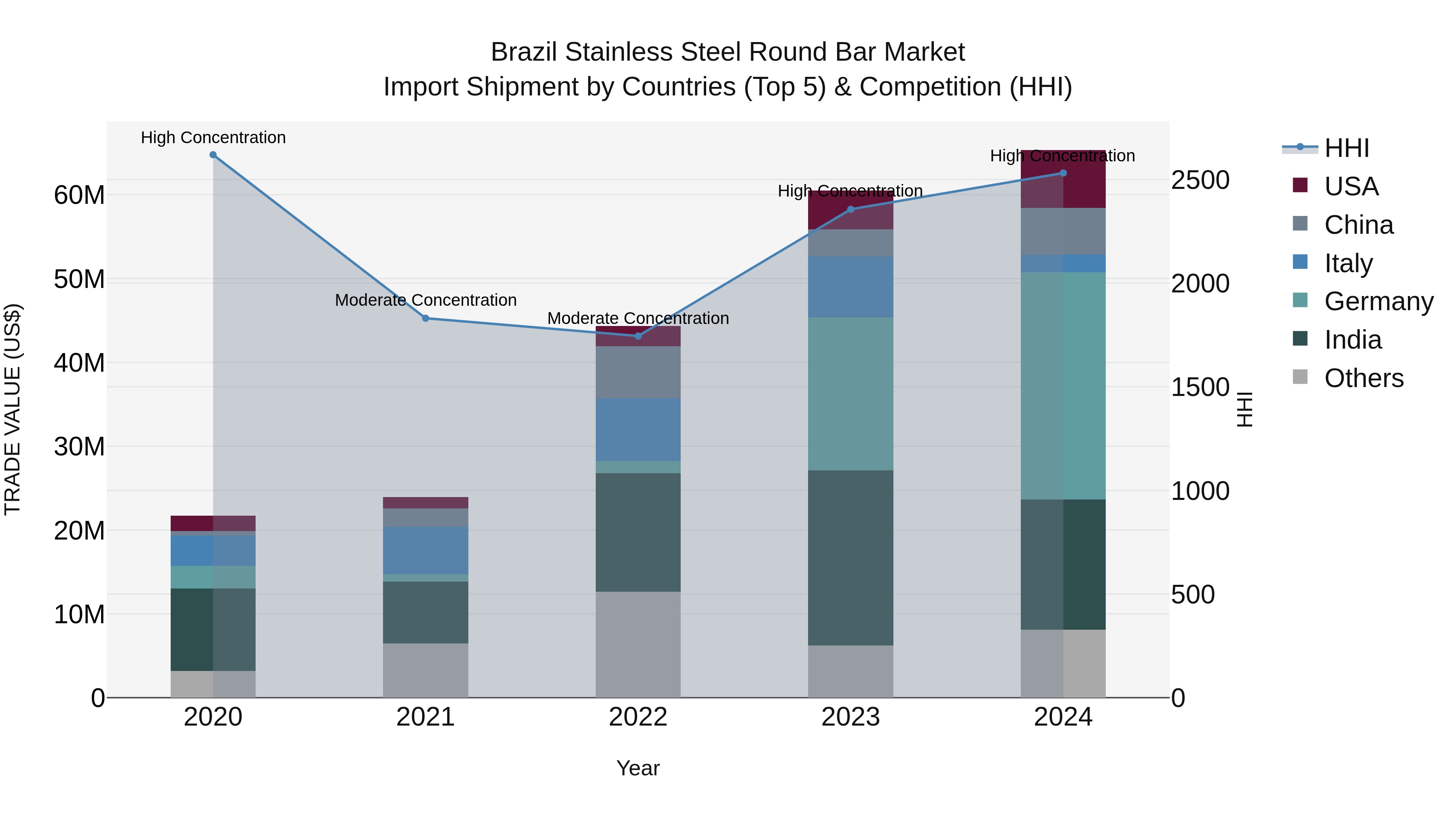
Brazil Stainless Steel Round Bar Market Overview
The stainless steel round bar market in Brazil reflects steady demand from sectors such as construction, manufacturing, and automotive. Stainless steel round bars are valued for their corrosion resistance, durability, and aesthetic appeal, making them essential in various structural and decorative applications.
Drivers of the market
The market for stainless steel round bars is driven by diverse sectors such as construction, manufacturing, and transportation, with factors like urbanization, infrastructure development, and industrial growth shaping demand.
Challenges of the market
Challenges in the stainless steel round bar market of Brazil include fierce competition from international suppliers and the need for stringent quality control measures to meet industry standards. Moreover, fluctuating nickel prices and currency exchange rates pose additional risks.
Government Policy of the market
Policies in the stainless steel round bar market prioritize the development of a robust industrial ecosystem through investment promotion, skills development programs, and market access facilitation. Government initiatives also aim to address challenges related to raw material sourcing and energy efficiency.
Key Highlights of the Report:
- Brazil Stainless Steel Round Bar Market Outlook
- Market Size of Brazil Stainless Steel Round Bar Market, 2024
- Forecast of Brazil Stainless Steel Round Bar Market, 2031
- Historical Data and Forecast of Brazil Stainless Steel Round Bar Revenues & Volume for the Period 2021-2031
- Brazil Stainless Steel Round Bar Market Trend Evolution
- Brazil Stainless Steel Round Bar Market Drivers and Challenges
- Brazil Stainless Steel Round Bar Price Trends
- Brazil Stainless Steel Round Bar Porter's Five Forces
- Brazil Stainless Steel Round Bar Industry Life Cycle
- Historical Data and Forecast of Brazil Stainless Steel Round Bar Market Revenues & Volume By Product for the Period 2021-2031
- Historical Data and Forecast of Brazil Stainless Steel Round Bar Market Revenues & Volume By Cr-Ni for the Period 2021-2031
- Historical Data and Forecast of Brazil Stainless Steel Round Bar Market Revenues & Volume By Duplex & Super Duplex for the Period 2021-2031
- Historical Data and Forecast of Brazil Stainless Steel Round Bar Market Revenues & Volume By High Nickel Alloys for the Period 2021-2031
- Brazil Stainless Steel Round Bar Import Export Trade Statistics
- Market Opportunity Assessment By Product
- Brazil Stainless Steel Round Bar Top Companies Market Share
- Brazil Stainless Steel Round Bar Competitive Benchmarking By Technical and Operational Parameters
- Brazil Stainless Steel Round Bar Company Profiles
- Brazil Stainless Steel Round Bar Key Strategic Recommendations






































