Global Telecommunication Market Highlights
| Market Size (2025) | USD 3100 Billion |
| Forecast Size (2032) | USD 3900 Billion |
| CAGR | 4.20% |
| Base Year | 2025 |
| Forecast Period | 2026-2032 |
| Largest Region | North America |
| Fastest Growing Region | Asia |
| Largest Segment | Services |
| Fastest Growing Segment | Software |
| Leading Companies | AT&T Inc., Verizon Communications Inc., Deutsche Telekom AG, China Mobile Communications Group Co., Ltd., Vodafone Group Plc |
Global Telecommunication Market Size & Growth Rate (2026-2032)
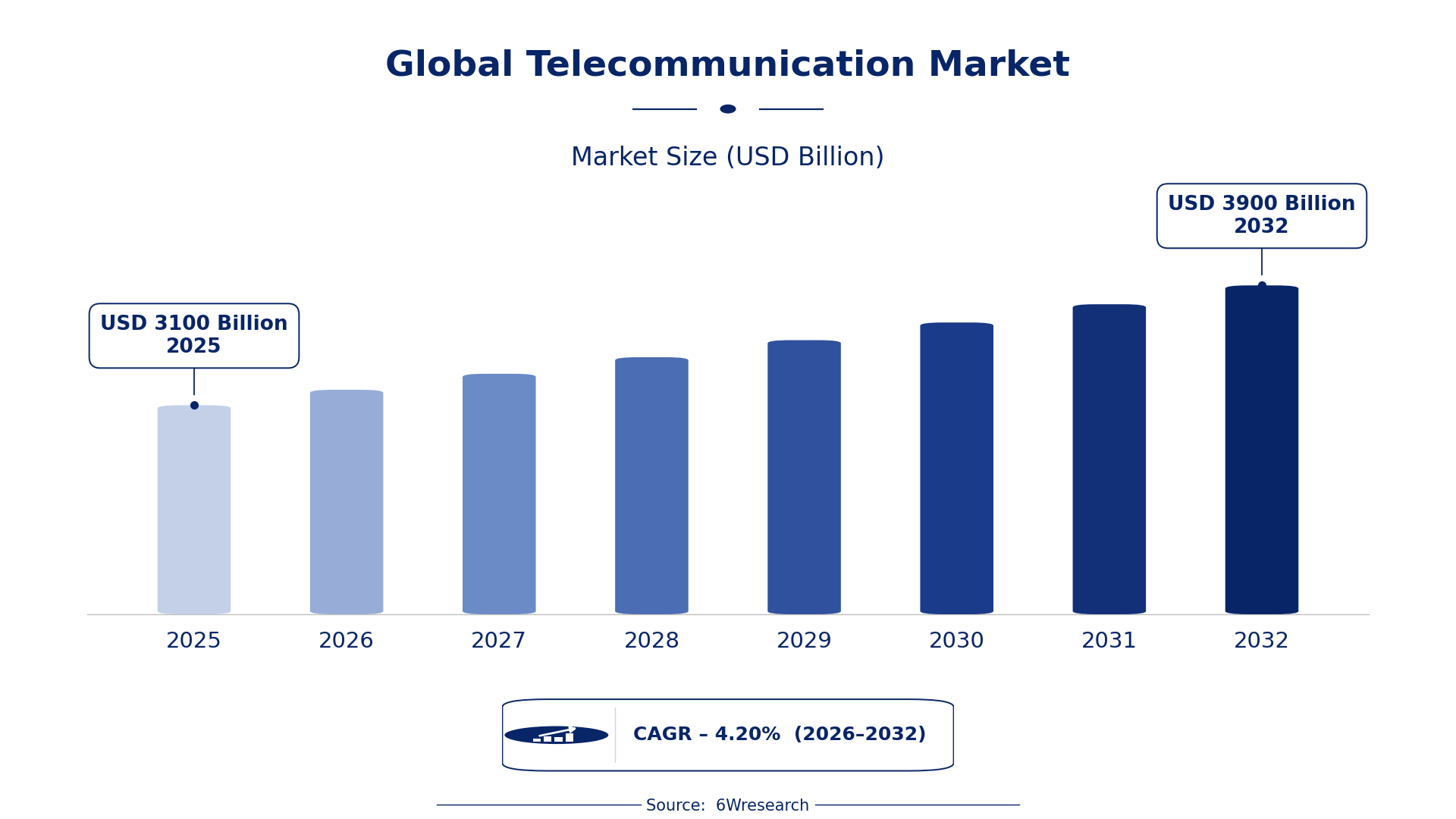
The Global Telecommunication Market was estimated at USD 3100 Billion in 2025 and is projected to reach USD 3900 Billion by 2032, growing at a CAGR of 4.20% from 2026 to 2032.
Global Telecommunication Market Synopsis
The Global Telecommunication Market is undergoing transformative changes, driven by increasing connectivity requirements and the surge in digital services. Major telecom operators are recalibrating their strategies, focusing on 5G technology and Internet of Things (IoT) applications to enhance user experience and operational efficiencies.
This market plays a pivotal role in various sectors, enabling seamless communication and fostering innovation across industries such as healthcare, entertainment, and e-commerce. As businesses increasingly rely on robust telecommunication infrastructure, the demand for reliable connectivity solutions remains paramount.
Global Telecommunication Market Year-wise Growth Rate and Key Drivers
This graph illustrates the annual growth rates of the Global Telecommunication Market from 2022 to 2032, highlighting a steady upward trajectory and projected expansion over the forecast period.
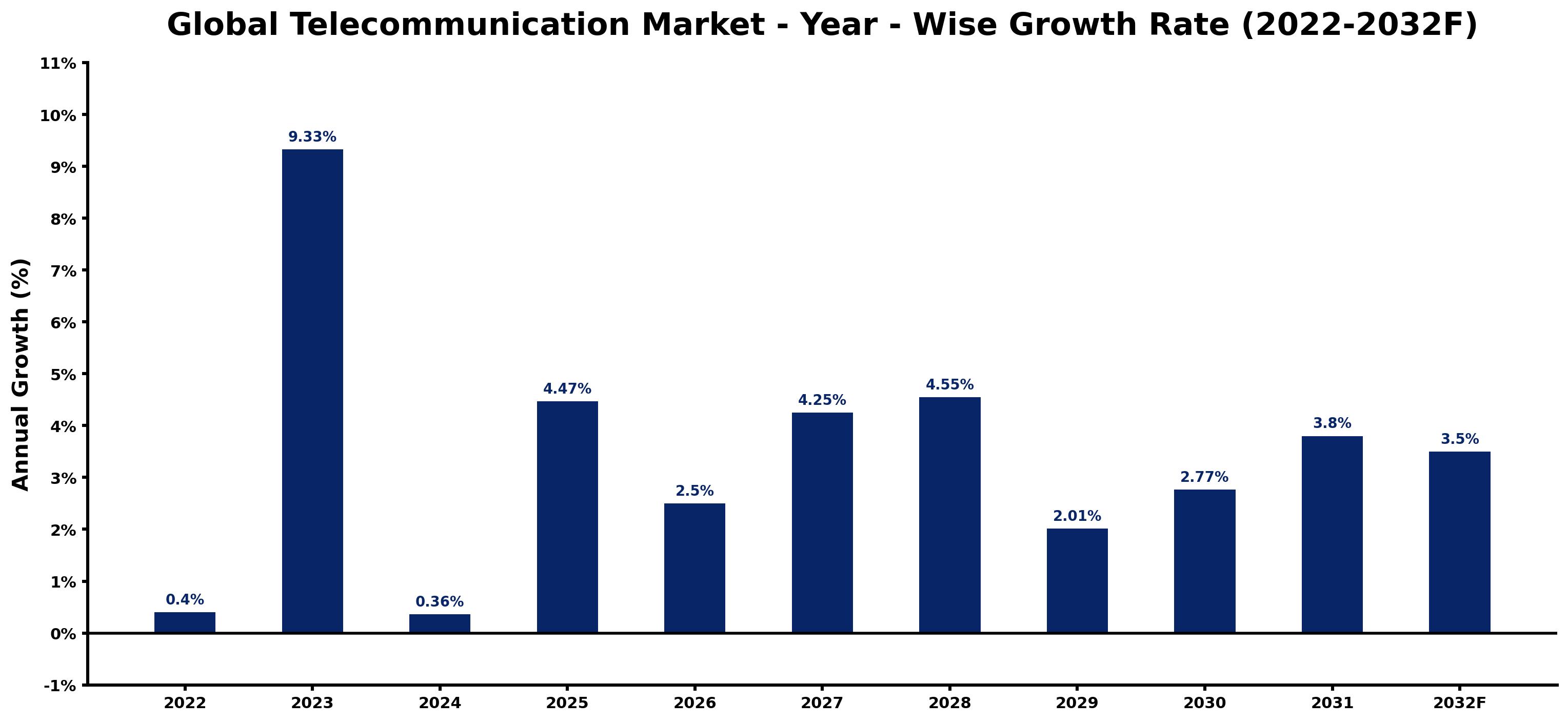
The table below presents the year‑wise growth rates along with the key drivers influencing the market
| Year | Growth Rate (%) | Major Drivers |
| 2022 | 0.4 | A shift toward 5G rollout changes customer engagement and telecom service offerings. |
| 2023 | 9.33 | In North America, telecom companies increasingly prioritize sustainable network infrastructure investments. |
| 2024 | 0.36 | Growing cybersecurity concerns among consumers heighten the need for advanced telecom solutions. |
| 2025 | 4.47 | Rising consumer expectations for high-speed internet drive adoption of fiber-optic buildout. |
| 2026 | 2.5 | As supply chain disruptions affect hardware availability, telecom firms focus on scalability. |
| 2027 | 4.25 | Expanding investment in edge computing technologies enhances telecom data processing capabilities. |
| 2028 | 4.55 | Customers demand more from service providers as regulatory requirements evolve in telecom. |
| 2029 | 2.01 | Consolidation among telecom providers shifts competitive dynamics within the 5G service segment. |
| 2030 | 2.77 | Telecom operators embrace skilled labor trends to enhance service delivery and innovation. |
| 2031 | 3.8 | Manufacturers of telecom equipment adapt to rising raw material costs impacting pricing strategies. |
| 2032 | 3.5 | 6G technology deployment enhances global telecommunication capabilities across emerging markets. |
Note - Market size estimations and growth projections presented in this report are based on 6Wresearch's proprietary research methodology, combining internal industry data, secondary research, and primary validation, updated periodically to reflect current market conditions. As markets evolve rapidly, figures for certain industries may vary slightly and are intended as informed estimates rather than absolute figures. For the most current market sizing, we recommend validating figures with a 6Wresearch analyst.
Global Telecommunication Market Key Takeaways
Below are some of the specific key takeaways from the market, including:
- North America accounted for approximately 45% of the global market share in 2025, benefitting from advanced infrastructure and high consumer demand.
- The software segment is expected to grow at a CAGR of 6.5% from 2026 to 2032, fueled by advancements in cloud solutions and application services.
- In 2025, AT&T Inc. reported revenues of nearly USD 170 Billion, affirming its position as a leading telecom entity.
- The introduction of ubiquitous 5G coverage is projected to reduce latency in communications by over 90%, enhancing real-time data exchange.
Evaluation of Restraints in Global Telecommunication Market
Despite its robust growth, the Global Telecommunication Market faces critical restraints, including high infrastructure development costs. For example, deploying 5G technology has required investments exceeding USD 200 Billion in the U.S. alone, which presents a barrier for some smaller operators. Additionally, increasing regulatory compliance requirements across different jurisdictions complicate multinational operations and raise operational expenses.
Global Telecommunication Market Trends
One dominant trend is the proliferation of 5G technology among major telecom operators, which significantly enhances data speed and capacity. Verizon Communications Inc. rolled out full 5G coverage in major metropolitan areas in 2021, catalyzing a shift towards next-generation applications, including remote surgeries and augmented reality. Another observable trend is the increasing integration of AI-driven analytics, which enables telecom companies to optimize network performance. For instance, Deutsche Telekom AG has successfully implemented AI to reduce downtimes by about 30%. Furthermore, the rise of over-the-top (OTT) services is reshaping revenue models, compelling traditional telecom providers to adapt or partner with cloud-based content delivery platforms.
Global Telecommunication Market Opportunities
The evolving landscape presents ample opportunities, particularly in IoT applications anticipated to hit USD 1 trillion by 2026. Companies such as China Mobile are investing heavily in smart city initiatives, projecting to implement over 100 million connected devices within urban infrastructure by 2025. Additionally, the acceleration of remote and hybrid work models fosters demand for cloud-based communication services, with forecasts suggesting that these could account for nearly 35% of total market revenue by 2032. Ultimately, telecom firms venturing into these sectors stand to capitalize on significant future revenues.
Global Telecommunication Market by Type
In the Global Telecommunication Market, the Services segment leads with an approximately 70% share in 2025, as users increasingly demand reliable connectivity. Meanwhile, the Software segment is recognized as the fastest-growing segment, exhibiting a CAGR of 6.5% from 2026 to 2032, driven by the surge in cloud-based applications and integrated telecommunications solutions.
Global Telecommunication Market by Large
Among business sizes, Large enterprises dominate with a commanding share of about 60% in 2025 as they leverage advanced telecom infrastructure for global operations. Conversely, the SMEs segment is expected to grow at a CAGR of 5.0% from 2026 to 2032, largely attributed to increasing digitalization efforts aimed at enhancing communication and collaboration.
Global Telecommunication Market by Region
North America remains the largest region, commanding approximately 45% of the overall market share in 2025 due to its mature telecom infrastructure and high penetration of advanced services. In contrast, Asia is projected to be the fastest-growing region, boasting a CAGR of 5.5% from 2026 to 2032, spurred by rapid digital adoption, increasing mobile penetration, and government initiatives promoting technological advancement.
Government Initiatives in the Global Telecommunication Market
The regulatory environment for the Global Telecommunication Market is evolving towards encouraging innovation and enhancing infrastructure development. Governments worldwide are implementing various policies that have profound implications for investment and operational frameworks across the sector.
- Federal Communications Commission (FCC), Rural Digital Opportunity Fund, 2020 - Aims to support broadband expansion in underserved rural areas, facilitating connections for millions.
- European Commission, Digital Compass 2030, 2021 - Focuses on ensuring secure, sustainable, and high-speed connectivity across Europe by investing EUR 150 billion.
- Ministry of Electronics and Information Technology, National Policy on Electronics, 2019 - Authorizes various incentives, aiming to boost local telecom manufacturing and reduce dependency on imports.
- Telecommunications Regulatory Authority of India (TRAI), National Broadband Plan, 2022 - Seeks a comprehensive rollout of broadband services across India, with a target to connect 100 million new subscribers by 2025.
Future Insights of the Global Telecommunication Market
The Global Telecommunication Market is likely to experience transformative shifts by 2032, particularly with the expansion of 5G networks and increased investments in IoT applications. Following a trend initiated by companies like China Mobile, which plans to integrate over 100 million IoT devices in urban infrastructures, there will be a marked increase in interconnected devices. Additionally, telecom entities are expected to pivot towards cloud-based solutions to enhance operational capabilities, enabling them to support a multitude of sectors and optimizing service delivery.
Global Telecommunication Market Latest Developments
Recent developments within the Global Telecommunication Market showcase a commitment to technological advancement and regional expansion among leading players.
- Recently, Verizon Communications Inc. announced the implementation of next-gen mobile edge computing, enhancing application responsiveness and reducing latency. This shift is pivotal for real-time applications across several industries.
- In Q3 2023, Deutsche Telekom AG is expanding its fiber optics network into rural areas, directly addressing connectivity gaps and increasing service availability in underserved regions.
- In early 2024, AT&T Inc. is set to launch a new platform leveraging AI for network management aimed at reducing operational expenses and enhancing user experience.
- Vodafone Group Plc is actively investing in renewable energy solutions for telecom infrastructure, facilitating a more sustainable operation while meeting rising environmental standards projected through 2032.
Global Telecommunication Market Key Players and Industry Positioning
The competitive landscape of the Global Telecommunication Market is characterized by a mix of consolidation and fragmentation. Major players dominate with advanced technologies, but emerging tech firms also contribute to innovations, making the sector dynamic.
| Leading Company | Core Strength | Strategic Focus |
|---|---|---|
| AT&T Inc. | Extensive network infrastructure | AI integration for operational efficiency |
| Verizon Communications Inc. | Cutting-edge 5G deployment | Expansion of mobile edge computing |
| Deutsche Telekom AG | Strong fiber optics offerings | Rural broadband expansion initiatives |
| China Mobile Communications Group Co., Ltd. | Massive IoT project implementations | Smart city development strategies |
| Vodafone Group Plc | Sustainable telecom initiatives | Investment in green energy solutions |
Given the focus on technological enhancements and sustainability, the competitive strategies of these firms indicate a broader trend towards innovation and responsible corporate practices within the industry.
Key Attractiveness of the Report
- 10 Years of Market Numbers
- Historical Data Starting from 2022 to 2025
- Base Year: 2025
- Forecast Data until 2032
- Key Performance Indicators Impacting the Market
- Major Upcoming Developments and Projects
Key Highlights of the Report:
- Global Telecommunication Market Outlook
- Market Size of Global Telecommunication Market, 2025
- Forecast of Global Telecommunication Market, 2032
- Historical Data and Forecast of Global Telecommunication Revenues & Volume for the Period 2022-2032
- Global Telecommunication Market Trend Evolution
- Global Telecommunication Market Drivers and Challenges
- Global Telecommunication Price Trends
- Global Telecommunication Porter's Five Forces
- Global Telecommunication Industry Life Cycle
- Historical Data and Forecast of Global Telecommunication Market Revenues & Volume
- Historical Data and Forecast of Global Telecommunication Market Revenues & Volume By Type for the Period 2022-2032
- Historical Data and Forecast of Global Telecommunication Market Revenues & Volume By Hardware for the Period 2022-2032
- Historical Data and Forecast of Global Telecommunication Market Revenues & Volume By Software for the Period 2022-2032
- Historical Data and Forecast of Global Telecommunication Market Revenues & Volume By Services for the Period 2022-2032
- Historical Data and Forecast of Global Telecommunication Market Revenues & Volume By Large for the Period 2022-2032
- Historical Data and Forecast of Global Telecommunication Market Revenues & Volume By SMEs for the Period 2022-2032
- Historical Data and Forecast of Global Telecommunication Market Revenues & Volume By Large for the Period 2022-2032
- Historical Data and Forecast of North America Telecommunication Market Revenues & Volume By Type for the Period 2022-2032
- Historical Data and Forecast of North America Telecommunication Market Revenues & Volume By Hardware for the Period 2022-2032
- Historical Data and Forecast of North America Telecommunication Market Revenues & Volume By Software for the Period 2022-2032
- Historical Data and Forecast of North America Telecommunication Market Revenues & Volume By Services for the Period 2022-2032
- Historical Data and Forecast of North America Telecommunication Market Revenues & Volume By Large for the Period 2022-2032
- Historical Data and Forecast of North America Telecommunication Market Revenues & Volume By SMEs for the Period 2022-2032
- Historical Data and Forecast of North America Telecommunication Market Revenues & Volume By Large for the Period 2022-2032
- Historical Data and Forecast of United States of America Telecommunication Market Revenues & Volume for the Period 2022-2032
- Historical Data and Forecast of Canada Telecommunication Market Revenues & Volume for the Period 2022-2032
- Historical Data and Forecast of Rest of North America Telecommunication Market Revenues & Volume for the Period 2022-2032
- Historical Data and Forecast of Latin America (LATAM) Telecommunication Market Revenues & Volume By Type for the Period 2022-2032
- Historical Data and Forecast of Latin America (LATAM) Telecommunication Market Revenues & Volume By Hardware for the Period 2022-2032
- Historical Data and Forecast of Latin America (LATAM) Telecommunication Market Revenues & Volume By Software for the Period 2022-2032
- Historical Data and Forecast of Latin America (LATAM) Telecommunication Market Revenues & Volume By Services for the Period 2022-2032
- Historical Data and Forecast of Latin America (LATAM) Telecommunication Market Revenues & Volume By Large for the Period 2022-2032
- Historical Data and Forecast of Latin America (LATAM) Telecommunication Market Revenues & Volume By SMEs for the Period 2022-2032
- Historical Data and Forecast of Latin America (LATAM) Telecommunication Market Revenues & Volume By Large for the Period 2022-2032
- Historical Data and Forecast of Brazil Telecommunication Market Revenues & Volume for the Period 2022-2032
- Historical Data and Forecast of Mexico Telecommunication Market Revenues & Volume for the Period 2022-2032
- Historical Data and Forecast of Argentina Telecommunication Market Revenues & Volume for the Period 2022-2032
- Historical Data and Forecast of Rest of LATAM Telecommunication Market Revenues & Volume for the Period 2022-2032
- Historical Data and Forecast of Asia Telecommunication Market Revenues & Volume By Type for the Period 2022-2032
- Historical Data and Forecast of Asia Telecommunication Market Revenues & Volume By Hardware for the Period 2022-2032
- Historical Data and Forecast of Asia Telecommunication Market Revenues & Volume By Software for the Period 2022-2032
- Historical Data and Forecast of Asia Telecommunication Market Revenues & Volume By Services for the Period 2022-2032
- Historical Data and Forecast of Asia Telecommunication Market Revenues & Volume By Large for the Period 2022-2032
- Historical Data and Forecast of Asia Telecommunication Market Revenues & Volume By SMEs for the Period 2022-2032
- Historical Data and Forecast of Asia Telecommunication Market Revenues & Volume By Large for the Period 2022-2032
- Historical Data and Forecast of China Telecommunication Market Revenues & Volume for the Period 2022-2032
- Historical Data and Forecast of India Telecommunication Market Revenues & Volume for the Period 2022-2032
- Historical Data and Forecast of Japan Telecommunication Market Revenues & Volume for the Period 2022-2032
- Historical Data and Forecast of Rest of Asia Telecommunication Market Revenues & Volume for the Period 2022-2032
- Historical Data and Forecast of Africa Telecommunication Market Revenues & Volume By Type for the Period 2022-2032
- Historical Data and Forecast of Africa Telecommunication Market Revenues & Volume By Hardware for the Period 2022-2032
- Historical Data and Forecast of Africa Telecommunication Market Revenues & Volume By Software for the Period 2022-2032
- Historical Data and Forecast of Africa Telecommunication Market Revenues & Volume By Services for the Period 2022-2032
- Historical Data and Forecast of Africa Telecommunication Market Revenues & Volume By Large for the Period 2022-2032
- Historical Data and Forecast of Africa Telecommunication Market Revenues & Volume By SMEs for the Period 2022-2032
- Historical Data and Forecast of Africa Telecommunication Market Revenues & Volume By Large for the Period 2022-2032
- Historical Data and Forecast of South Africa Telecommunication Market Revenues & Volume for the Period 2022-2032
- Historical Data and Forecast of Nigeria Telecommunication Market Revenues & Volume for the Period 2022-2032
- Historical Data and Forecast of Egypt Telecommunication Market Revenues & Volume for the Period 2022-2032
- Historical Data and Forecast of Rest of Africa Telecommunication Market Revenues & Volume for the Period 2022-2032
- Historical Data and Forecast of Europe Telecommunication Market Revenues & Volume By Type for the Period 2022-2032
- Historical Data and Forecast of Europe Telecommunication Market Revenues & Volume By Hardware for the Period 2022-2032
- Historical Data and Forecast of Europe Telecommunication Market Revenues & Volume By Software for the Period 2022-2032
- Historical Data and Forecast of Europe Telecommunication Market Revenues & Volume By Services for the Period 2022-2032
- Historical Data and Forecast of Europe Telecommunication Market Revenues & Volume By Large for the Period 2022-2032
- Historical Data and Forecast of Europe Telecommunication Market Revenues & Volume By SMEs for the Period 2022-2032
- Historical Data and Forecast of Europe Telecommunication Market Revenues & Volume By Large for the Period 2022-2032
- Historical Data and Forecast of United Kingdom Telecommunication Market Revenues & Volume for the Period 2022-2032
- Historical Data and Forecast of France Telecommunication Market Revenues & Volume for the Period 2022-2032
- Historical Data and Forecast of Germany Telecommunication Market Revenues & Volume for the Period 2022-2032
- Historical Data and Forecast of Rest of Europe Telecommunication Market Revenues & Volume for the Period 2022-2032
- Historical Data and Forecast of Middle East Telecommunication Market Revenues & Volume By Type for the Period 2022-2032
- Historical Data and Forecast of Middle East Telecommunication Market Revenues & Volume By Hardware for the Period 2022-2032
- Historical Data and Forecast of Middle East Telecommunication Market Revenues & Volume By Software for the Period 2022-2032
- Historical Data and Forecast of Middle East Telecommunication Market Revenues & Volume By Services for the Period 2022-2032
- Historical Data and Forecast of Middle East Telecommunication Market Revenues & Volume By Large for the Period 2022-2032
- Historical Data and Forecast of Middle East Telecommunication Market Revenues & Volume By SMEs for the Period 2022-2032
- Historical Data and Forecast of Middle East Telecommunication Market Revenues & Volume By Large for the Period 2022-2032
- Historical Data and Forecast of Saudi Arabia Telecommunication Market Revenues & Volume for the Period 2022-2032
- Historical Data and Forecast of UAE Telecommunication Market Revenues & Volume for the Period 2022-2032
- Historical Data and Forecast of Turkey Telecommunication Market Revenues & Volume for the Period 2022-2032
- Historical Data and Forecast of Rest of Middle East Telecommunication Market Revenues & Volume for the Period 2022-2032
- Global Telecommunication Market - Key Performance Indicators
- Global Telecommunication Market - Import Export Trade Statistics
- Global Telecommunication Market - Opportunity Assessment By Countries
- Global Telecommunication Market - Opportunity Assessment By Type
- Global Telecommunication Market - Opportunity Assessment By Large
- Global Telecommunication Market - Top Companies Market Share
- Global Telecommunication Market - Top Companies Profiles
- Global Telecommunication Market - Comparison of Players in Technical and Operating Parameters
- Global Telecommunication Market - Strategic Recommendations
Markets Covered
The Global Telecommunication Market report provides a detailed analysis of the following market segments:
By Regions and Countries:
- North America
- Europe
- LATAM
- Middle East
- Asia
- Africa
By Type:
- Hardware
- Software
- Services
By Large:
- SMEs
- Large






































