Global Tinned Fish & Seafood Market Highlights
| Market Size (2025) | USD 12 Billion |
| Forecast Size (2032) | USD 16.5 Billion |
| CAGR | 6.90% |
| Base Year | 2025 |
| Forecast Period | 2026-2032 |
| Largest Region | Europe |
| Fastest Growing Region | Asia Pacific |
| Largest Segment | Tuna |
| Fastest Growing Segment | Salmon |
| Leading Companies | Thai Union Group, Mowi ASA, Dongwon Industries, Canned Foods Holdings, and Ocean Brands |
Global Tinned Fish & Seafood Market Size & Growth Rate (2026-2032)
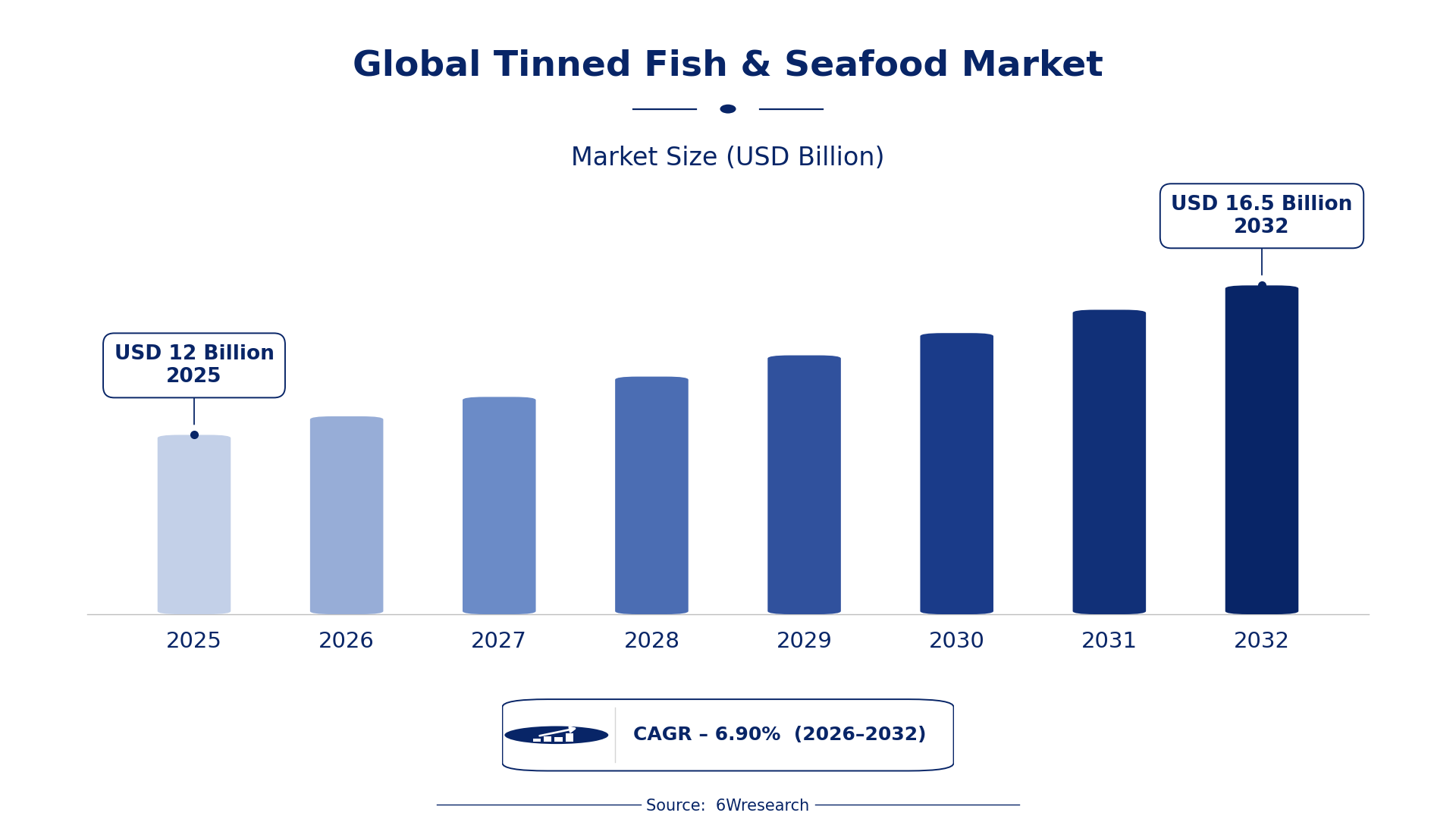
The Global Tinned Fish & Seafood Market was estimated at USD 12 Billion in 2025 and is projected to reach USD 16.5 Billion by 2032, growing at a CAGR of 6.90% from 2026 to 2032.
Global Tinned Fish & Seafood Market Synopsis
The market for tinned fish and seafood is on a transformative path, bolstered by changing consumer lifestyles and a notable preference for convenient food options. A surge in health-focused diets and a growing inclination towards quick, ready-to-eat meals are reshaping the demand dynamics, particularly in urban centres where meal preparation time is at a premium.
In parallel, the sector is witnessing significant innovations in product formulations and packaging. Premium and gourmet offerings are becoming increasingly available to satisfy discerning consumers. Brands are now emphasising sustainable practices, appealing to eco-conscious buyers, thus distinguishing the tinned fish and seafood sector from adjacent markets like frozen or fresh seafood, which face different challenges.
Global Tinned Fish & Seafood Market Year-wise Growth Rate and Key Drivers
This graph illustrates the annual growth rates of the Global Tinned Fish & Seafood Market from 2022 to 2032, highlighting a steady upward trajectory and projected expansion over the forecast period.
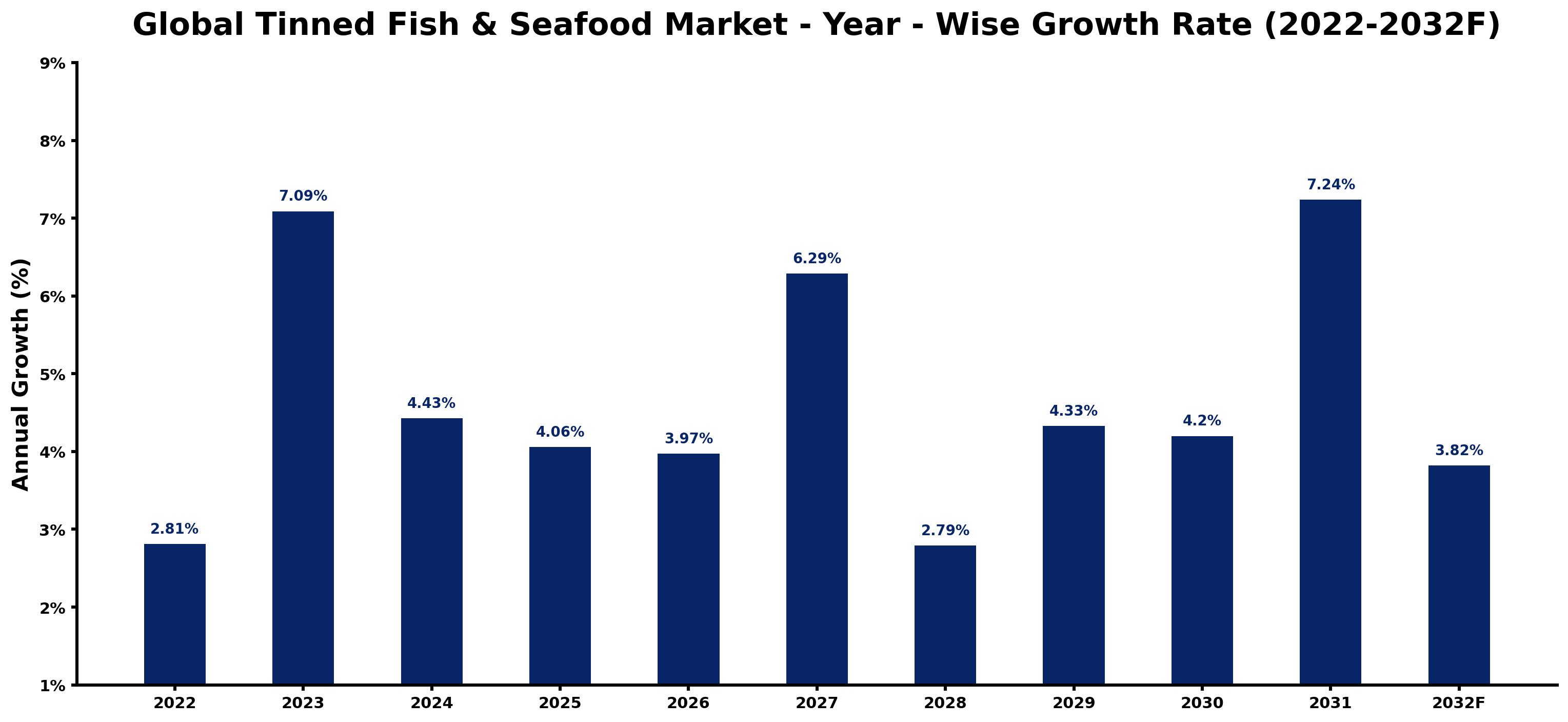
The table below presents the year‑wise growth rates along with the key drivers influencing the market
| Year | Growth Rate (%) | Major Drivers |
| 2022 | 2.81 | Consumers increasingly favor tinned fish options due to innovative clean-label formulations. |
| 2023 | 7.09 | In North America, tinned seafood brands benefit from expanded retail distribution channels. |
| 2024 | 4.43 | Acquisitions among seafood companies are enhancing brand portfolios and market reach for tinned products. |
| 2025 | 4.06 | A shift toward sustainable packaging practices enhances consumer interest in tinned fish offerings. |
| 2026 | 3.97 | Canned seafood products resonate with consumers seeking convenient, high-protein meal solutions. |
| 2027 | 6.29 | Increasing health-conscious eating trends among consumers elevate the appeal of nutrient-dense tinned seafood. |
| 2028 | 2.79 | Manufacturers face challenges from fluctuating supply chain dynamics impacting tinned fish production costs. |
| 2029 | 4.33 | New sustainability regulations are driving innovation in eco-friendly packaging for tinned seafood. |
| 2030 | 4.2 | Rising private-label competition in retail outlets pressures established tinned fish brands to innovate. |
| 2031 | 7.24 | As raw material costs fluctuate, manufacturers of tinned fish adjust pricing strategies accordingly. |
| 2032 | 3.82 | Retail distributors are increasingly investing in skilled workforce training for tinned seafood sales. |
Note - Market size estimations and growth projections presented in this report are based on 6Wresearch's proprietary research methodology, combining internal industry data, secondary research, and primary validation, updated periodically to reflect current market conditions. As markets evolve rapidly, figures for certain industries may vary slightly and are intended as informed estimates rather than absolute figures. For the most current market sizing, we recommend validating figures with a 6Wresearch analyst.
Global Tinned Fish & Seafood Market Key Takeaways
Below are some of the specific key takeaways from the market, including:
- As of 2025, Europe holds approximately ~50% share of the Global Tinned Fish & Seafood Market, leveraging a strong consumption culture and extensive distribution networks.
- The salmon segment is projected to experience a robust CAGR of 8.2% from 2026 to 2032, responding to rising consumer interest in healthy protein sources.
- Mowi ASA, a leader in the seafood sector, reported a revenue increase of 10% year-on-year in 2023, showcasing strong market presence and consumer trust.
- E-commerce contributions are expected to rise by 20% as companies expand online sales channels to tap into the growing digital consumer base.
- Consumer preference for sustainably sourced seafood has led to a 15% increase in brands adopting eco-label certifications to meet market demands.
Evaluation of Restraints in Global Tinned Fish & Seafood Market
The Global Tinned Fish & Seafood Market faces several restraints that can hinder growth trajectories. Notably, the stigma surrounding tinned fish as a lower-quality alternative to fresh options can deter purchase decisions, affecting market confidence. Additionally, rising operational costs are a concern; for instance, transportation and raw material expenses have surged by approximately 12% over the last two years, directly impacting profitability. Regulatory pressures are also tightening, with new sustainability policies adding compliance costs. For example, the EU’s Green Deal has set stringent targets for fisheries, compelling companies to invest heavily in sustainable practices to comply.
Global Tinned Fish & Seafood Market Trends
A significant trend reshaping the Global Tinned Fish & Seafood Market is the increasing automation of production processes. Manufacturers like Thai Union Group have adopted AI-driven systems, enhancing efficiency and reducing labor costs. For example, their latest facility in Thailand employs robotic packaging technology, resulting in a 30% improvement in operational productivity since its launch in early 2022. Furthermore, there's an escalating shift towards premiumization in product offerings. Consumers seek gourmet tinned seafood options, driving brands to innovate flavors and create artisanal products that elevate the tinned seafood experience. This trend is evident with Ocean Brands’ launch of their new premium line, which has seen a 25% uptake since release.
Global Tinned Fish & Seafood Market Opportunities
Emerging opportunities within the Global Tinned Fish & Seafood Market hinge significantly on sustainable product development. Companies are increasingly focusing on eco-friendly packaging and responsibly sourced seafood to capture environmentally aware consumers. For instance, the move towards biodegradable packaging solutions has become a focal point for companies like Dongwon Industries, with a projected investment of USD 10 million into R&D for eco-friendly materials by 2025. Additionally, the rise of the health-centric consumer provides avenues for fortified tinned products, capable of delivering enriched nutritional benefits. This segment is projected to grow at a CAGR of 8.0% from 2026 to 2032, driven by new product introductions aimed at health-conscious consumers.
Global Tinned Fish & Seafood Market by Type
As of 2025, the largest segment within the Global Tinned Fish & Seafood Market is tuna, commanding approximately ~42% share in 2025. Tuna's widespread acceptance as a nutritious, versatile food product ensures steady demand across various consumer categories. On the other hand, the fastest-growing segment is salmon, which is projected to demonstrate a CAGR of 8.2% from 2026 to 2032. This growth trajectory can be attributed to shifting consumer preferences towards fatty fish, recognized for their health benefits, which inclusively contributes to both culinary innovation and premium offerings.
Global Tinned Fish & Seafood Market by Application
In terms of application, the residential segment is the largest, with ~60% share in 2025. This dominance is mainly due to rising home cooking trends bolstered by increasing awareness of nutritious meals. Conversely, the commercial segment is the fastest-growing, projected to see a CAGR of 7.5% from 2026 to 2032, as more restaurants and food service companies adapt to consumer preferences for ready-to-eat, quality options that can be efficiently served without extensive preparation.
Global Tinned Fish & Seafood Market by Region
Europe is the largest region in the Global Tinned Fish & Seafood Market, accounting for approximately ~50% share in 2025, driven by established consumer habits and extensive distribution networks that facilitate easy access to products. Conversely, Asia Pacific is the fastest-growing region, projected to achieve a CAGR of 8.3% from 2026 to 2032. Factors contributing to this growth include urbanization, increased disposable income, and an expanding appetite for diverse seafood options, which all foster a conducive environment for rising consumption rates.
Government Initiatives in the Global Tinned Fish & Seafood Market
The regulatory landscape for the Global Tinned Fish & Seafood Market is evolving, with governments implementing various initiatives aimed at promoting sustainability and responsible fishing practices. These initiatives not only shape operational parameters but also influence competitive dynamics within the industry.
- European Commission, "Common Fisheries Policy," Implemented in 2013 - This policy aims to maintain sustainable fish stocks while promoting economically viable fishing, directly impacting seafood supply chains.
- U.S. Department of Agriculture, "Seafood Inspection Program," Established in 1997 - Enhances food safety and quality in seafood products, thereby improving market confidence and promoting higher standards.
- Food Standards Australia New Zealand, "Food Standards Code," Updated in 2021 - This initiative establishes safety standards and labeling requirements influencing consumer choices and encouraging transparency in sourcing.
- Ministry of Agriculture, Fisheries and Food (Spain), "Sustainable Fisheries Plan," Proposed for 2024 - Aiming to increase support for sustainable fishing practices, which may lead to enhanced market opportunities for compliant producers.
Future Insights of the Global Tinned Fish & Seafood Market
The Global Tinned Fish & Seafood Market is set to experience transformative shifts driven by advancements in manufacturing technology and evolving consumer behaviors. With brands like Ocean Brands focusing on premium, health-oriented product lines, a notable shift towards fortified tinned options rich in nutrients is anticipated. Additionally, sustainability initiatives will define future competitive dynamics, as companies like Dongwon Industries invest significantly in eco-friendly packaging solutions. By 2032, the integration of smart supply chains may elevate operational efficiencies, further influencing pricing and market competitiveness.
Global Tinned Fish & Seafood Market Latest Developments
Recent developments in the Global Tinned Fish & Seafood Market highlight companies' strategic responses to consumer trends and sustainability pressures. The following are significant actions taken by key players:
- In early 2023, Mowi ASA launched a new line of premium tinned salmon enriched with Omega-3, aiming to capture health-conscious consumers and enhance its product portfolio.
- Recently completed in late 2022, Thai Union Group expanded its production facility in Thailand, increasing operational capacity for tinned tuna by 25%, thus improving supply chain resilience.
- Upcoming in mid-2024, Dongwon Industries plans to introduce a new line of sustainably sourced canned seafood featuring biodegradable packaging, reflecting a shift towards environmental responsibility.
- Ongoing since early 2023, Ocean Brands has been collaborating with local fisheries to adopt traceability technology that boosts transparency in sourcing, aiming to satisfy eco-conscious consumers.
Global Tinned Fish & Seafood Market Key Players and Industry Positioning
The competitive structure of the Global Tinned Fish & Seafood Market is moderately consolidated, with a few key players dominating through strategic investments in sustainability and product innovation. Larger firms leverage economies of scale, while smaller entities innovate niche offerings. This dynamic fosters a competitive landscape where consumer preferences for quality and sustainability increasingly dictate market success.
| Leading Company | Core Strength | Strategic Focus |
|---|---|---|
| Thai Union Group | Extensive product range and strong brand recognition. | Focus on innovation and sustainability. |
| Mowi ASA | Leader in salmon production with high-quality standards. | Premiumization and health-oriented offerings. |
| Dongwon Industries | Robust supply chain and sourcing relationships. | Investment in sustainable practices and technology. |
| Canned Foods Holdings | Diverse product portfolio catering to various tastes. | Market expansion and adaptation to trends. |
| Ocean Brands | Strong commitment to sustainability and local sourcing. | Traceability and premium product offerings. |
As the Global Tinned Fish & Seafood Market evolves, established companies will need to adapt to shifting consumer preferences while newcomers may find opportunities by emphasizing niche, health-centric products. The continuous interplay of sustainability and technology will remain pivotal in shaping future competitive strategies.
Key Attractiveness of the Report
- 10 Years of Market Numbers
- Historical Data Starting from 2022 to 2025
- Base Year: 2025
- Forecast Data until 2032
- Key Performance Indicators Impacting the Market
- Major Upcoming Developments and Projects
Key Highlights of the Report:
- Global Tinned Fish & Seafood Market Outlook
- Market Size of Global Tinned Fish & Seafood Market, 2025
- Forecast of Global Tinned Fish & Seafood Market, 2032
- Historical Data and Forecast of Global Tinned Fish & Seafood Revenues & Volume for the Period 2022-2032
- Global Tinned Fish & Seafood Market Trend Evolution
- Global Tinned Fish & Seafood Market Drivers and Challenges
- Global Tinned Fish & Seafood Price Trends
- Global Tinned Fish & Seafood Porter's Five Forces
- Global Tinned Fish & Seafood Industry Life Cycle
- Historical Data and Forecast of Global Tinned Fish & Seafood Market Revenues & Volume
- Historical Data and Forecast of Global Tinned Fish & Seafood Market Revenues & Volume By Type for the Period 2022-2032
- Historical Data and Forecast of Global Tinned Fish & Seafood Market Revenues & Volume By Tuna for the Period 2022-2032
- Historical Data and Forecast of Global Tinned Fish & Seafood Market Revenues & Volume By Salmon for the Period 2022-2032
- Historical Data and Forecast of Global Tinned Fish & Seafood Market Revenues & Volume By Sardines for the Period 2022-2032
- Historical Data and Forecast of Global Tinned Fish & Seafood Market Revenues & Volume By Other fish for the Period 2022-2032
- Historical Data and Forecast of Global Tinned Fish & Seafood Market Revenues & Volume By Prawns for the Period 2022-2032
- Historical Data and Forecast of Global Tinned Fish & Seafood Market Revenues & Volume By Shrimps for the Period 2022-2032
- Historical Data and Forecast of Global Tinned Fish & Seafood Market Revenues & Volume By Application for the Period 2022-2032
- Historical Data and Forecast of Global Tinned Fish & Seafood Market Revenues & Volume By Residential for the Period 2022-2032
- Historical Data and Forecast of Global Tinned Fish & Seafood Market Revenues & Volume By Commercial for the Period 2022-2032
- Historical Data and Forecast of North America Tinned Fish & Seafood Market Revenues & Volume By Type for the Period 2022-2032
- Historical Data and Forecast of North America Tinned Fish & Seafood Market Revenues & Volume By Tuna for the Period 2022-2032
- Historical Data and Forecast of North America Tinned Fish & Seafood Market Revenues & Volume By Salmon for the Period 2022-2032
- Historical Data and Forecast of North America Tinned Fish & Seafood Market Revenues & Volume By Sardines for the Period 2022-2032
- Historical Data and Forecast of North America Tinned Fish & Seafood Market Revenues & Volume By Other fish for the Period 2022-2032
- Historical Data and Forecast of North America Tinned Fish & Seafood Market Revenues & Volume By Prawns for the Period 2022-2032
- Historical Data and Forecast of North America Tinned Fish & Seafood Market Revenues & Volume By Shrimps for the Period 2022-2032
- Historical Data and Forecast of North America Tinned Fish & Seafood Market Revenues & Volume By Application for the Period 2022-2032
- Historical Data and Forecast of North America Tinned Fish & Seafood Market Revenues & Volume By Residential for the Period 2022-2032
- Historical Data and Forecast of North America Tinned Fish & Seafood Market Revenues & Volume By Commercial for the Period 2022-2032
- Historical Data and Forecast of United States of America Tinned Fish & Seafood Market Revenues & Volume for the Period 2022-2032
- Historical Data and Forecast of Canada Tinned Fish & Seafood Market Revenues & Volume for the Period 2022-2032
- Historical Data and Forecast of Rest of North America Tinned Fish & Seafood Market Revenues & Volume for the Period 2022-2032
- Historical Data and Forecast of Latin America (LATAM) Tinned Fish & Seafood Market Revenues & Volume By Type for the Period 2022-2032
- Historical Data and Forecast of Latin America (LATAM) Tinned Fish & Seafood Market Revenues & Volume By Tuna for the Period 2022-2032
- Historical Data and Forecast of Latin America (LATAM) Tinned Fish & Seafood Market Revenues & Volume By Salmon for the Period 2022-2032
- Historical Data and Forecast of Latin America (LATAM) Tinned Fish & Seafood Market Revenues & Volume By Sardines for the Period 2022-2032
- Historical Data and Forecast of Latin America (LATAM) Tinned Fish & Seafood Market Revenues & Volume By Other fish for the Period 2022-2032
- Historical Data and Forecast of Latin America (LATAM) Tinned Fish & Seafood Market Revenues & Volume By Prawns for the Period 2022-2032
- Historical Data and Forecast of Latin America (LATAM) Tinned Fish & Seafood Market Revenues & Volume By Shrimps for the Period 2022-2032
- Historical Data and Forecast of Latin America (LATAM) Tinned Fish & Seafood Market Revenues & Volume By Application for the Period 2022-2032
- Historical Data and Forecast of Latin America (LATAM) Tinned Fish & Seafood Market Revenues & Volume By Residential for the Period 2022-2032
- Historical Data and Forecast of Latin America (LATAM) Tinned Fish & Seafood Market Revenues & Volume By Commercial for the Period 2022-2032
- Historical Data and Forecast of Brazil Tinned Fish & Seafood Market Revenues & Volume for the Period 2022-2032
- Historical Data and Forecast of Mexico Tinned Fish & Seafood Market Revenues & Volume for the Period 2022-2032
- Historical Data and Forecast of Argentina Tinned Fish & Seafood Market Revenues & Volume for the Period 2022-2032
- Historical Data and Forecast of Rest of LATAM Tinned Fish & Seafood Market Revenues & Volume for the Period 2022-2032
- Historical Data and Forecast of Asia Tinned Fish & Seafood Market Revenues & Volume By Type for the Period 2022-2032
- Historical Data and Forecast of Asia Tinned Fish & Seafood Market Revenues & Volume By Tuna for the Period 2022-2032
- Historical Data and Forecast of Asia Tinned Fish & Seafood Market Revenues & Volume By Salmon for the Period 2022-2032
- Historical Data and Forecast of Asia Tinned Fish & Seafood Market Revenues & Volume By Sardines for the Period 2022-2032
- Historical Data and Forecast of Asia Tinned Fish & Seafood Market Revenues & Volume By Other fish for the Period 2022-2032
- Historical Data and Forecast of Asia Tinned Fish & Seafood Market Revenues & Volume By Prawns for the Period 2022-2032
- Historical Data and Forecast of Asia Tinned Fish & Seafood Market Revenues & Volume By Shrimps for the Period 2022-2032
- Historical Data and Forecast of Asia Tinned Fish & Seafood Market Revenues & Volume By Application for the Period 2022-2032
- Historical Data and Forecast of Asia Tinned Fish & Seafood Market Revenues & Volume By Residential for the Period 2022-2032
- Historical Data and Forecast of Asia Tinned Fish & Seafood Market Revenues & Volume By Commercial for the Period 2022-2032
- Historical Data and Forecast of China Tinned Fish & Seafood Market Revenues & Volume for the Period 2022-2032
- Historical Data and Forecast of India Tinned Fish & Seafood Market Revenues & Volume for the Period 2022-2032
- Historical Data and Forecast of Japan Tinned Fish & Seafood Market Revenues & Volume for the Period 2022-2032
- Historical Data and Forecast of Rest of Asia Tinned Fish & Seafood Market Revenues & Volume for the Period 2022-2032
- Historical Data and Forecast of Africa Tinned Fish & Seafood Market Revenues & Volume By Type for the Period 2022-2032
- Historical Data and Forecast of Africa Tinned Fish & Seafood Market Revenues & Volume By Tuna for the Period 2022-2032
- Historical Data and Forecast of Africa Tinned Fish & Seafood Market Revenues & Volume By Salmon for the Period 2022-2032
- Historical Data and Forecast of Africa Tinned Fish & Seafood Market Revenues & Volume By Sardines for the Period 2022-2032
- Historical Data and Forecast of Africa Tinned Fish & Seafood Market Revenues & Volume By Other fish for the Period 2022-2032
- Historical Data and Forecast of Africa Tinned Fish & Seafood Market Revenues & Volume By Prawns for the Period 2022-2032
- Historical Data and Forecast of Africa Tinned Fish & Seafood Market Revenues & Volume By Shrimps for the Period 2022-2032
- Historical Data and Forecast of Africa Tinned Fish & Seafood Market Revenues & Volume By Application for the Period 2022-2032
- Historical Data and Forecast of Africa Tinned Fish & Seafood Market Revenues & Volume By Residential for the Period 2022-2032
- Historical Data and Forecast of Africa Tinned Fish & Seafood Market Revenues & Volume By Commercial for the Period 2022-2032
- Historical Data and Forecast of South Africa Tinned Fish & Seafood Market Revenues & Volume for the Period 2022-2032
- Historical Data and Forecast of Nigeria Tinned Fish & Seafood Market Revenues & Volume for the Period 2022-2032
- Historical Data and Forecast of Egypt Tinned Fish & Seafood Market Revenues & Volume for the Period 2022-2032
- Historical Data and Forecast of Rest of Africa Tinned Fish & Seafood Market Revenues & Volume for the Period 2022-2032
- Historical Data and Forecast of Europe Tinned Fish & Seafood Market Revenues & Volume By Type for the Period 2022-2032
- Historical Data and Forecast of Europe Tinned Fish & Seafood Market Revenues & Volume By Tuna for the Period 2022-2032
- Historical Data and Forecast of Europe Tinned Fish & Seafood Market Revenues & Volume By Salmon for the Period 2022-2032
- Historical Data and Forecast of Europe Tinned Fish & Seafood Market Revenues & Volume By Sardines for the Period 2022-2032
- Historical Data and Forecast of Europe Tinned Fish & Seafood Market Revenues & Volume By Other fish for the Period 2022-2032
- Historical Data and Forecast of Europe Tinned Fish & Seafood Market Revenues & Volume By Prawns for the Period 2022-2032
- Historical Data and Forecast of Europe Tinned Fish & Seafood Market Revenues & Volume By Shrimps for the Period 2022-2032
- Historical Data and Forecast of Europe Tinned Fish & Seafood Market Revenues & Volume By Application for the Period 2022-2032
- Historical Data and Forecast of Europe Tinned Fish & Seafood Market Revenues & Volume By Residential for the Period 2022-2032
- Historical Data and Forecast of Europe Tinned Fish & Seafood Market Revenues & Volume By Commercial for the Period 2022-2032
- Historical Data and Forecast of United Kingdom Tinned Fish & Seafood Market Revenues & Volume for the Period 2022-2032
- Historical Data and Forecast of France Tinned Fish & Seafood Market Revenues & Volume for the Period 2022-2032
- Historical Data and Forecast of Germany Tinned Fish & Seafood Market Revenues & Volume for the Period 2022-2032
- Historical Data and Forecast of Rest of Europe Tinned Fish & Seafood Market Revenues & Volume for the Period 2022-2032
- Historical Data and Forecast of Middle East Tinned Fish & Seafood Market Revenues & Volume By Type for the Period 2022-2032
- Historical Data and Forecast of Middle East Tinned Fish & Seafood Market Revenues & Volume By Tuna for the Period 2022-2032
- Historical Data and Forecast of Middle East Tinned Fish & Seafood Market Revenues & Volume By Salmon for the Period 2022-2032
- Historical Data and Forecast of Middle East Tinned Fish & Seafood Market Revenues & Volume By Sardines for the Period 2022-2032
- Historical Data and Forecast of Middle East Tinned Fish & Seafood Market Revenues & Volume By Other fish for the Period 2022-2032
- Historical Data and Forecast of Middle East Tinned Fish & Seafood Market Revenues & Volume By Prawns for the Period 2022-2032
- Historical Data and Forecast of Middle East Tinned Fish & Seafood Market Revenues & Volume By Shrimps for the Period 2022-2032
- Historical Data and Forecast of Middle East Tinned Fish & Seafood Market Revenues & Volume By Application for the Period 2022-2032
- Historical Data and Forecast of Middle East Tinned Fish & Seafood Market Revenues & Volume By Residential for the Period 2022-2032
- Historical Data and Forecast of Middle East Tinned Fish & Seafood Market Revenues & Volume By Commercial for the Period 2022-2032
- Historical Data and Forecast of Saudi Arabia Tinned Fish & Seafood Market Revenues & Volume for the Period 2022-2032
- Historical Data and Forecast of UAE Tinned Fish & Seafood Market Revenues & Volume for the Period 2022-2032
- Historical Data and Forecast of Turkey Tinned Fish & Seafood Market Revenues & Volume for the Period 2022-2032
- Historical Data and Forecast of Rest of Middle East Tinned Fish & Seafood Market Revenues & Volume for the Period 2022-2032
- Global Tinned Fish & Seafood Market - Key Performance Indicators
- Global Tinned Fish & Seafood Market - Import Export Trade Statistics
- Global Tinned Fish & Seafood Market - Opportunity Assessment By Countries
- Global Tinned Fish & Seafood Market - Opportunity Assessment By Type
- Global Tinned Fish & Seafood Market - Opportunity Assessment By Application
- Global Tinned Fish & Seafood Market - Top Companies Market Share
- Global Tinned Fish & Seafood Market - Top Companies Profiles
- Global Tinned Fish & Seafood Market - Comparison of Players in Technical and Operating Parameters
- Global Tinned Fish & Seafood Market - Strategic Recommendations
Markets Covered
The Global Tinned Fish & Seafood Market report provides a detailed analysis of the following market segments:
By Regions and Countries:
- North America
- Europe
- LATAM
- Middle East
- Asia
- Africa
By Type:
- Tuna
- Salmon
- Sardines
- Other fish
- Prawns
- Shrimps
By Application:
- Residential
- Commercial






































