Global Tourism Market Highlights
| Market Size (2025) | USD 9823 Billion |
| Forecast Size (2032) | USD 15467 Billion |
| CAGR | 5.50% |
| Base Year | 2025 |
| Forecast Period | 2026-2032 |
| Largest Region | Europe |
| Fastest Growing Region | Asia |
| Largest Segment | International |
| Fastest Growing Segment | Local/domestic |
| Leading Companies | Expedia Group, Booking Holdings, TripAdvisor, Airbnb, TUI Group |
Global Tourism Market Size & Growth Rate (2026-2032)
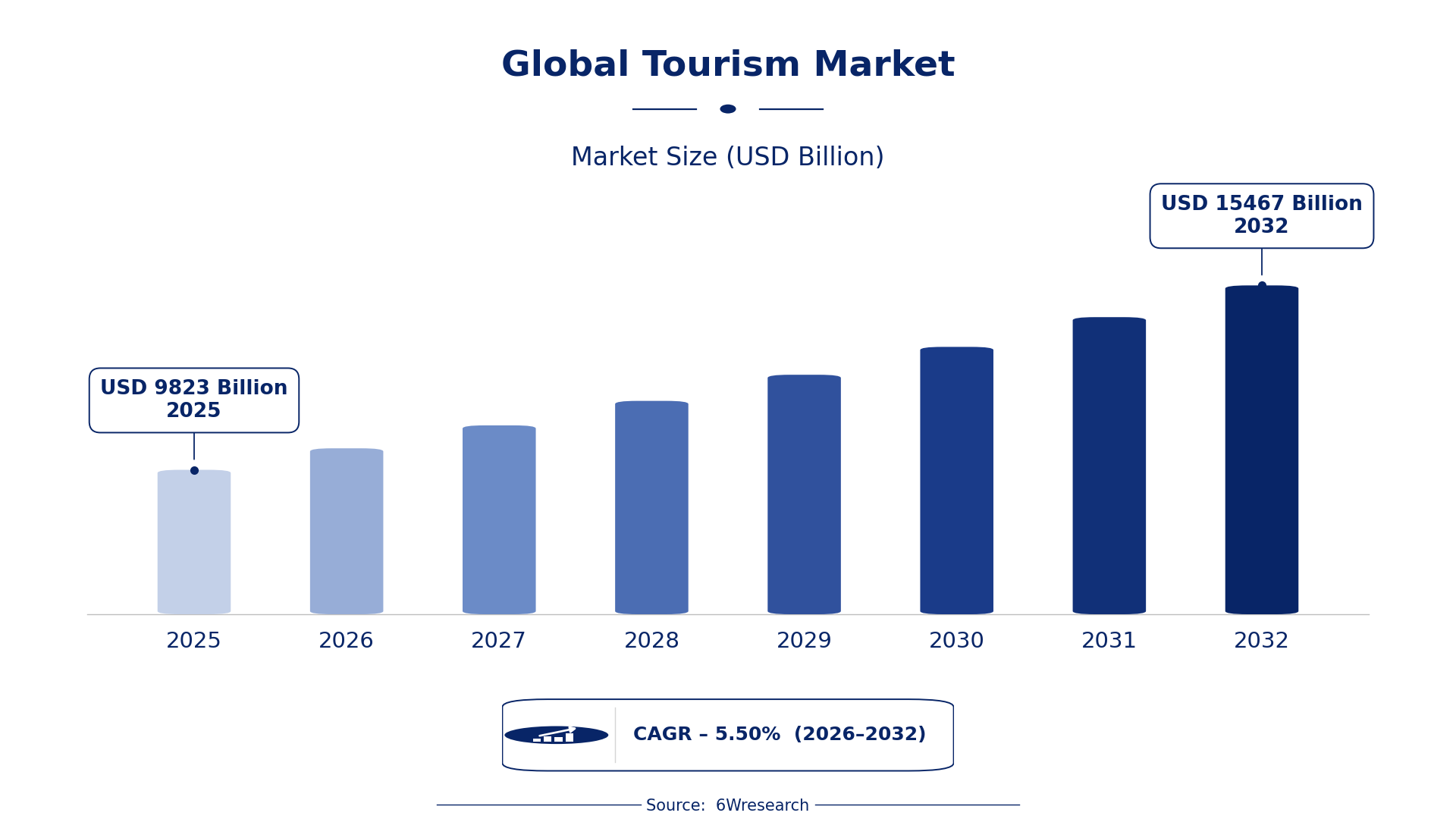
The Global Tourism Market was estimated at USD 9823 Billion in 2025 and is projected to reach USD 15467 Billion by 2032, growing at a CAGR of 5.50% from 2026 to 2032.
Global Tourism Market Synopsis
The Global Tourism Market is experiencing a transformational phase as post-pandemic recovery accelerates. Increased health and safety measures are prompting a shift towards domestic tourism, while international travel is reshaping its protocols to align with the new consumer priorities focused on safety and sustainability. The interaction between technology and tourism is redefining consumer experiences, resulting in higher expectations for personalization and responsiveness from travel providers.
This market is characterized by the rise of experiential and sustainable travel, where visitors are increasingly seeking authentic cultural experiences. Countries in Asia are particularly benefitting from this trend, leveraging their rich cultural heritages to attract travelers looking for immersive encounters. Additionally, tourism services are adopting advanced technologies to enhance customer engagement, thereby facilitating deeper connections between visitors and destinations.
Global Tourism Market Year-wise Growth Rate and Key Drivers
This graph illustrates the annual growth rates of the Global Tourism Market from 2022 to 2032, highlighting a steady upward trajectory and projected expansion over the forecast period.
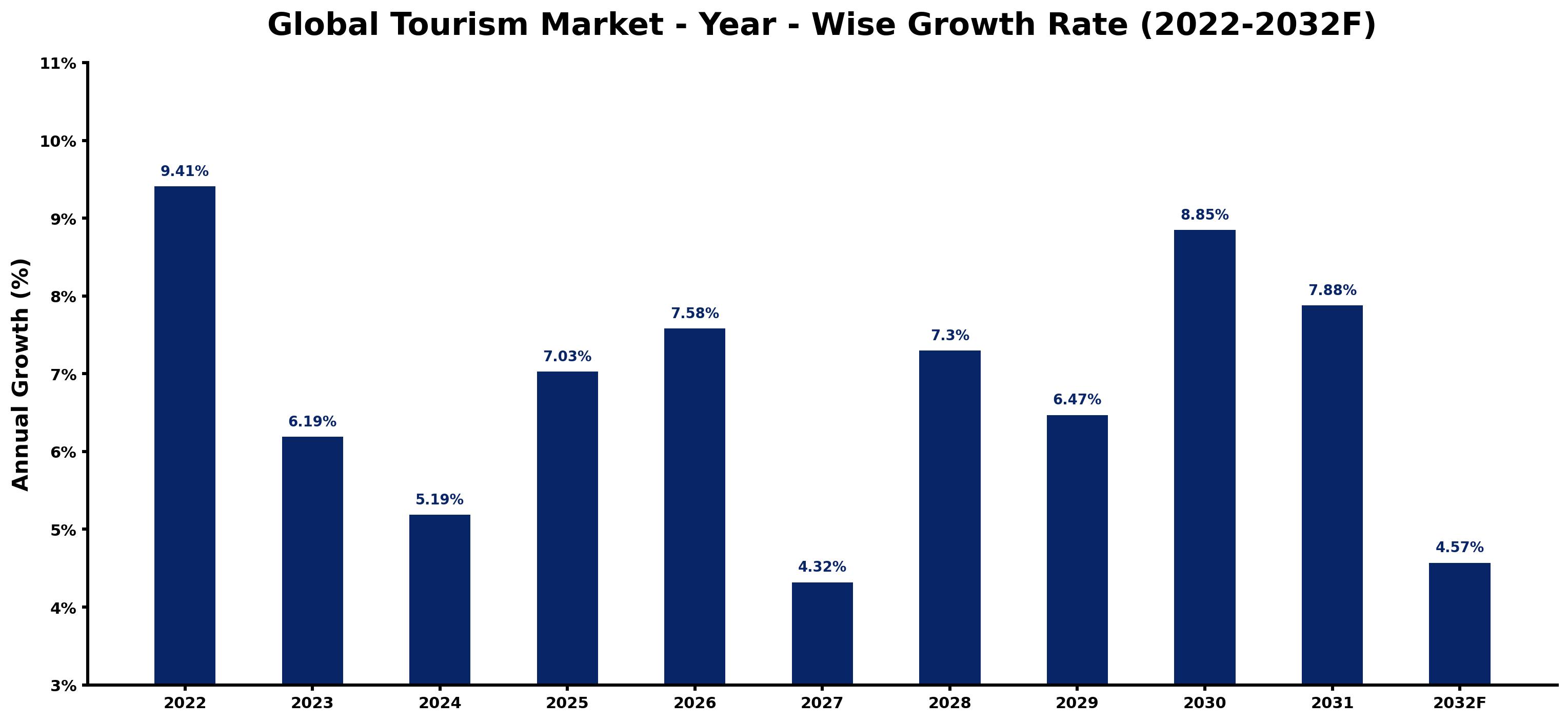
The table below presents the year‑wise growth rates along with the key drivers influencing the market
| Year | Growth Rate (%) | Major Drivers |
| 2022 | 9.41 | Travel agencies are witnessing a surge in demand for personalized tourism experiences. |
| 2023 | 6.19 | Increased regulatory measures promote sustainable tourism practices across various destinations. |
| 2024 | 5.19 | In the context of eco-tourism, sustainability initiatives significantly reshape tourism business models. |
| 2025 | 7.03 | As international travel routes expand, tourism accessibility is notably improving for global travelers. |
| 2026 | 7.58 | Tour operators benefit from refining their supply chains to enhance tourism service delivery. |
| 2027 | 4.32 | Rising costs of travel accommodations are prompting tourists to seek budget-friendly tourism options. |
| 2028 | 7.3 | A shift toward experiential tourism transforms how companies attract and retain visitors. |
| 2029 | 6.47 | Growing digital skills among travel agents streamline the tourism booking process for consumers. |
| 2030 | 8.85 | Smart travel applications enhance tourist engagement with tailored digital tourism solutions. |
| 2031 | 7.88 | Improving AI technology in tourism facilitates personalized travel planning and customer service. |
| 2032 | 4.57 | Strategic mergers in hospitality strengthen investment channels within the global tourism sector. |
Note - Market size estimations and growth projections presented in this report are based on 6Wresearch's proprietary research methodology, combining internal industry data, secondary research, and primary validation, updated periodically to reflect current market conditions. As markets evolve rapidly, figures for certain industries may vary slightly and are intended as informed estimates rather than absolute figures. For the most current market sizing, we recommend validating figures with a 6Wresearch analyst.
Global Tourism Market Key Takeaways
Below are some of the specific key takeaways from the market, including:
- Travel & Tourism accounted for ~10.4% of global GDP in 2020, underscoring its economic significance.
- Europe represents the largest travel destination, accounting for approximately 48% of international arrivals in 2025.
- Local/domestic tourism is anticipated to grow at a CAGR of 6.5% between 2026 and 2032, driven by a preference for nearby escapes.
- Booking Holdings has expanded its market reach by acquiring competitors, enhancing its portfolio to cater to diverse travel preferences.
- Asia is projected to witness a substantial increase in travel demand, spurred by improving infrastructure and connectivity.
Evaluation of Restraints in Global Tourism Market
The Global Tourism Market confronts several significant challenges that can disrupt growth. Economic instability in major source countries can adversely affect disposable incomes, leading to reduced travel expenditures. Notably, the COVID-19 pandemic highlighted vulnerabilities in the tourism sector, with an estimated loss of $4.5 trillion. For example, regulatory complexities such as varying visa restrictions and travel bans can deter tourists, further complicating recovery strategies for industry stakeholders.
Global Tourism Market Trends
Several key trends are shaping the Global Tourism Market, with a clear shift towards sustainability and experiential travel. For instance, in response to burgeoning environmental concerns, companies like Viator have introduced eco-friendly tours that reflect travelers' desire for sustainable experiences. Furthermore, advancements in technology are enabling enhanced customer interactions; in 2023, Airbnb reported over 300 million guest arrivals, highlighting the importance of technology in bridging users and local hosts. Another trend includes the rise of digital nomadism, which is projected to reach ~1 billion people by 2035, as more individuals opt for flexible work arrangements that allow them to travel while maintaining their careers.
Global Tourism Market Opportunities
Emerging opportunities in the Global Tourism Market are ripe for exploration, particularly in sustainable and digital tourism initiatives. For example, TUI Group has committed to investing €1 billion in sustainable projects by 2025, reflecting a significant shift towards eco-friendly travel solutions. There is also an opportunity in targeting the solo traveler market, which is projected to represent ~20% of travelers by 2026. Furthermore, leveraging technology to offer personalized travel experiences—using AI and big data analytics—can unlock new revenue streams, facilitating customized itineraries for diverse consumer preferences.
Global Tourism Market by Type
International tourism leads the Global Tourism Market, commanding a substantial share of approximately 60% in 2025. This dominance is driven by a strong preference for cross-border travel among tourists seeking unique experiences. However, the local/domestic segment is positioned for rapid growth, expected to register a CAGR of 6.5% from 2026 to 2032 as travelers prioritize proximity and safety. The rise of local tourism services enables communities to harness their cultural and historical advantages, further stimulating this segment's growth.
Global Tourism Market by Purpose
Adventure tourism is the leading purpose for travel, capturing about 25% of the market share as of 2025. This segment is characterized by the increasing demand for unique and adrenaline-pumping experiences. Additionally, the business travel segment is expected to grow at a CAGR of 7.2% from 2026 to 2032, signaling a resurgence in corporate travel as companies expand their global operations. This growth is bolstered by the return of in-person meetings and conferences, contributing significantly to overall tourist spending.
Global Tourism Market by Region
Europe remains the largest region in terms of tourism, accounting for approximately 48% share in 2025 due to its historic cities and cultural richness. However, the Asia region is anticipated to be the fastest-growing, with an impressive CAGR of 7.5% from 2026 to 2032, largely driven by rising disposable incomes and a burgeoning middle class looking for travel experiences. The improved infrastructure and connectivity in countries like India and Thailand further boost tourism attractiveness in the region.
Government Initiatives in the Global Tourism Market
The regulatory framework surrounding the Global Tourism Market is evolving to enhance travel experiences and support recovery post-pandemic. Governments are actively implementing policies aimed at boosting tourism infrastructure and promoting sustainability. These initiatives are designed to encourage investments and ensure a competitive edge in the rapidly returning travel landscape.
- U.S. Department of Commerce, National Travel and Tourism Strategy, 2021 - This policy aims to promote international travel to the U.S. by enhancing marketing efforts and streamlining visa processing.
- European Commission, European Tourism Agenda, 2023 - The initiative focuses on sustainable tourism and creating a coordinated approach to support the recovery and growth of the sector across EU member states.
- Government of Japan, Japan Tourism Agency, Visit Japan Campaign, 2022 - This ongoing campaign aims to revitalize inbound tourism through targeted marketing strategies and improved travel infrastructure.
- Ministry of Tourism, India, Swadesh Darshan Scheme, 2024 - Planned to develop theme-based tourist circuits and enhance tourism infrastructure across India, aimed at attracting domestic and international tourists.
Future Insights of the Global Tourism Market
The Global Tourism Market is likely to witness transformative changes driven by advancements in technology and evolving consumer behaviors. As of 2023, companies such as Airbnb are fully utilizing AI to provide personalized travel experiences, setting a precedent for the industry. Additionally, the market is anticipated to pivot towards integrating sustainable practices into tourism offerings. Investments in digital infrastructure and eco-friendly projects will be pivotal, reflecting a broader commitment to minimizing environmental impacts while enhancing traveler satisfaction.
Global Tourism Market Latest Developments
Recent developments in the Global Tourism Market underscore strategic shifts that companies are making to adapt to changing consumer demands and enhance competitiveness.
- Expedia Group has launched a comprehensive sustainability initiative in early 2023, aimed at achieving carbon neutrality by 2030. This move is significant as it aligns with increasing consumer preference for eco-friendly travel options.
- In recent months, Booking Holdings expanded its local presence by acquiring a regional travel agency in Southeast Asia, highlighting its strategy to enhance service offerings in fast-growing markets.
- Airbnb is currently testing new feature enhancements that include personalized local recommendations based on traveler preferences, slated for rollout by late 2024, elevating user engagement through customized experiences.
- TUI Group has announced an investment in a series of eco-resorts set to launch in 2025, positioning itself at the forefront of the sustainable tourism movement and appealing to environmentally conscious travelers.
Global Tourism Market Key Players and Industry Positioning
The competitive structure of the Global Tourism Market is largely consolidated, with a few dominant players shaping the landscape. These firms leverage their extensive resources and technological capabilities to maintain competitive advantages and deliver a range of services across various segments.
| Leading Company | Core Strength | Strategic Focus |
|---|---|---|
| Expedia Group | Diverse portfolio of travel services | Expansion through strategic acquisitions |
| Booking Holdings | Technology-driven accommodation solutions | Enhancing user experience via personalization |
| TripAdvisor | Robust user-generated content for reviews | Integrating e-commerce with travel planning |
| Airbnb | Unique peer-to-peer lodging platform | Focus on localized travel experiences |
| TUI Group | Strong brand presence in tourism and leisure | Commitment to sustainable tourism investment |
As the Global Tourism Market evolves, these key players are likely to continue leveraging their unique strengths to innovate and adapt, ensuring they remain competitive in an increasingly complex environment.
Key Attractiveness of the Report
- 10 Years of Market Numbers
- Historical Data Starting from 2022 to 2025
- Base Year: 2025
- Forecast Data until 2032
- Key Performance Indicators Impacting the Market
- Major Upcoming Developments and Projects
Key Highlights of the Report:
- Global Tourism Market Outlook
- Market Size of Global Tourism Market, 2025
- Forecast of Global Tourism Market, 2032
- Historical Data and Forecast of Global Tourism Revenues & Volume for the Period 2022-2032
- Global Tourism Market Trend Evolution
- Global Tourism Market Drivers and Challenges
- Global Tourism Price Trends
- Global Tourism Porter's Five Forces
- Global Tourism Industry Life Cycle
- Historical Data and Forecast of Global Tourism Market Revenues & Volume
- Historical Data and Forecast of Global Tourism Market Revenues & Volume By Type for the Period 2022-2032
- Historical Data and Forecast of Global Tourism Market Revenues & Volume By Local/domestic for the Period 2022-2032
- Historical Data and Forecast of Global Tourism Market Revenues & Volume By International for the Period 2022-2032
- Historical Data and Forecast of Global Tourism Market Revenues & Volume By Purpose for the Period 2022-2032
- Historical Data and Forecast of Global Tourism Market Revenues & Volume By Adventure for the Period 2022-2032
- Historical Data and Forecast of Global Tourism Market Revenues & Volume By Business for the Period 2022-2032
- Historical Data and Forecast of Global Tourism Market Revenues & Volume By Medical for the Period 2022-2032
- Historical Data and Forecast of Global Tourism Market Revenues & Volume By Sea Farming for the Period 2022-2032
- Historical Data and Forecast of Global Tourism Market Revenues & Volume By Others for the Period 2022-2032
- Historical Data and Forecast of North America Tourism Market Revenues & Volume By Type for the Period 2022-2032
- Historical Data and Forecast of North America Tourism Market Revenues & Volume By Local/domestic for the Period 2022-2032
- Historical Data and Forecast of North America Tourism Market Revenues & Volume By International for the Period 2022-2032
- Historical Data and Forecast of North America Tourism Market Revenues & Volume By Purpose for the Period 2022-2032
- Historical Data and Forecast of North America Tourism Market Revenues & Volume By Adventure for the Period 2022-2032
- Historical Data and Forecast of North America Tourism Market Revenues & Volume By Business for the Period 2022-2032
- Historical Data and Forecast of North America Tourism Market Revenues & Volume By Medical for the Period 2022-2032
- Historical Data and Forecast of North America Tourism Market Revenues & Volume By Sea Farming for the Period 2022-2032
- Historical Data and Forecast of North America Tourism Market Revenues & Volume By Others for the Period 2022-2032
- Historical Data and Forecast of United States of America Tourism Market Revenues & Volume for the Period 2022-2032
- Historical Data and Forecast of Canada Tourism Market Revenues & Volume for the Period 2022-2032
- Historical Data and Forecast of Rest of North America Tourism Market Revenues & Volume for the Period 2022-2032
- Historical Data and Forecast of Latin America (LATAM) Tourism Market Revenues & Volume By Type for the Period 2022-2032
- Historical Data and Forecast of Latin America (LATAM) Tourism Market Revenues & Volume By Local/domestic for the Period 2022-2032
- Historical Data and Forecast of Latin America (LATAM) Tourism Market Revenues & Volume By International for the Period 2022-2032
- Historical Data and Forecast of Latin America (LATAM) Tourism Market Revenues & Volume By Purpose for the Period 2022-2032
- Historical Data and Forecast of Latin America (LATAM) Tourism Market Revenues & Volume By Adventure for the Period 2022-2032
- Historical Data and Forecast of Latin America (LATAM) Tourism Market Revenues & Volume By Business for the Period 2022-2032
- Historical Data and Forecast of Latin America (LATAM) Tourism Market Revenues & Volume By Medical for the Period 2022-2032
- Historical Data and Forecast of Latin America (LATAM) Tourism Market Revenues & Volume By Sea Farming for the Period 2022-2032
- Historical Data and Forecast of Latin America (LATAM) Tourism Market Revenues & Volume By Others for the Period 2022-2032
- Historical Data and Forecast of Brazil Tourism Market Revenues & Volume for the Period 2022-2032
- Historical Data and Forecast of Mexico Tourism Market Revenues & Volume for the Period 2022-2032
- Historical Data and Forecast of Argentina Tourism Market Revenues & Volume for the Period 2022-2032
- Historical Data and Forecast of Rest of LATAM Tourism Market Revenues & Volume for the Period 2022-2032
- Historical Data and Forecast of Asia Tourism Market Revenues & Volume By Type for the Period 2022-2032
- Historical Data and Forecast of Asia Tourism Market Revenues & Volume By Local/domestic for the Period 2022-2032
- Historical Data and Forecast of Asia Tourism Market Revenues & Volume By International for the Period 2022-2032
- Historical Data and Forecast of Asia Tourism Market Revenues & Volume By Purpose for the Period 2022-2032
- Historical Data and Forecast of Asia Tourism Market Revenues & Volume By Adventure for the Period 2022-2032
- Historical Data and Forecast of Asia Tourism Market Revenues & Volume By Business for the Period 2022-2032
- Historical Data and Forecast of Asia Tourism Market Revenues & Volume By Medical for the Period 2022-2032
- Historical Data and Forecast of Asia Tourism Market Revenues & Volume By Sea Farming for the Period 2022-2032
- Historical Data and Forecast of Asia Tourism Market Revenues & Volume By Others for the Period 2022-2032
- Historical Data and Forecast of China Tourism Market Revenues & Volume for the Period 2022-2032
- Historical Data and Forecast of India Tourism Market Revenues & Volume for the Period 2022-2032
- Historical Data and Forecast of Japan Tourism Market Revenues & Volume for the Period 2022-2032
- Historical Data and Forecast of Rest of Asia Tourism Market Revenues & Volume for the Period 2022-2032
- Historical Data and Forecast of Africa Tourism Market Revenues & Volume By Type for the Period 2022-2032
- Historical Data and Forecast of Africa Tourism Market Revenues & Volume By Local/domestic for the Period 2022-2032
- Historical Data and Forecast of Africa Tourism Market Revenues & Volume By International for the Period 2022-2032
- Historical Data and Forecast of Africa Tourism Market Revenues & Volume By Purpose for the Period 2022-2032
- Historical Data and Forecast of Africa Tourism Market Revenues & Volume By Adventure for the Period 2022-2032
- Historical Data and Forecast of Africa Tourism Market Revenues & Volume By Business for the Period 2022-2032
- Historical Data and Forecast of Africa Tourism Market Revenues & Volume By Medical for the Period 2022-2032
- Historical Data and Forecast of Africa Tourism Market Revenues & Volume By Sea Farming for the Period 2022-2032
- Historical Data and Forecast of Africa Tourism Market Revenues & Volume By Others for the Period 2022-2032
- Historical Data and Forecast of South Africa Tourism Market Revenues & Volume for the Period 2022-2032
- Historical Data and Forecast of Nigeria Tourism Market Revenues & Volume for the Period 2022-2032
- Historical Data and Forecast of Egypt Tourism Market Revenues & Volume for the Period 2022-2032
- Historical Data and Forecast of Rest of Africa Tourism Market Revenues & Volume for the Period 2022-2032
- Historical Data and Forecast of Europe Tourism Market Revenues & Volume By Type for the Period 2022-2032
- Historical Data and Forecast of Europe Tourism Market Revenues & Volume By Local/domestic for the Period 2022-2032
- Historical Data and Forecast of Europe Tourism Market Revenues & Volume By International for the Period 2022-2032
- Historical Data and Forecast of Europe Tourism Market Revenues & Volume By Purpose for the Period 2022-2032
- Historical Data and Forecast of Europe Tourism Market Revenues & Volume By Adventure for the Period 2022-2032
- Historical Data and Forecast of Europe Tourism Market Revenues & Volume By Business for the Period 2022-2032
- Historical Data and Forecast of Europe Tourism Market Revenues & Volume By Medical for the Period 2022-2032
- Historical Data and Forecast of Europe Tourism Market Revenues & Volume By Sea Farming for the Period 2022-2032
- Historical Data and Forecast of Europe Tourism Market Revenues & Volume By Others for the Period 2022-2032
- Historical Data and Forecast of United Kingdom Tourism Market Revenues & Volume for the Period 2022-2032
- Historical Data and Forecast of France Tourism Market Revenues & Volume for the Period 2022-2032
- Historical Data and Forecast of Germany Tourism Market Revenues & Volume for the Period 2022-2032
- Historical Data and Forecast of Rest of Europe Tourism Market Revenues & Volume for the Period 2022-2032
- Historical Data and Forecast of Middle East Tourism Market Revenues & Volume By Type for the Period 2022-2032
- Historical Data and Forecast of Middle East Tourism Market Revenues & Volume By Local/domestic for the Period 2022-2032
- Historical Data and Forecast of Middle East Tourism Market Revenues & Volume By International for the Period 2022-2032
- Historical Data and Forecast of Middle East Tourism Market Revenues & Volume By Purpose for the Period 2022-2032
- Historical Data and Forecast of Middle East Tourism Market Revenues & Volume By Adventure for the Period 2022-2032
- Historical Data and Forecast of Middle East Tourism Market Revenues & Volume By Business for the Period 2022-2032
- Historical Data and Forecast of Middle East Tourism Market Revenues & Volume By Medical for the Period 2022-2032
- Historical Data and Forecast of Middle East Tourism Market Revenues & Volume By Sea Farming for the Period 2022-2032
- Historical Data and Forecast of Middle East Tourism Market Revenues & Volume By Others for the Period 2022-2032
- Historical Data and Forecast of Saudi Arabia Tourism Market Revenues & Volume for the Period 2022-2032
- Historical Data and Forecast of UAE Tourism Market Revenues & Volume for the Period 2022-2032
- Historical Data and Forecast of Turkey Tourism Market Revenues & Volume for the Period 2022-2032
- Historical Data and Forecast of Rest of Middle East Tourism Market Revenues & Volume for the Period 2022-2032
- Global Tourism Market - Key Performance Indicators
- Global Tourism Market - Import Export Trade Statistics
- Global Tourism Market - Opportunity Assessment By Countries
- Global Tourism Market - Opportunity Assessment By Type
- Global Tourism Market - Opportunity Assessment By Purpose
- Global Tourism Market - Top Companies Market Share
- Global Tourism Market - Top Companies Profiles
- Global Tourism Market - Comparison of Players in Technical and Operating Parameters
- Global Tourism Market - Strategic Recommendations
Markets Covered
The Global Tourism Market report provides a detailed analysis of the following market segments:
By Regions and Countries:
- North America
- Europe
- LATAM
- Middle East
- Asia
- Africa
By Type:
- Local/domestic
- International
By Purpose:
- Adventure
- Business
- Medical
- Sea Farming
- Others






































