Taiwan Tourism Market Growth Rate
According to 6Wresearch internal databases and industry insights, the Taiwan Tourism Market is expected to grow at a steady compound annual growth rate (CAGR) of 5.9% during the forecast period 2026–2032.
Taiwan Tourism Market Year-wise Growth Rate and Key Drivers
This graph illustrates the annual growth rates of the Taiwan Tourism Market from 2021 to 2032, highlighting a steady upward trajectory and projected market expansion over the forecast period.
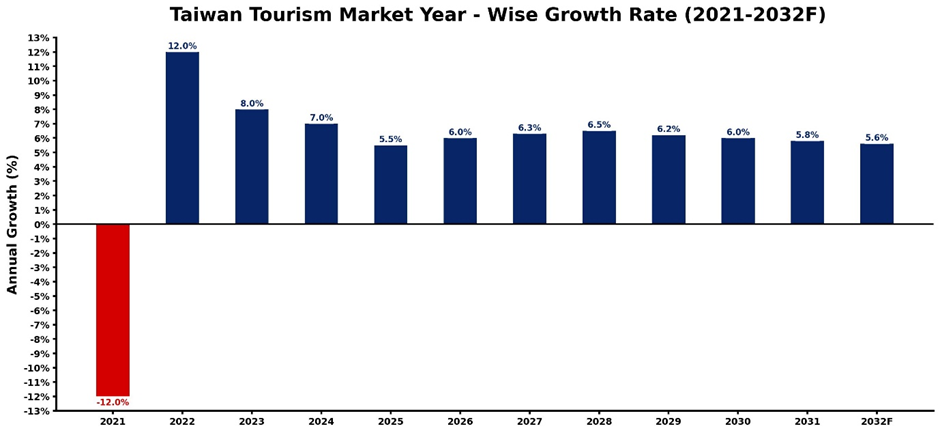
The following table summarizes the historical and forecasted growth rates of the Taiwan Tourism Market along with the rationale behind each year’s performance.
| Year | Estimated Growth (%) | Market Rationale |
| 2021 | -12% | Rigorous travel restrictions, border closures, and zero inbound tourism led to sharp fall of market during COVID-19. |
| 2022 | 12% | Domestic tourism demand bounced back after revival begun with partial reopening. |
| 2023 | 8% | Inbound recovery enhanced as international travel resumed and pent-up requirement is released. |
| 2024 | 7% | Near-normal travel conditions return; strong regional tourism flew across Asia-Pacific. |
| 2025 | 5.5% | Post-pandemic surge led to transition toward sustainable tourism growth which resulted in stable market. |
| 2026 | 6% | Steady expansion supported by improved airline connectivity and digital travel platforms. |
| 2027 | 6.3% | Travel experiences diversified and progress supported by MICE tourism. |
| 2028 | 6.5% | International marketing and tourism infrastructure improvements leads to steady expansion of the market. |
| 2029 | 6.2% | Competition increases from regional destinations as growth slowdown and market matures. |
| 2030 | 6% | Due to smart tourism adaption and value-based travel requirement, market growth is sustained. |
| 2031 | 5.8% | As market saturates, transition toward niche tourism segments face mild deceleration. |
| 2032 | 5.6% | Mature market phase with steady growth driven by sustainability and premium tourism experiences. |
Topics Covered in the Taiwan Tourism Market Report
The Taiwan Tourism Industry report covers the market by type and purpose. The report provides a detailed analysis of ongoing market trends, opportunities/high-growth areas, and market drivers that will help stakeholders align strategies based on current and future market dynamics.
Taiwan Tourism Market Highlights
| Report Name | Taiwan Tourism Market |
| Forecast period | 2026-2032 |
| CAGR | 5.9% |
| Growing Sector | Travel & Tourism Sector |
Taiwan Tourism Market Synopsis
The Taiwan Tourism Market is expected to witness steady and sustainable expansion during the forecast period. Rising international arrivals, recovery of Asia-Pacific travel routes, and strong government-led tourism promotion initiatives are key drivers. Inbound and domestic tourism segments both are accelerated by rising requirement for cultural tourism, night-market experiences, eco-tourism, and MICE (Meetings, Incentives, Conferences, and Exhibitions) travel. Also, digital transformation in travel booking platforms and improved air connectivity are supporting overall industry growth momentum.
Evaluation of Growth Drivers in Taiwan Tourism Market (2026–2032)
Below are some major drivers and their influence on the market dynamics:
| Drivers | Primary Segment Affected | Why It Matters (Evidence) |
| Expansion of International Air Connectivity | Inbound Tourism | Increased flight routes from Japan, South Korea, Southeast Asia, and Europe are improving tourist inflow and reducing travel barriers. |
| Strong Cultural & Heritage Tourism Demand | Leisure Tourism | Taiwan’s temples, night markets, festivals, and indigenous cultural experiences continue to attract regional travellers. |
| Growth of MICE Tourism | Business Tourism | Surged corporate travel and events lead to expansion of Taipei and Kaohsiung are expanding conference infrastructure |
| Digital Travel Platforms & OTA Expansion | Online Travel Agencies | Spontaneous travel demand is increased due to improved accessibility offered by online booking platforms. |
| Government Tourism Promotion Programs | National Tourism Board Initiatives | Inbound tourism competitiveness is enhanced by Campaigns like destination branding and visa facilitation. |
The Taiwan Tourism Market Share is projected to rise with a CAGR of 5.9% during 2026-2032. Surging regional tourism flows, recovery of international long-haul travel post pandemic, and widespread experiential tourism offerings are the key drivers. Also, advancements in smart tourism infrastructure, AI-based travel personalization, and sustainable tourism policies are encouraging long-term market resilience and seamless travel experience for tourists. The transition from volume-based tourism to value-based tourism is assisting to boost per-tourist spending while sustaining steady visitors growth.
Evaluation of Restraints in Taiwan Tourism Market
Below are some major restraints and their influence on the market dynamics:
| Restraints | Primary Segment Affected | What This Means (Evidence) |
| High Dependence on Regional Tourists | Inbound Tourism | Heavy reliance on Japan, South Korea, and China increases geopolitical sensitivity and economic fluctuations. |
| Seasonal Demand Fluctuations | Hospitality Sector | Tourism demand peaks during festivals and holidays, leading to inconsistent occupancy rates. |
| Rising Operational Costs | Hotels & Airlines | Tourism operators experience loss due to Increased labor, fuel, and maintenance cost. |
| Geopolitical Sensitivities in Asia-Pacific | International Travel | Flight routes, travel advisories, and tourist confidence will be hinder by regional tensions. |
| Infrastructure Saturation in Urban Centers | City Tourism | Overcrowding in Taipei and popular tourist zones can reduce visitor experience quality. |
Taiwan Tourism Market Challenges
In spite of several growth factors, the market is restricted by several factors such as intense regional competition from Japan, Thailand, and South Korea, high vulnerability to global economic slowdowns, and limited capacity extension in peak tourism zones. Also, fluctuating exchange rates and managing sustainable tourism while preventing overcrowding in famous destinations remain a key operational concern. For the Taiwan Tourism Market growth, regional diversification, increasing lesser-known destinations, and boosting off-season tourism strategies are important factors.
Taiwan Tourism Market Trends
Major trends responsible for Taiwan Tourism Market growth include:
- Experiential & Cultural Tourism Growth: Increasing demand for night markets, food tourism, festivals, and indigenous cultural experiences among the travellers.
- Rise of Smart Tourism: AI-powered travel planning, digital guides, and personalized itinerary platforms are used by travellers for seamless experience.
- Sustainable Tourism Adoption: Tourists becoming more aware and responsible than before, thus choosing green hotels, and low-carbon tourism experiences.
- Growth of Independent Travel (FIT Segment): Flexible, self-planned solo travel itineraries are gaining more prominence than the previously preferred group tours.
Investment Opportunities in the Taiwan Tourism Market
Below are the investment opportunities available in the Taiwan Tourism Market:
- Smart Tourism Technology Platforms: Travel planning apps, smart booking systems, and digital concierge services are now integrated with AI tools foe seamless experience.
- Eco-Tourism & Sustainable Resorts: Building environmental-friendly hotels, resorts, and spas and introduction of new nature-based tourism destinations will engage more tourists.
- Regional Tourism Development: Extension of tourism industry in various hidden and underdeveloped regions of Taiwan beyond Taipei (e.g., Taitung, Hualien).
- MICE Infrastructure Expansion: Funding in infrastructure such as convention centers, exhibition halls, and business tourism facilities is going to attract the global events.
Top 5 Leading Players in the Taiwan Tourism Market
Below are some of the leading companies in the Taiwan Tourism Market:
1. Lion Travel Service
| Company Name | Lion Travel Service |
|---|---|
| Established Year | 1977 |
| Headquarters | Taipei, Taiwan |
| Official Website | Click Here |
Lion Travel Service is the largest travel agency in Taiwan by revenue. It operates across outbound, inbound, and domestic tourism segments.
2. KKday
| Company Name | KKday |
|---|---|
| Established Year | 2014 |
| Headquarters | Taipei, Taiwan |
| Official Website | Click Here |
KKday is a leading travel e-commerce platform specializing in digital booking of tours, experiences, and attraction tickets. It serves millions of users across Asia.
3. Edison Tours
| Company Name | Edison Tours |
|---|---|
| Established Year | 1988 |
| Headquarters | Taipei, Taiwan |
| Official Website | Click Here |
Edison Tours is a premier destination management company in Taiwan, focusing on inbound tourism and high-end group travel.
4. My Taiwan Tour
| Company Name | My Taiwan Tour |
|---|---|
| Established Year | 2013 |
| Headquarters | Taipei, Taiwan |
| Official Website | Click Here |
My Taiwan Tour specializes in customized and experiential travel services across Taiwan. It focuses on private tours, cultural immersion experiences, and personalized itineraries.
5. Klook
| Company Name | Klook |
|---|---|
| Established Year | 2014 |
| Headquarters | Hong Kong SAR, China |
| Official Website | Click Here |
Klook is a global travel and experiences platform with strong operations in Taiwan. It provides booking services for attractions, transportation, and local experiences.
Government Initiatives being implemented in the Taiwan Tourism Market
According to the Taiwanese government data, Tourism market is promoted by government-led initiatives that concentrate on post-pandemic recovery. The Taiwan Tourism Market revenue will be increased through key programs such as widespread visa-free entry for multiple countries and promotional campaigns such as “Taiwan the Lucky Land”. The Tourism Administration launched the “TAIWAN, Waves of Wonder” branding strategy to reposition Taiwan as a premium destination. Additionally, digital arrival systems improving accessibility and visibility of Taiwan tourism worldwide.
Future Insights of the Taiwan Tourism Market
The market is projected to grow sustainably due to rising international arrivals and surging demand for experiential and cultural tourism. The smart tourism technologies, AI-based travel personalization, and stronger MICE (Meetings, Incentives, Conferences, and Exhibitions) infrastructure development leads to expand the Taiwan Tourism Market Size. The market will transition towards value-based tourism, with higher spending per visitor rather than volume growth. Moreover, competition from regional destinations like Japan and South Korea will determine the strategic positioning of Taiwan.
Market Segmentation Analysis
The report offers a comprehensive study of the following market segments and their leading categories:
By Type -Market Dominated by Domestic tourism, International Tourism Set for Rapid Expansion
According to Vasudha, Senior Research Analyst, 6Wresearch, by type, in 2025, domestic tourism was leading by holding 62% share of the Taiwan tourism market due to strong local travel demand and post-pandemic internal recovery. International tourism is set to rise in 2026-2032 with a CAGR of 6.5%, backed by stronger air connectivity and visa facilitation.
By Purpose – Others Led Market, Medical Tourism Show Rapid Growth
By Purpose, Others commanded the Taiwan tourism market with 40% share acquisition in 2025, driven by leisure, cultural, and family travel. Meanwhile, during 2026-2032, Medical tourism grows the fastest with 7.5% CAGR, due to advanced healthcare services and rising cross-border treatment demand.
Note:Market size estimations and growth projections presented in this report are based on 6Wresearch’s advanced forecasting approach, validated with industry datasets as of June 2026.
Key Attractiveness of the Report:
- 10 Years of Market Numbers
- Historical Data Starting from 2022 to 2025
- Base Year: 2025
- Forecast Data until 2032
- Key Performance Indicators Impacting the Market
- Major Upcoming Developments and Projects
Key Highlights of the Report:
- Taiwan Tourism Market Outlook
- Market Size of Taiwan Tourism Market, 2025
- Forecast of Taiwan Tourism Market, 2032
- Historical Data and Forecast of Taiwan Tourism Revenues & Volume for the Period 2022- 2032
- Taiwan Tourism Market Trend Evolution
- Taiwan Tourism Market Drivers and Challenges
- Taiwan Tourism Price Trends
- Taiwan Tourism Porter's Five Forces
- Taiwan Tourism Industry Life Cycle
- Historical Data and Forecast of Taiwan Tourism Market Revenues & Volume By Type for the Period 2022- 2032
- Historical Data and Forecast of Taiwan Tourism Market Revenues & Volume By Local/domestic for the Period 2022- 2032
- Historical Data and Forecast of Taiwan Tourism Market Revenues & Volume By International for the Period 2022- 2032
- Historical Data and Forecast of Taiwan Tourism Market Revenues & Volume By Purpose for the Period 2022- 2032
- Historical Data and Forecast of Taiwan Tourism Market Revenues & Volume By Adventure for the Period 2022- 2032
- Historical Data and Forecast of Taiwan Tourism Market Revenues & Volume By Business for the Period 2022- 2032
- Historical Data and Forecast of Taiwan Tourism Market Revenues & Volume By Medical for the Period 2022- 2032
- Historical Data and Forecast of Taiwan Tourism Market Revenues & Volume By Sea Farming for the Period 2022- 2032
- Historical Data and Forecast of Taiwan Tourism Market Revenues & Volume By Others for the Period 2022- 2032
- Taiwan Tourism Import Export Trade Statistics
- Market Opportunity Assessment By Type
- Market Opportunity Assessment By Purpose
- Taiwan Tourism Top Companies Market Share
- Taiwan Tourism Competitive Benchmarking By Technical and Operational Parameters
- Taiwan Tourism Company Profiles
- Taiwan Tourism Key Strategic Recommendations
Market Covered
The report offers an extensive study of the following market segments:
By Type
- Local/Domestic
- International
By Purpose
- Adventure
- Business
- Medical
- Sea Farming
- Others






































