Global UAV Propulsion Systems Market Highlights
| Market Size (2025) | USD 4.1 Billion |
| Forecast Size (2032) | USD 9.8 Billion |
| CAGR | 9.00% |
| Base Year | 2025 |
| Forecast Period | 2026-2032 |
| Largest Region | North America |
| Fastest Growing Region | Asia Pacific |
| Largest Segment | Energy Source |
| Fastest Growing Segment | Mechanical Energy Converter |
| Leading Companies | DJI, General Atomics, Northrop Grumman, AeroVironment, Siemens |
Global UAV Propulsion Systems Market Size & Growth Rate (2026-2032)
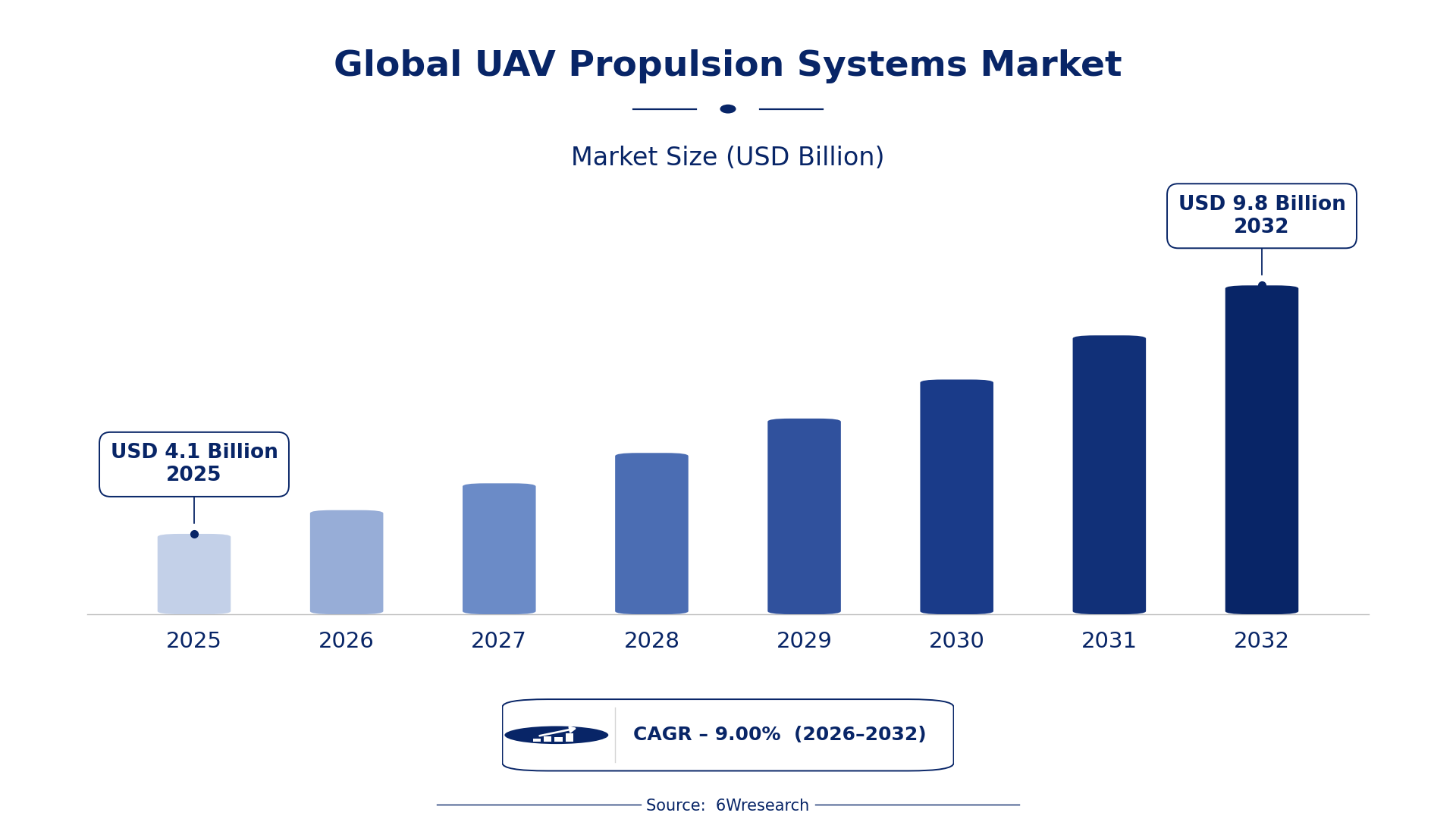
The Global UAV Propulsion Systems Market was estimated at USD 4.1 Billion in 2025 and is projected to reach USD 9.8 Billion by 2032, growing at a CAGR of 9.00% from 2026 to 2032.
Global UAV Propulsion Systems Market Synopsis
The Global UAV Propulsion Systems Market is currently in a state of dynamic transformation. The increasing utilization of unmanned aerial vehicles across diverse applications, including military, commercial, and surveillance segments, is contributing to this growth. Notably, a shift towards more efficient propulsion technologies is being observed, as manufacturers prioritize longer flight durations and enhanced payload capacities.
This market is distinct from adjacent sectors due to its rapid technological advancements in propulsion methodologies, such as electric and hybrid systems. Countries across North America and Europe, backed by robust research funding, are forming the core of market activities, while emerging economies in Asia Pacific anticipate significant growth driven by burgeoning UAV adoption.
Global UAV Propulsion Systems Market Year-wise Growth Rate and Key Drivers
This graph illustrates the annual growth rates of the Global UAV Propulsion Systems Market from 2022 to 2032, highlighting a steady upward trajectory and projected expansion over the forecast period.
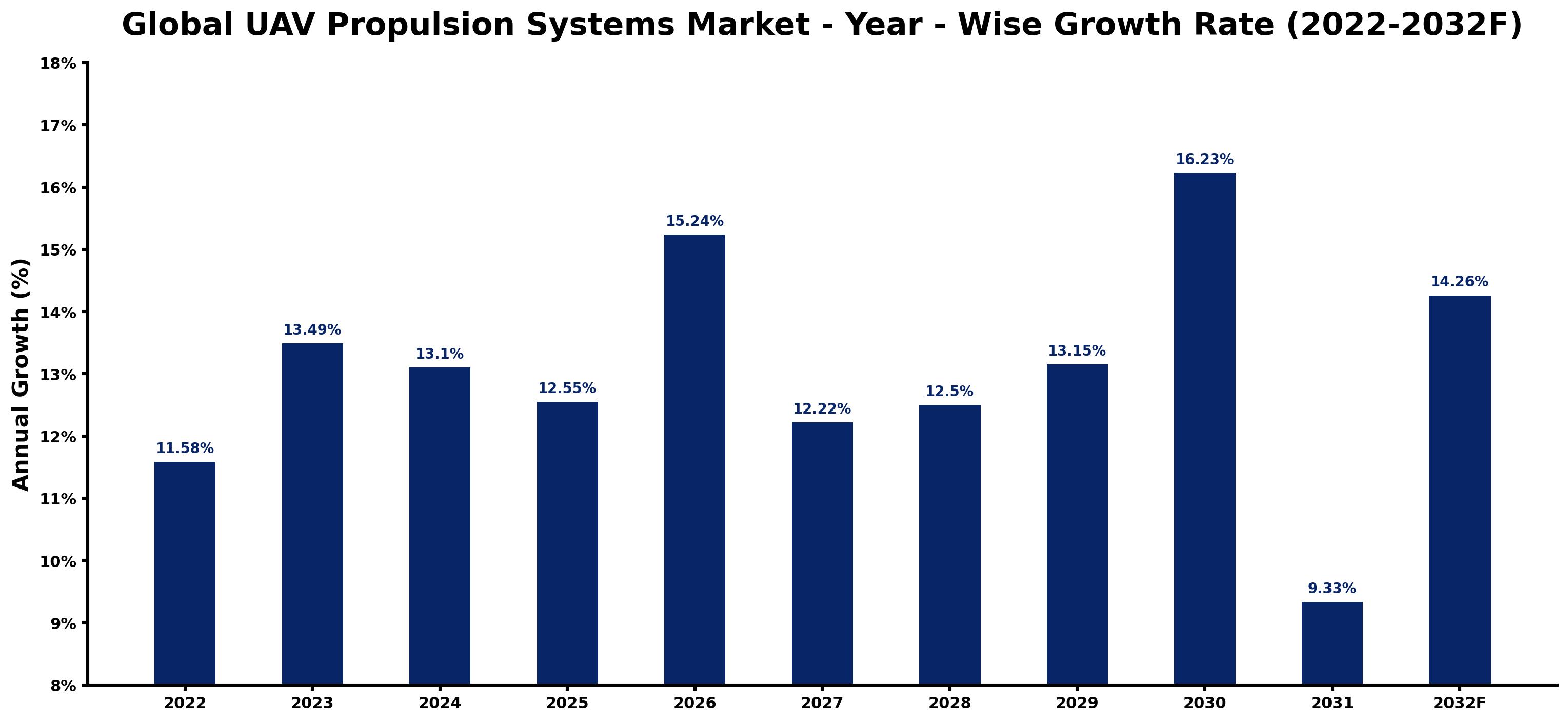
The table below presents the year‑wise growth rates along with the key drivers influencing the market
| Year | Growth Rate (%) | Major Drivers |
| 2022 | 11.58 | Defense contractors are increasing investments in advanced UAV propulsion systems to enhance capabilities. |
| 2023 | 13.49 | Growing sustainability concerns prompt manufacturers to adopt eco-friendly UAV propulsion technologies. |
| 2024 | 13.1 | As governments implement stricter airspace regulations, UAV propulsion system designs are evolving. |
| 2025 | 12.55 | UAV propulsion systems are expanding into new markets, driven by military modernization programs. |
| 2026 | 15.24 | In the aerospace sector, innovative propulsion system technologies are enhancing UAV performance and efficiency. |
| 2027 | 12.22 | Manufacturers face rising costs for composite materials, affecting UAV propulsion system pricing strategies. |
| 2028 | 12.5 | Aerospace companies are seeking skilled engineers to enhance UAV propulsion systems' development capabilities. |
| 2029 | 13.15 | Expanding military applications for drones creates rising demand for specialized UAV propulsion systems. |
| 2030 | 16.23 | Increased competition among suppliers is reshaping the dynamics of UAV propulsion system offerings. |
| 2031 | 9.33 | A shift toward modular UAV systems changes procurement strategies for propulsion system manufacturers. |
| 2032 | 14.26 | Sourcing high-performance components significantly influences UAV propulsion systems' overall production timelines. |
Note - Market size estimations and growth projections presented in this report are based on 6Wresearch's proprietary research methodology, combining internal industry data, secondary research, and primary validation, updated periodically to reflect current market conditions. As markets evolve rapidly, figures for certain industries may vary slightly and are intended as informed estimates rather than absolute figures. For the most current market sizing, we recommend validating figures with a 6Wresearch analyst.
Global UAV Propulsion Systems Market Key Takeaways
Below are some of the specific key takeaways from the market, including:
- Expectations show the Asia Pacific region will achieve an impressive CAGR of approximately 11.5% from 2026 to 2032, highlighting its potential.
- The military application segment is projected to dominate the market, capturing around 60% of the share by 2032.
- DJI introduced a new propulsion system in 2023 that allows UAVs to carry double the payload, enhancing operational capabilities.
- Advancements in battery technology have led to a notable increase in flight times, which is critical for industries like agriculture and delivery systems.
- Northrop Grumman's recent investments in hybrid propulsion technologies aim to reduce fuel consumption rates by over 20% by 2030.
Evaluation of Restraints in Global UAV Propulsion Systems Market
The Global UAV Propulsion Systems Market faces several notable restraints that could potentially impede growth. One significant challenge is regulatory compliance, as manufacturers must navigate stringent government regulations regarding UAV operations. For instance, the Federal Aviation Administration (FAA) in the United States mandates that UAVs must meet specific airworthiness criteria, creating an additional layer of complexity and cost for new entrants into the market. Additionally, production costs can reach upwards of $1 million for advanced propulsion systems, which can deter smaller companies from competing effectively. Technological constraints in battery capacities continue to limit the operational range of UAVs, further complicating advancements.
Global UAV Propulsion Systems Market Trends
Several defining trends are reshaping the Global UAV Propulsion Systems Market. First, there's a marked shift towards hybrid and electric propulsion systems, reflecting environmental sustainability concerns. Companies like Siemens are investing in hybrid solutions that enhance fuel efficiency and lower emissions significantly. For example, their recent prototype demonstrated a 30% reduction in fuel consumption compared to traditional systems.
Another trend is the integration of artificial intelligence (AI) into propulsion system management. This technology enables real-time monitoring and optimization of flight parameters, potentially improving flight and fuel efficiency. For instance, AeroVironment launched an AI-enhanced control system in 2022 that optimizes energy consumption based on flight conditions. Lastly, the focus on lighter materials and advanced engineering techniques is shifting as manufacturers seek to reduce overall UAV weight without compromising performance.
Global UAV Propulsion Systems Market Opportunities
Future opportunities in the Global UAV Propulsion Systems Market are substantial, hinging upon emerging sectors ripe for UAV integration. The logistics sector is increasingly recognizing the potential for drone-based delivery services, projected to reach a value of $1.5 billion by 2030, thereby stimulating demand for efficient propulsion solutions. Companies like Zipline are pioneering drone delivery for medical supplies, showcasing the practicality of UAVs in urgent logistics.
Furthermore, investments into hydrogen fuel cell propulsion systems are anticipated to gain traction, with estimated growth rates hitting 12% by 2032. This transition could address sustainability challenges and regulatory barriers significantly. Additionally, heightened emphasis on agriculture technology (AgTech) applications will drive demand for UAVs equipped with precision agriculture capabilities, estimated to become a $1 billion market in the next several years.
Global UAV Propulsion Systems Market by Type
In the Global UAV Propulsion Systems Market, the leading value segment is Energy Source, expected to hold approximately 47% share in 2025. The fastest-growing segment is the Mechanical Energy Converter, projected to exhibit a CAGR of 10.5% from 2026 to 2032. The Energy Source segment leads due to its essential role in powering UAVs, with advanced fuel technologies being pivotal in meeting the increasing operational demands.
Global UAV Propulsion Systems Market by Application
Among various application segments, Micro UAV is forecasted to dominate the market, commanding around 55% share in 2025. Conversely, the Mini UAV segment is anticipated to grow at a robust CAGR of 10.2% from 2026 to 2032. Micro UAVs are widely used for surveillance and reconnaissance, making them critical to defense and commercial sectors, while Mini UAVs are becoming popular for applications such as mapping and survey operations.
Global UAV Propulsion Systems Market by Region
North America is set to retain its status as the largest region in the Global UAV Propulsion Systems Market, capturing an estimated 40% share in 2025. Asia Pacific, however, is predicted to be the fastest-growing region, with a remarkable CAGR of 10.8% from 2026 to 2032. The stronghold of North America stems from a mature UAV ecosystem bolstered by significant investments in defense and commercial applications. Conversely, Asia Pacific's rapid growth is attributed to increased UAV adoption in sectors like agriculture and emergency services, driven by investments from governments in innovative technologies.
Government Initiatives in the Global UAV Propulsion Systems Market
The regulatory landscape for the Global UAV Propulsion Systems Market is becoming increasingly supportive, with various governmental bodies implementing policies designed to enhance the development and utilization of UAV technologies. Initiatives range from funding programs to new regulations aimed at promoting innovation in the production and application of UAV propulsion systems.
- U.S. Department of Transportation, Unmanned Aircraft System (UAS) Integration Pilot Program, 2018 - This initiative supports testing and evaluating UAV technologies across various sectors, promoting partnerships between local governments and industries.
- European Commission, Horizon 2020, 2014-2020 - This program has focused on fostering research and innovation in UAV technologies, having allocated over EUR 600 million in funding for projects enhancing UAV systems.
- Civil Aviation Safety Authority (Australia), Remote Pilot License Introduction, 2021 - The introduction of this regulation has streamlined the pathway for commercial UAV operations, facilitating the growth of the UAV market in Australia.
- Indian Ministry of Civil Aviation, Draft National UAS Policy, 2022 - This planned initiative aims to create a regulatory framework to support the approved use and development of drones within the country, enhancing innovation and market penetration.
Future Insights of the Global UAV Propulsion Systems Market
As the Global UAV Propulsion Systems Market progresses towards 2032, a shift towards organic integration of renewable energy sources is expected. Companies like Siemens are investing heavily in hydrogen fuel cell technology, with expectations that this segment could reach near double-digit growth rates. The convergence of AI technologies with UAV propulsion management will also transform operational efficiencies, signaling a crucial turning point in UAV capabilities. Competition will likely intensify as emerging applications, particularly in agricultural surveillance and logistics, demand innovative propulsion solutions.
Global UAV Propulsion Systems Market Latest Developments
Recent advancements among leading companies demonstrate their commitment to enhancing UAV propulsion system capabilities and capturing new market opportunities.
- In March 2023, DJI introduced a new drone model equipped with a dual propulsion system, increasing payload capacity by nearly 50%. This enhancement significantly broadens operational capabilities, making UAVs more appealing for commercial applications.
- Northrop Grumman is actively investing in hybrid propulsion systems, with ongoing tests expected to complete by mid-2024. These systems aim to improve fuel efficiency and reliability, setting a benchmark for future military UAV applications.
- AeroVironment's AI-powered propulsion management system is currently in pilot testing, anticipated for rollout in late 2024. This technology optimizes flight efficiency and reduces energy costs, positioning AeroVironment as a technology leader.
- Siemens has recently initiated a research project focused on developing lighter composite materials for UAV propulsion systems. Results are expected by 2025, potentially achieving significant weight reductions without sacrificing performance.
Global UAV Propulsion Systems Market Key Players and Industry Positioning
The Global UAV Propulsion Systems Market is characterized by a fragmented structure, with several companies vying for leadership through specialized technologies and strategic partnerships. These players are differentiating themselves through unique strengths in research, development, and innovative solutions tailored to specific market segments.
| Leading Company | Core Strength | Strategic Focus |
|---|---|---|
| DJI | Industry leader in UAV manufacturing with a strong focus on consumer applications. | Expanding payload capabilities for commercial sectors. |
| General Atomics | Pioneering military UAV technology with advanced propulsion systems. | Emphasis on R&D for hybrid propulsion solutions. |
| Northrop Grumman | Strong capabilities in defense UAV technologies and hybrid systems. | Focus on innovations aimed at reducing operational costs. |
| AeroVironment | Expertise in small-scale UAVs and advanced AI applications. | Leveraging AI for enhanced energy management and efficiency. |
| Siemens | Leading in hybrid technology development and energy efficiency. | Investing in sustainable energy solutions for UAVs. |
The competitive landscape suggests a robust focus on technological advancements, ensuring that industry leaders maintain their edge through innovation and strategic initiatives.
Key Attractiveness of the Report
- 10 Years of Market Numbers
- Historical Data Starting from 2022 to 2025
- Base Year: 2025
- Forecast Data until 2032
- Key Performance Indicators Impacting the Market
- Major Upcoming Developments and Projects
Key Highlights of the Report:
- Global UAV Propulsion Systems Market Outlook
- Market Size of Global UAV Propulsion Systems Market, 2025
- Forecast of Global UAV Propulsion Systems Market, 2032
- Historical Data and Forecast of Global UAV Propulsion Systems Revenues & Volume for the Period 2022-2032
- Global UAV Propulsion Systems Market Trend Evolution
- Global UAV Propulsion Systems Market Drivers and Challenges
- Global UAV Propulsion Systems Price Trends
- Global UAV Propulsion Systems Porter's Five Forces
- Global UAV Propulsion Systems Industry Life Cycle
- Historical Data and Forecast of Global UAV Propulsion Systems Market Revenues & Volume
- Historical Data and Forecast of Global UAV Propulsion Systems Market Revenues & Volume By Type for the Period 2022-2032
- Historical Data and Forecast of Global UAV Propulsion Systems Market Revenues & Volume By Energy Source for the Period 2022-2032
- Historical Data and Forecast of Global UAV Propulsion Systems Market Revenues & Volume By Storage Media for the Period 2022-2032
- Historical Data and Forecast of Global UAV Propulsion Systems Market Revenues & Volume By Mechanical Energy Converter for the Period 2022-2032
- Historical Data and Forecast of Global UAV Propulsion Systems Market Revenues & Volume By Lift Converter for the Period 2022-2032
- Historical Data and Forecast of Global UAV Propulsion Systems Market Revenues & Volume By Application for the Period 2022-2032
- Historical Data and Forecast of Global UAV Propulsion Systems Market Revenues & Volume By Micro UAV for the Period 2022-2032
- Historical Data and Forecast of Global UAV Propulsion Systems Market Revenues & Volume By Mini UAV for the Period 2022-2032
- Historical Data and Forecast of North America UAV Propulsion Systems Market Revenues & Volume By Type for the Period 2022-2032
- Historical Data and Forecast of North America UAV Propulsion Systems Market Revenues & Volume By Energy Source for the Period 2022-2032
- Historical Data and Forecast of North America UAV Propulsion Systems Market Revenues & Volume By Storage Media for the Period 2022-2032
- Historical Data and Forecast of North America UAV Propulsion Systems Market Revenues & Volume By Mechanical Energy Converter for the Period 2022-2032
- Historical Data and Forecast of North America UAV Propulsion Systems Market Revenues & Volume By Lift Converter for the Period 2022-2032
- Historical Data and Forecast of North America UAV Propulsion Systems Market Revenues & Volume By Application for the Period 2022-2032
- Historical Data and Forecast of North America UAV Propulsion Systems Market Revenues & Volume By Micro UAV for the Period 2022-2032
- Historical Data and Forecast of North America UAV Propulsion Systems Market Revenues & Volume By Mini UAV for the Period 2022-2032
- Historical Data and Forecast of United States of America UAV Propulsion Systems Market Revenues & Volume for the Period 2022-2032
- Historical Data and Forecast of Canada UAV Propulsion Systems Market Revenues & Volume for the Period 2022-2032
- Historical Data and Forecast of Rest of North America UAV Propulsion Systems Market Revenues & Volume for the Period 2022-2032
- Historical Data and Forecast of Latin America (LATAM) UAV Propulsion Systems Market Revenues & Volume By Type for the Period 2022-2032
- Historical Data and Forecast of Latin America (LATAM) UAV Propulsion Systems Market Revenues & Volume By Energy Source for the Period 2022-2032
- Historical Data and Forecast of Latin America (LATAM) UAV Propulsion Systems Market Revenues & Volume By Storage Media for the Period 2022-2032
- Historical Data and Forecast of Latin America (LATAM) UAV Propulsion Systems Market Revenues & Volume By Mechanical Energy Converter for the Period 2022-2032
- Historical Data and Forecast of Latin America (LATAM) UAV Propulsion Systems Market Revenues & Volume By Lift Converter for the Period 2022-2032
- Historical Data and Forecast of Latin America (LATAM) UAV Propulsion Systems Market Revenues & Volume By Application for the Period 2022-2032
- Historical Data and Forecast of Latin America (LATAM) UAV Propulsion Systems Market Revenues & Volume By Micro UAV for the Period 2022-2032
- Historical Data and Forecast of Latin America (LATAM) UAV Propulsion Systems Market Revenues & Volume By Mini UAV for the Period 2022-2032
- Historical Data and Forecast of Brazil UAV Propulsion Systems Market Revenues & Volume for the Period 2022-2032
- Historical Data and Forecast of Mexico UAV Propulsion Systems Market Revenues & Volume for the Period 2022-2032
- Historical Data and Forecast of Argentina UAV Propulsion Systems Market Revenues & Volume for the Period 2022-2032
- Historical Data and Forecast of Rest of LATAM UAV Propulsion Systems Market Revenues & Volume for the Period 2022-2032
- Historical Data and Forecast of Asia UAV Propulsion Systems Market Revenues & Volume By Type for the Period 2022-2032
- Historical Data and Forecast of Asia UAV Propulsion Systems Market Revenues & Volume By Energy Source for the Period 2022-2032
- Historical Data and Forecast of Asia UAV Propulsion Systems Market Revenues & Volume By Storage Media for the Period 2022-2032
- Historical Data and Forecast of Asia UAV Propulsion Systems Market Revenues & Volume By Mechanical Energy Converter for the Period 2022-2032
- Historical Data and Forecast of Asia UAV Propulsion Systems Market Revenues & Volume By Lift Converter for the Period 2022-2032
- Historical Data and Forecast of Asia UAV Propulsion Systems Market Revenues & Volume By Application for the Period 2022-2032
- Historical Data and Forecast of Asia UAV Propulsion Systems Market Revenues & Volume By Micro UAV for the Period 2022-2032
- Historical Data and Forecast of Asia UAV Propulsion Systems Market Revenues & Volume By Mini UAV for the Period 2022-2032
- Historical Data and Forecast of China UAV Propulsion Systems Market Revenues & Volume for the Period 2022-2032
- Historical Data and Forecast of India UAV Propulsion Systems Market Revenues & Volume for the Period 2022-2032
- Historical Data and Forecast of Japan UAV Propulsion Systems Market Revenues & Volume for the Period 2022-2032
- Historical Data and Forecast of Rest of Asia UAV Propulsion Systems Market Revenues & Volume for the Period 2022-2032
- Historical Data and Forecast of Africa UAV Propulsion Systems Market Revenues & Volume By Type for the Period 2022-2032
- Historical Data and Forecast of Africa UAV Propulsion Systems Market Revenues & Volume By Energy Source for the Period 2022-2032
- Historical Data and Forecast of Africa UAV Propulsion Systems Market Revenues & Volume By Storage Media for the Period 2022-2032
- Historical Data and Forecast of Africa UAV Propulsion Systems Market Revenues & Volume By Mechanical Energy Converter for the Period 2022-2032
- Historical Data and Forecast of Africa UAV Propulsion Systems Market Revenues & Volume By Lift Converter for the Period 2022-2032
- Historical Data and Forecast of Africa UAV Propulsion Systems Market Revenues & Volume By Application for the Period 2022-2032
- Historical Data and Forecast of Africa UAV Propulsion Systems Market Revenues & Volume By Micro UAV for the Period 2022-2032
- Historical Data and Forecast of Africa UAV Propulsion Systems Market Revenues & Volume By Mini UAV for the Period 2022-2032
- Historical Data and Forecast of South Africa UAV Propulsion Systems Market Revenues & Volume for the Period 2022-2032
- Historical Data and Forecast of Nigeria UAV Propulsion Systems Market Revenues & Volume for the Period 2022-2032
- Historical Data and Forecast of Egypt UAV Propulsion Systems Market Revenues & Volume for the Period 2022-2032
- Historical Data and Forecast of Rest of Africa UAV Propulsion Systems Market Revenues & Volume for the Period 2022-2032
- Historical Data and Forecast of Europe UAV Propulsion Systems Market Revenues & Volume By Type for the Period 2022-2032
- Historical Data and Forecast of Europe UAV Propulsion Systems Market Revenues & Volume By Energy Source for the Period 2022-2032
- Historical Data and Forecast of Europe UAV Propulsion Systems Market Revenues & Volume By Storage Media for the Period 2022-2032
- Historical Data and Forecast of Europe UAV Propulsion Systems Market Revenues & Volume By Mechanical Energy Converter for the Period 2022-2032
- Historical Data and Forecast of Europe UAV Propulsion Systems Market Revenues & Volume By Lift Converter for the Period 2022-2032
- Historical Data and Forecast of Europe UAV Propulsion Systems Market Revenues & Volume By Application for the Period 2022-2032
- Historical Data and Forecast of Europe UAV Propulsion Systems Market Revenues & Volume By Micro UAV for the Period 2022-2032
- Historical Data and Forecast of Europe UAV Propulsion Systems Market Revenues & Volume By Mini UAV for the Period 2022-2032
- Historical Data and Forecast of United Kingdom UAV Propulsion Systems Market Revenues & Volume for the Period 2022-2032
- Historical Data and Forecast of France UAV Propulsion Systems Market Revenues & Volume for the Period 2022-2032
- Historical Data and Forecast of Germany UAV Propulsion Systems Market Revenues & Volume for the Period 2022-2032
- Historical Data and Forecast of Rest of Europe UAV Propulsion Systems Market Revenues & Volume for the Period 2022-2032
- Historical Data and Forecast of Middle East UAV Propulsion Systems Market Revenues & Volume By Type for the Period 2022-2032
- Historical Data and Forecast of Middle East UAV Propulsion Systems Market Revenues & Volume By Energy Source for the Period 2022-2032
- Historical Data and Forecast of Middle East UAV Propulsion Systems Market Revenues & Volume By Storage Media for the Period 2022-2032
- Historical Data and Forecast of Middle East UAV Propulsion Systems Market Revenues & Volume By Mechanical Energy Converter for the Period 2022-2032
- Historical Data and Forecast of Middle East UAV Propulsion Systems Market Revenues & Volume By Lift Converter for the Period 2022-2032
- Historical Data and Forecast of Middle East UAV Propulsion Systems Market Revenues & Volume By Application for the Period 2022-2032
- Historical Data and Forecast of Middle East UAV Propulsion Systems Market Revenues & Volume By Micro UAV for the Period 2022-2032
- Historical Data and Forecast of Middle East UAV Propulsion Systems Market Revenues & Volume By Mini UAV for the Period 2022-2032
- Historical Data and Forecast of Saudi Arabia UAV Propulsion Systems Market Revenues & Volume for the Period 2022-2032
- Historical Data and Forecast of UAE UAV Propulsion Systems Market Revenues & Volume for the Period 2022-2032
- Historical Data and Forecast of Turkey UAV Propulsion Systems Market Revenues & Volume for the Period 2022-2032
- Historical Data and Forecast of Rest of Middle East UAV Propulsion Systems Market Revenues & Volume for the Period 2022-2032
- Global UAV Propulsion Systems Market - Key Performance Indicators
- Global UAV Propulsion Systems Market - Import Export Trade Statistics
- Global UAV Propulsion Systems Market - Opportunity Assessment By Countries
- Global UAV Propulsion Systems Market - Opportunity Assessment By Type
- Global UAV Propulsion Systems Market - Opportunity Assessment By Application
- Global UAV Propulsion Systems Market - Top Companies Market Share
- Global UAV Propulsion Systems Market - Top Companies Profiles
- Global UAV Propulsion Systems Market - Comparison of Players in Technical and Operating Parameters
- Global UAV Propulsion Systems Market - Strategic Recommendations
Markets Covered
The Global UAV Propulsion Systems Market report provides a detailed analysis of the following market segments:
By Regions and Countries:
- North America
- Europe
- LATAM
- Middle East
- Asia
- Africa
By Type:
- Energy Source
- Storage Media
- Mechanical Energy Converter
- Lift Converter
By Application:
- Micro UAV
- Mini UAV






































