Greece Drones Market: Import Trend Analysis
In the Greece drones market, the import trend witnessed a significant upsurge from 2023 to 2024, with a remarkable growth rate of 3521.22%. The compound annual growth rate (CAGR) for the period 2020-2024 stood at 255.88%. This surge in imports can be attributed to a notable shift in demand towards advanced drone technologies, driving market expansion and import momentum during the period.
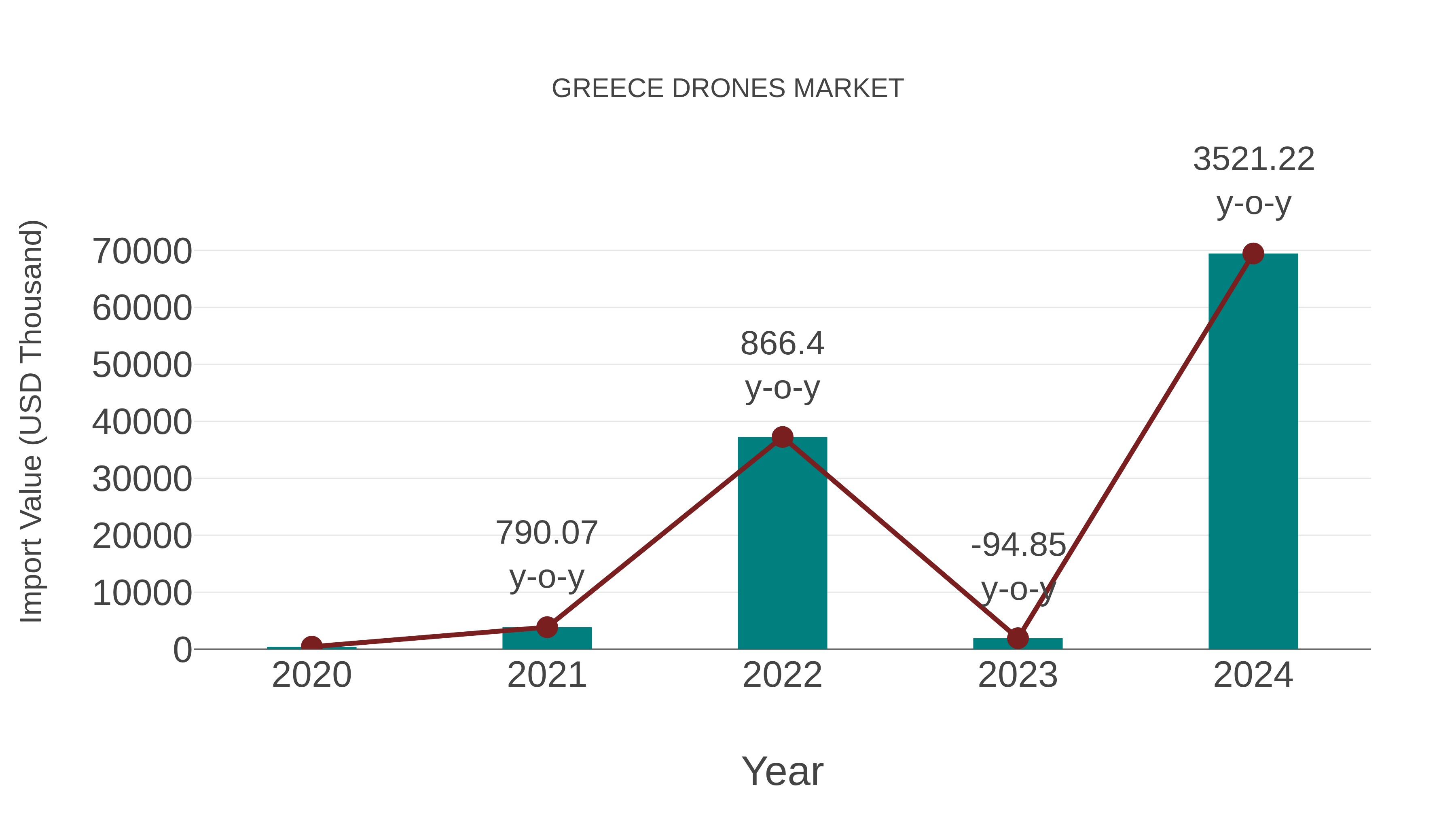
Greece Drones Market Growth Rate
According to 6Wresearch internal database and industry insights, the Greece Drones Market is growing at a compound annual growth rate (CAGR) of 8.4% during the forecast period (2026-2032).
Topics Covered in the Greece Drones Market Report
Greece Drones Market report thoroughly covers the market by application and component. The market report provides an unbiased and detailed analysis of ongoing market trends, opportunities/high growth areas, and market drivers, which would help stakeholders devise and align their market strategies according to the current and future market dynamics.
Greece Drones Market Highlights
| Report Name | Greece Drones Market |
| Forecast period | 2026-2032 |
| CAGR | 8.4% |
| Growing Sector | Agriculture |
Greece Drones Market Synopsis
The Greece Drones Market will experience substantial growth as multiple industries including agriculture and construction and law enforcement will increase their usage of drones. The demand for drones in precision farming and infrastructure monitoring and public safety operations is rising significantly. Government initiatives that support drone regulations and their commercial sector integration are driving market growth. The drone market in Greece experiences growth as of increased investments in drone technology and the demand for better data collection and surveillance systems.
Evaluation of Growth Drivers in the Greece Drones Market
Below mentioned some growth drivers and their impact on market dynamics:
| Drivers | Primary Segments Affected | Why It Matters |
| Government Support & Regulation | All Segments (Applications, Components) | Enables safe adoption and commercial drone usage. |
| Growth in Precision Agriculture | Application (Agriculture) | Increases crop monitoring and farming efficiency. |
| Rising Demand for Surveillance | Application (Law Enforcement, Energy) | Makes the security high and increases infrastructure monitoring safety. |
| Expansion in Construction Activities | Application (Construction) | Makes the demand higher for site inspection and mapping. |
| Technological Advancements | Component (Hardware, Software) | Increases drone performance and capabilities. |
The Greece Drones Market is projected to grow significantly, with a CAGR of 8.4% during the forecast period of 2026-2032. The Greece Drones Market experiences growth as multiple industries especially precision agriculture and construction and surveillance applications, adopt drones. The government supports commercial drone operations through its creation of regulatory frameworks which match European aviation standards. The market experiences growth as there is an increasing need for efficient systems that collect data and create maps and conduct monitoring activities. Drone capabilities receive enhancement through technological progress which includes AI integration and better sensors and automation systems. The market expansion occurs as infrastructure development investments increase and drone delivery services expand.
Evaluation of Restraints in the Greece Drones Market
Below mentioned are some major restraints and their influence on market dynamics:
| Restraints | Primary Segments Affected | What This Means |
| Regulatory Restrictions | All Segments | Limits drone operations and airspace usage. |
| High Initial Investment | Component (Hardware) | Restricts adoption among small businesses. |
| Privacy Concerns | Application (Law Enforcement, Surveillance) | Increases public resistance and compliance issues. |
| Limited Skilled Operators | All Segments | Slows the adoption of advanced and high tech drone solutions. |
| Weather Dependency | Application (Agriculture, Construction) | It badly effects the reliability of using drones in various weather conditions |
Greece Drones Market Challenges
The Greece Drones Market encounters several challenges as of strict regulatory frameworks which control both drone operations and airspace management. High initial investment costs limit adoption among small and medium enterprises. Privacy concerns about surveillance applications create challenges for both public acceptance and regulatory processes. The market expansion faces two limitations which include a shortage of skilled operators and technical expertise while weather conditions bring about negative effects on drone operational capacity and dependability.
Greece Drones Market Trends
Some major trends contributing to the Greece Drones Market Growth are:
- Growth in Aerial Surveillance: The rising adoption of drones in law enforcement, energy and security inspection sectors is increasing the market growth.
- Advancements in AI-Enabled Drones: The consumers are increasingly opting for AI and automation integrated drones which increases operational efficiency in various drone applications.
- Expansion of Drone Delivery Services: The growth of online retail platforms is contributing significantly to the industry growth by providing ease of accessibility and wide range product offerings to the consumer.
Investment Opportunities in the Greece Drones Market
Here are some investment opportunities in the Greece Drones Industry:
- Surveillance & Security Systems: Making of drone-based monitoring solutions offers opportunities in public safety, energy infrastructure, and border security.
- Agricultural Drone Solutions: Increasing investment in drones for precision farming can increase the overall productivity, reduce costs, and support sustainable agriculture practices.
- Drone Software Development: Creating advanced analytics and AI-based software enhances drone capabilities and supports various industrial applications.
Top 5 Leading Players in the Greece Drones Market
Here are some top companies contributing to Greece Drones Market Share:
1. PROBOTEK
| Company Name | PROBOTEK |
|---|---|
| Established Year | 2019 |
| Headquarters | Corfu, Greece |
| Official Website | Click Here |
PROBOTEK is a pioneer in the "Internet of Drones" (IoD) sector, specializing in AI-integrated software for enterprise operations. They made history in Greece by conducting the first authorized BVLOS (Beyond Visual Line of Sight) inter-island delivery. Their focus includes medical supply transport, automated security patrols, and maritime SAR (Search and Rescue) coordination.
2. Hellenic Drones S.A.
| Company Name | Hellenic Drones S.A. |
|---|---|
| Established Year | 2017 |
| Headquarters | Piraeus, Greece |
| Official Website | Click Here |
This company is a leading manufacturer and service provider focusing on industrial inspections and 3D mapping. They are the official regional partner for Flyability (Elios drones) and specialize in "indoor" drones for safe inspections in confined or hazardous spaces like ship hulls and industrial tanks. They also operate a major EASA-certified training academy.
3. S.A.S Technology (Spirit Aeronautical Systems)
| Company Name | S.A.S Technology (Spirit Aeronautical Systems) |
|---|---|
| Established Year | 2020 |
| Headquarters | Piraeus, Greece |
| Official Website | Click Here |
SAS Tech is the primary Greek manufacturer for heavy-lift and tactical unmanned systems. They developed the SARISA SRS-1A, the first Greek-made tactical multirotor capable of carrying rocket launchers. Their portfolio bridges the gap between commercial logistics and high-end defense, specializing in long-endurance platforms and heavy-cargo multirotors.
4. UCANDRONE S.A.
| Company Name | UCANDRONE S.A. |
|---|---|
| Established Year | 2013 |
| Headquarters | Glyfada, Greece |
| Official Website | Click Here |
One of Greece's most established UAS companies, UCANDRONE focuses on precision agriculture, aerial monitoring, and environmental data analysis. They provide custom-built aerial platforms designed for high-accuracy surveying and have a strong footprint in public sector contracts for border monitoring and wildfire detection.
5. Hellenic Defence Systems (EAS)
| Company Name | Hellenic Defence Systems (EAS) |
|---|---|
| Established Year | 1874 (Drone production: 2023) |
| Headquarters | Hymettus, Greece |
| Official Website | Click Here |
As the state-owned defense leader, EAS has pivoted toward drone manufacturing through strategic partnerships. A key highlight is the production of the IRIX, a next-generation long-range loitering munition (suicide drone) developed in collaboration with Paramount. This marks a major step in Greece’s indigenous production of advanced tactical UAVs.
Government Regulations Introduced in the Greece Drones Market
According to Greek government data, Greece follows the European Union Aviation Safety Agency (EASA) regulations for drone operations, which provide safety requirements and compliance standards. The Hellenic Civil Aviation Authority (HCAA) drone framework supports commercial drone operations through its established official programs. Greece is advancing smart agriculture initiatives through its digital transformation programs that utilize drone technology for monitoring purposes and data collection activities. Also, the drone ecosystem have operational improvements through these initiatives, which basically provide increased safety standards and innovative development capabilities.
Future Insights of the Greece Drones Market
The Greece Drones Market shows positive growth prospects as various industries are beginning to adopt drone technology. The market will grow as of three factors which include precision agriculture operations, infrastructure development projects and security surveillance needs. The development of artificial intelligence and automation technology will enable drones to achieve greater operational capabilities. The market will expand through government support and regulatory frameworks while investments in delivery drones and smart solutions will open up new business opportunities.
Market Segmentation Analysis
The report offers a comprehensive study of the subsequent market segments and their leading categories.
Agriculture to Dominate the Market - By Application
According to Guneet Kaur, Senior Research Analyst at 6Wresearch, agriculture dominates the market due to increasing adoption of drones for precision farming, crop monitoring, and resource management. Drones help farmers improve productivity, reduce costs, and optimize irrigation and fertilization processes.
Hardware to Dominate the Market – By Component
Hardware leads the market due to the high demand for advanced drones integrated with sensors and GPS systems. Also, increased innovation in drone design and performance is making their usability more across various industries.
Key attractiveness of the report
- 10 Years Market Numbers.
- Historical Data Starting from 2022 to 2025.
- Base Year: 2025
- Forecast Data until 2032.
- Key Performance Indicators Impacting the Market.
- Major Upcoming Developments and Projects.
Key Highlights of the Report:
- Greece Drones Market Outlook
- Market Size of Greece Drones Market, 2025
- Forecast of Greece Drones Market, 2032
- Historical Data and Forecast of Greece Drones Revenues & Volume for the Period 2022-2032
- Greece Drones Market Trend Evolution
- Greece Drones Market Drivers and Challenges
- Greece Drones Price Trends
- Greece Drones Porter's Five Forces
- Greece Drones Industry Life Cycle
- Historical Data and Forecast of Greece Drones Market Revenues & Volume By Application for the Period 2022-2032
- Historical Data and Forecast of Greece Drones Market Revenues & Volume By Construction for the Period 2022-2032
- Historical Data and Forecast of Greece Drones Market Revenues & Volume By Agriculture for the Period 2022-2032
- Historical Data and Forecast of Greece Drones Market Revenues & Volume By Energy for the Period 2022-2032
- Historical Data and Forecast of Greece Drones Market Revenues & Volume By Entertainment for the Period 2022-2032
- Historical Data and Forecast of Greece Drones Market Revenues & Volume By Law Enforcement for the Period 2022-2032
- Historical Data and Forecast of Greece Drones Market Revenues & Volume By Delivery for the Period 2022-2032
- Historical Data and Forecast of Greece Drones Market Revenues & Volume By Other for the Period 2022-2032
- Historical Data and Forecast of Greece Drones Market Revenues & Volume By Component for the Period 2022-2032
- Historical Data and Forecast of Greece Drones Market Revenues & Volume By Hardware for the Period 2022-2032
- Historical Data and Forecast of Greece Drones Market Revenues & Volume By Software for the Period 2022-2032
- Historical Data and Forecast of Greece Drones Market Revenues & Volume By Accessories for the Period 2022-2032
- Greece Drones Import Export Trade Statistics
- Market Opportunity Assessment By Application
- Market Opportunity Assessment By Component
- Greece Drones Top Companies Market Share
- Greece Drones Competitive Benchmarking By Technical and Operational Parameters
- Greece Drones Company Profiles
- Greece Drones Key Strategic Recommendations
Market covered
The report subsequently covers the market by following segments and subsegments.
By Application
- Construction
- Agriculture
- Energy
- Entertainment
- Law Enforcement
- Delivery
- Other
By Component
- Hardware
- Software
- Accessories






































