Guyana Halal Meat Market Top 5 Importing Countries and Market Competition (HHI) Analysis
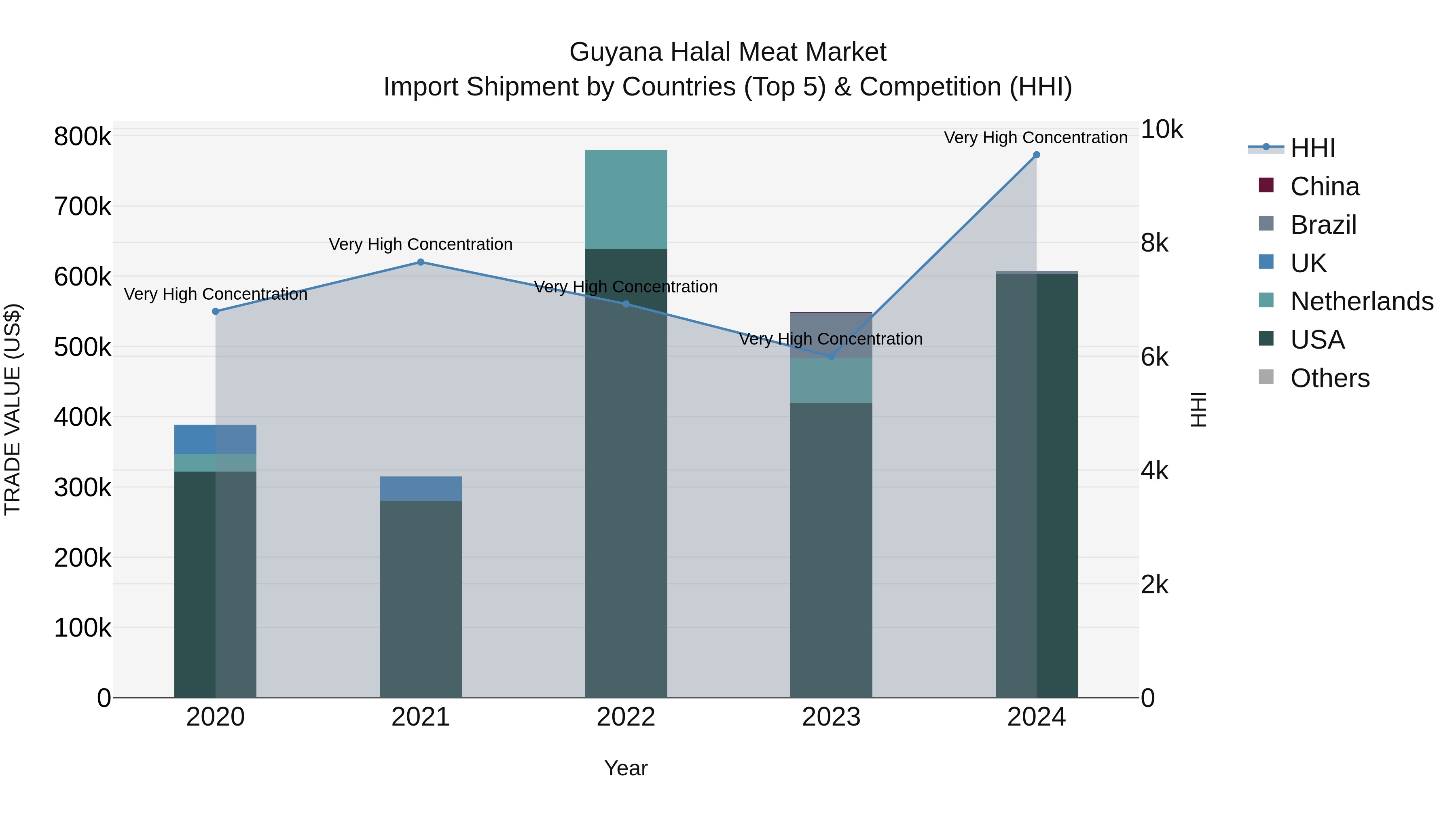
Guyana`s halal meat import market continues to be dominated by key players such as the USA, Brazil, China, Jamaica, and the Netherlands. The high Herfindahl-Hirschman Index (HHI) indicates a concentrated market in 2024. With a strong compound annual growth rate (CAGR) of 11.82% from 2020 to 2024 and a notable growth rate of 10.7% from 2023 to 2024, the import shipments of halal meat into Guyana are showing promising expansion and opportunities for market players in the coming years.
Halal Meat Market: Guyana vs Top 5 Major Economies in 2027 (Latin America)
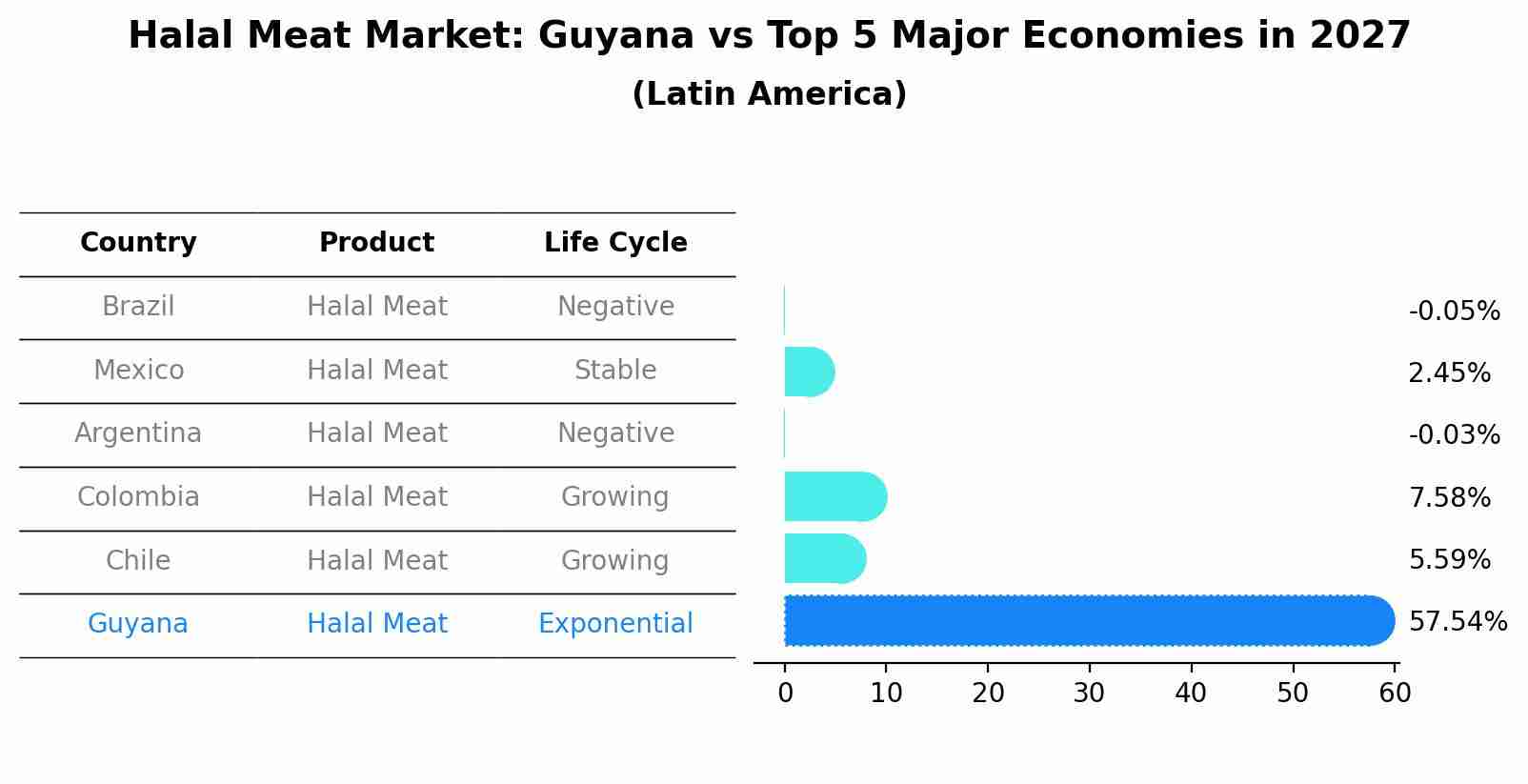
Guyana's Halal Meat market is anticipated to experience a exponential growth rate of 57.54% by 2027, reflecting trends observed in the largest economy Brazil, followed by Mexico, Argentina, Colombia and Chile.
Guyana Halal Meat Market Overview
The halal meat market in Guyana is experiencing steady growth, driven by demand from the Muslim community and export opportunities. Local producers are focusing on meeting stringent halal certification requirements to cater to both domestic and international markets. While this market holds significant potential, limited infrastructure and competition from global suppliers could hinder its growth.
Drivers of the market
The halal meat market in Guyana is growing due to the increasing number of consumers seeking meat products that adhere to halal dietary laws. The expanding Muslim population in Guyana is a significant driver, with a growing demand for halal-certified meat. Furthermore, the growing global trend toward ethical and sustainable food sourcing, along with the increasing awareness of halal meat`s health benefits, is contributing to the market`s growth. The improvement of halal certification standards and the availability of halal meat products in supermarkets and restaurants also play key roles in market expansion.
Challenges of the market
The halal meat market in Guyana faces similar challenges as the general halal food market, such as a small target demographic and limited local suppliers. The cost of sourcing halal-certified meat can be high, resulting in higher prices for consumers. Additionally, there are challenges in maintaining a reliable supply chain for halal meat, which requires proper slaughtering facilities and certifications. The lack of awareness about halal meat among the general population further hinders its growth in the local market.
Government Policy of the market
The halal meat market is supported by government policies that encourage ethical and sustainable meat production practices. Policies focus on establishing halal certification standards and modernizing slaughterhouses to comply with international norms. Incentives are provided for local farmers and meat processors to expand their capabilities, fostering growth in both domestic and export markets.
Key Highlights of the Report:
- Guyana Halal Meat Market Outlook
- Market Size of Guyana Halal Meat Market, 2024
- Forecast of Guyana Halal Meat Market, 2031
- Historical Data and Forecast of Guyana Halal Meat Revenues & Volume for the Period 2021-2031
- Guyana Halal Meat Market Trend Evolution
- Guyana Halal Meat Market Drivers and Challenges
- Guyana Halal Meat Price Trends
- Guyana Halal Meat Porter`s Five Forces
- Guyana Halal Meat Industry Life Cycle
- Historical Data and Forecast of Guyana Halal Meat Market Revenues & Volume By Product Type for the Period 2021-2031
- Historical Data and Forecast of Guyana Halal Meat Market Revenues & Volume By Fresh Food for the Period 2021-2031
- Historical Data and Forecast of Guyana Halal Meat Market Revenues & Volume By Processed Food for the Period 2021-2031
- Guyana Halal Meat Import Export Trade Statistics
- Market Opportunity Assessment By Product Type
- Guyana Halal Meat Top Companies Market Share
- Guyana Halal Meat Competitive Benchmarking By Technical and Operational Parameters
- Guyana Halal Meat Company Profiles
- Guyana Halal Meat Key Strategic Recommendations






































