Hong Kong Coal Tar Market Top 5 Importing Countries and Market Competition (HHI) Analysis
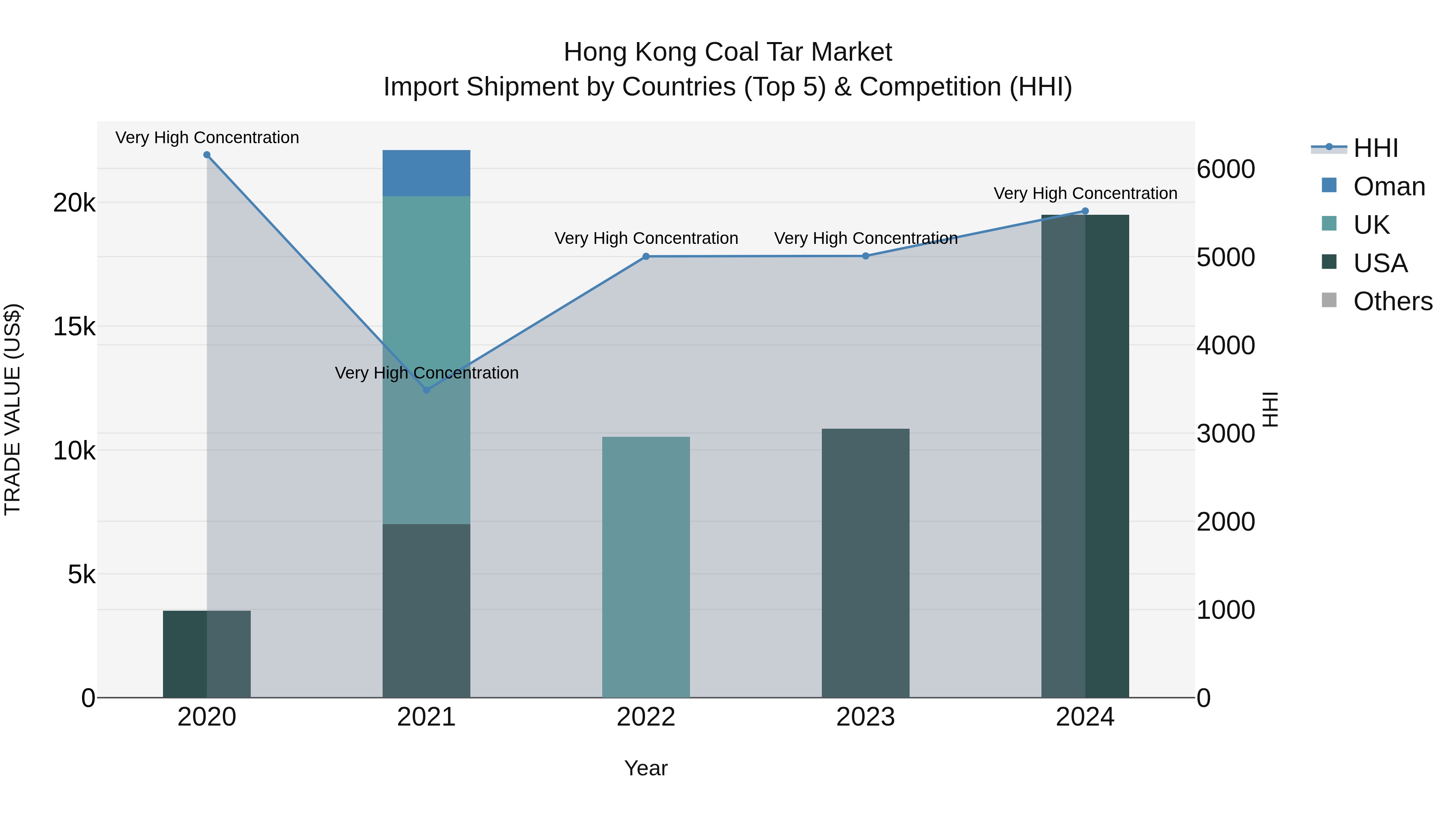
Hong Kong`s coal tar import market in 2024 saw significant growth with a high Herfindahl-Hirschman Index (HHI) indicating concentration among top exporting countries - USA, Oman, and UK. The Compound Annual Growth Rate (CAGR) from 2020-24 was an impressive 53.56%, with a notable growth spurt of 79.59% from 2023-24. These statistics suggest a robust demand for coal tar in Hong Kong, potentially driven by various industries such as construction and manufacturing. Market participants should closely monitor these trends for strategic insights and opportunities in the sector.
Hong Kong Coal Tar Market Synopsis
The coal tar market in Hong Kong is focused on the production and application of coal tar and its derivatives. Coal tar is a viscous black liquid obtained from the carbonization of coal and is used in various industries, including construction, roofing, and pharmaceuticals. The demand for coal tar is driven by its unique properties and versatility in applications. As industries seek sustainable alternatives, the coal tar market is likely to evolve, with a focus on enhancing product quality and reducing environmental impacts.
Drivers of the market
The Hong Kong coal tar market is primarily driven by its use in the production of chemicals, including creosote and coal tar pitch. These chemicals are used in various industries, including construction, road paving, and steel manufacturing. The increasing demand for these end-products, along with the expansion of infrastructure projects, supports the growth of the coal tar market in the region.
Challenges of the market
The coal tar market in Hong Kong faces challenges associated with regulatory scrutiny and market demand fluctuations. Coal tar, being a byproduct of the coal carbonization process, is subject to stringent environmental regulations due to its hazardous nature and potential health risks. Compliance with these regulations can lead to increased operational costs and necessitate investments in safety and waste management practices. Additionally, market demand for coal tar products is influenced by various factors, including the performance of end-user industries such as construction and manufacturing. Economic downturns can lead to reduced demand for coal tar products, impacting profitability. Moreover, competition from alternative materials and the growing emphasis on sustainability further challenge the coal tar market, compelling producers to innovate and adapt their offerings to meet changing consumer preferences.
Government Policy of the market
In the Coal Tar market, the Hong Kong government prioritizes policies that ensure compliance with safety and environmental regulations for coal tar products. The government promotes research into innovative applications of coal tar in various industries, such as construction and manufacturing. Regulations are established to mitigate the environmental impact of coal tar production and usage. Additionally, initiatives are aimed at educating businesses about the benefits and safe handling of coal tar.
Key Highlights of the Report:
- Hong Kong Coal Tar Market Outlook
- Market Size of Hong Kong Coal Tar Market, 2024
- Forecast of Hong Kong Coal Tar Market, 2031
- Historical Data and Forecast of Hong Kong Coal Tar Revenues & Volume for the Period 2021-2031
- Hong Kong Coal Tar Market Trend Evolution
- Hong Kong Coal Tar Market Drivers and Challenges
- Hong Kong Coal Tar Price Trends
- Hong Kong Coal Tar Porter`s Five Forces
- Hong Kong Coal Tar Industry Life Cycle
- Historical Data and Forecast of Hong Kong Coal Tar Market Revenues & Volume By Type for the Period 2021-2031
- Historical Data and Forecast of Hong Kong Coal Tar Market Revenues & Volume By Low Temperature Coal Tar for the Period 2021-2031
- Historical Data and Forecast of Hong Kong Coal Tar Market Revenues & Volume By Medium Temperature Coal Tar for the Period 2021-2031
- Historical Data and Forecast of Hong Kong Coal Tar Market Revenues & Volume By High Temperature Coal Tar for the Period 2021-2031
- Historical Data and Forecast of Hong Kong Coal Tar Market Revenues & Volume By Application for the Period 2021-2031
- Historical Data and Forecast of Hong Kong Coal Tar Market Revenues & Volume By Coal Tar Pitch for the Period 2021-2031
- Historical Data and Forecast of Hong Kong Coal Tar Market Revenues & Volume By Carbon Black Oil for the Period 2021-2031
- Historical Data and Forecast of Hong Kong Coal Tar Market Revenues & Volume By Specialty Oils for the Period 2021-2031
- Historical Data and Forecast of Hong Kong Coal Tar Market Revenues & Volume By End-use for the Period 2021-2031
- Historical Data and Forecast of Hong Kong Coal Tar Market Revenues & Volume By Aluminum Industry for the Period 2021-2031
- Historical Data and Forecast of Hong Kong Coal Tar Market Revenues & Volume By Roofing for the Period 2021-2031
- Historical Data and Forecast of Hong Kong Coal Tar Market Revenues & Volume By Tire Industry for the Period 2021-2031
- Historical Data and Forecast of Hong Kong Coal Tar Market Revenues & Volume By Paint Industry for the Period 2021-2031
- Historical Data and Forecast of Hong Kong Coal Tar Market Revenues & Volume By Wood Preservation for the Period 2021-2031
- Historical Data and Forecast of Hong Kong Coal Tar Market Revenues & Volume By Others for the Period 2021-2031
- Historical Data and Forecast of Hong Kong Coal Tar Market Revenues & Volume By Marketing Channel for the Period 2021-2031
- Historical Data and Forecast of Hong Kong Coal Tar Market Revenues & Volume By Online for the Period 2021-2031
- Historical Data and Forecast of Hong Kong Coal Tar Market Revenues & Volume By Offline for the Period 2021-2031
- Hong Kong Coal Tar Import Export Trade Statistics
- Market Opportunity Assessment By Type
- Market Opportunity Assessment By Application
- Market Opportunity Assessment By End-use
- Market Opportunity Assessment By Marketing Channel
- Hong Kong Coal Tar Top Companies Market Share
- Hong Kong Coal Tar Competitive Benchmarking By Technical and Operational Parameters
- Hong Kong Coal Tar Company Profiles
- Hong Kong Coal Tar Key Strategic Recommendations






































