Hong Kong Cutting Equipment Market Top 5 Importing Countries and Market Competition (HHI) Analysis
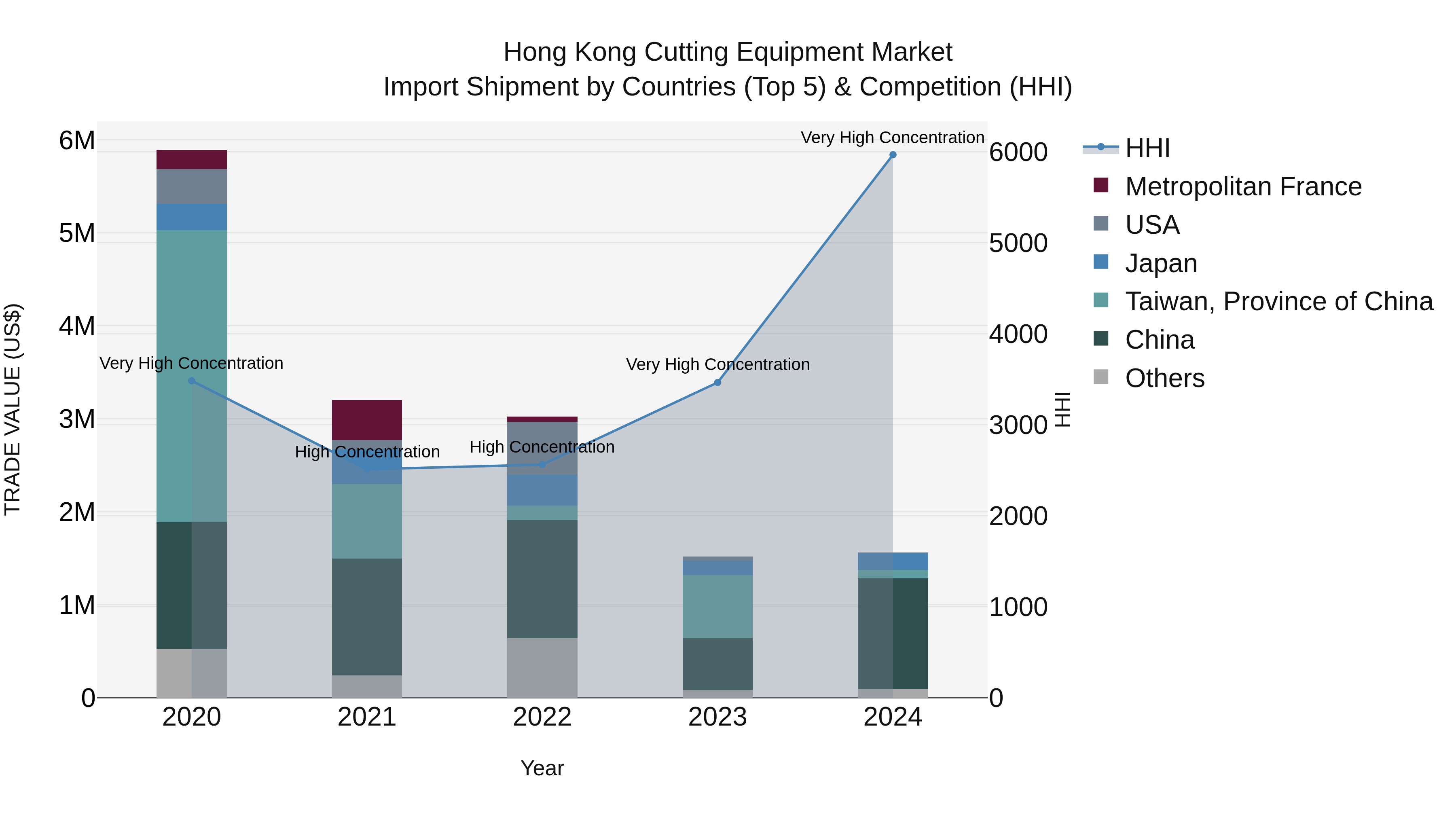
Hong Kong`s cutting equipment import shipments in 2024 saw a significant concentration from top exporting countries such as China, Japan, Taiwan, Italy, and the USA. Despite a negative CAGR of -28.22% from 2020 to 2024, there was a slight growth rate of 3.03% from 2023 to 2024. The high Herfindahl-Hirschman Index (HHI) indicates a market dominated by a few key players, highlighting the competitive landscape and potential challenges for new entrants in the cutting equipment import market in Hong Kong.
Hong Kong Cutting Equipment Market Synopsis
The cutting equipment market in Hong Kong is expanding as industries seek efficient and precise cutting solutions. Cutting equipment is essential in various sectors, including manufacturing, construction, and textiles. The market is characterized by advancements in technology, leading to the development of high-performance cutting tools and machinery. Additionally, the increasing focus on automation and productivity is driving the adoption of cutting equipment across industries, enabling businesses to optimize their operations.
Drivers of the market
The cutting equipment market in Hong Kong is expanding due to the increasing demand for precision cutting solutions in various industries, including manufacturing, construction, and automotive. As companies seek to improve efficiency and reduce waste in their operations, the need for advanced cutting equipment grows. Technological advancements and the focus on automation further drive market dynamics.
Challenges of the market
The cutting equipment market in Hong Kong encounters challenges related to technological advancements and market competition. As new cutting technologies emerge, manufacturers must invest in research and development to stay competitive. Additionally, competition from alternative cutting solutions necessitates continuous innovation to maintain market relevance. Companies must prioritize technological integration and product differentiation to address these challenges effectively.
Government Policy of the market
Government policies in the Cutting Equipment market focus on safety and compliance with industry standards. The government mandates regular inspections and certifications for cutting equipment to ensure safe usage. Initiatives are implemented to educate manufacturers and operators about best practices for equipment maintenance and safety standards, fostering a culture of responsibility in the industry.
Key Highlights of the Report:
- Hong Kong Cutting Equipment Market Outlook
- Market Size of Hong Kong Cutting Equipment Market, 2024
- Forecast of Hong Kong Cutting Equipment Market, 2031
- Historical Data and Forecast of Hong Kong Cutting Equipment Revenues & Volume for the Period 2021-2031
- Hong Kong Cutting Equipment Market Trend Evolution
- Hong Kong Cutting Equipment Market Drivers and Challenges
- Hong Kong Cutting Equipment Price Trends
- Hong Kong Cutting Equipment Porter`s Five Forces
- Hong Kong Cutting Equipment Industry Life Cycle
- Historical Data and Forecast of Hong Kong Cutting Equipment Market Revenues & Volume By Equipment Type for the Period 2021-2031
- Historical Data and Forecast of Hong Kong Cutting Equipment Market Revenues & Volume By Manual for the Period 2021-2031
- Historical Data and Forecast of Hong Kong Cutting Equipment Market Revenues & Volume By Mechanized for the Period 2021-2031
- Historical Data and Forecast of Hong Kong Cutting Equipment Market Revenues & Volume By Cutting Technology for the Period 2021-2031
- Historical Data and Forecast of Hong Kong Cutting Equipment Market Revenues & Volume By Plasma cutting for the Period 2021-2031
- Historical Data and Forecast of Hong Kong Cutting Equipment Market Revenues & Volume By Oxy-fuel cutting for the Period 2021-2031
- Historical Data and Forecast of Hong Kong Cutting Equipment Market Revenues & Volume By Laser cutting for the Period 2021-2031
- Historical Data and Forecast of Hong Kong Cutting Equipment Market Revenues & Volume By Waterjet cutting for the Period 2021-2031
- Historical Data and Forecast of Hong Kong Cutting Equipment Market Revenues & Volume By Carbon arc cutting for the Period 2021-2031
- Historical Data and Forecast of Hong Kong Cutting Equipment Market Revenues & Volume By End Use Industry for the Period 2021-2031
- Historical Data and Forecast of Hong Kong Cutting Equipment Market Revenues & Volume By Construction for the Period 2021-2031
- Historical Data and Forecast of Hong Kong Cutting Equipment Market Revenues & Volume By Heavy metal fabrication for the Period 2021-2031
- Historical Data and Forecast of Hong Kong Cutting Equipment Market Revenues & Volume By Shipbuilding & offshore for the Period 2021-2031
- Historical Data and Forecast of Hong Kong Cutting Equipment Market Revenues & Volume By Automotive for the Period 2021-2031
- Historical Data and Forecast of Hong Kong Cutting Equipment Market Revenues & Volume By Others for the Period 2021-2031
- Historical Data and Forecast of Hong Kong Cutting Equipment Market Revenues & Volume By Type for the Period 2021-2031
- Historical Data and Forecast of Hong Kong Cutting Equipment Market Revenues & Volume By Equipment for the Period 2021-2031
- Historical Data and Forecast of Hong Kong Cutting Equipment Market Revenues & Volume By Consumables/Accessories for the Period 2021-2031
- Hong Kong Cutting Equipment Import Export Trade Statistics
- Market Opportunity Assessment By Equipment Type
- Market Opportunity Assessment By Cutting Technology
- Market Opportunity Assessment By End Use Industry
- Market Opportunity Assessment By Type
- Hong Kong Cutting Equipment Top Companies Market Share
- Hong Kong Cutting Equipment Competitive Benchmarking By Technical and Operational Parameters
- Hong Kong Cutting Equipment Company Profiles
- Hong Kong Cutting Equipment Key Strategic Recommendations






































