Hong Kong Garden Equipment Market Top 5 Importing Countries and Market Competition (HHI) Analysis
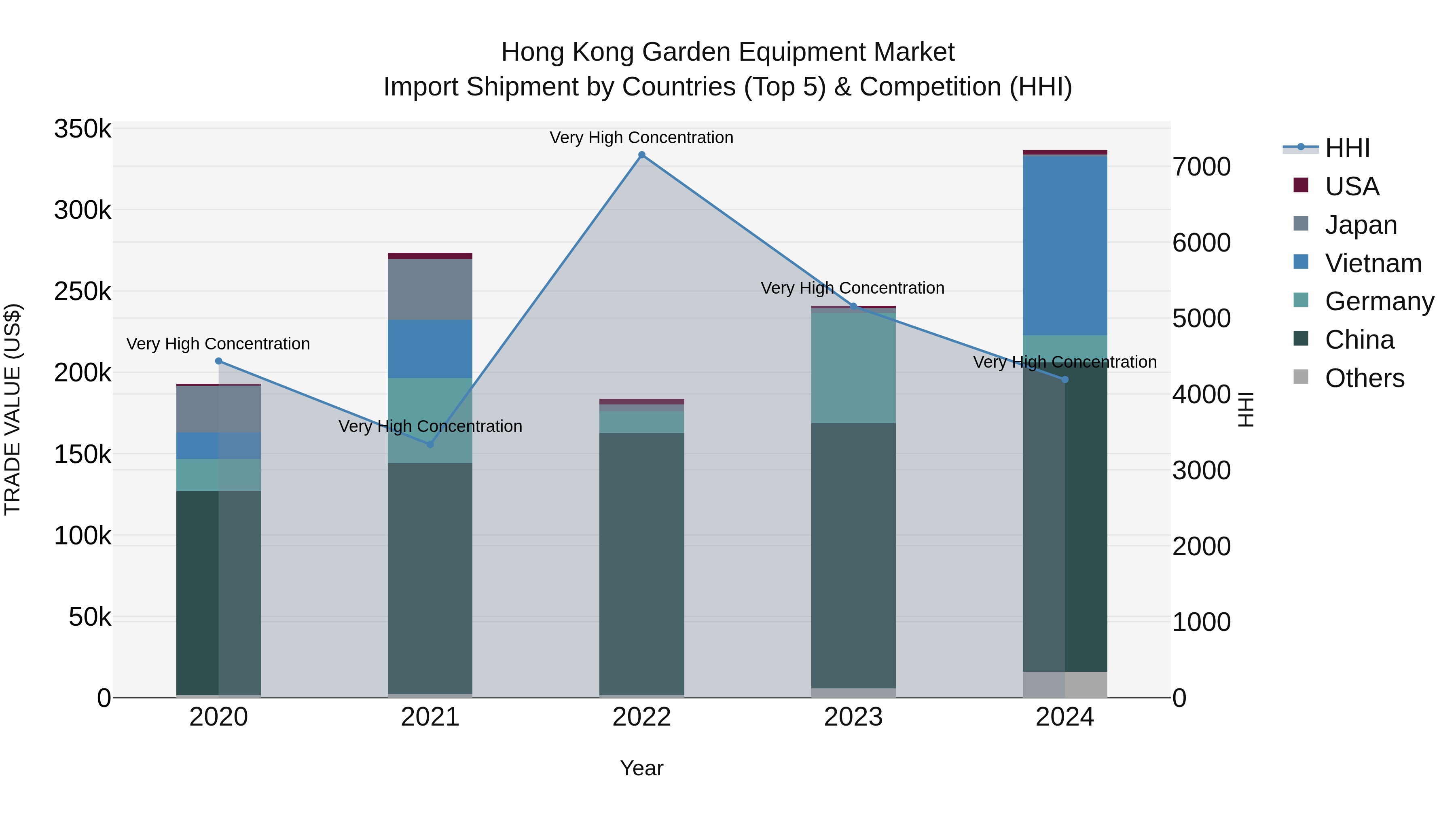
The Hong Kong garden equipment import market continues to be dominated by key players such as China, Vietnam, Germany, Sweden, and Brazil, reflecting a high Herfindahl-Hirschman Index (HHI) concentration in 2024. With a strong compound annual growth rate (CAGR) of 14.94% from 2020 to 2024, the market shows promising expansion. The impressive growth rate of 39.71% from 2023 to 2024 indicates a surge in demand and potential opportunities for both local and international suppliers.
Hong Kong Garden Equipment Market Synopsis
The Hong Kong Garden Equipment Market is characterized by a growing demand for high-quality gardening tools and equipment driven by an increasing number of urban residents taking up gardening as a hobby. Key trends in the market include a rise in sustainable and eco-friendly product offerings, such as electric or battery-powered tools, reflecting a growing environmental consciousness among consumers. Additionally, the market is witnessing a shift towards ergonomic and user-friendly designs, catering to the needs of both experienced gardeners and novices. Key players in the market include both international brands and local manufacturers, offering a wide range of products catering to different price points and consumer preferences. With the trend of home gardening on the rise, the Hong Kong Garden Equipment Market is expected to continue its growth trajectory in the coming years.
Hong Kong Garden Equipment Market Trends
The Hong Kong Garden Equipment Market is experiencing a shift towards environmentally friendly and sustainable products, driven by increasing awareness of climate change and pollution. Consumers are seeking electric or battery-powered garden tools that are more energy-efficient and produce fewer emissions. This trend presents an opportunity for manufacturers to introduce innovative eco-friendly solutions such as solar-powered equipment or tools with ergonomic designs for improved user experience. Additionally, the growing popularity of urban gardening in Hong Kong has created a demand for compact and portable gardening tools suitable for small spaces. Companies that can cater to these evolving consumer preferences and offer products tailored to urban gardening needs are likely to find success in the Hong Kong market.
Hong Kong Garden Equipment Market Challenges
In the Hong Kong Garden Equipment Market, challenges include intense competition from both domestic and international brands, leading to pricing pressure and the need for continuous product innovation to stand out. Additionally, limited space in urban areas poses a challenge for retailers to display larger garden equipment, while the high cost of real estate contributes to higher operating expenses. Furthermore, changing consumer preferences towards eco-friendly and sustainable products require manufacturers and retailers to adapt their offerings to meet these demands, adding complexity to the market landscape. Finally, fluctuations in raw material prices and regulatory changes related to environmental standards can impact production costs and product availability, requiring companies to stay agile and responsive to market dynamics.
Hong Kong Garden Equipment Market Investment Opportunities
The Hong Kong Garden Equipment Market is primarily driven by factors such as increasing urbanization, growing disposable income levels, and a rising trend towards home gardening and landscaping. As more individuals in Hong Kong are living in urban areas with limited outdoor space, there is a growing demand for compact and versatile garden equipment that is suitable for smaller gardens or balconies. Additionally, the rising awareness about environmental sustainability and the benefits of gardening for mental well-being are also driving the market growth. The availability of a wide range of innovative and technologically advanced garden equipment, coupled with the influence of social media and gardening influencers, is further fueling the demand for these products in Hong Kong.
Hong Kong Garden Equipment Market Government Polices
The Hong Kong government has implemented regulations to ensure the safety and quality of garden equipment in the market. These policies include strict product testing and certification requirements to meet international standards, aiming to protect consumers from substandard or unsafe products. Additionally, there are guidelines in place to promote environmental sustainability in the design and manufacturing of garden equipment, encouraging the use of eco-friendly materials and energy-efficient technologies. The government also supports innovation and research in the industry through funding programs and collaboration opportunities to enhance product development and competitiveness. Overall, these policies create a framework for a well-regulated and environmentally conscious garden equipment market in Hong Kong.
Hong Kong Garden Equipment Market Future Outlook
The future outlook for the Hong Kong Garden Equipment Market appears promising with a projected growth driven by increasing urbanization, a growing focus on green spaces, and rising disposable incomes. The demand for garden equipment such as lawn mowers, trimmers, and gardening tools is expected to rise as more people in Hong Kong are engaging in gardening as a hobby or for leisure. Additionally, the government`s initiatives to promote urban greening and sustainability are likely to further boost the market. Technological advancements in garden equipment, such as electric and battery-powered alternatives, are also anticipated to drive market growth. Overall, the Hong Kong Garden Equipment Market is expected to witness steady growth in the coming years, presenting opportunities for market players to expand their product offerings and capture a larger market share.
Key Highlights of the Report:
- Hong Kong Garden Equipment Market Outlook
- Market Size of Hong Kong Garden Equipment Market, 2024
- Forecast of Hong Kong Garden Equipment Market, 2031
- Historical Data and Forecast of Hong Kong Garden Equipment Revenues & Volume for the Period 2021- 2031
- Hong Kong Garden Equipment Market Trend Evolution
- Hong Kong Garden Equipment Market Drivers and Challenges
- Hong Kong Garden Equipment Price Trends
- Hong Kong Garden Equipment Porter's Five Forces
- Hong Kong Garden Equipment Industry Life Cycle
- Historical Data and Forecast of Hong Kong Garden Equipment Market Revenues & Volume By GardeProduct for the Period 2021- 2031
- Historical Data and Forecast of Hong Kong Garden Equipment Market Revenues & Volume By Lawn Mowing Machines for the Period 2021- 2031
- Historical Data and Forecast of Hong Kong Garden Equipment Market Revenues & Volume By Handheld Tools for the Period 2021- 2031
- Historical Data and Forecast of Hong Kong Garden Equipment Market Revenues & Volume By Tillers for the Period 2021- 2031
- Historical Data and Forecast of Hong Kong Garden Equipment Market Revenues & Volume By Cleaning for the Period 2021- 2031
- Historical Data and Forecast of Hong Kong Garden Equipment Market Revenues & Volume By Others for the Period 2021- 2031
- Historical Data and Forecast of Hong Kong Garden Equipment Market Revenues & Volume By Power Source for the Period 2021- 2031
- Historical Data and Forecast of Hong Kong Garden Equipment Market Revenues & Volume By Petro for the Period 2021- 2031
- Historical Data and Forecast of Hong Kong Garden Equipment Market Revenues & Volume By Electric Corded for the Period 2021- 2031
- Historical Data and Forecast of Hong Kong Garden Equipment Market Revenues & Volume By Battery for the Period 2021- 2031
- Historical Data and Forecast of Hong Kong Garden Equipment Market Revenues & Volume By Cordless for the Period 2021- 2031
- Historical Data and Forecast of Hong Kong Garden Equipment Market Revenues & Volume By Others for the Period 2021- 2031
- Historical Data and Forecast of Hong Kong Garden Equipment Market Revenues & Volume By Material for the Period 2021- 2031
- Historical Data and Forecast of Hong Kong Garden Equipment Market Revenues & Volume By Wood for the Period 2021- 2031
- Historical Data and Forecast of Hong Kong Garden Equipment Market Revenues & Volume By Metal for the Period 2021- 2031
- Historical Data and Forecast of Hong Kong Garden Equipment Market Revenues & Volume By Plastic for the Period 2021- 2031
- Historical Data and Forecast of Hong Kong Garden Equipment Market Revenues & Volume By Recycled Plastics for the Period 2021- 2031
- Historical Data and Forecast of Hong Kong Garden Equipment Market Revenues & Volume By Synthetic Resin for the Period 2021- 2031
- Historical Data and Forecast of Hong Kong Garden Equipment Market Revenues & Volume By Others for the Period 2021- 2031
- Historical Data and Forecast of Hong Kong Garden Equipment Market Revenues & Volume By Distribution Channel for the Period 2021- 2031
- Historical Data and Forecast of Hong Kong Garden Equipment Market Revenues & Volume By B2B/Direct Sales for the Period 2021- 2031
- Historical Data and Forecast of Hong Kong Garden Equipment Market Revenues & Volume By Supermarkets/Hypermarkets for the Period 2021- 2031
- Historical Data and Forecast of Hong Kong Garden Equipment Market Revenues & Volume By E-Commerce for the Period 2021- 2031
- Historical Data and Forecast of Hong Kong Garden Equipment Market Revenues & Volume By Specialty Stores for the Period 2021- 2031
- Historical Data and Forecast of Hong Kong Garden Equipment Market Revenues & Volume By Convenience Stores for the Period 2021- 2031
- Historical Data and Forecast of Hong Kong Garden Equipment Market Revenues & Volume By Others for the Period 2021- 2031
- Historical Data and Forecast of Hong Kong Garden Equipment Market Revenues & Volume By End-user for the Period 2021- 2031
- Historical Data and Forecast of Hong Kong Garden Equipment Market Revenues & Volume By Residential for the Period 2021- 2031
- Historical Data and Forecast of Hong Kong Garden Equipment Market Revenues & Volume By Commercial Offices for the Period 2021- 2031
- Historical Data and Forecast of Hong Kong Garden Equipment Market Revenues & Volume By Malls/Supermarkets for the Period 2021- 2031
- Historical Data and Forecast of Hong Kong Garden Equipment Market Revenues & Volume By Parks for the Period 2021- 2031
- Historical Data and Forecast of Hong Kong Garden Equipment Market Revenues & Volume By Airports for the Period 2021- 2031
- Historical Data and Forecast of Hong Kong Garden Equipment Market Revenues & Volume By Sports Stadium for the Period 2021- 2031
- Historical Data and Forecast of Hong Kong Garden Equipment Market Revenues & Volume By Others for the Period 2021- 2031
- Hong Kong Garden Equipment Import Export Trade Statistics
- Market Opportunity Assessment By GardeProduct
- Market Opportunity Assessment By Power Source
- Market Opportunity Assessment By Material
- Market Opportunity Assessment By Distribution Channel
- Market Opportunity Assessment By End-user
- Hong Kong Garden Equipment Top Companies Market Share
- Hong Kong Garden Equipment Competitive Benchmarking By Technical and Operational Parameters
- Hong Kong Garden Equipment Company Profiles
- Hong Kong Garden Equipment Key Strategic Recommendations






































