Hong Kong Magnesium Sulfate Market Top 5 Importing Countries and Market Competition (HHI) Analysis
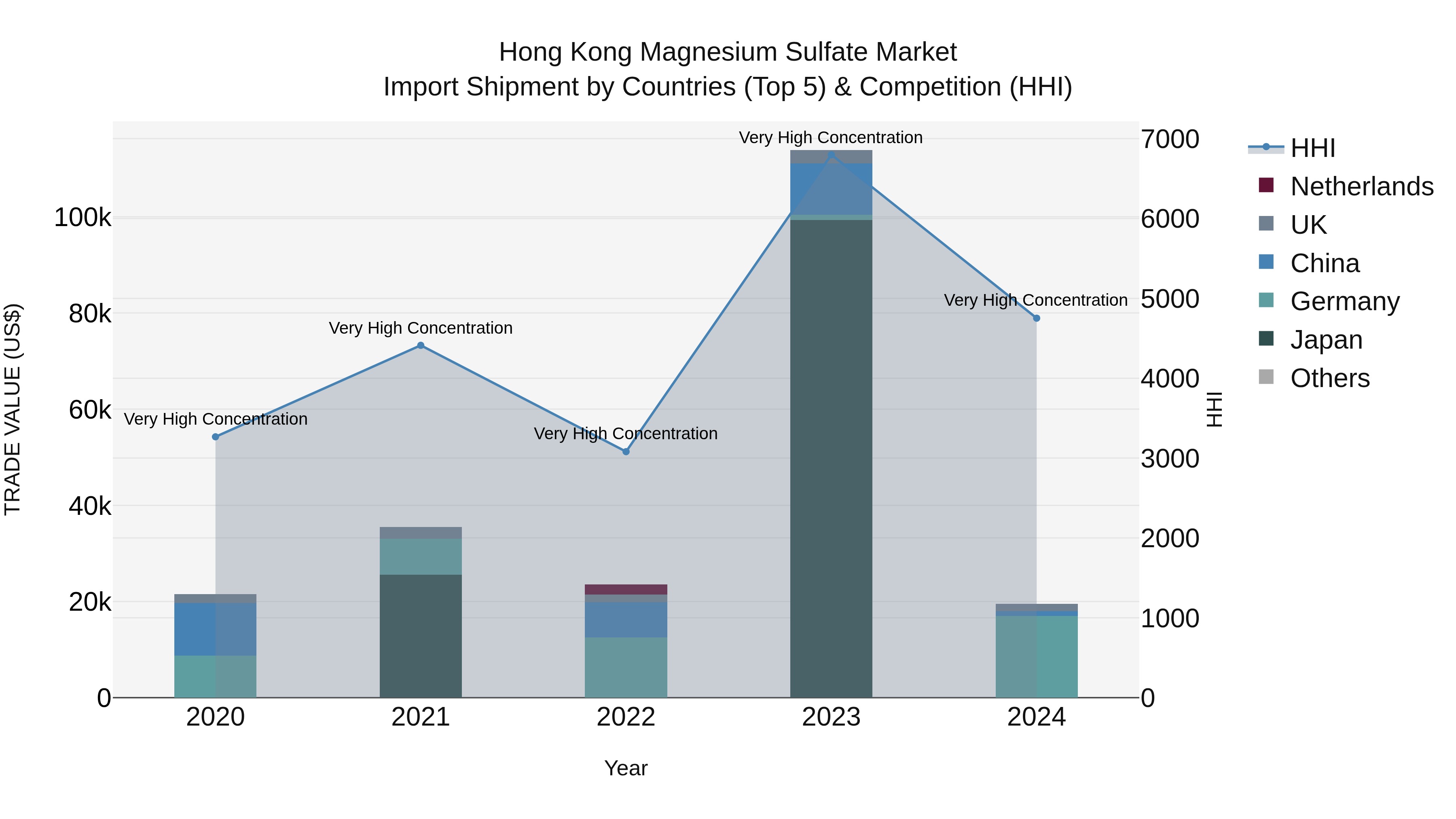
In 2024, Hong Kong continued to see significant magnesium sulfate import shipments, with top exporting countries including Germany, UK, China, Japan, and Netherlands. The market remained highly concentrated, as indicated by the high Herfindahl-Hirschman Index (HHI) in 2024. However, the compound annual growth rate (CAGR) for magnesium sulfate imports from 2020 to 2024 experienced a decline of -2.35%. Moreover, the growth rate from 2023 to 2024 plummeted by -82.83%, reflecting a challenging year for the industry. This data suggests a shifting landscape in the magnesium sulfate market, warranting further analysis and strategic considerations for market participants.
Hong Kong Magnesium Sulfate Market Synopsis
Magnesium sulfate, commonly known as Epsom salt, has applications in agriculture, healthcare, and personal care. In Hong Kong, the market is driven by its use in fertilizers to improve soil quality, as well as in health products for its therapeutic properties.
Drivers of the market
The Hong Kong Magnesium Sulfate Market is driven by the increasing demand for magnesium sulfate in agriculture, pharmaceuticals, and industrial applications. Magnesium sulfate is recognized for its essential role in crop nutrition, helping to enhance soil quality and improve plant growth. As the agriculture sector in Hong Kong focuses on sustainable practices and increased yields, the demand for magnesium sulfate as a fertilizer is rising. Additionally, the growing use of magnesium sulfate in pharmaceuticals, particularly in intravenous fluids and laxatives, is contributing to market growth. The expanding applications of magnesium sulfate in various industries, including food processing and cosmetics, are also propelling demand in Hong Kong.
Challenges of the market
The magnesium sulfate market contends with high production costs, fluctuating raw material prices, and competition from alternative products in agriculture and healthcare applications. Strict environmental regulations and compliance requirements further complicate the market.
Government Policy of the market
The magnesium sulfate market in Hong Kong is shaped by government initiatives promoting the use of magnesium compounds in agriculture, pharmaceuticals, and food industries. Policies encouraging sustainable practices and the development of eco-friendly products drive demand for magnesium sulfate as a safe and effective ingredient. Regulatory frameworks surrounding product safety and quality ensure that manufacturers adhere to strict standards, enhancing consumer trust. The increasing demand for magnesium sulfate in horticulture and as a dietary supplement further stimulates market growth, requiring continuous innovation to meet evolving consumer preferences.
Key Highlights of the Report:
- Hong Kong Magnesium Sulfate Market Outlook
- Market Size of Hong Kong Magnesium Sulfate Market, 2024
- Forecast of Hong Kong Magnesium Sulfate Market, 2031
- Historical Data and Forecast of Hong Kong Magnesium Sulfate Revenues & Volume for the Period 2021-2031
- Hong Kong Magnesium Sulfate Market Trend Evolution
- Hong Kong Magnesium Sulfate Market Drivers and Challenges
- Hong Kong Magnesium Sulfate Price Trends
- Hong Kong Magnesium Sulfate Porter`s Five Forces
- Hong Kong Magnesium Sulfate Industry Life Cycle
- Historical Data and Forecast of Hong Kong Magnesium Sulfate Market Revenues & Volume By Form for the Period 2021-2031
- Historical Data and Forecast of Hong Kong Magnesium Sulfate Market Revenues & Volume By Crystal for the Period 2021-2031
- Historical Data and Forecast of Hong Kong Magnesium Sulfate Market Revenues & Volume By Powder for the Period 2021-2031
- Historical Data and Forecast of Hong Kong Magnesium Sulfate Market Revenues & Volume By Granules for the Period 2021-2031
- Historical Data and Forecast of Hong Kong Magnesium Sulfate Market Revenues & Volume By Types for the Period 2021-2031
- Historical Data and Forecast of Hong Kong Magnesium Sulfate Market Revenues & Volume By Heptahydrate for the Period 2021-2031
- Historical Data and Forecast of Hong Kong Magnesium Sulfate Market Revenues & Volume By Anhydrous for the Period 2021-2031
- Historical Data and Forecast of Hong Kong Magnesium Sulfate Market Revenues & Volume By Monohydrate for the Period 2021-2031
- Historical Data and Forecast of Hong Kong Magnesium Sulfate Market Revenues & Volume By Others for the Period 2021-2031
- Historical Data and Forecast of Hong Kong Magnesium Sulfate Market Revenues & Volume By Applications for the Period 2021-2031
- Historical Data and Forecast of Hong Kong Magnesium Sulfate Market Revenues & Volume By Fertilizer for the Period 2021-2031
- Historical Data and Forecast of Hong Kong Magnesium Sulfate Market Revenues & Volume By Medical for the Period 2021-2031
- Historical Data and Forecast of Hong Kong Magnesium Sulfate Market Revenues & Volume By Food Additive for the Period 2021-2031
- Historical Data and Forecast of Hong Kong Magnesium Sulfate Market Revenues & Volume By Industrial for the Period 2021-2031
- Historical Data and Forecast of Hong Kong Magnesium Sulfate Market Revenues & Volume By Chemical for the Period 2021-2031
- Historical Data and Forecast of Hong Kong Magnesium Sulfate Market Revenues & Volume By Others for the Period 2021-2031
- Hong Kong Magnesium Sulfate Import Export Trade Statistics
- Market Opportunity Assessment By Form
- Market Opportunity Assessment By Types
- Market Opportunity Assessment By Applications
- Hong Kong Magnesium Sulfate Top Companies Market Share
- Hong Kong Magnesium Sulfate Competitive Benchmarking By Technical and Operational Parameters
- Hong Kong Magnesium Sulfate Company Profiles
- Hong Kong Magnesium Sulfate Key Strategic Recommendations






































