Hong Kong Recordable Optical Disc Market Top 5 Importing Countries and Market Competition (HHI) Analysis
In 2024, Hong Kong continued to see a high concentration of recordable optical disc import shipments, with top exporters being Taiwan, Japan, Singapore, China, and the UK. Despite a challenging CAGR of -10.8% from 2020 to 2024, there was a significant growth spurt of 70.59% from 2023 to 2024. This indicates a shifting landscape in the market dynamics, possibly driven by changing consumer preferences or emerging technologies. The dominance of these key exporting countries underscores the importance of their contributions to Hong Kong`s optical disc market.
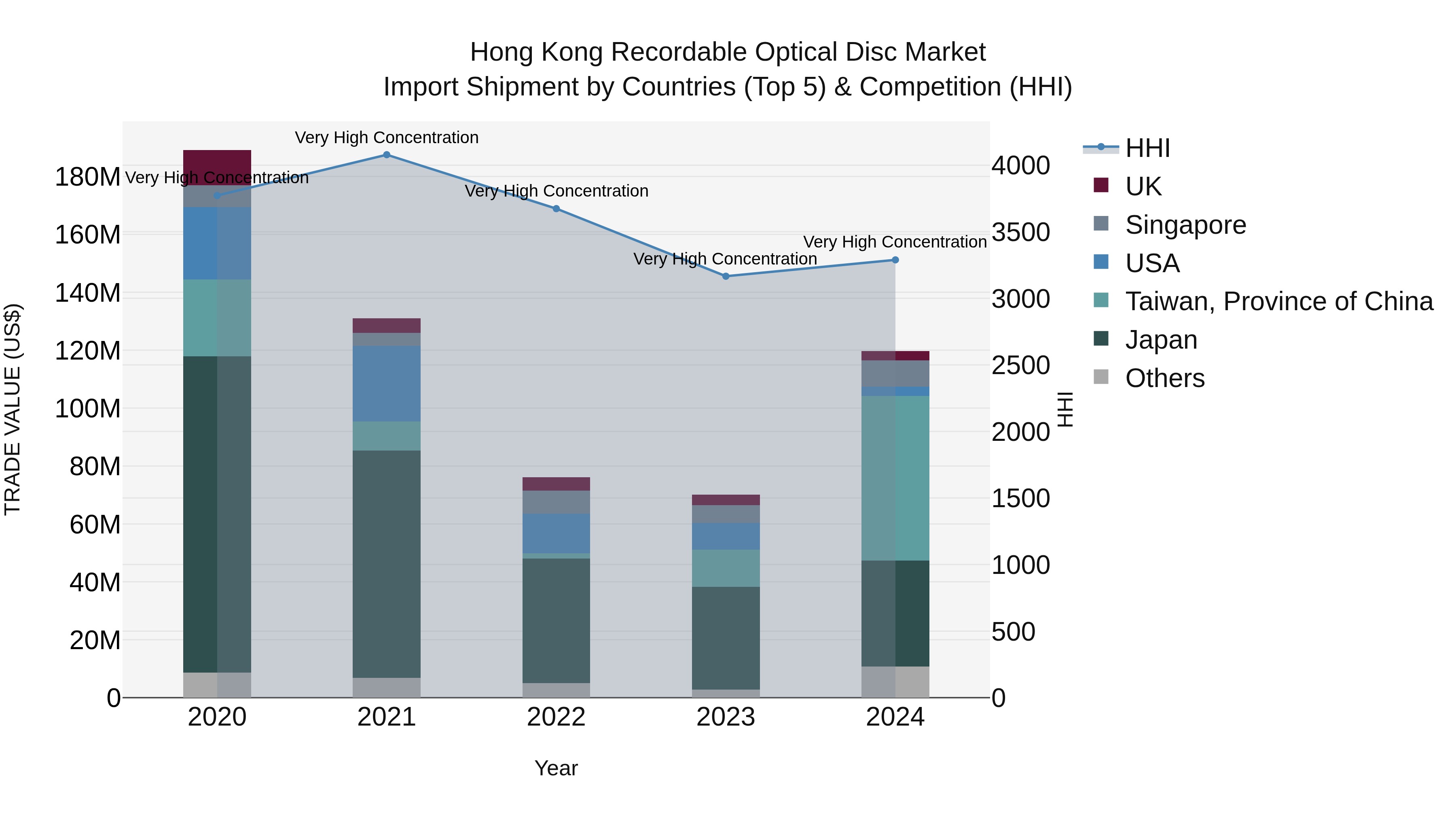
Hong Kong Recordable Optical Disc Market Synopsis
The recordable optical disc market in Hong Kong, though in decline due to the shift toward digital storage solutions, still maintains a presence in niche segments such as data archiving and media storage. Recordable optical discs like CDs, DVDs, and Blu-rays are used in industries that require long-term data preservation and in media production. However, the rise of cloud storage and digital media formats is gradually reducing demand for these traditional storage mediums in Hong Kong.
Drivers of the market
The drivers for the Hong Kong Recordable Optical Disc Market include the continued demand for physical storage media in specific applications, despite the rise of digital storage. Recordable optical discs are still preferred for archival purposes and data security, particularly in sectors like legal, education, and entertainment. Additionally, some consumers and businesses in Hong Kong still favor physical media for data backup and distribution due to its cost-effectiveness and durability. The availability of optical discs as a cost-efficient option in scenarios where large-scale digital infrastructure isn`t necessary also supports the market.
Challenges of the market
The recordable optical disc market in Hong Kong is grappling with the decline in demand for physical media due to the rise of digital storage solutions and streaming services. As consumers shift towards cloud storage and digital downloads, manufacturers face dwindling sales and are forced to rethink their business models. Additionally, competition from alternative storage technologies, such as solid-state drives and USB flash drives, poses a significant threat to the traditional optical disc market, necessitating innovation and diversification to remain relevant.
Government Policy of the market
The recordable optical disc market in Hong Kong is facing challenges due to the rise of digital storage solutions. However, the government supports the digital economy through various policies aimed at promoting technological advancements and digital literacy. Initiatives to enhance data storage and security contribute to a stable environment for the optical disc market, particularly for industries that still rely on physical media for data storage and archiving.
Key Highlights of the Report:
- Hong Kong Recordable Optical Disc Market Outlook
- Market Size of Hong Kong Recordable Optical Disc Market, 2024
- Forecast of Hong Kong Recordable Optical Disc Market, 2031
- Historical Data and Forecast of Hong Kong Recordable Optical Disc Revenues & Volume for the Period 2021-2031
- Hong Kong Recordable Optical Disc Market Trend Evolution
- Hong Kong Recordable Optical Disc Market Drivers and Challenges
- Hong Kong Recordable Optical Disc Price Trends
- Hong Kong Recordable Optical Disc Porter`s Five Forces
- Hong Kong Recordable Optical Disc Industry Life Cycle
- Historical Data and Forecast of Hong Kong Recordable Optical Disc Market Revenues & Volume By Product Type for the Period 2021-2031
- Historical Data and Forecast of Hong Kong Recordable Optical Disc Market Revenues & Volume By Compact Discs (CD) for the Period 2021-2031
- Historical Data and Forecast of Hong Kong Recordable Optical Disc Market Revenues & Volume By Digital Versatile Discs (DVD) for the Period 2021-2031
- Historical Data and Forecast of Hong Kong Recordable Optical Disc Market Revenues & Volume By Sales Channel for the Period 2021-2031
- Historical Data and Forecast of Hong Kong Recordable Optical Disc Market Revenues & Volume By Online Sales of Recordable Optical Discs for the Period 2021-2031
- Historical Data and Forecast of Hong Kong Recordable Optical Disc Market Revenues & Volume By Offline Sales of Recordable Optical Discs for the Period 2021-2031
- Historical Data and Forecast of Hong Kong Recordable Optical Disc Market Revenues & Volume By Sales of Recordable Optical Discs by Distributors for the Period 2021-2031
- Historical Data and Forecast of Hong Kong Recordable Optical Disc Market Revenues & Volume By Sales of Recordable Optical Discs by Resellers for the Period 2021-2031
- Historical Data and Forecast of Hong Kong Recordable Optical Disc Market Revenues & Volume By Direct Sales of Sales of Recordable Optical Discs for the Period 2021-2031
- Historical Data and Forecast of Hong Kong Recordable Optical Disc Market Revenues & Volume By End Use for the Period 2021-2031
- Historical Data and Forecast of Hong Kong Recordable Optical Disc Market Revenues & Volume By Consumers for the Period 2021-2031
- Historical Data and Forecast of Hong Kong Recordable Optical Disc Market Revenues & Volume By Professionals for the Period 2021-2031
- Historical Data and Forecast of Hong Kong Recordable Optical Disc Market Revenues & Volume By Storage Capacity for the Period 2021-2031
- Historical Data and Forecast of Hong Kong Recordable Optical Disc Market Revenues & Volume By Below 5GB Recordable Optical Discs for the Period 2021-2031
- Historical Data and Forecast of Hong Kong Recordable Optical Disc Market Revenues & Volume By 5-10 GB Recordable Optical Discs for the Period 2021-2031
- Historical Data and Forecast of Hong Kong Recordable Optical Disc Market Revenues & Volume By Above 10 GB Recordable Optical Discs for the Period 2021-2031
- Hong Kong Recordable Optical Disc Import Export Trade Statistics
- Market Opportunity Assessment By Product Type
- Market Opportunity Assessment By Sales Channel
- Market Opportunity Assessment By End Use
- Market Opportunity Assessment By Storage Capacity
- Hong Kong Recordable Optical Disc Top Companies Market Share
- Hong Kong Recordable Optical Disc Competitive Benchmarking By Technical and Operational Parameters
- Hong Kong Recordable Optical Disc Company Profiles
- Hong Kong Recordable Optical Disc Key Strategic Recommendations






































