Hungary Automotive Engine Market: Import Trend Analysis
In the Hungary automotive engine market, the import trend experienced a significant upsurge from 2023 to 2024, with a growth rate of 700.0%. The compound annual growth rate (CAGR) for imports between 2020 and 2024 stood at 54.61%. This notable increase can be attributed to a heightened demand for automotive engines, potentially driven by technological advancements or shifts in consumer preferences within the market.
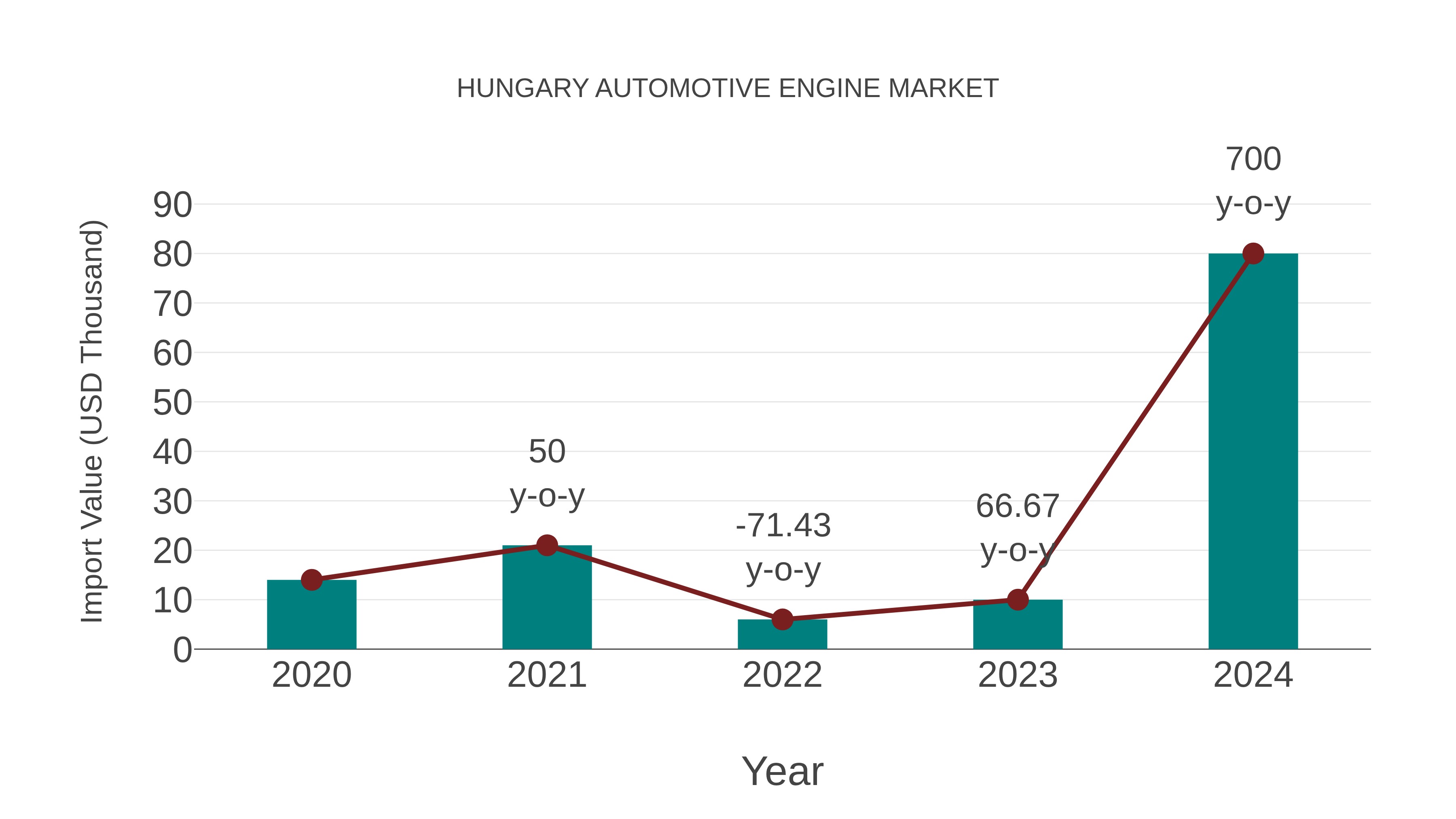
Hungary Automotive Engine Market Overview
The Hungary Automotive Engine Market is experiencing steady growth driven by factors such as increasing demand for fuel-efficient vehicles, technological advancements in engine design, and growing investments in automotive manufacturing. The market is characterized by a strong presence of international automotive manufacturers and suppliers, with a focus on producing engines that comply with stringent emission regulations. Hungary`s strategic location in Europe also contributes to its attractiveness as a manufacturing hub for automotive engines, with several key players establishing production facilities in the country. Additionally, the rising trend towards electric and hybrid vehicles is expected to impact the market, leading to investments in alternative powertrains and sustainable engine technologies to meet evolving consumer preferences and regulatory requirements.
Hungary Automotive Engine Market Trends
The Hungary Automotive Engine Market is currently experiencing a shift towards electric and hybrid technologies, driven by increasing environmental concerns and government regulations on emissions. Electric vehicles (EVs) and hybrid vehicles are gaining popularity among consumers, leading to a growing demand for electric engines and components. The market is also witnessing a trend towards downsizing of engines for improved fuel efficiency without compromising on performance. Additionally, advancements in lightweight materials and engine design are being adopted to enhance overall vehicle efficiency. With a focus on sustainability and reducing carbon footprints, the Hungary Automotive Engine Market is expected to continue evolving towards cleaner and more efficient engine technologies in the coming years.
Hungary Automotive Engine Market Challenges
In the Hungary Automotive Engine Market, some challenges include increasing competition from international manufacturers, fluctuating raw material prices, and strict environmental regulations. International manufacturers entering the market bring with them established brands and advanced technologies, making it challenging for local companies to compete. Fluctuating raw material prices can impact production costs and profitability for engine manufacturers. Additionally, stringent environmental regulations are pushing for cleaner and more fuel-efficient engines, requiring companies to invest in research and development to meet these standards while maintaining cost-effectiveness. Overall, navigating these challenges requires Hungarian automotive engine manufacturers to stay innovative, cost-effective, and environmentally conscious to remain competitive in the market.
Hungary Automotive Engine Market Investment Opportunities
The Hungary Automotive Engine Market presents promising investment opportunities due to several factors. The country has a strong automotive industry with a skilled workforce and a strategic location in Central Europe. With increasing demand for fuel-efficient and electric vehicles, there is a growing need for advanced automotive engines that are more environmentally friendly and technologically advanced. Investing in research and development of innovative engine technologies, such as electric and hybrid engines, could be a lucrative opportunity in the Hungary Automotive Engine Market. Additionally, partnerships with local automotive manufacturers and government incentives for sustainable transportation solutions can further enhance the growth potential for investors in this sector.
Hungary Automotive Engine Market Government Policy
The Hungarian government has implemented various policies to support the automotive engine market. These include incentives for research and development in the automotive sector, tax benefits for companies investing in green technology and sustainable practices, as well as funding programs to improve infrastructure and promote innovation in the industry. Additionally, the government has established partnerships with key stakeholders to drive growth and competitiveness in the automotive engine market. Regulations regarding emissions standards and safety requirements are also in place to ensure compliance and sustainability within the sector. Overall, the Hungarian government`s policies aim to foster a competitive and sustainable automotive engine market while promoting innovation and environmental responsibility.
Hungary Automotive Engine Market Future Outlook
The future outlook for the Hungary Automotive Engine Market is expected to be positive, driven by increasing demand for fuel-efficient and environmentally friendly vehicles. The market is likely to witness growth due to advancements in engine technologies, such as electric vehicles and hybrid engines. Additionally, government initiatives promoting cleaner transportation and stricter emission regulations are expected to further boost the market. The rising trend of automotive manufacturers investing in research and development activities to enhance engine performance and efficiency will also contribute to the market`s growth. Overall, the Hungary Automotive Engine Market is anticipated to experience steady expansion in the coming years, catering to the evolving needs of the automotive industry and consumers alike.
Key Highlights of the Report:
- Hungary Automotive Engine Market Outlook
- Market Size of Hungary Automotive Engine Market, 2025
- Forecast of Hungary Automotive Engine Market, 2032
- Historical Data and Forecast of Hungary Automotive Engine Revenues & Volume for the Period 2022 - 2032F
- Hungary Automotive Engine Market Trend Evolution
- Hungary Automotive Engine Market Drivers and Challenges
- Hungary Automotive Engine Price Trends
- Hungary Automotive Engine Porter's Five Forces
- Hungary Automotive Engine Industry Life Cycle
- Historical Data and Forecast of Hungary Automotive Engine Market Revenues & Volume By Placement Type for the Period 2022 - 2032F
- Historical Data and Forecast of Hungary Automotive Engine Market Revenues & Volume By In-line Engine for the Period 2022 - 2032F
- Historical Data and Forecast of Hungary Automotive Engine Market Revenues & Volume By W Engine for the Period 2022 - 2032F
- Historical Data and Forecast of Hungary Automotive Engine Market Revenues & Volume By V-Type for the Period 2022 - 2032F
- Historical Data and Forecast of Hungary Automotive Engine Market Revenues & Volume By Vehicle Type for the Period 2022 - 2032F
- Historical Data and Forecast of Hungary Automotive Engine Market Revenues & Volume By Passenger Car for the Period 2022 - 2032F
- Historical Data and Forecast of Hungary Automotive Engine Market Revenues & Volume By Commercial Vehicle for the Period 2022 - 2032F
- Historical Data and Forecast of Hungary Automotive Engine Market Revenues & Volume By Fuel Type for the Period 2022 - 2032F
- Historical Data and Forecast of Hungary Automotive Engine Market Revenues & Volume By Gasoline for the Period 2022 - 2032F
- Historical Data and Forecast of Hungary Automotive Engine Market Revenues & Volume By Diesel for the Period 2022 - 2032F
- Historical Data and Forecast of Hungary Automotive Engine Market Revenues & Volume By Other Fuel Types for the Period 2022 - 2032F
- Hungary Automotive Engine Import Export Trade Statistics
- Market Opportunity Assessment By Placement Type
- Market Opportunity Assessment By Vehicle Type
- Market Opportunity Assessment By Fuel Type
- Hungary Automotive Engine Top Companies Market Share
- Hungary Automotive Engine Competitive Benchmarking By Technical and Operational Parameters
- Hungary Automotive Engine Company Profiles
- Hungary Automotive Engine Key Strategic Recommendations






































