Hungary Dill Seed Oil Market Size, Share & Growth Rate
The Hungary Dill Seed Oil Market was estimated at USD 493 Million in 2025 and is projected to reach USD 677 Million by 2032, growing at a CAGR of 4.6% from 2026 to 2032. This growth trajectory is underpinned by the surging demand for natural and organic products across the food and pharmaceutical sectors. With increasing consumer awareness regarding health benefits and culinary versatility, dill seed oil is carving out a significant niche in both local and international markets.
Hungary Dill Seed Oil Market Year-wise Growth Rate and Key Drivers
This graph highlights how the Hungary Dill Seed Oil Market has steadily grown over the years, supported by major growth factors.
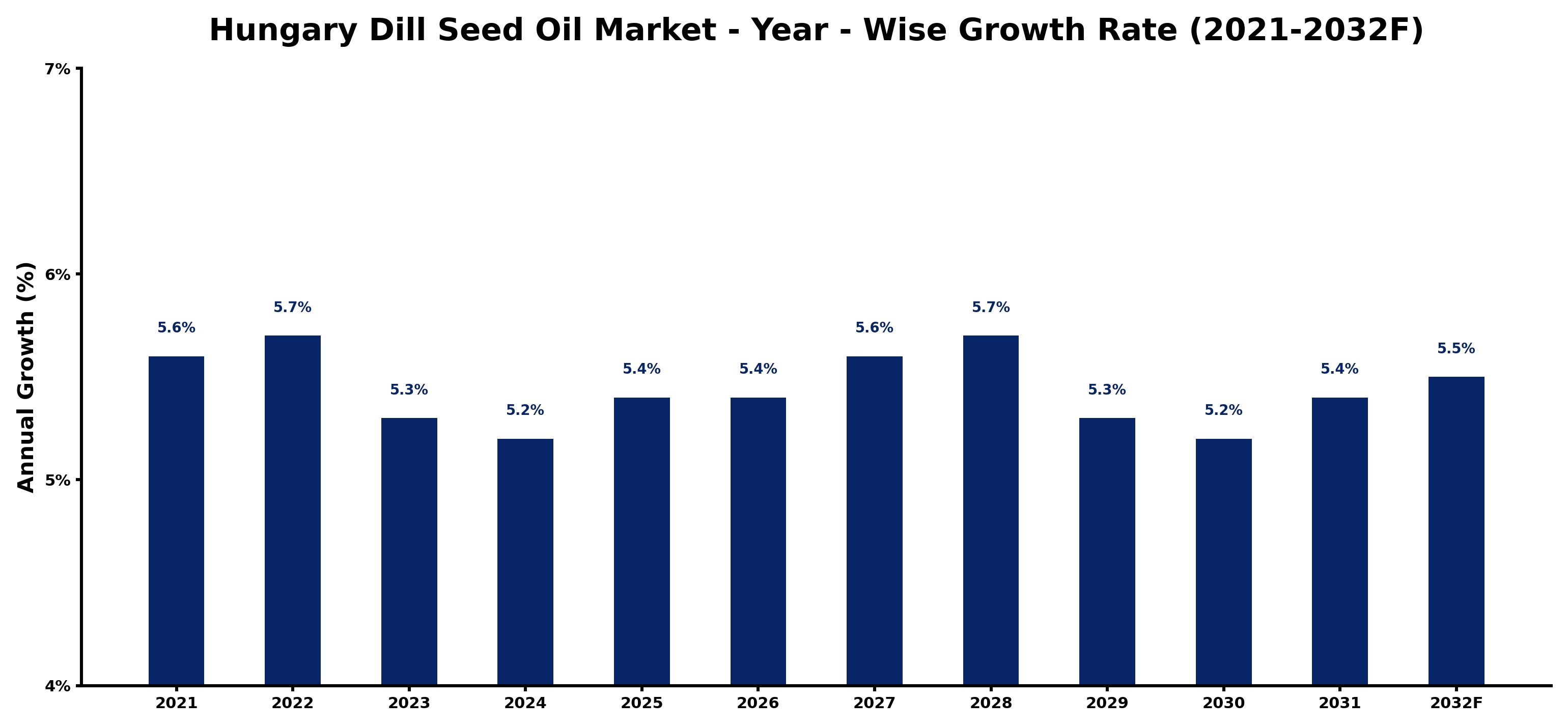
The table below presents the year‑wise growth rates along with the key drivers influencing the market
| Year | Growth Rate | Major Drivers |
| 2021 | 5.6% | Increasing industrial infrastructure investments |
| 2022 | 5.7% | Growing renewable energy integration projects |
| 2023 | 5.3% | Rising electricity demand across industries |
| 2024 | 5.2% | Growing urbanization and commercial development |
| 2025 | 5.4% | Rapid growth in telecom and data center sectors |
| 2026 | 5.4% | Expansion of manufacturing activities |
| 2027 | 5.6% | Increasing industrial automation investments |
| 2028 | 5.7% | Rising electricity demand across industries |
| 2029 | 5.3% | Rapid growth in telecom and data center sectors |
| 2030 | 5.2% | Increasing industrial infrastructure investments |
| 2031 | 5.4% | Increasing industrial infrastructure investments |
| 2032 | 5.5% | Rising electricity demand across industries |
Note - Market size estimations and growth projections presented in this report are based on 6Wresearch’s advanced forecasting approach, validated with industry datasets as of June 2026.
Hungary Dill Seed Oil Market Synopsis
The primary driver of the Hungary Dill Seed Oil Market is the growing consumer preference for natural health products. As the understanding of the health benefits associated with dill seed oil, such as its anti-inflammatory and digestive properties, becomes more widespread, demand continues to climb. This trend is particularly evident in the food sector, where traditional Hungarian cuisines incorporate dill seed oil, enhancing its cultural significance.
Additionally, the pharmaceutical industry's expanding interest in essential oils is propelling the market forward. Dill seed oil is increasingly recognized for its potential therapeutic benefits, thus attracting investment in research and product development. This, combined with innovative distribution strategies, is enabling producers to reach a wider audience and enhance market penetration.
Hungary Dill Seed Oil Market Key Takeaways
- The market is experiencing robust growth driven by heightened awareness of health benefits.
- There is a notable shift towards organic and natural products among consumers.
- Innovations in product offerings, including cosmetics, are emerging trends.
- Domestic production is complemented by international supply to meet rising demand.
- Government support and regulatory frameworks are shaping a conducive market environment.
Evaluation of Restraints in Hungary Dill Seed Oil Market
The Hungary Dill Seed Oil Market faces several constraints that could impact growth. Chief among these are the fluctuations in raw material supply driven by unpredictable weather conditions, which can adversely affect dill seed harvests. Price volatility poses another challenge, potentially squeezing profit margins for producers. Furthermore, competition from alternative essential oils adds pressure, necessitating differentiation strategies. Regulatory compliance for exports also requires ongoing attention to maintain quality standards. These factors collectively underline the need for strategic planning and innovative approaches to sustain growth in this dynamic market.
Hungary Dill Seed Oil Market Trends
Several trends are shaping the Hungary Dill Seed Oil Market, particularly the increasing consumer demand for organic and clean-label products. The rise of health-conscious consumers has led to a marked preference for products devoid of synthetic additives. In addition, the application of dill seed oil in aromatherapy and personal care products is gaining traction, further broadening its appeal. Producers are responding by innovating, with new formulations emerging that capitalize on the oil's numerous health benefits.
Hungary Dill Seed Oil Market Opportunities
Investment opportunities within the Hungary Dill Seed Oil Market are particularly promising in the pharmaceutical and cosmetic sectors. As the market for natural skincare and health products expands, dill seed oil stands out for its versatility and efficacy. Additionally, leveraging Hungary's reputation as a major producer offers strategic advantages for investors looking to establish a foothold in the European market. The growing global interest in Hungarian cuisine and its traditional uses of dill seed oil further opens doors for market expansion and product diversification.
Government Initiatives in the Hungary Dill Seed Oil Market
The Hungarian government plays a significant role in facilitating the growth of the Dill Seed Oil Market through various policies and initiatives. Quality control measures have been implemented to ensure that dill seed oil meets high standards for purity and authenticity. Furthermore, there are environmental regulations that promote sustainable agricultural practices. The government also provides incentives to bolster domestic production and enhance export capabilities, aiming to strengthen Hungary's position in the global market.
Future Insights of the Hungary Dill Seed Oil Market
Looking ahead to 2026-2032, the Hungary Dill Seed Oil Market is set to flourish as consumer awareness of its benefits continues to rise. The ongoing trend towards natural and organic products will further fuel demand across the food, cosmetic, and pharmaceutical industries. With innovative product development and strategic partnerships becoming commonplace, the market is well-positioned for sustainable growth. However, it will be essential for stakeholders to stay agile, addressing challenges such as raw material costs and competitive pressures to maintain a positive growth trajectory.
Hungary Dill Seed Oil Market Latest Developments (May 2025 - June 2026)
Recent developments in the Hungary Dill Seed Oil Market highlight a trend toward sustainability and innovation. Companies are increasingly investing in research to enhance product formulations and address evolving consumer preferences. The expansion of distribution channels, both online and offline, is also a key focus area, aimed at improving accessibility. Additionally, collaborations with local agricultural producers are being established to ensure a steady supply of high-quality raw materials, bolstering the market's resilience against fluctuations.
Hungary Dill Seed Oil Market - Key Attractiveness of the Report
- 10 Years of Market Numbers
- Historical Data Starting from 2022 to 2025
- Base Year: 2025
- Forecast Data until 2032
- Key Performance Indicators Impacting the Market
- Major Upcoming Developments and Projects
Key Highlights of the Report:
- Hungary Dill Seed Oil Market Outlook
- Market Size of Hungary Dill Seed Oil Market, 2025
- Forecast of Hungary Dill Seed Oil Market, 2032
- Historical Data and Forecast of Hungary Dill Seed Oil Revenues & Volume for the Period 2022-2032F
- Hungary Dill Seed Oil Market Trend Evolution
- Hungary Dill Seed Oil Market Drivers and Challenges
- Hungary Dill Seed Oil Price Trends
- Hungary Dill Seed Oil Porter's Five Forces
- Hungary Dill Seed Oil Industry Life Cycle
- Historical Data and Forecast of Hungary Dill Seed Oil Market Revenues & Volume By Type for the Period 2022-2032F
- Historical Data and Forecast of Hungary Dill Seed Oil Market Revenues & Volume By Anethum Graveolens Seed Oil for the Period 2022-2032F
- Historical Data and Forecast of Hungary Dill Seed Oil Market Revenues & Volume By Anethum Sowa Seed Oil for the Period 2022-2032F
- Historical Data and Forecast of Hungary Dill Seed Oil Market Revenues & Volume By Application for the Period 2022-2032F
- Historical Data and Forecast of Hungary Dill Seed Oil Market Revenues & Volume By Flavor for the Period 2022-2032F
- Historical Data and Forecast of Hungary Dill Seed Oil Market Revenues & Volume By Fragrance for the Period 2022-2032F
- Historical Data and Forecast of Hungary Dill Seed Oil Market Revenues & Volume By Pharmaceutical for the Period 2022-2032F
- Historical Data and Forecast of Hungary Dill Seed Oil Market Revenues & Volume By Skincare for the Period 2022-2032F
- Historical Data and Forecast of Hungary Dill Seed Oil Market Revenues & Volume By Aromatherapy for the Period 2022-2032F
- Hungary Dill Seed Oil Import Export Trade Statistics
- Market Opportunity Assessment By Type
- Market Opportunity Assessment By Application
- Hungary Dill Seed Oil Top Companies Market Share
- Hungary Dill Seed Oil Competitive Benchmarking By Technical and Operational Parameters
- Hungary Dill Seed Oil Company Profiles
- Hungary Dill Seed Oil Key Strategic Recommendations






































