Hungary Ductile Iron Pipes Market Size (2020-2030)
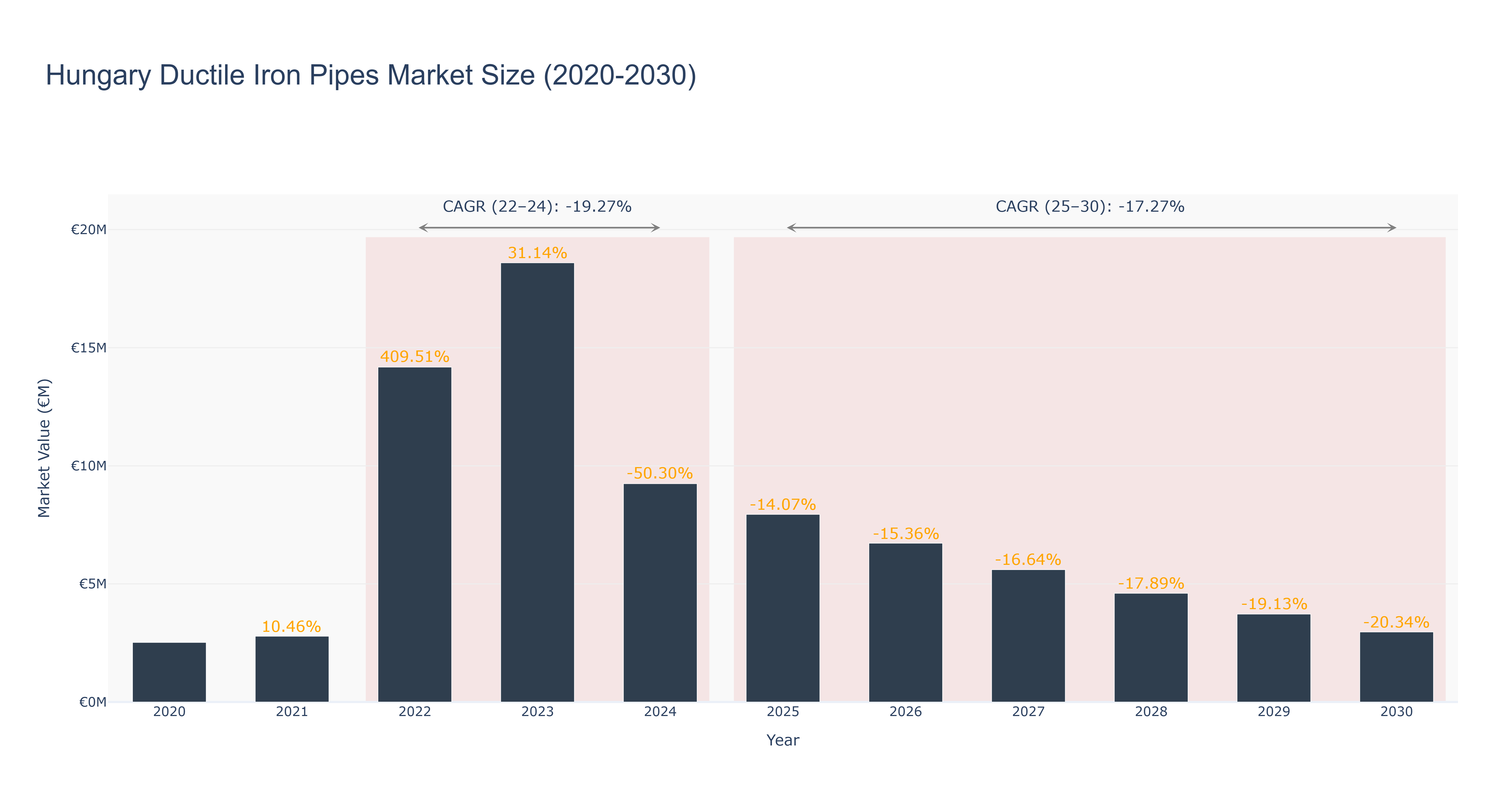
Hungary Ductile Iron Pipes Market has shown a fluctuating trend in market size over the years. The peak market size was recorded in 2023 at €18.59 million, followed by a significant decline to €9.24 million in 2024. The market is forecasted to continue shrinking, reaching €2.96 million in 2030, with a CAGR of -17.27% from 2025 to 2030. The decline in market size can be attributed to various factors such as economic uncertainties, changing consumer preferences, and increased competition. Despite the challenging market conditions, recent developments in Hungary's infrastructure sector, including the initiation of large-scale pipeline projects, are expected to stimulate demand for ductile iron pipes in the near future. The industry drivers include government investments in infrastructure and the need for efficient water distribution systems to support urban growth.
Hungary Ductile Iron Pipes Market: Production & Trade Performance (2019-2025)
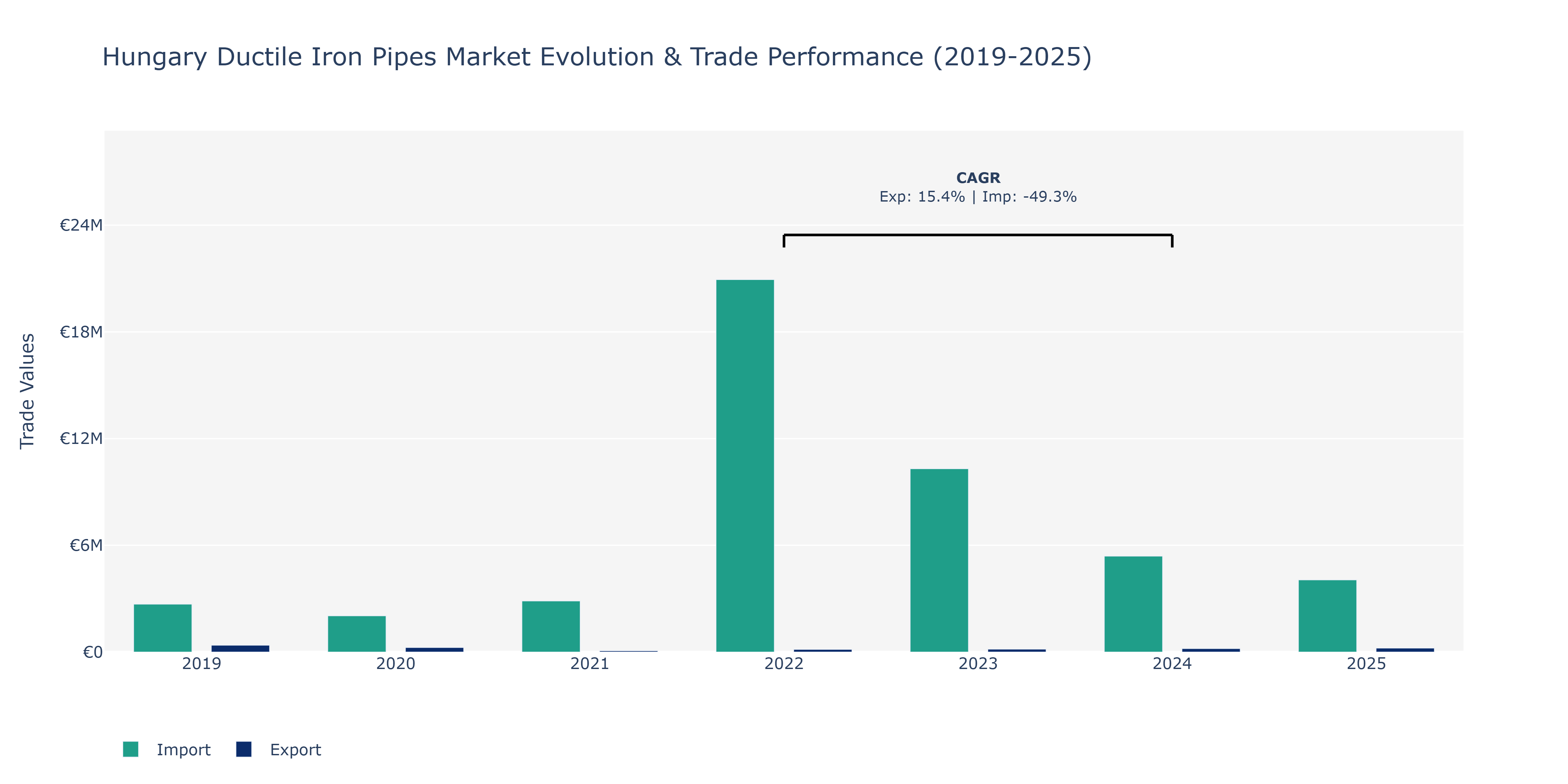
In the Hungary Ductile Iron Pipes Market, exports showed a declining trend from 2019 to 2021, dropping from €381.09 thousand to €67.36 thousand, possibly due to global economic uncertainties impacting trade volumes. However, there was a notable recovery in 2022, with exports increasing to €144.7 thousand and continuing to rise to €219.03 thousand in 2025, indicating a positive growth trajectory driven by increased demand for ductile iron pipes in infrastructure projects within and outside Hungary. On the other hand, imports experienced fluctuations during the same period, with a peak in 2022 at €20.94 million, followed by a significant decline in 2024 to €5.39 million. This drastic decrease could be attributed to changes in import regulations, supply chain disruptions, or shifts in sourcing strategies prompted by geopolitical factors affecting trade dynamics. The subsequent stabilization and moderate increase in imports by 2025 to €4.05 million suggest a recovery phase and potential strategic realignments in procurement practices within the market. These movements reflect the market's adaptation to evolving trade conditions and emphasize the importance of resilience and flexibility in navigating external challenges for sustainable growth in the ductile iron pipes sector.
Key Highlights of the Report:
- Hungary Ductile Iron Pipes Market Outlook
- Market Size of Hungary Ductile Iron Pipes Market, 2025
- Forecast of Hungary Ductile Iron Pipes Market, 2032
- Historical Data and Forecast of Hungary Ductile Iron Pipes Revenues & Volume for the Period 2022-2032F
- Hungary Ductile Iron Pipes Market Trend Evolution
- Hungary Ductile Iron Pipes Market Drivers and Challenges
- Hungary Ductile Iron Pipes Price Trends
- Hungary Ductile Iron Pipes Porter's Five Forces
- Hungary Ductile Iron Pipes Industry Life Cycle
- Historical Data and Forecast of Hungary Ductile Iron Pipes Market Revenues & Volume By Diameter for the Period 2022-2032F
- Historical Data and Forecast of Hungary Ductile Iron Pipes Market Revenues & Volume By DN 80 - DN 300 for the Period 2022-2032F
- Historical Data and Forecast of Hungary Ductile Iron Pipes Market Revenues & Volume By DN 350 - DN 600 for the Period 2022-2032F
- Historical Data and Forecast of Hungary Ductile Iron Pipes Market Revenues & Volume By DN 700 - DN 1000 for the Period 2022-2032F
- Historical Data and Forecast of Hungary Ductile Iron Pipes Market Revenues & Volume By DN 1200 - DN 2000 for the Period 2022-2032F
- Historical Data and Forecast of Hungary Ductile Iron Pipes Market Revenues & Volume By DN 2200 & Above for the Period 2022-2032F
- Historical Data and Forecast of Hungary Ductile Iron Pipes Market Revenues & Volume By Application for the Period 2022-2032F
- Historical Data and Forecast of Hungary Ductile Iron Pipes Market Revenues & Volume By Drinking Water Distribution for the Period 2022-2032F
- Historical Data and Forecast of Hungary Ductile Iron Pipes Market Revenues & Volume By Wastewater for the Period 2022-2032F
- Historical Data and Forecast of Hungary Ductile Iron Pipes Market Revenues & Volume By Irrigation for the Period 2022-2032F
- Historical Data and Forecast of Hungary Ductile Iron Pipes Market Revenues & Volume By Mining for the Period 2022-2032F
- Historical Data and Forecast of Hungary Ductile Iron Pipes Market Revenues & Volume By Others for the Period 2022-2032F
- Hungary Ductile Iron Pipes Import Export Trade Statistics
- Market Opportunity Assessment By Diameter
- Market Opportunity Assessment By Application
- Hungary Ductile Iron Pipes Top Companies Market Share
- Hungary Ductile Iron Pipes Competitive Benchmarking By Technical and Operational Parameters
- Hungary Ductile Iron Pipes Company Profiles
- Hungary Ductile Iron Pipes Key Strategic Recommendations






































