Hungary Enterprise AI Market Size & Growth Rate (2026-2032)
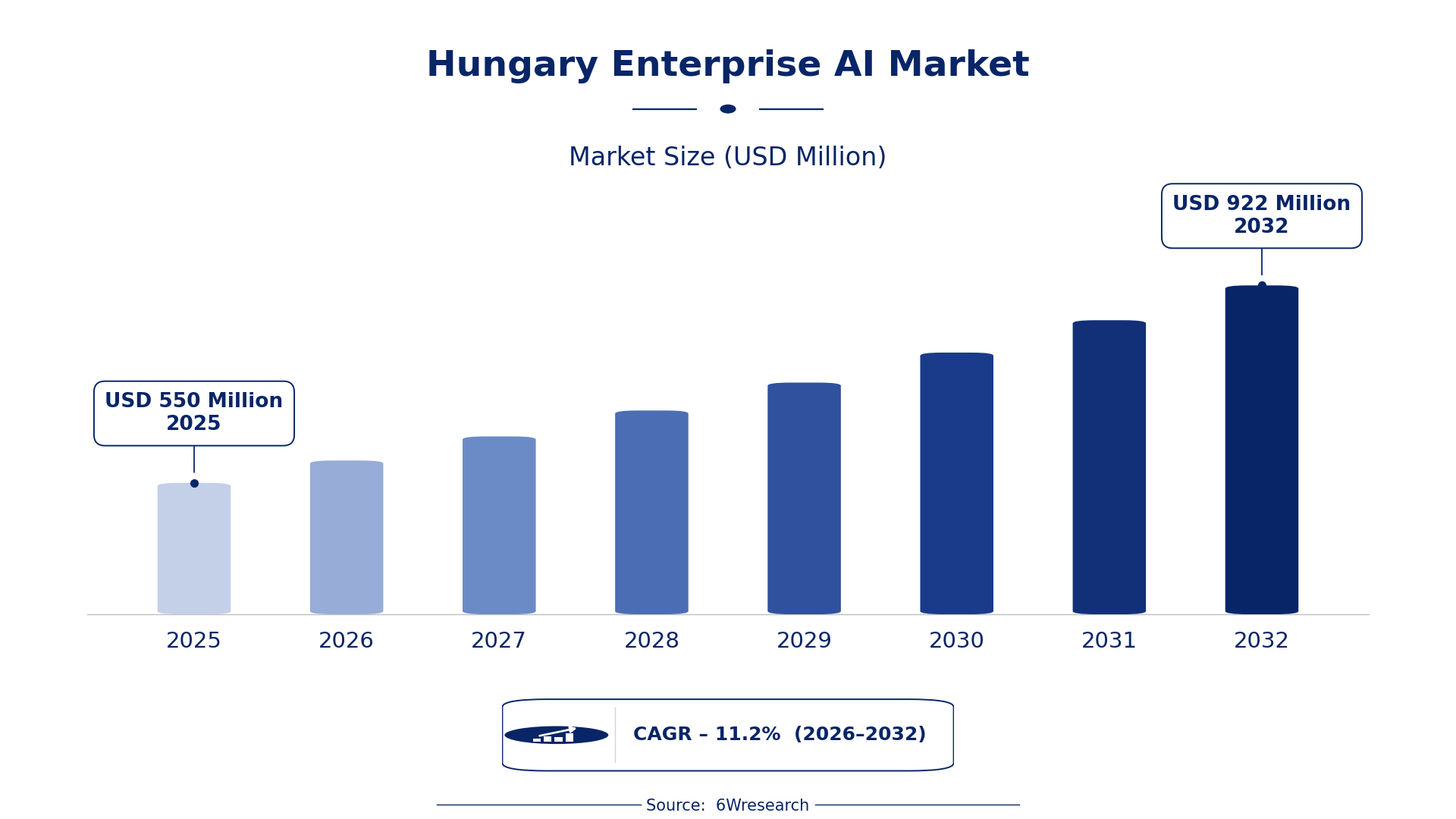
The Hungary Enterprise AI Market was estimated at USD 550 Million in 2025 and is projected to reach USD 922 Million by 2032, growing at a CAGR of 11.2% from 2026 to 2032.
Hungary Enterprise AI Market Synopsis
The Hungary Enterprise AI Market is on a clear upward trajectory, driven by the increasing integration of AI technologies across various sectors. Companies are embracing AI to streamline operations, enhance customer interactions, and make data-driven decisions, leading to a fertile environment for growth.
Hungary’s unique position in Central Europe, coupled with a tech-savvy workforce, is making it an attractive hub for AI innovation. The convergence of startups focusing on AI development and established enterprises seeking efficiency is catalyzing this market's expansion.
Hungary Enterprise AI Market Year-wise Growth Rate and Key Drivers
This graph illustrates the annual growth rates of the Hungary Enterprise AI Market from 2021 to 2032, highlighting a steady upward trajectory and projected expansion over the forecast period.
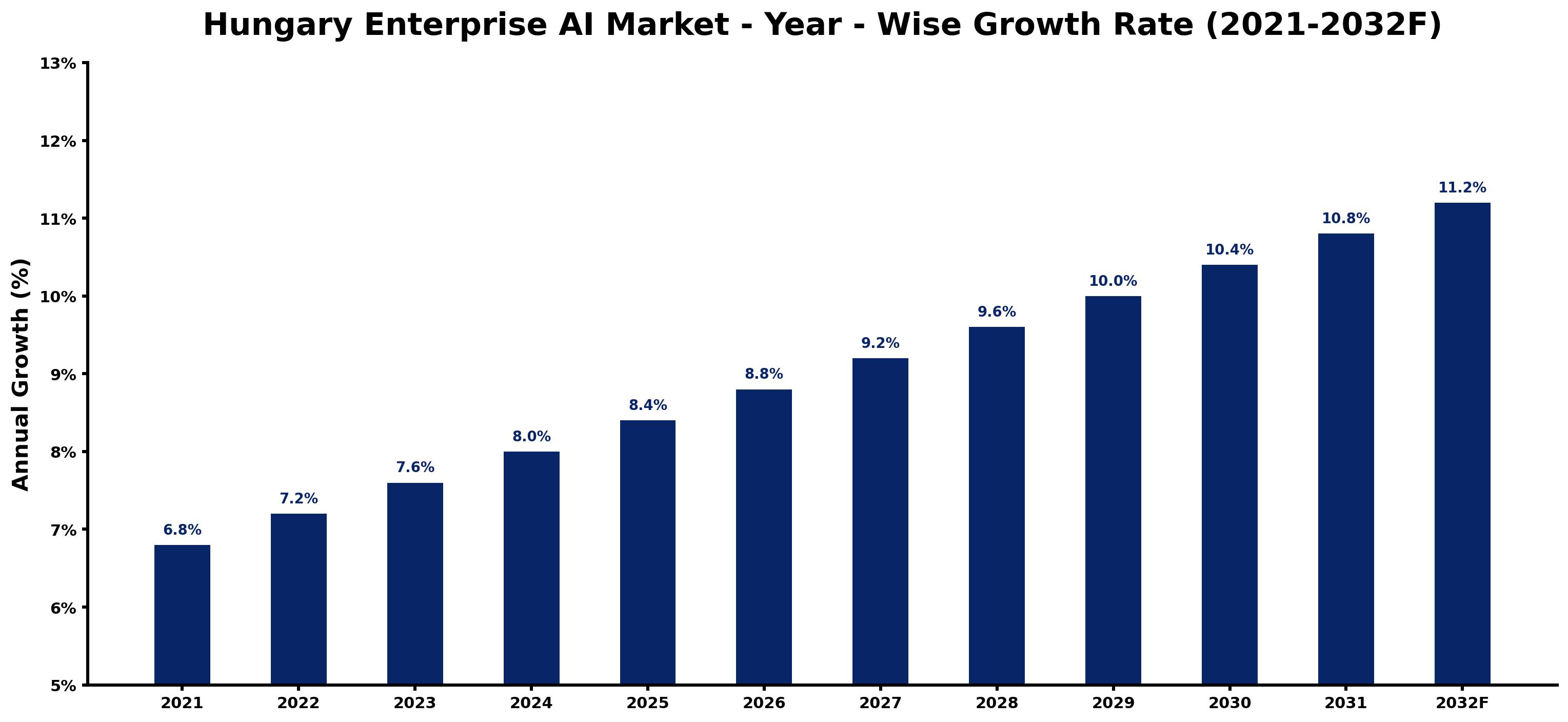
The table below presents the year‑wise growth rates along with the key drivers influencing the market
| Year | Growth Rate | Major Drivers |
| 2021 | 6.8% | Hungary's digital strategy promotes AI adoption across industries. |
| 2022 | 7.2% | Growth in local startups focusing on AI innovations. |
| 2023 | 7.6% | EU funding boosts AI projects in Hungarian enterprises. |
| 2024 | 8.0% | Increased investment in AI-driven analytics by financial sectors. |
| 2025 | 8.4% | Hungarian universities launch specialized AI training programs. |
| 2026 | 8.8% | Government incentives for AI integration in public services. |
| 2027 | 9.2% | Local demand for predictive maintenance in manufacturing sectors. |
| 2028 | 9.6% | Rise in cloud services tailored for Hungarian businesses. |
| 2029 | 10.0% | Partnerships between tech firms and universities enhancing AI skills. |
| 2030 | 10.4% | Local regulations encourage ethical AI usage in enterprises. |
| 2031 | 10.8% | Increased consumer awareness driving AI adoption in retail. |
| 2032 | 11.2% | Strong focus on AI applications in data security compliance. |
Note: Market size estimations and growth projections presented in this report are based on 6Wresearch's proprietary forecasting methodology, utilizing the latest available industry data, government publications, and primary research inputs.
Hungary Enterprise AI Market Key Takeaways
Below are some of the specific key takeaways from the market, including:
- The market's growth is fueled by strong demand for AI solutions in sectors such as healthcare, finance, and manufacturing.
- Integration of AI-powered tools is enhancing operational efficiency and customer engagement across various industries.
- Government initiatives are playing a crucial role in fostering AI innovation and collaboration between sectors.
- A growing shortage of skilled AI professionals presents both a challenge and an opportunity for educational institutions.
- Investment in AI consulting and training programs is increasing as businesses seek to harness AI capabilities effectively.
Evaluation of Restraints in Hungary Enterprise AI Market
Despite the promising outlook, the Hungary Enterprise AI Market faces several restraints that hinder its growth. One of the most pressing issues is the shortage of skilled AI talent. Many organizations struggle to find qualified professionals who can implement and manage AI technologies effectively. Limited access to quality datasets also poses a challenge, as AI systems rely heavily on data for training and function. on top of that, concerns regarding data privacy and security are leading to hesitance in adopting AI solutions. The high costs associated with implementing and maintaining AI infrastructure can deter smaller enterprises from entering the market. Addressing these issues will be critical for unlocking the full potential of AI in Hungary.
Hungary Enterprise AI Market Trends
Several trends are currently shaping the Hungary Enterprise AI Market. The rise of AI-powered chatbots is revolutionizing customer service, allowing businesses to provide 24/7 support and personalized experiences. Predictive analytics is being increasingly utilized for crafting targeted marketing strategies, enabling companies to anticipate customer needs. Additionally, machine learning algorithms are being integrated into data analysis processes to enhance decision-making. These trends highlight a shift towards automation and data-driven strategies across various sectors.
Hungary Enterprise AI Market Opportunities
The market is ripe with opportunities for growth and investment. Developing AI solutions for process automation is a key area where businesses can achieve significant efficiency gains. There is also a growing demand for AI applications in fraud detection, particularly within the financial sector. Supply chain optimization through AI is another avenue that organizations are exploring to reduce costs and improve service levels. Additionally, as firms increasingly recognize the value of AI consulting services, there is an opportunity for firms specializing in training and advisory roles to flourish.
Government Initiatives in the Hungary Enterprise AI Market
The Hungarian government is actively working to foster the growth of the Enterprise AI market through targeted policies and initiatives. By promoting AI research and development, the government is creating an environment conducive to innovation. Public-sector priorities focus on collaboration between academia and industry, which is crucial for developing a skilled workforce capable of meeting market demands.
- A recently launched program offers tax incentives for businesses investing in AI technologies to spur adoption and innovation.
- Ongoing initiatives are focused on enhancing partnerships between universities and tech companies, aimed at facilitating technology transfer and research collaboration.
- Planned funding allocations for AI research are expected to increase significantly over the next few years, encouraging more startups to enter the market.
- Regulations introduced to ensure ethical AI usage are fostering trust among consumers and businesses alike.
Future Insights of the Hungary Enterprise AI Market
Looking ahead to 2026-2032, the Hungary Enterprise AI Market is expected to continue its upward momentum. As organizations increasingly realize the advantages of AI technologies in enhancing operational efficiency, adoption rates will likely rise. The availability of abundant data, coupled with advancements in AI algorithms, will further drive market growth. Key sectors such as finance, healthcare, and manufacturing are anticipated to lead in AI solution adoption, bolstered by supportive government initiatives aimed at digital transformation.
Hungary Enterprise AI Market Latest Developments
In the past year, the Hungary Enterprise AI Market has witnessed a flurry of activity, with various initiatives and developments aimed at enhancing AI capabilities. Companies are rapidly evolving their AI strategies to stay competitive, while collaborations between public and private sectors are becoming more common.
- A major technology vendor announced a partnership with a local university to create an AI training program, launched in Q1 2025.
- An initiative focused on AI-driven healthcare solutions began in late 2024 and is currently underway, aiming to improve patient outcomes through predictive analytics.
- Plans for a national AI innovation hub are expected to be revealed in early 2026, designed to support startups and facilitate knowledge sharing.
- A rollout of AI-based supply chain management tools is currently in progress, with several companies integrating these systems to streamline operations.
Hungary Enterprise AI Market - Key Attractiveness of the Report
- 10 Years of Market Numbers
- Historical Data Starting from 2022 to 2025
- Base Year: 2025
- Forecast Data until 2032
- Key Performance Indicators Impacting the Market
- Major Upcoming Developments and Projects
The Hungarian government is incentivizing AI adoption through tax breaks for R&D investments and promoting collaboration between academia and industry to drive innovation.
Key Highlights of the Report:
- Hungary Enterprise AI Market Outlook
- Market Size of Hungary Enterprise AI Market, 2025
- Forecast of Hungary Enterprise AI Market, 2032
- Historical Data and Forecast of Hungary Enterprise AI Revenues & Volume for the Period 2022-2032F
- Hungary Enterprise AI Market Trend Evolution
- Hungary Enterprise AI Market Drivers and Challenges
- Hungary Enterprise AI Price Trends
- Hungary Enterprise AI Porter's Five Forces
- Hungary Enterprise AI Industry Life Cycle
- Historical Data and Forecast of Hungary Enterprise AI Market Revenues & Volume By Component for the Period 2022-2032F
- Historical Data and Forecast of Hungary Enterprise AI Market Revenues & Volume By Solution for the Period 2022-2032F
- Historical Data and Forecast of Hungary Enterprise AI Market Revenues & Volume By Services for the Period 2022-2032F
- Historical Data and Forecast of Hungary Enterprise AI Market Revenues & Volume By Technology for the Period 2022-2032F
- Historical Data and Forecast of Hungary Enterprise AI Market Revenues & Volume By Machine learning and deep learning for the Period 2022-2032F
- Historical Data and Forecast of Hungary Enterprise AI Market Revenues & Volume By Natural Language Processing (NLP) for the Period 2022-2032F
- Historical Data and Forecast of Hungary Enterprise AI Market Revenues & Volume By Application Area for the Period 2022-2032F
- Historical Data and Forecast of Hungary Enterprise AI Market Revenues & Volume By Security and risk management for the Period 2022-2032F
- Historical Data and Forecast of Hungary Enterprise AI Market Revenues & Volume By Marketing management for the Period 2022-2032F
- Historical Data and Forecast of Hungary Enterprise AI Market Revenues & Volume By Customer support and experience for the Period 2022-2032F
- Historical Data and Forecast of Hungary Enterprise AI Market Revenues & Volume By Human resource and recruitment management for the Period 2022-2032F
- Historical Data and Forecast of Hungary Enterprise AI Market Revenues & Volume By Analytics application for the Period 2022-2032F
- Historical Data and Forecast of Hungary Enterprise AI Market Revenues & Volume By Process automation for the Period 2022-2032F
- Historical Data and Forecast of Hungary Enterprise AI Market Revenues & Volume By Deployment Type for the Period 2022-2032F
- Historical Data and Forecast of Hungary Enterprise AI Market Revenues & Volume By Cloud for the Period 2022-2032F
- Historical Data and Forecast of Hungary Enterprise AI Market Revenues & Volume By On-premises for the Period 2022-2032F
- Historical Data and Forecast of Hungary Enterprise AI Market Revenues & Volume By Organization Size for the Period 2022-2032F
- Historical Data and Forecast of Hungary Enterprise AI Market Revenues & Volume By Small and Medium-sized Businesses (SMBs) for the Period 2022-2032F
- Historical Data and Forecast of Hungary Enterprise AI Market Revenues & Volume By Large enterprises for the Period 2022-2032F
- Hungary Enterprise AI Import Export Trade Statistics
- Market Opportunity Assessment By Component
- Market Opportunity Assessment By Technology
- Market Opportunity Assessment By Application Area
- Market Opportunity Assessment By Deployment Type
- Market Opportunity Assessment By Organization Size
- Hungary Enterprise AI Top Companies Market Share
- Hungary Enterprise AI Competitive Benchmarking By Technical and Operational Parameters
- Hungary Enterprise AI Company Profiles
- Hungary Enterprise AI Key Strategic Recommendations






































