Hungary Gallium Market Size Growth Rate
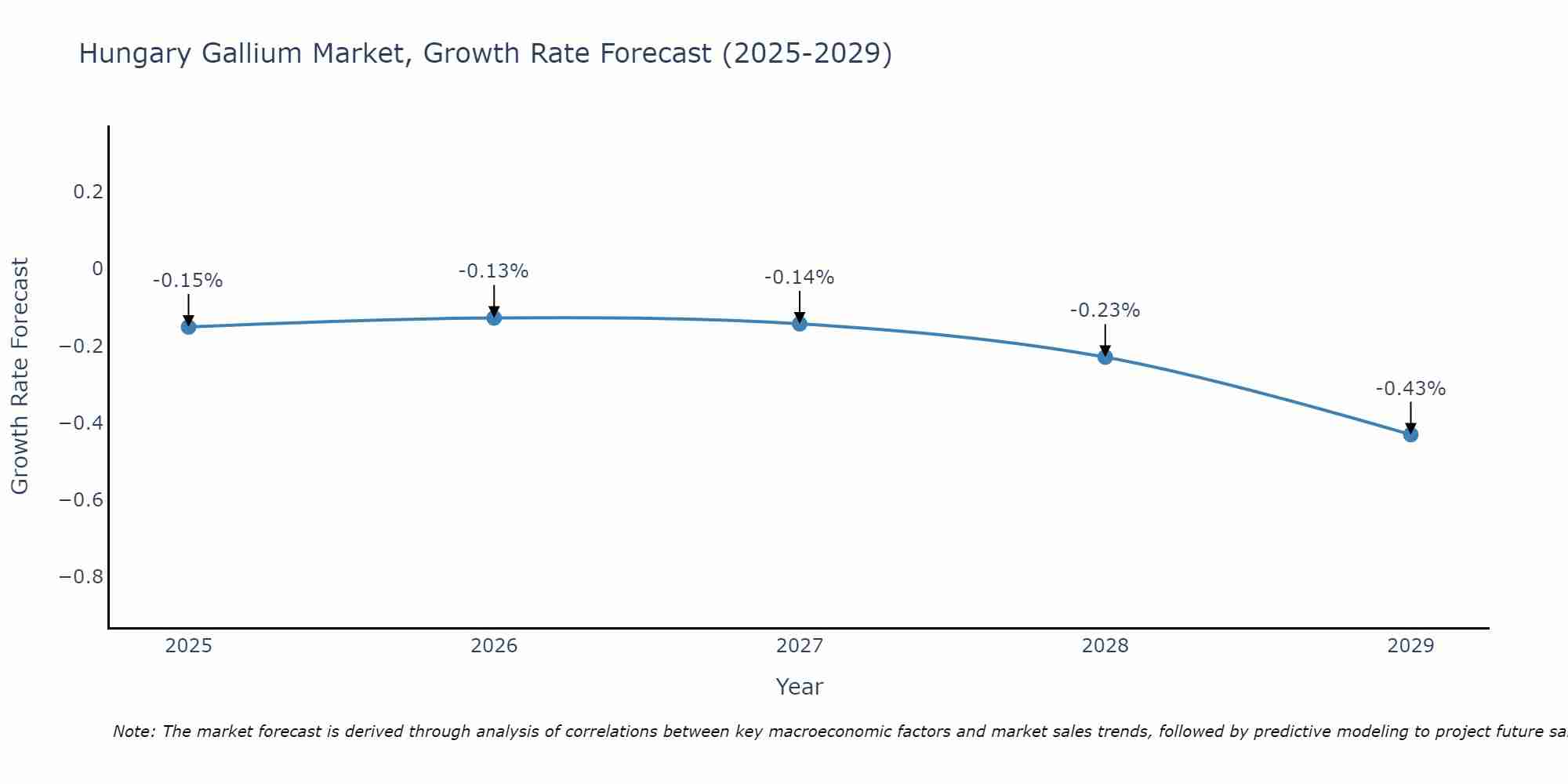
The Hungary Gallium Market is projected to witness mixed growth rate patterns during 2025 to 2029. The growth rate begins at -0.15% in 2025, climbs to a high of -0.13% in 2026, and moderates to -0.43% by 2029.
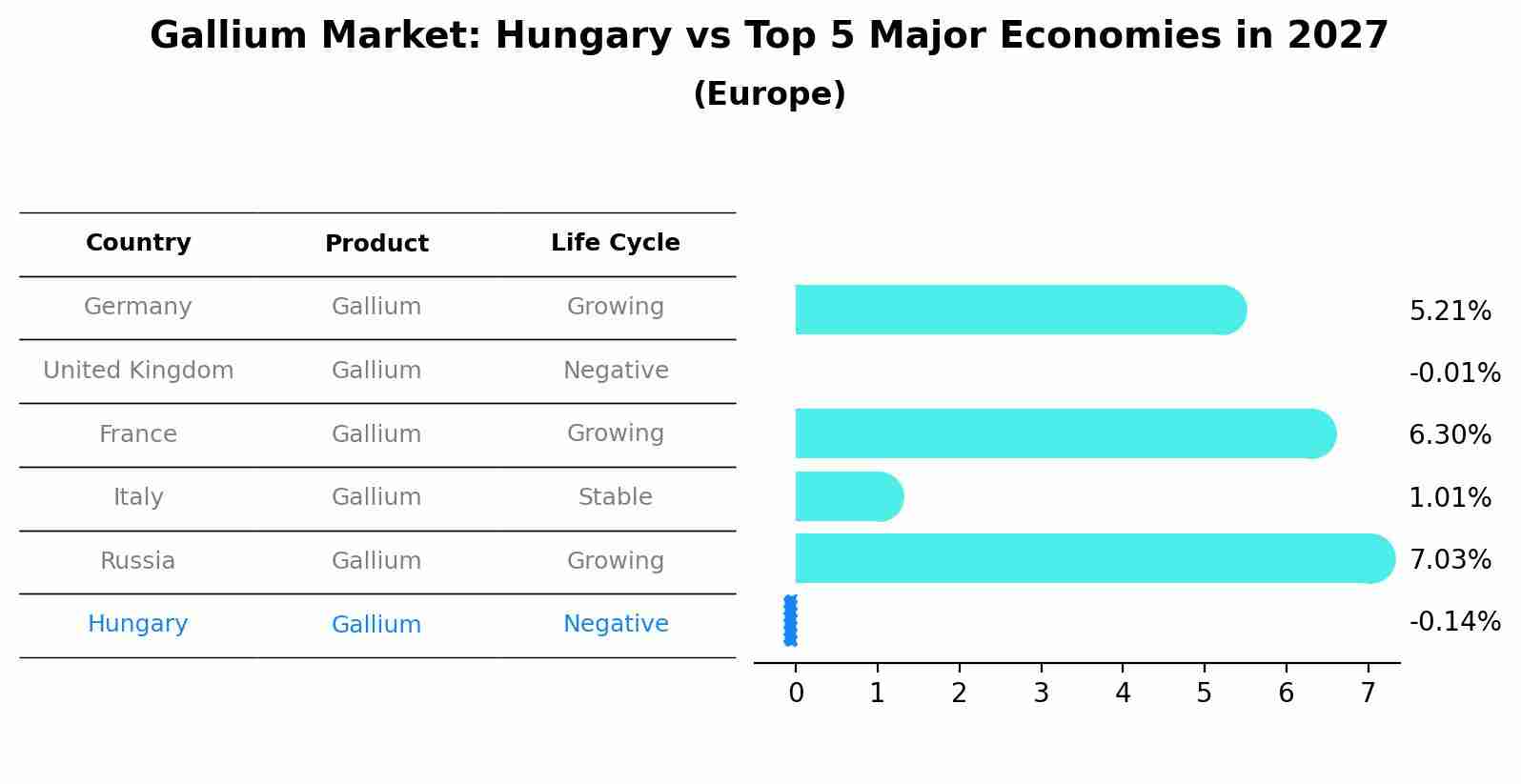
Gallium Market: Hungary vs Top 5 Major Economies in 2027 (Europe)
Hungary's Gallium market is anticipated to experience a negative growth rate of -0.14% by 2027, reflecting trends observed in the largest economy Germany, followed by United Kingdom, France, Italy and Russia.
Hungary Gallium Market Overview
The Hungary Gallium Market is experiencing steady growth driven by the increasing demand for gallium in industries such as electronics, semiconductors, and solar panels. Gallium is used in the production of LEDs, photovoltaic cells, and high-speed electronic devices due to its unique properties such as high electrical conductivity and resistance to corrosion. The market is also benefiting from the rising adoption of gallium nitride (GaN) technology in various applications. However, challenges such as fluctuating prices of gallium and supply chain disruptions may impact market growth. Overall, the Hungary Gallium Market is expected to continue to expand in the coming years, with key players focusing on research and development to innovate new applications and enhance the efficiency of gallium production processes.
Hungary Gallium Market Trends
Currently, the Hungary Gallium market is experiencing a growing demand due to its increasing applications in technology sectors such as electronics and semiconductors. Gallium is a critical component in the production of LEDs, solar panels, and mobile devices, driving the market growth. Additionally, the rising focus on renewable energy sources and the shift towards electric vehicles are further boosting the demand for Gallium in Hungary. Technological advancements and innovations in the industry are also contributing to the market expansion. However, challenges such as fluctuating prices and supply chain disruptions may impact the market dynamics in the coming years. Overall, the Hungary Gallium market is poised for growth with opportunities for manufacturers and suppliers to capitalize on the evolving trends and demands in the industry.
Hungary Gallium Market Challenges
In the Hungary Gallium market, one of the key challenges is the limited domestic production of Gallium, leading to a heavy reliance on imports from other countries. This dependency on external sources can result in supply chain disruptions, price volatility, and potential geopolitical risks. Additionally, the fluctuating demand for Gallium, primarily driven by the semiconductor industry, can pose a challenge for market players in terms of production planning and inventory management. Furthermore, the need for continuous innovation and technological advancements in Gallium-based products adds complexity to the market landscape, requiring companies to stay abreast of the latest developments and trends to remain competitive and meet evolving customer demands. Overall, navigating these challenges requires a strategic approach and a thorough understanding of the global Gallium market dynamics.
Hungary Gallium Market Investment Opportunities
The Hungary Gallium market presents promising investment opportunities due to the increasing demand for gallium in various industries such as electronics, semiconductors, and photovoltaics. With gallium being a key component in the production of LEDs, solar cells, and integrated circuits, the market is expected to grow steadily. Investing in companies involved in gallium production, refining, or recycling could be a viable option for investors looking to capitalize on this trend. Additionally, considering the global shift towards renewable energy sources, the demand for gallium in solar panels is likely to drive further growth in the market. Conducting thorough market research and analyzing the supply chain dynamics could help investors make informed decisions in tapping into the Hungary Gallium market.
Hungary Gallium Market Government Policy
The Hungarian government has implemented policies to support the growth of the gallium market in the country. These policies include providing financial incentives and tax breaks to companies investing in gallium production and research. The government is also focused on promoting collaboration between industry and research institutions to drive innovation in the gallium sector. Additionally, Hungary has implemented regulations to ensure environmental sustainability in gallium production, aiming to minimize the impact on the environment. Overall, the government is actively supporting the development of the gallium market in Hungary through a combination of financial incentives, collaboration initiatives, and environmental regulations.
Hungary Gallium Market Future Outlook
The future outlook for the Hungary Gallium Market appears promising, driven by increasing demand for gallium in the electronics and semiconductor industries. With the growing adoption of advanced technologies like 5G, Internet of Things (IoT), and electric vehicles, the need for gallium-based products is expected to rise. Additionally, gallium`s unique properties, such as its ability to improve the performance of semiconductors and LEDs, make it a sought-after material in various high-tech applications. As Hungary continues to invest in research and development activities and strengthen its position in the global semiconductor market, the demand for gallium is likely to grow. However, factors like supply chain disruptions, fluctuating raw material prices, and regulatory challenges could impact the market dynamics in the future.
Key Highlights of the Report:
- Hungary Gallium Market Outlook
- Market Size of Hungary Gallium Market, 2021
- Forecast of Hungary Gallium Market, 2031
- Historical Data and Forecast of Hungary Gallium Revenues & Volume for the Period 2018 - 2031
- Hungary Gallium Market Trend Evolution
- Hungary Gallium Market Drivers and Challenges
- Hungary Gallium Price Trends
- Hungary Gallium Porter's Five Forces
- Hungary Gallium Industry Life Cycle
- Historical Data and Forecast of Hungary Gallium Market Revenues & Volume By Applications for the Period 2018 - 2031
- Historical Data and Forecast of Hungary Gallium Market Revenues & Volume By LED for the Period 2018 - 2031
- Historical Data and Forecast of Hungary Gallium Market Revenues & Volume By Laser Diodes for the Period 2018 - 2031
- Historical Data and Forecast of Hungary Gallium Market Revenues & Volume By Integrated Circuits for the Period 2018 - 2031
- Historical Data and Forecast of Hungary Gallium Market Revenues & Volume By Solar Cells for the Period 2018 - 2031
- Hungary Gallium Import Export Trade Statistics
- Market Opportunity Assessment By Applications
- Hungary Gallium Top Companies Market Share
- Hungary Gallium Competitive Benchmarking By Technical and Operational Parameters
- Hungary Gallium Company Profiles
- Hungary Gallium Key Strategic Recommendations






































