Hungary Gambling Market Summary
The hungary gambling market was estimated at USD 445 Million in 2025 and is projected to reach USD 581 Million by 2032, growing at a CAGR of 4.6% from 2026 to 2032.
Hungary Gambling Market Year-wise Growth Rate and Key Drivers
This graph highlights how the Hungary Gambling Market has steadily grown over the past five years, supported by major growth factors.
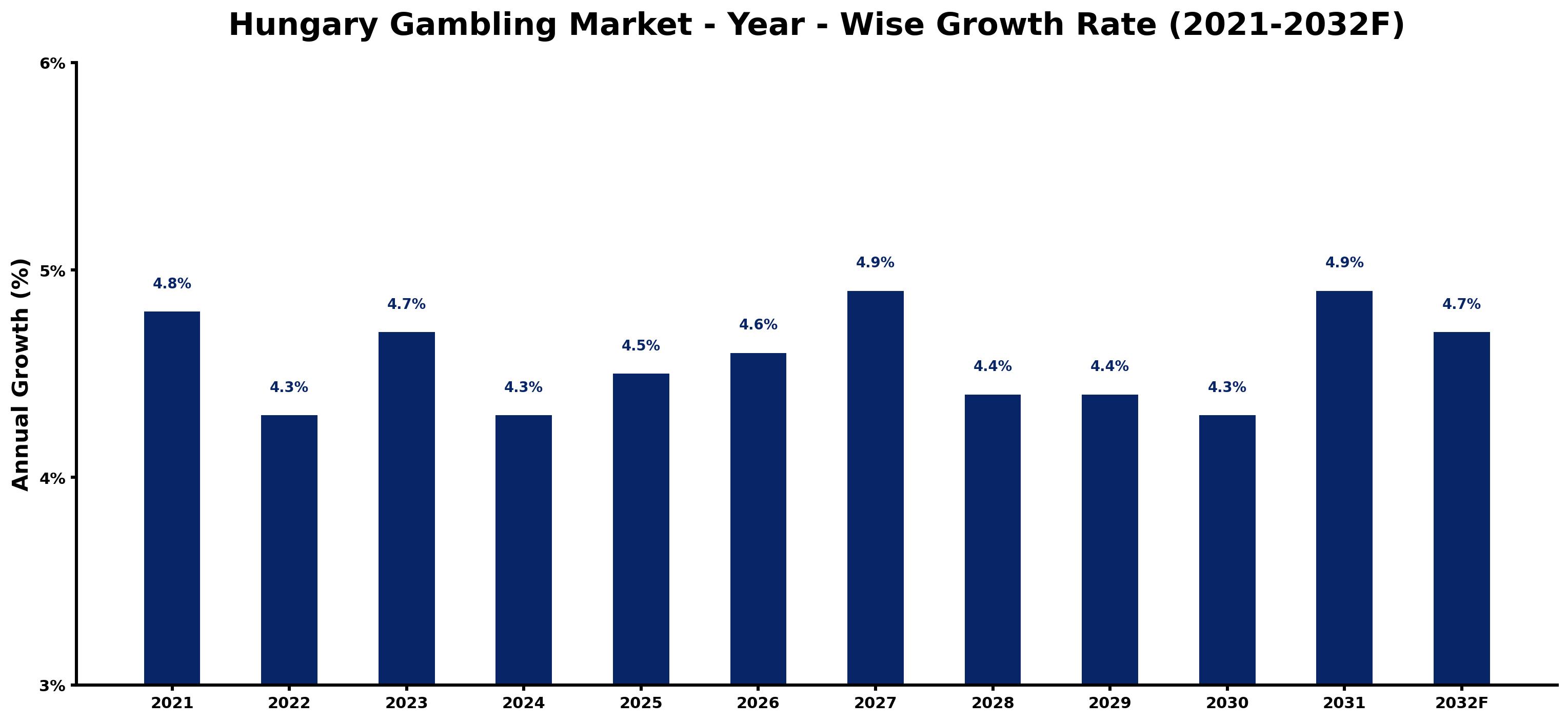
The table below presents the year wise growth rates along with the key drivers influencing the market
| Year | Growth Rate | Major Drivers |
| 2021 | 4.8% | Post-lockdown retail projects led to increased foot traffic at gaming establishments. |
| 2022 | 4.3% | Digital platforms reported significant engagement, attracting younger demographics to online gambling. |
| 2023 | 4.7% | Innovative marketing strategies focused on mobile apps enhanced user acquisition rates. |
| 2024 | 4.3% | Collaborations between local casinos and tech firms improved customer experience and loyalty. |
| 2025 | 4.5% | The emergence of virtual reality casinos captured attention, enhancing immersive gambling experiences. |
| 2026 | 4.6% | Consumer interest in esports betting surged, diversifying traditional gambling demographics. |
| 2027 | 4.9% | Analytical tools provided operators with invaluable insights on player behavior and preferences. |
| 2028 | 4.4% | Increased focus on responsible gambling initiatives fostered trust among consumers and regulators. |
| 2029 | 4.4% | Blockchain technology implementation enhanced transparency, boosting player confidence in transactions. |
| 2030 | 4.3% | Partnerships with international gaming brands expanded market reach beyond Hungary's borders. |
| 2031 | 4.9% | Emerging payment solutions made transactions smoother, attracting a broader audience to gambling. |
| 2032 | 4.7% | Community engagement through sponsorships and events reinforced the social aspect of gambling. |
Note - Market size estimations and growth projections presented in this report are based on 6Wresearch's advanced forecasting approach, validated with industry datasets as of June 2026.
Hungary Gambling Market Synopsis
The Hungary Gambling Market is projected to reach 4.6% and witness significant growth during the forecast period (2026-2032). This growth trajectory reflects a combination of factors including stringent regulations, advancements in technology, and evolving consumer preferences, particularly among younger demographics. The acceleration of mobile technology and internet-based gaming platforms has also catalyzed expansion in this sector, indicating a promising future for stakeholders involved in the Hungarian gambling arena.
Hungary Gambling Market Growth Drivers
Several key drivers are propelling the growth of the Hungary gambling market. First and foremost, the enhancement of regulatory frameworks has fostered a more secure and transparent environment for both operators and consumers. As a result, more players are willing to engage in gaming activities, knowing that their welfare is protected. Secondly, the increasing penetration of mobile devices has allowed for greater accessibility to gambling platforms, leading to a surge in online participation.
- The younger adult demographic is a critical contributor to market growth, with a notable shift towards online casinos and interactive gaming experiences.
- Technological innovations such as virtual reality and augmented reality are reshaping consumer experiences, attracting a diverse audience and retaining existing customers.
- Growing awareness of responsible gaming practices has prompted regulatory bodies to invest in educational campaigns, further legitimizing the market.
- Collaborations between tech firms and gambling operators are on the rise, leading to the introduction of unique features and services that enhance user engagement.
- The expansion of digital payment systems offers convenient and secure transaction methods, facilitating seamless betting experiences for users.
Hungary Gambling Market Trends and Opportunities
The Hungary gambling market is currently witnessing several trends that signify future opportunities for growth and investment. One significant trend is the increasing popularity of live dealer games, which merge the convenience of online gambling with the immersive experience of traditional gaming. This hybrid model appeals to a broad audience, particularly those who desire a more interactive environment.
- Mobile gaming is projected to become the dominant channel, fueled by advancements in smartphone technology and data accessibility.
- Gamification strategies are being adopted to enhance user engagement, transforming standard gambling activities into more interactive and competitively driven experiences.
- Social casinos, where players can engage without monetary stakes, are gaining traction, particularly among younger generations seeking entertaining and social experiences.
- Enhanced data analytics and AI technologies are enabling operators to create personalized gaming experiences tailored to user preferences.
- The integration of cryptocurrency as a payment option is emerging, providing an alternative for tech-savvy players who prefer decentralized methods.
Hungary Gambling Market Challenges and Restraints
Despite the optimistic outlook, the Hungary gambling market also faces several challenges that could hinder its growth. Regulatory compliance remains a complex landscape for operators, requiring substantial investment in legal adherence and operational adjustments. Additionally, the stigmatisation of gambling as a social vice can deter potential customers and impact brand reputations.
- Economic fluctuations may lead to variances in disposable income, affecting consumer spending on entertainment, including gambling.
- The fine line between responsible gaming promotion and excessive advertising can lead to regulatory scrutiny that could impact market dynamics.
- Competition from unregulated platforms poses a risk to established operators, as they often offer lower prices and fewer restrictions.
- Challenges related to cybersecurity and data privacy are increasingly prominent, requiring operators to invest heavily in protective measures.
- Societal pressures for more transparent and responsible gaming practices may necessitate changes that could increase operational costs for businesses.
Hungary Gambling Market Government Investment and Initiatives
The Hungarian government plays an instrumental role in shaping the gambling landscape through various investments and initiatives. Regulatory bodies such as the Magyarország Szerencsejáték Felügyelet (MSZF) have implemented strict regulations to ensure fair play and protect consumers. Furthermore, government campaigns aimed at promoting responsible gaming practices highlight an ongoing commitment to public welfare. Investments are also directed towards improving technological infrastructure, which enhances the efficiency and security of gambling operations.
- Public spending initiatives prioritize the reinforcement of regulatory frameworks, ensuring that operators align with legal standards and ethical practices.
- The government is actively involved in educational programs that address problem gambling, providing resources and support for those in need.
- Tax incentives are being considered for operators that invest in innovative technologies, encouraging the integration of advanced gaming options.
- Strategic partnerships with technology firms aim to bolster the sector's ability to harness new digital tools and platforms.
- Ongoing research and development funding is directed towards assessing the impact of gambling on health and society, providing insights for future policy-making.
Hungary Gambling Market Latest Developments (May 2025 - June 2026)
Recent developments in the Hungary gambling market indicate a progressive shift towards modernization and consumer-centric services. Regulatory authorities have intensified their focus on digital compliance, urging operators to adopt stricter security protocols to safeguard player information. Concurrently, there has been an increase in collaborations between technology providers and gambling firms to create immersive gaming experiences, including the integration of VR technologies. As a result, consumers can expect to see a surge in innovative features designed to enhance engagement and satisfaction levels.
- The introduction of new regulatory guidelines aims to enhance transparency and consumer protection across all gaming platforms.
- There has been an upswing in the implementation of responsible gaming tools, allowing users to set personal limits and access support services more easily.
- Operators are investing heavily in marketing campaigns that emphasize ethical gambling, appealing to socially conscious consumers.
- Technological advancements have led to the emergence of new gaming formats that cater to evolving consumer preferences.
- Increased public discussions surrounding gambling addiction have prompted further governmental initiatives to address and educate on this critical issue.
Hungary Gambling Market - Key Attractiveness of the Report
- 10 Years of Market Numbers
- Historical Data Starting from 2022 to 2025
- Base Year: 2025
- Forecast Data until 2032
- Key Performance Indicators Impacting the Market
- Major Upcoming Developments and Projects
Key Highlights of the Report:
- Hungary Gambling Market Outlook
- Market Size of Hungary Gambling Market, 2025
- Forecast of Hungary Gambling Market, 2032F
- Historical Data and Forecast of Hungary Gambling Revenues & Volume for the Period 2022-2032F
- Hungary Gambling Market Trend Evolution
- Hungary Gambling Market Drivers and Challenges
- Hungary Gambling Price Trends
- Hungary Gambling Porter's Five Forces
- Hungary Gambling Industry Life Cycle
- Historical Data and Forecast of Hungary Gambling Market Revenues & Volume By Product Type for the Period 2022-2032F
- Historical Data and Forecast of Hungary Gambling Market Revenues & Volume By Betting for the Period 2022-2032F
- Historical Data and Forecast of Hungary Gambling Market Revenues & Volume By Casino for the Period 2022-2032F
- Historical Data and Forecast of Hungary Gambling Market Revenues & Volume By Lottery for the Period 2022-2032F
- Historical Data and Forecast of Hungary Gambling Market Revenues & Volume By Others for the Period 2022-2032F
- Historical Data and Forecast of Hungary Gambling Market Revenues & Volume By Channel Type for the Period 2022-2032F
- Historical Data and Forecast of Hungary Gambling Market Revenues & Volume By Offline for the Period 2022-2032F
- Historical Data and Forecast of Hungary Gambling Market Revenues & Volume By Online for the Period 2022-2032F
- Historical Data and Forecast of Hungary Gambling Market Revenues & Volume By Virtual Reality VR for the Period 2022-2032F
- Historical Data and Forecast of Hungary Gambling Market Revenues & Volume By Platform for the Period 2022-2032F
- Historical Data and Forecast of Hungary Gambling Market Revenues & Volume By Land-Based for the Period 2022-2032F
- Historical Data and Forecast of Hungary Gambling Market Revenues & Volume By Online for the Period 2022-2032F
- Hungary Gambling Import Export Trade Statistics
- Market Opportunity Assessment By Product Type
- Market Opportunity Assessment By Channel Type
- Market Opportunity Assessment By Platform
- Hungary Gambling Top Companies Market Share
- Hungary Gambling Competitive Benchmarking By Technical and Operational Parameters
- Hungary Gambling Company Profiles
- Hungary Gambling Key Strategic Recommendations






































