Hungary Gas Sensors Market: Import Trend Analysis
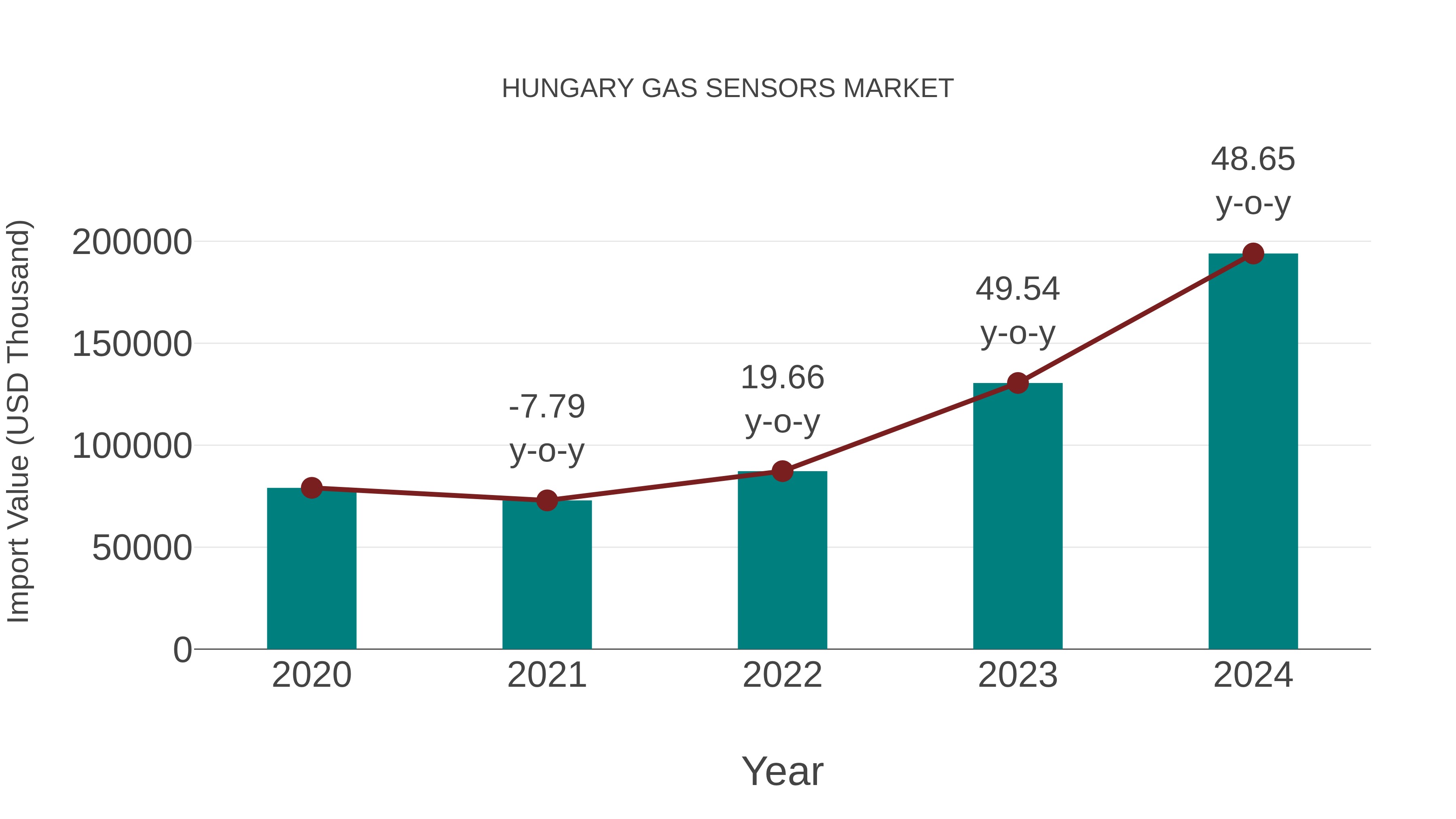
In the Hungary gas sensors market, import trends showed a notable growth trajectory from 2023 to 2024, with a growth rate of 48.65%. The compound annual growth rate (CAGR) for imports from 2020 to 2024 stood at 25.14%. This surge in imports can be attributed to a notable increase in demand for gas sensors within Hungary, reflecting a shift in market dynamics towards enhanced safety measures or environmental regulations during this period.
Hungary Gas Sensors Market Synopsis
The Hungary Gas Sensors Market is experiencing steady growth driven by increasing awareness of air quality monitoring and industrial safety regulations. The market is primarily driven by the automotive sector for emission control and environmental monitoring. Additionally, the growing adoption of gas sensors in smart homes and HVAC systems is further fueling market growth. Key players in the Hungary Gas Sensors Market include Bosch Sensortec, Figaro Engineering, and Honeywell International, among others. The market is characterized by intense competition, technological advancements, and a focus on developing innovative and cost-effective solutions. With a growing emphasis on environmental sustainability and safety standards, the demand for gas sensors in Hungary is expected to continue to rise across various industries in the coming years.
Hungary Gas Sensors Market Trends
The Hungary Gas Sensors Market is experiencing growth driven by increasing awareness of environmental safety and regulations, particularly in industrial and automotive sectors. Demand for gas sensors is rising due to the need for monitoring air quality, detecting gas leaks, and ensuring workplace safety. Technological advancements such as the development of wireless and IoT-enabled gas sensors are also driving market growth. Additionally, the growing adoption of gas sensors in smart homes and buildings for safety and energy efficiency purposes is further fueling market expansion. Key players in the Hungary Gas Sensors Market are focusing on innovation and product development to meet the evolving needs of industries and consumers, with a particular emphasis on compact, cost-effective, and high-performance sensor solutions.
Hungary Gas Sensors Market Challenges
In the Hungary Gas Sensors Market, one of the key challenges is the increasing competition from international players offering advanced technologies at competitive prices. This poses a threat to local gas sensor companies in Hungary, as they may struggle to keep up with the pace of innovation and cost-effectiveness. Additionally, the regulatory environment and compliance standards in Hungary can be stringent, requiring companies to invest in research and development to meet these requirements. Another challenge is the limited awareness among end-users about the benefits and importance of gas sensors, leading to slower adoption rates in certain industries. Overall, navigating these challenges while maintaining product quality and competitiveness in the market is crucial for the growth and sustainability of gas sensor companies in Hungary.
Hungary Gas Sensors Market Investment Opportunities
The Hungary Gas Sensors Market offers attractive investment opportunities due to the increasing demand for gas sensors in various industries such as automotive, healthcare, and environmental monitoring. With the growing emphasis on air quality monitoring and safety regulations, there is a rising need for reliable gas detection systems, driving the market`s growth. Investing in innovative gas sensor technologies, such as wireless and IoT-enabled sensors, can provide significant returns as these advancements cater to the modernization of industries. Additionally, the market is witnessing collaborations between sensor manufacturers and technology companies to develop enhanced products, further expanding the investment potential. Overall, the Hungary Gas Sensors Market presents a promising landscape for investors looking to capitalize on the growing demand for gas detection solutions.
Jordan Agar Market Government Policies
In Hungary, the government has implemented various policies related to the Gas Sensors Market to ensure safety and environmental protection. These policies include regulations on gas sensor standards and certifications, aimed at ensuring the quality and reliability of gas sensors used in industrial and residential applications. Additionally, there are directives focused on promoting the adoption of innovative and energy-efficient gas sensor technologies to reduce emissions and improve air quality. The government also provides support for research and development initiatives in the gas sensor sector through grants and incentives to encourage technological advancements and market growth. Overall, these policies play a crucial role in shaping the Hungary Gas Sensors Market by fostering a competitive and sustainable environment for industry players while prioritizing public safety and environmental conservation.
Hungary Gas Sensors Market Future Outlook
The Hungary Gas Sensors Market is expected to witness steady growth in the coming years, driven by increasing demand for gas sensing technologies across various industries such as automotive, healthcare, and environmental monitoring. The growing emphasis on safety and environmental regulations will further fuel the adoption of gas sensors in Hungary. Advancements in sensor technology, such as the development of miniaturized and wireless sensors, are likely to enhance market growth by providing improved accuracy and efficiency in gas detection applications. Additionally, the rising awareness regarding the importance of air quality monitoring and the need to detect harmful gases in industrial settings will contribute to the expansion of the gas sensors market in Hungary. Overall, the market is anticipated to experience positive growth prospects in the foreseeable future.
Key Highlights of the Report:
- Hungary Gas Sensors Market Outlook
- Market Size of Hungary Gas Sensors Market, 2025
- Forecast of Hungary Gas Sensors Market, 2032
- Historical Data and Forecast of Hungary Gas Sensors Revenues & Volume for the Period 2022 - 2032F
- Hungary Gas Sensors Market Trend Evolution
- Hungary Gas Sensors Market Drivers and Challenges
- Hungary Gas Sensors Price Trends
- Hungary Gas Sensors Porter's Five Forces
- Hungary Gas Sensors Industry Life Cycle
- Historical Data and Forecast of Hungary Gas Sensors Market Revenues & Volume By Product for the Period 2022 - 2032F
- Historical Data and Forecast of Hungary Gas Sensors Market Revenues & Volume By Hydrogen for the Period 2022 - 2032F
- Historical Data and Forecast of Hungary Gas Sensors Market Revenues & Volume By Ammonia for the Period 2022 - 2032F
- Historical Data and Forecast of Hungary Gas Sensors Market Revenues & Volume By Hydrogen Sulfide for the Period 2022 - 2032F
- Historical Data and Forecast of Hungary Gas Sensors Market Revenues & Volume By Methyl Mercaptan Sensor for the Period 2022 - 2032F
- Historical Data and Forecast of Hungary Gas Sensors Market Revenues & Volume By NOx Sensor for the Period 2022 - 2032F
- Historical Data and Forecast of Hungary Gas Sensors Market Revenues & Volume By Carbon Monoxide Sensor for the Period 2022 - 2032F
- Historical Data and Forecast of Hungary Gas Sensors Market Revenues & Volume By Carbon Dioxide Sensor for the Period 2022 - 2032F
- Historical Data and Forecast of Hungary Hydrogen Gas Sensors Market Revenues & Volume By Oxygen/Lambda Sensor for the Period 2022 - 2032F
- Historical Data and Forecast of Hungary Gas Sensors Market Revenues & Volume By Technology for the Period 2022 - 2032F
- Historical Data and Forecast of Hungary Gas Sensors Market Revenues & Volume By Infrared for the Period 2022 - 2032F
- Historical Data and Forecast of Hungary Gas Sensors Market Revenues & Volume By Catalytic for the Period 2022 - 2032F
- Historical Data and Forecast of Hungary Gas Sensors Market Revenues & Volume By Photo-Ionization Detector for the Period 2022 - 2032F
- Historical Data and Forecast of Hungary Gas Sensors Market Revenues & Volume By Solid State/MOS for the Period 2022 - 2032F
- Historical Data and Forecast of Hungary Gas Sensors Market Revenues & Volume By Semiconductor for the Period 2022 - 2032F
- Historical Data and Forecast of Hungary Gas Sensors Market Revenues & Volume By Electrochemical for the Period 2022 - 2032F
- Hungary Gas Sensors Import Export Trade Statistics
- Market Opportunity Assessment By Product
- Market Opportunity Assessment By Technology
- Hungary Gas Sensors Top Companies Market Share
- Hungary Gas Sensors Competitive Benchmarking By Technical and Operational Parameters
- Hungary Gas Sensors Company Profiles
- Hungary Gas Sensors Key Strategic Recommendations






































