Hungary Industrial Machinery Market: Import Trend Analysis
Hungary`s industrial machinery market witnessed a notable decline in import momentum from 2023 to 2024, with a growth rate of -48.21%. The compound annual growth rate (CAGR) for imports in the sector between 2020 and 2024 stood at -7.15%. This decline can be attributed to shifting market demands or potential changes in trade policies affecting the sector`s stability.
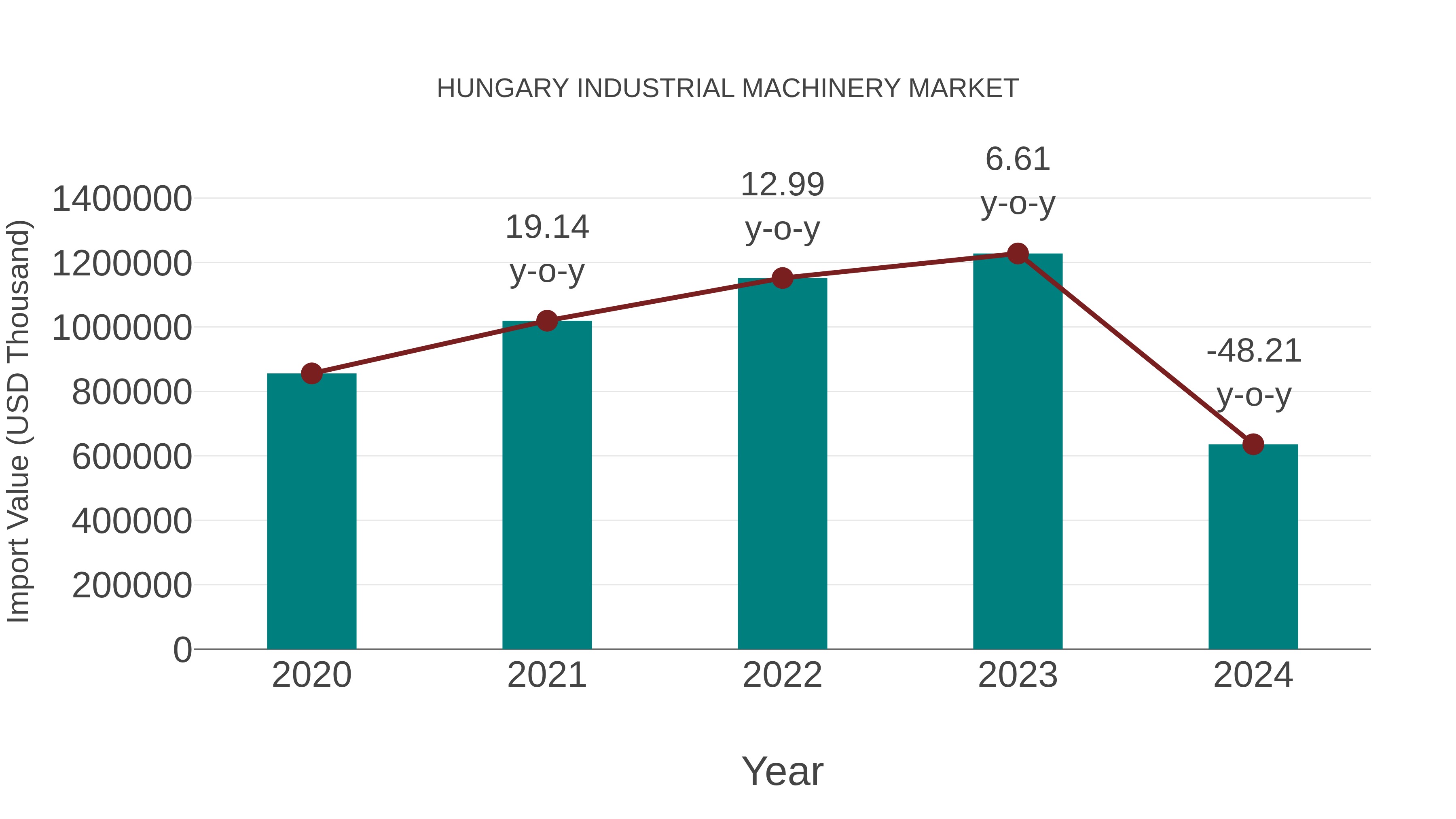
Hungary Industrial Machinery Market Overview
Hungary industrial machinery market is diverse, covering a wide range of equipment used in manufacturing, construction, and other industrial processes. Key players are focusing on technological advancements, automation, and digitalization to enhance the efficiency and performance of industrial machinery.
Drivers of the market
The Hungary industrial machinery market is driven by factors such as manufacturing activities, automation trends, and demand for advanced and efficient production equipment. Industrial machinery encompasses a wide range of equipment, including machine tools, robotics, and automation systems, used in manufacturing processes across various industries. Moreover, advancements in machinery design, digitalization, and additive manufacturing further stimulate market growth by improving productivity, flexibility, and competitiveness of Hungary manufacturing sector.
Challenges of the market
Challenges in the Hungary industrial machinery market include enhancing equipment performance, addressing technological obsolescence, and optimizing production processes. Manufacturers must innovate to develop advanced machinery that improves productivity, reduces downtime, and meets evolving market demands for automation, customization, and flexibility in manufacturing and processing industries.
Government Policy of the market
Government policies in Hungary support the modernization and expansion of the industrial machinery sector through investment incentives, export promotion efforts, and collaboration with research institutions to foster innovation and technology transfer.
Key Highlights of the Report:
- Hungary Industrial Machinery Market Outlook
- Market Size of Hungary Industrial Machinery Market, 2025
- Forecast of Hungary Industrial Machinery Market, 2032
- Historical Data and Forecast of Hungary Industrial Machinery Revenues & Volume for the Period 2022-2032F
- Hungary Industrial Machinery Market Trend Evolution
- Hungary Industrial Machinery Market Drivers and Challenges
- Hungary Industrial Machinery Price Trends
- Hungary Industrial Machinery Porter's Five Forces
- Hungary Industrial Machinery Industry Life Cycle
- Historical Data and Forecast of Hungary Industrial Machinery Market Revenues & Volume By Application for the Period 2022-2032F
- Historical Data and Forecast of Hungary Industrial Machinery Market Revenues & Volume By Agriculture for the Period 2022-2032F
- Historical Data and Forecast of Hungary Industrial Machinery Market Revenues & Volume By Construction for the Period 2022-2032F
- Historical Data and Forecast of Hungary Industrial Machinery Market Revenues & Volume By Packaging for the Period 2022-2032F
- Historical Data and Forecast of Hungary Industrial Machinery Market Revenues & Volume By Food Processing for the Period 2022-2032F
- Historical Data and Forecast of Hungary Industrial Machinery Market Revenues & Volume By Mining for the Period 2022-2032F
- Historical Data and Forecast of Hungary Industrial Machinery Market Revenues & Volume By Semiconductor Manufacturing for the Period 2022-2032F
- Hungary Industrial Machinery Import Export Trade Statistics
- Market Opportunity Assessment By Application
- Hungary Industrial Machinery Top Companies Market Share
- Hungary Industrial Machinery Competitive Benchmarking By Technical and Operational Parameters
- Hungary Industrial Machinery Company Profiles
- Hungary Industrial Machinery Key Strategic Recommendations






































