Hungary LED Professional Lighting Market Summary
The hungary led professional lighting market was estimated at USD 239 Million in 2025 and is projected to reach USD 310 Million by 2032, growing at a CAGR of 4.6% from 2026 to 2032.
Hungary LED Professional Lighting Market Year-wise Growth Rate and Key Drivers
This graph highlights how the Hungary LED Professional Lighting Market has steadily grown over the past five years, supported by major growth factors.
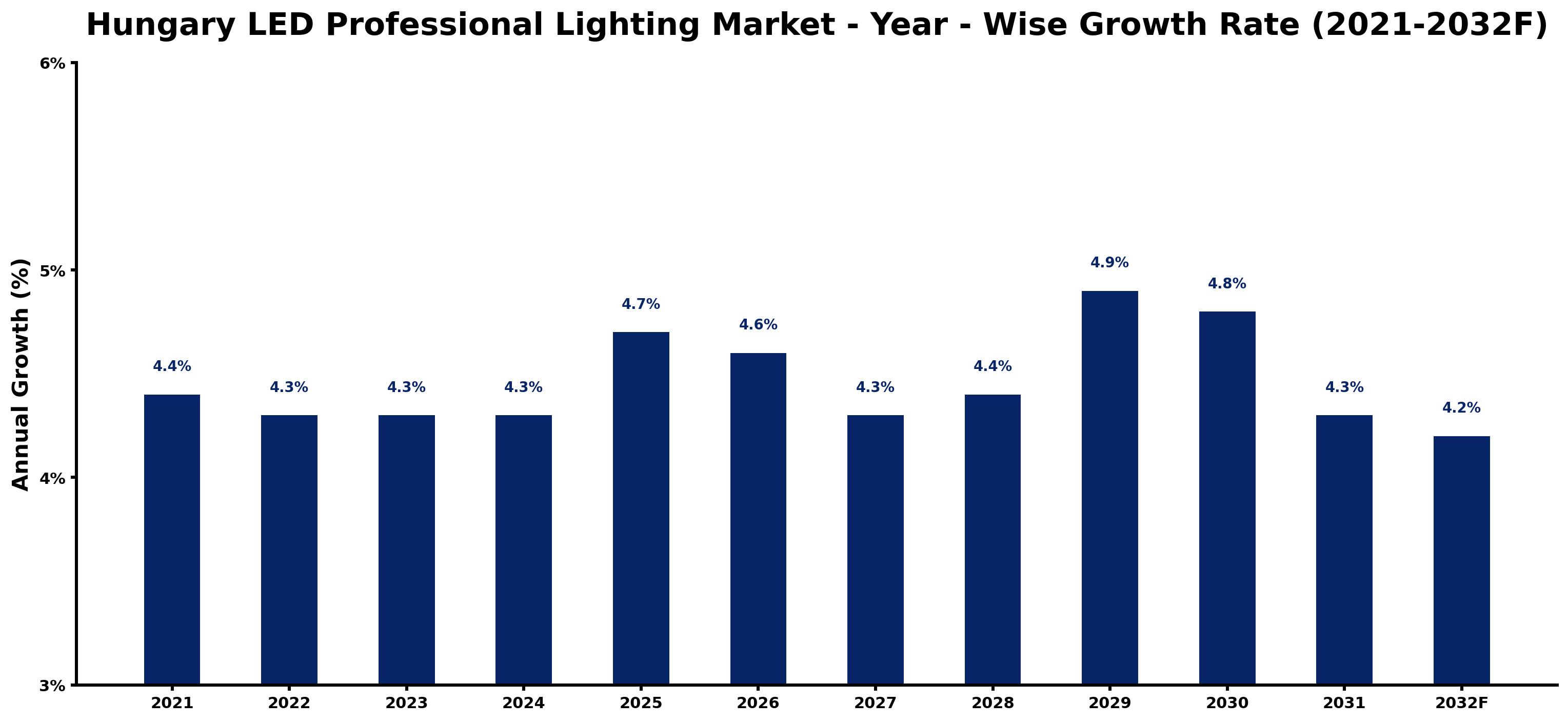
The table below presents the year wise growth rates along with the key drivers influencing the market
| Year | Growth Rate | Major Drivers |
| 2021 | 4.4% | Post-lockdown retail projects increasingly emphasized energy-efficient lighting solutions. |
| 2022 | 4.3% | Corporate sustainability goals encouraged investments in advanced LED lighting technologies. |
| 2023 | 4.3% | Rising energy prices intensified the shift towards cost-effective lighting alternatives. |
| 2024 | 4.3% | Market competition pushed manufacturers to innovate with smart lighting systems. |
| 2025 | 4.7% | Urbanization trends prompted extensive infrastructure upgrades in Hungarian cities. |
| 2026 | 4.6% | Emerging green building standards incentivized the integration of LED lighting. |
| 2027 | 4.3% | Technological improvements facilitated the development of high-performance lighting products. |
| 2028 | 4.4% | Consumer preferences shifted towards environmentally friendly lighting solutions. |
| 2029 | 4.9% | Increased awareness of energy conservation further fueled LED market expansion. |
| 2030 | 4.8% | Government partnerships with private sectors enhanced residential lighting retrofitting projects. |
| 2031 | 4.3% | Smart home technology integration drove consumer demand for intelligent lighting systems. |
| 2032 | 4.2% | Collaboration with international firms boosted innovative projects in the lighting sector. |
Note - Market size estimations and growth projections presented in this report are based on 6Wresearch's advanced forecasting approach, validated with industry datasets as of June 2026.
Hungary LED Professional Lighting Market Synopsis
The Hungary LED Professional Lighting Market is projected to reach 4.6% and witness significant growth during the forecast period (2026-2032). This growth is anticipated to be driven by several key factors, including the increasing demand for energy-efficient lighting solutions and the growing adoption of LED technology across various sectors, including commercial, residential, and industrial applications. As urban areas in Hungary focus on modernization and smart city initiatives, the need for innovative lighting solutions that enhance energy efficiency and reduce operational costs becomes increasingly critical. Technological advancements, particularly in connected lighting systems that offer remote management capabilities, are also expected to fuel market expansion.
Hungary LED Professional Lighting Market Growth Drivers
Several drivers are propelling the Hungary LED Professional Lighting Market forward. First, the demand for energy-efficient lighting solutions is rising significantly, driven by both consumer preferences and regulatory frameworks. Second, the adoption of LED lighting in commercial spaces is becoming more prevalent as businesses seek to reduce energy expenses. Third, technological innovations, such as IoT-enabled lighting systems, allow users to control lighting settings through smartphones or automated systems, enhancing user convenience. Fourth, the push from government and local authorities to develop smart cities is leading to increased investments in modern lighting infrastructure. Finally, the growing emphasis on sustainability and reduced carbon footprints is encouraging both public and private sectors to transition to LED technologies.
- The ongoing transition towards energy-efficient lighting systems is a central growth driver for the market, particularly in urban environments.
- Government initiatives that advocate for green technologies are fostering an environment conducive to the adoption of LED lighting solutions.
- Technological advancements, including the integration of smart lighting systems, are enhancing the appeal of LED solutions for consumers and businesses alike.
- Public infrastructure projects aimed at modernizing urban spaces are prioritizing energy-efficient lighting, which favors the uptake of LED technology.
- The cost-effectiveness of LEDs, particularly in terms of long-term savings from reduced energy usage, continues to drive their adoption across various sectors.
Hungary LED Professional Lighting Market Challenges and Restraints
Despite the positive outlook for the Hungary LED Professional Lighting Market, several challenges may impede its growth. High installation costs associated with transitioning from conventional lighting systems to LED technology can deter some businesses and municipalities from making the switch. Additionally, the initial capital required for infrastructure upgrades can be substantial, especially for smaller enterprises or local authorities with limited budgets. There is also the challenge of ensuring that the existing workforce is adequately trained to install and maintain new lighting technologies, which can slow down the implementation process. Furthermore, potential supply chain disruptions and fluctuating raw material costs for LED manufacturing may present additional hurdles for market players.
- The high upfront costs of LED installation may yield reluctance among certain commercial and public sectors to invest in upgrading their lighting systems.
- Training and upskilling of personnel are necessary to handle advanced LED technologies, which can create delays in deployment.
- Economic fluctuations may lead to uncertainty in investment decisions, affecting the overall market growth.
- Supply chain disruptions and volatility in raw material prices can impact manufacturer operations and profitability.
- Market competition may lead to price wars, potentially affecting the financial viability of smaller players in the market.
Hungary LED Professional Lighting Market Government Investment and Initiatives
The government of Hungary has shown a strong commitment to modernizing its infrastructure through various initiatives that directly support the Hungary LED Professional Lighting Market. A significant focus is placed on developing smart cities, which includes the integration of energy-efficient lighting solutions to enhance public safety and optimize energy consumption. Funding programs and incentives are being established to encourage municipalities to invest in LED technologies. Additionally, public spending on urban infrastructure is increasingly directed toward projects that prioritize sustainability and energy efficiency, which supports the growth of LED lighting in public spaces. These initiatives are essential for reducing the carbon footprint while simultaneously improving the quality of life for residents.
- Government-led programs are facilitating the transition toward energy-efficient lighting solutions as part of broader smart city initiatives.
- Public spending on infrastructure enhancements is increasingly incorporating LED lighting technologies to promote sustainability.
- Regulatory frameworks are being established to encourage the adoption of energy-efficient lighting in both public and private sectors.
- Incentives and funding are available for municipalities that choose to invest in modern lighting solutions, reflecting a supportive policy environment.
- Collaboration between government bodies and private sector players aims to develop innovative lighting technologies that align with national energy goals.
Hungary LED Professional Lighting Market Latest Developments (May 2025 - June 2026)
The Hungary LED Professional Lighting Market is currently witnessing a series of developments aimed at enhancing the capabilities and applications of LED lighting. Industry players are increasingly focusing on integrating smart technologies into their offerings, enabling users to manage lighting remotely and efficiently. Research and development efforts are being ramped up to improve the performance and longevity of LED products. Furthermore, partnerships between local governments and technology providers are being established to pilot innovative lighting projects in urban areas, providing case studies for wider implementation. This collaborative approach is expected to accelerate the adoption of LED solutions and improve overall market dynamics.
- Innovative collaborations between government entities and technology firms are paving the way for new smart city lighting projects.
- There is a noticeable increase in R&D investments aimed at enhancing LED technology performance and expanding its applications.
- Pilot projects in urban areas are demonstrating the benefits of advanced LED solutions, fostering increased interest in smart lighting systems.
- Market players are focusing on sustainability, with new product lines emphasizing eco-friendly manufacturing processes.
- Education and awareness campaigns are being initiated to showcase the benefits and efficiencies of LED lighting, encouraging wider adoption.
Hungary LED Professional Lighting Market - Key Attractiveness of the Report
- 10 Years of Market Numbers
- Historical Data Starting from 2022 to 2025
- Base Year: 2025
- Forecast Data until 2032
- Key Performance Indicators Impacting the Market
- Major Upcoming Developments and Projects
Key Highlights of the Report:
- Hungary LED Professional Lighting Market Outlook
- Market Size of Hungary LED Professional Lighting Market, 2025
- Forecast of Hungary LED Professional Lighting Market, 2032
- Historical Data and Forecast of Hungary LED Professional Lighting Revenues & Volume for the Period 2022-2032
- Hungary LED Professional Lighting Market Trend Evolution
- Hungary LED Professional Lighting Market Drivers and Challenges
- Hungary LED Professional Lighting Price Trends
- Hungary LED Professional Lighting Porter's Five Forces
- Hungary LED Professional Lighting Industry Life Cycle
- Historical Data and Forecast of Hungary LED Professional Lighting Market Revenues & Volume By Product Type for the Period 2022-2032
- Historical Data and Forecast of Hungary LED Professional Lighting Market Revenues & Volume By LED Bulbs for the Period 2022-2032
- Historical Data and Forecast of Hungary LED Professional Lighting Market Revenues & Volume By LED Fixtures for the Period 2022-2032
- Historical Data and Forecast of Hungary LED Professional Lighting Market Revenues & Volume By Bare LED Tubes for the Period 2022-2032
- Historical Data and Forecast of Hungary LED Professional Lighting Market Revenues & Volume By LED Down lights for the Period 2022-2032
- Historical Data and Forecast of Hungary LED Professional Lighting Market Revenues & Volume By Applications for the Period 2022-2032
- Historical Data and Forecast of Hungary LED Professional Lighting Market Revenues & Volume By Indoor for the Period 2022-2032
- Historical Data and Forecast of Hungary LED Professional Lighting Market Revenues & Volume By Outdoor for the Period 2022-2032
- Historical Data and Forecast of Hungary LED Professional Lighting Market Revenues & Volume By Automotive for the Period 2022-2032
- Historical Data and Forecast of Hungary LED Professional Lighting Market Revenues & Volume By Backlighting for the Period 2022-2032
- Hungary LED Professional Lighting Import Export Trade Statistics
- Market Opportunity Assessment By Product Type
- Market Opportunity Assessment By Applications
- Hungary LED Professional Lighting Top Companies Market Share
- Hungary LED Professional Lighting Competitive Benchmarking By Technical and Operational Parameters
- Hungary LED Professional Lighting Company Profiles
- Hungary LED Professional Lighting Key Strategic Recommendations
Market Covered
This report offers a comprehensive study of the subsequent market segments:
By Product Type
- LED Bulbs
- LED Fixtures
- Bare LED Tubes
- LED Down lights
By Applications
- Indoor, Outdoor
- Automotive
- Backlighting






































