Hungary Palmitic Acid Market Size (2020-2030)
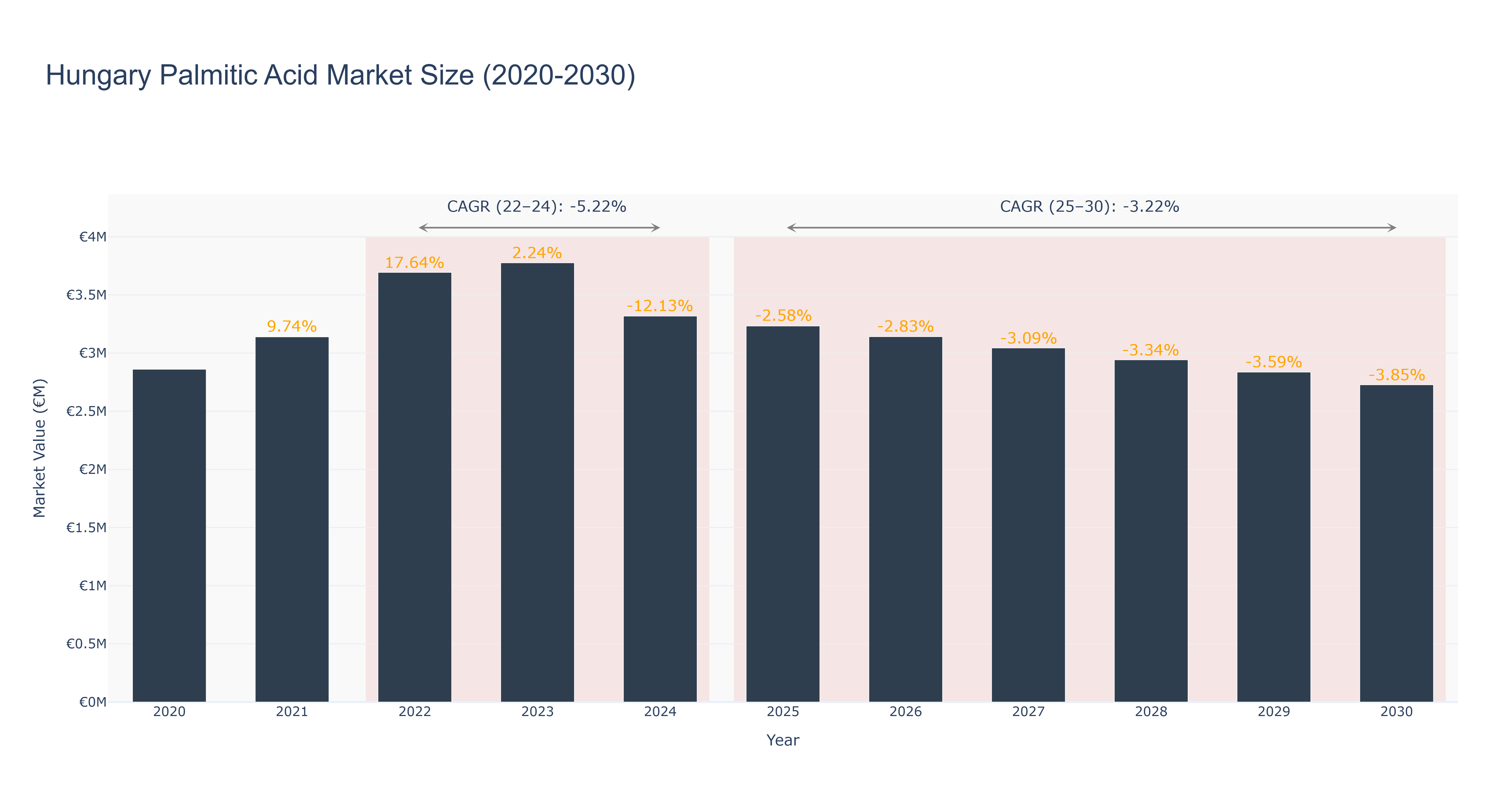
Hungary's Palmitic Acid Market experienced a peak market size of €3.78 million in 2023, with a subsequent decline to €3.32 million in 2024. The market is forecasted to continue shrinking, reaching €2.73 million by 2030, with a CAGR of -3.215023314% from 2025 to 2030. The recent negative growth trends can be attributed to factors such as changing consumer preferences towards alternative products and global economic fluctuations impacting demand. Despite the current challenges, Hungary's Palmitic Acid Market is expected to witness new investments in sustainable production technologies and increased focus on product innovation to drive growth in the coming years. This strategic shift towards sustainability and innovation could potentially revitalize the market and attract new opportunities for stakeholders.
Hungary Palmitic Acid Market: Production & Trade Performance (2019-2025)
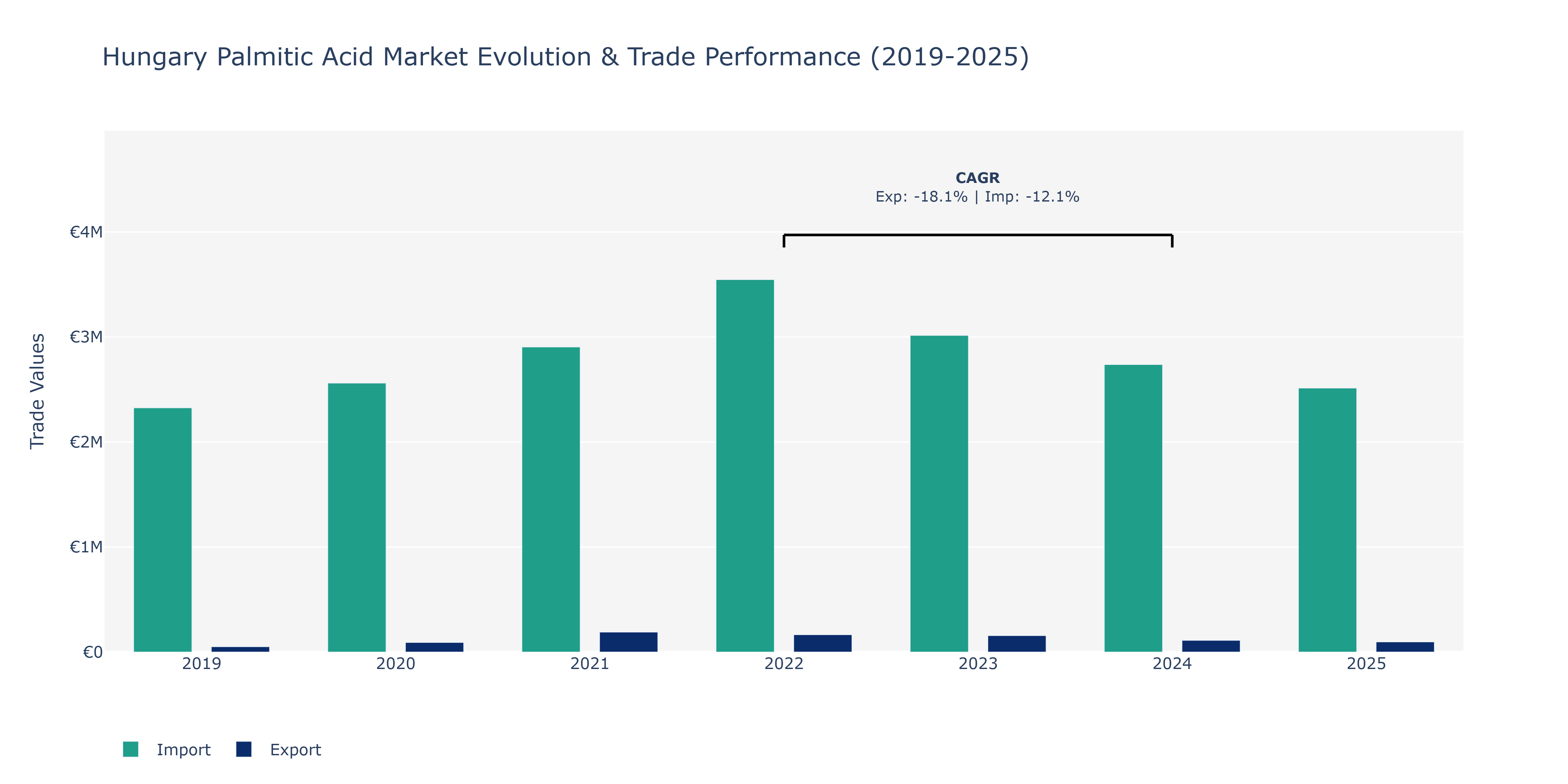
Between 2019 and 2025, Hungary's Palmitic Acid market witnessed notable fluctuations in both exports and imports. Exports started at €50.82 thousand in 2019, increased to €189.7 thousand in 2021, and then gradually declined to €96.33 thousand by 2025. On the other hand, imports surged from €2.32 million in 2019 to €3.55 million in 2022 before experiencing a slight decrease to €2.51 million in 2025. A peak in exports occurred in 2021, possibly due to increased global demand for palmitic acid in cosmetics and personal care products. Conversely, the peak in imports in 2022 could be attributed to Hungary's growing reliance on foreign suppliers for raw materials. The fluctuations in both exports and imports could reflect shifts in production capacity, changes in domestic consumption, and evolving trade relationships within the industry. Additionally, the negative CAGR for exports and imports between 2022 and 2024 may be linked to global market dynamics impacting trade volumes and pricing strategies in the Palmitic Acid market.
Hungary Palmitic Acid Market Synopsis
The Hungary Palmitic Acid market is experiencing steady growth due to the increasing demand from various industries such as food and beverage, cosmetics, and pharmaceuticals. Palmitic acid is a saturated fatty acid widely used in the production of soaps, detergents, and personal care products. The market is driven by the growing consumer preference for natural and organic ingredients in products, leading to a rise in demand for palmitic acid derived from sustainable sources. Additionally, the rising awareness about the health benefits of palmitic acid in the food industry is further propelling market growth. Key players in the Hungary Palmitic Acid market are focusing on product innovation and expanding their distribution networks to capitalize on the growing market opportunities.
Hungary Palmitic Acid Market Trends
The Hungary Palmitic Acid market is experiencing steady growth due to its versatile applications in various industries such as food and beverage, cosmetics, pharmaceuticals, and personal care products. The increasing demand for palmitic acid in the food industry as a food additive and in the cosmetics industry for skincare products is driving the market growth. Additionally, the rising awareness about the benefits of palmitic acid in improving skin texture and providing moisture retention is fueling its demand in the personal care segment. Manufacturers are focusing on product innovation and research to develop sustainable and eco-friendly sources of palmitic acid to meet the growing consumer demand for natural ingredients. Overall, the Hungary Palmitic Acid market is expected to continue its growth trajectory in the coming years.
Hungary Palmitic Acid Market Challenges
In the Hungary Palmitic Acid Market, some key challenges include fluctuating raw material prices, increasing competition from alternative products, and regulatory constraints on the use of certain chemicals in the production process. The volatility in raw material prices can impact the overall production cost and profit margins for manufacturers. Additionally, the market faces competition from substitutes such as stearic acid and other fatty acids, which offer similar functionalities at potentially lower prices. Moreover, stringent regulations regarding the environmental impact and safety of chemicals used in the production of palmitic acid can pose challenges for market players in terms of compliance and adapting to changing requirements. Overall, navigating these challenges requires strategic planning, innovation, and a deep understanding of market dynamics.
Hungary Palmitic Acid Market Investment Opportunities
In the Hungary Palmitic Acid market, there are several potential investment opportunities worth considering. With the increasing demand for palmitic acid in various industries such as food, personal care, and pharmaceuticals, investing in companies involved in the production or distribution of palmitic acid could be lucrative. Additionally, there is a growing trend towards the use of sustainable and natural ingredients in products, creating opportunities for investments in companies that offer eco-friendly or ethically sourced palmitic acid. Furthermore, exploring partnerships with local manufacturers or suppliers in Hungary can provide a strategic advantage in accessing high-quality palmitic acid at competitive prices. Overall, investing in the Hungary Palmitic Acid market presents opportunities for growth and diversification in a sector with strong market potential.
Jordan Agar Market Government Policies
Government policies in Hungary related to the Palmitic Acid Market primarily focus on ensuring compliance with EU regulations and standards for the production and distribution of palmitic acid within the country. These policies include measures to promote sustainability and environmental regulations, as well as monitoring and enforcing quality control standards to safeguard consumer health and safety. The government also supports initiatives to increase domestic production of palmitic acid to reduce reliance on imports and enhance the competitiveness of the Hungarian market. Additionally, there are regulations in place to promote fair trade practices and prevent monopolistic behavior in the market to foster a competitive and diverse industry landscape.
Hungary Palmitic Acid Market Future Outlook
The future outlook for the Hungary Palmitic Acid Market appears positive, with steady growth expected in the coming years. The increasing demand for palmitic acid in various industries such as food and beverage, cosmetics, and pharmaceuticals is driving market growth. Additionally, the growing consumer preference for natural and sustainable products is likely to further boost the market for palmitic acid, which is derived from natural sources such as palm oil and coconut oil. Technological advancements and innovations in production processes are also anticipated to enhance market efficiency and product quality. Overall, the Hungary Palmitic Acid Market is projected to experience a gradual but consistent expansion in the foreseeable future, presenting opportunities for market players to capitalize on the growing demand and emerging trends.
Key Highlights of the Report:
- Hungary Palmitic Acid Market Outlook
- Market Size of Hungary Palmitic Acid Market, 2021
- Forecast of Hungary Palmitic Acid Market, 2031
- Historical Data and Forecast of Hungary Palmitic Acid Revenues & Volume for the Period 2018 - 2031
- Hungary Palmitic Acid Market Trend Evolution
- Hungary Palmitic Acid Market Drivers and Challenges
- Hungary Palmitic Acid Price Trends
- Hungary Palmitic Acid Porter's Five Forces
- Hungary Palmitic Acid Industry Life Cycle
- Historical Data and Forecast of Hungary Palmitic Acid Market Revenues & Volume By Type for the Period 2018 - 2031
- Historical Data and Forecast of Hungary Palmitic Acid Market Revenues & Volume By Distilled Type for the Period 2018 - 2031
- Historical Data and Forecast of Hungary Palmitic Acid Market Revenues & Volume By Fractionated Type for the Period 2018 - 2031
- Historical Data and Forecast of Hungary Palmitic Acid Market Revenues & Volume By Application for the Period 2018 - 2031
- Historical Data and Forecast of Hungary Palmitic Acid Market Revenues & Volume By Soap & Detergent for the Period 2018 - 2031
- Historical Data and Forecast of Hungary Palmitic Acid Market Revenues & Volume By Cosmetics for the Period 2018 - 2031
- Historical Data and Forecast of Hungary Palmitic Acid Market Revenues & Volume By Grease & Lubricant for the Period 2018 - 2031
- Historical Data and Forecast of Hungary Palmitic Acid Market Revenues & Volume By Others for the Period 2018 - 2031
- Hungary Palmitic Acid Import Export Trade Statistics
- Market Opportunity Assessment By Type
- Market Opportunity Assessment By Application
- Hungary Palmitic Acid Top Companies Market Share
- Hungary Palmitic Acid Competitive Benchmarking By Technical and Operational Parameters
- Hungary Palmitic Acid Company Profiles
- Hungary Palmitic Acid Key Strategic Recommendations






































