Hungary Payment Security Market Size & Growth Rate (2026-2032)
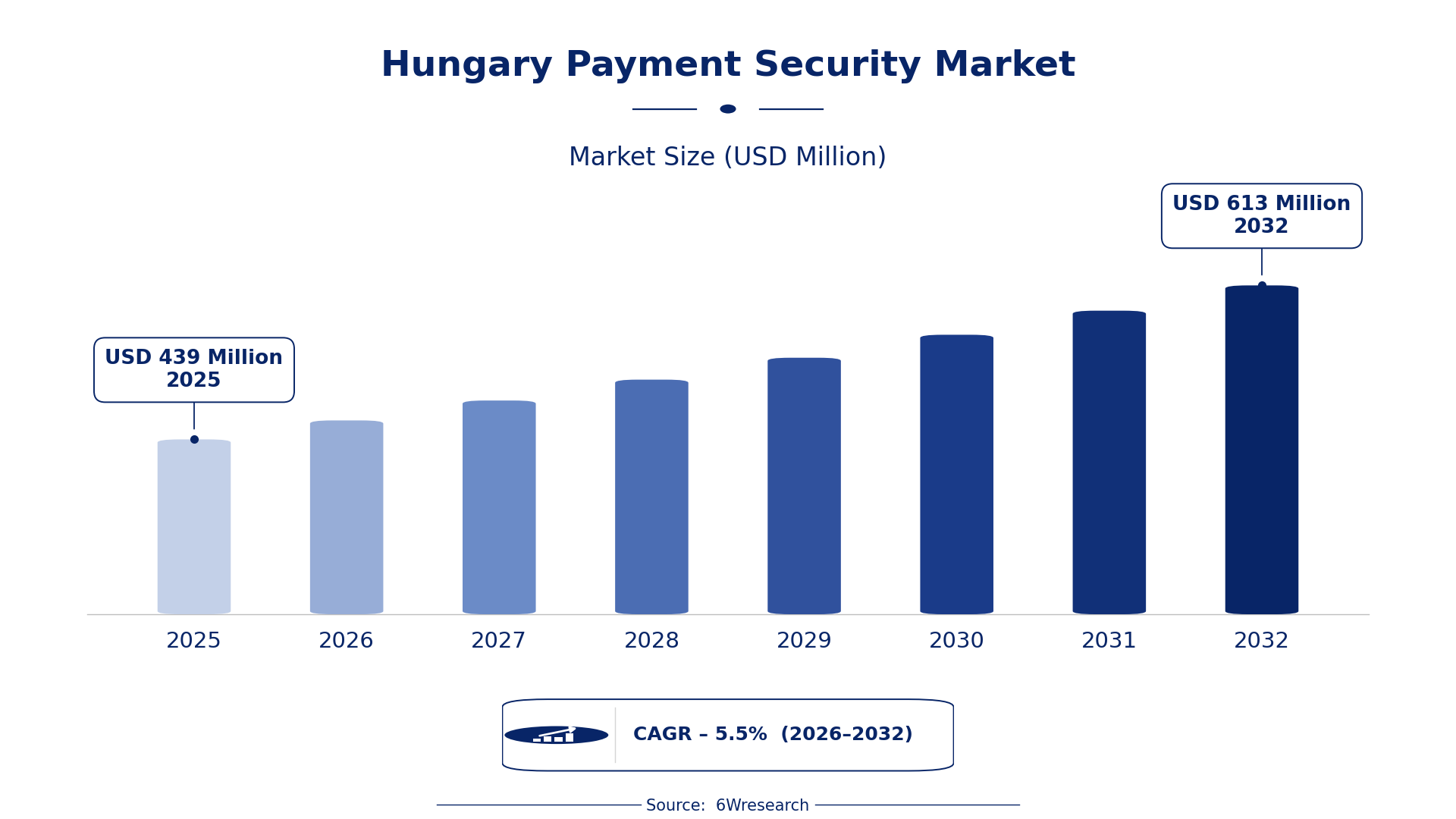
The Hungary Payment Security Market was estimated at USD 439 Million in 2025 and is projected to reach USD 613 Million by 2032, growing at a CAGR of 5.5% from 2026 to 2032.
Hungary Payment Security Market Synopsis
The primary force driving growth in the Hungary Payment Security Market is the rapid shift toward digital transactions. As consumers increasingly prefer online shopping and mobile payments, businesses are compelled to adopt advanced security measures to protect sensitive data.
With the sophistication of cyber threats on the rise, robust payment security solutions are not just a preference but a necessity. Technologies like encryption and biometric authentication are becoming essential tools for financial institutions and payment service providers to build and maintain consumer trust.
Hungary Payment Security Market Year-wise Growth Rate and Key Drivers
This graph illustrates the annual growth rates of the Hungary Payment Security Market from 2021 to 2032, highlighting a steady upward trajectory and projected expansion over the forecast period.
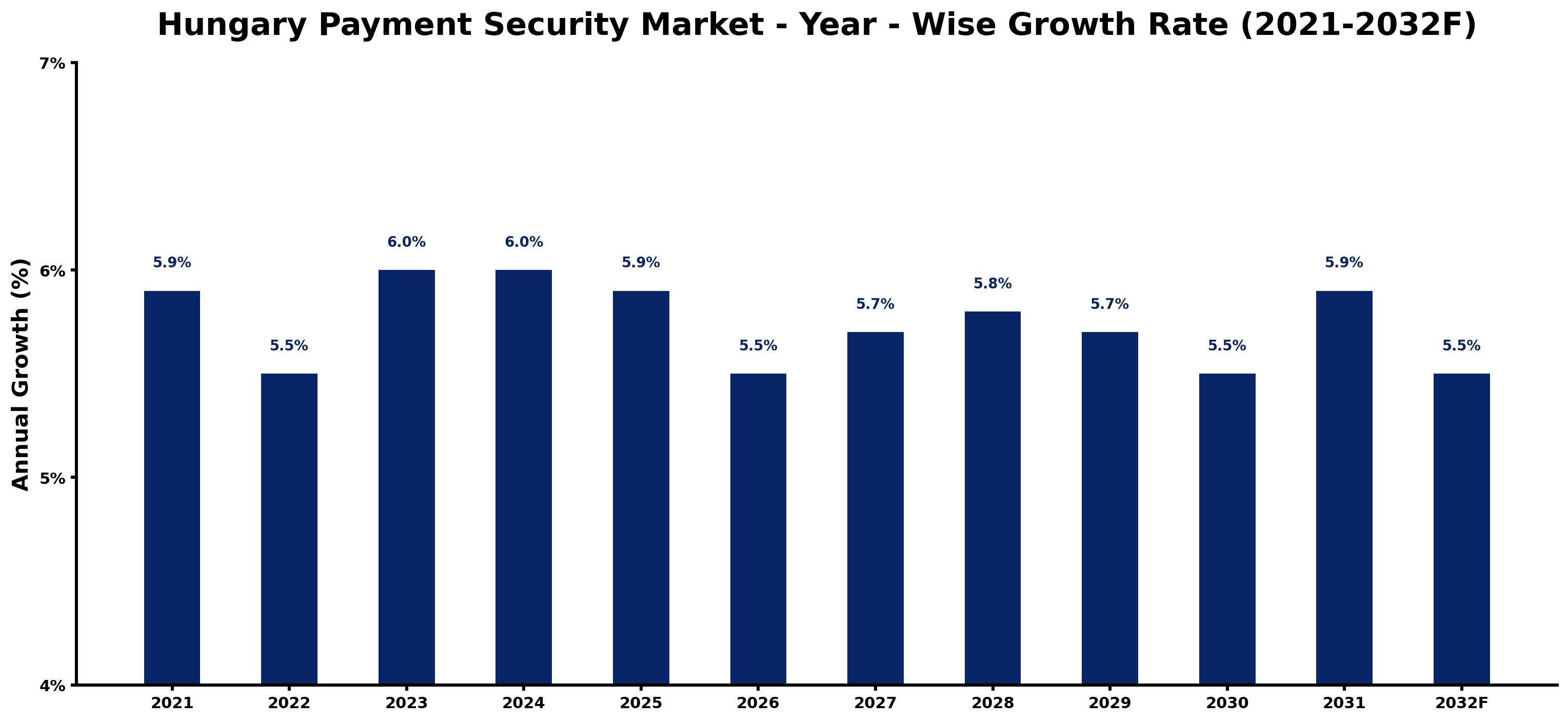
The table below presents the year‑wise growth rates along with the key drivers influencing the market
| Year | Growth Rate | Major Drivers |
| 2021 | 5.9% | EU PSD2 regulations boosting transaction security focus |
| 2022 | 5.5% | Increased online retail fraud incidents prompting security investments |
| 2023 | 6.0% | Growing fintech startups driving demand for secure payments |
| 2024 | 6.0% | Adoption of biometric authentication by local banks |
| 2025 | 5.9% | Cybersecurity awareness initiatives by Hungarian National Bank |
| 2026 | 5.5% | Rise in mobile payments necessitating advanced fraud prevention |
| 2027 | 5.7% | Government initiatives promoting digital economy security standards |
| 2028 | 5.8% | Increased cross-border e-commerce demanding secure payment solutions |
| 2029 | 5.7% | Enhancements in local cybersecurity frameworks encouraging investment |
| 2030 | 5.5% | Surge in remote work leading to more secure transactions |
| 2031 | 5.9% | Adoption of 2FA in retail due to regulatory pressure |
| 2032 | 5.5% | Focus on consumer data protection by local businesses |
Note: Market size estimations and growth projections presented in this report are based on 6Wresearch's proprietary forecasting methodology, utilizing the latest available industry data, government publications, and primary research inputs.
Hungary Payment Security Market Key Takeaways
Below are some of the specific key takeaways from the market, including:
- The growing trend of online and mobile payments is pushing demand for innovative payment security solutions.
- Regulatory compliance, particularly with EU directives, is a significant driver for enhanced security measures.
- Companies are increasingly focusing on advanced technologies like tokenization and biometric systems.
- The market is characterized by a complex interplay between user convenience and stringent security protocols.
- Investment in cybersecurity remains vital for businesses to safeguard customer information and maintain trust.
Evaluation of Restraints in Hungary Payment Security Market
Despite its growth, the Hungary Payment Security Market faces several constraints. One of the most pressing issues is the rapid evolution of cyber threats, which continually challenge existing security measures. Companies find themselves in a race to keep up with the sophistication of attacks, resulting in an ongoing need for investment in newer technologies.
on top of that, regulatory compliance adds another layer of complexity, especially in navigating the EU's General Data Protection Regulation (GDPR). The struggle to integrate new security technologies with existing systems without disrupting user experience also hampers growth. Balancing security and convenience remains an ongoing challenge for many organizations.
Hungary Payment Security Market Trends
Emerging trends are reshaping the Hungary Payment Security Market. Notably, the surge in contactless payments is driving demand for solutions that secure these transactions. The integration of artificial intelligence for fraud detection is gaining traction, as businesses seek ways to enhance real-time security.
Additionally, consumer awareness regarding data protection is rising, prompting companies to adopt more transparent security practices. This heightened awareness influences market players to innovate and offer solutions that not only protect but also educate consumers about security risks.
Hungary Payment Security Market Opportunities
The Hungary Payment Security Market holds substantial growth opportunities, particularly in developing tailored solutions for businesses and consumers. The advent of new digital payment platforms creates a demand for specialized security services that can adapt to various transaction types.
on top of that, the ongoing evolution of mobile payment technologies presents avenues for innovation. Companies that can offer seamless, secure payment experiences while ensuring compliance with regulatory standards are likely to capture significant market share.
Government Initiatives in the Hungary Payment Security Market
The Hungarian government is actively shaping the Payment Security Market through various regulatory frameworks and initiatives. By prioritizing consumer protection and data security, public policy is enhancing the overall trust in digital payment systems. The collaboration between regulatory bodies and industry stakeholders is crucial for setting security standards and ensuring compliance.
- A national initiative aimed at enhancing cybersecurity for payment systems, launched in early 2025, focuses on providing support to small and medium enterprises.
- Currently, the National Bank of Hungary is working on implementing stringent security measures as part of the Payment Services Act, ensuring that all payment service providers adhere to high-security standards.
- The government is planning an awareness campaign set to launch in 2026, aimed at educating consumers on safe digital payment practices and understanding their rights.
- Ongoing collaboration with the European Banking Authority is facilitating compliance with EU guidelines on secure payment processing.
- A public-private partnership expected to start in late 2026 will focus on developing next-generation security technologies for payment systems.
Future Insights of the Hungary Payment Security Market
Looking ahead to 2026-2032, the Hungary Payment Security Market is set for substantial growth driven by the continued rise of digital transactions. As e-commerce expands, businesses will increasingly prioritize the implementation of advanced security measures to safeguard consumer data against a backdrop of growing cyber threats.
The adoption of innovative technologies, particularly in biometrics and artificial intelligence, will be crucial in enhancing security protocols. With regulations evolving, companies that proactively adapt to compliance requirements will be well-positioned to thrive in this competitive environment.
Hungary Payment Security Market Latest Developments
Recent activity in the Hungary Payment Security Market has shown a notable shift towards innovation and compliance enhancements. In the past year, companies have accelerated their efforts to implement cutting-edge security technologies amid increasing regulatory scrutiny. This focus reflects the urgency to secure customer data and build trust in payment systems.
- A major technology vendor announced the rollout of a new biometric payment system, which is currently underway and expected to be completed by mid-2026.
- In Q1 2025, a regional bank implemented a tokenization solution aimed at protecting sensitive customer data during transactions, now fully operational.
- A strategic partnership between a cybersecurity firm and a local fintech company was formed in late 2025, focusing on developing advanced fraud detection algorithms.
- Ongoing investment in upgrading digital payment infrastructures is seen across various sectors, particularly in retail, with initiatives starting in early 2026.
- Plans for a comprehensive cybersecurity training program for businesses are being developed, slated to launch in late 2026 to bolster awareness of security practices.
Hungary Payment Security Market - Key Attractiveness of the Report
- 10 Years of Market Numbers
- Historical Data Starting from 2022 to 2025
- Base Year: 2025
- Forecast Data until 2032
- Key Performance Indicators Impacting the Market
- Major Upcoming Developments and Projects
Key Highlights of the Report:
- Hungary Payment Security Market Outlook
- Market Size of Hungary Payment Security Market, 2025
- Forecast of Hungary Payment Security Market, 2032
- Historical Data and Forecast of Hungary Payment Security Revenues & Volume for the Period 2022-2032F
- Hungary Payment Security Market Trend Evolution
- Hungary Payment Security Market Drivers and Challenges
- Hungary Payment Security Price Trends
- Hungary Payment Security Porter's Five Forces
- Hungary Payment Security Industry Life Cycle
- Historical Data and Forecast of Hungary Payment Security Market Revenues & Volume By Solution for the Period 2022-2032F
- Historical Data and Forecast of Hungary Payment Security Market Revenues & Volume By Encryption for the Period 2022-2032F
- Historical Data and Forecast of Hungary Payment Security Market Revenues & Volume By Tokenization for the Period 2022-2032F
- Historical Data and Forecast of Hungary Payment Security Market Revenues & Volume By Fraud Detection for the Period 2022-2032F
- Historical Data and Forecast of Hungary Payment Security Market Revenues & Volume By Prevention for the Period 2022-2032F
- Historical Data and Forecast of Hungary Payment Security Market Revenues & Volume By Service for the Period 2022-2032F
- Historical Data and Forecast of Hungary Payment Security Market Revenues & Volume By Integration for the Period 2022-2032F
- Historical Data and Forecast of Hungary Payment Security Market Revenues & Volume By Support for the Period 2022-2032F
- Historical Data and Forecast of Hungary Payment Security Market Revenues & Volume By Consulting for the Period 2022-2032F
- Historical Data and Forecast of Hungary Payment Security Market Revenues & Volume By Organization Size for the Period 2022-2032F
- Historical Data and Forecast of Hungary Payment Security Market Revenues & Volume By Large Enterprises for the Period 2022-2032F
- Historical Data and Forecast of Hungary Payment Security Market Revenues & Volume By SMEs for the Period 2022-2032F
- Historical Data and Forecast of Hungary Payment Security Market Revenues & Volume By Industry Vertical for the Period 2022-2032F
- Hungary Payment Security Import Export Trade Statistics
- Market Opportunity Assessment By Solution
- Market Opportunity Assessment By Service
- Market Opportunity Assessment By Organization Size
- Market Opportunity Assessment By Industry Vertical
- Hungary Payment Security Top Companies Market Share
- Hungary Payment Security Competitive Benchmarking By Technical and Operational Parameters
- Hungary Payment Security Company Profiles
- Hungary Payment Security Key Strategic Recommendations






































