Hungary Photonics Market: Import Trend Analysis
Hungary`s import trend in the photonics market exhibited a growth rate of 1.4% from 2023 to 2024, contrasting the -13.55% CAGR from 2020 to 2024. This decline could be attributed to shifts in demand dynamics or changes in trade policies affecting market stability.
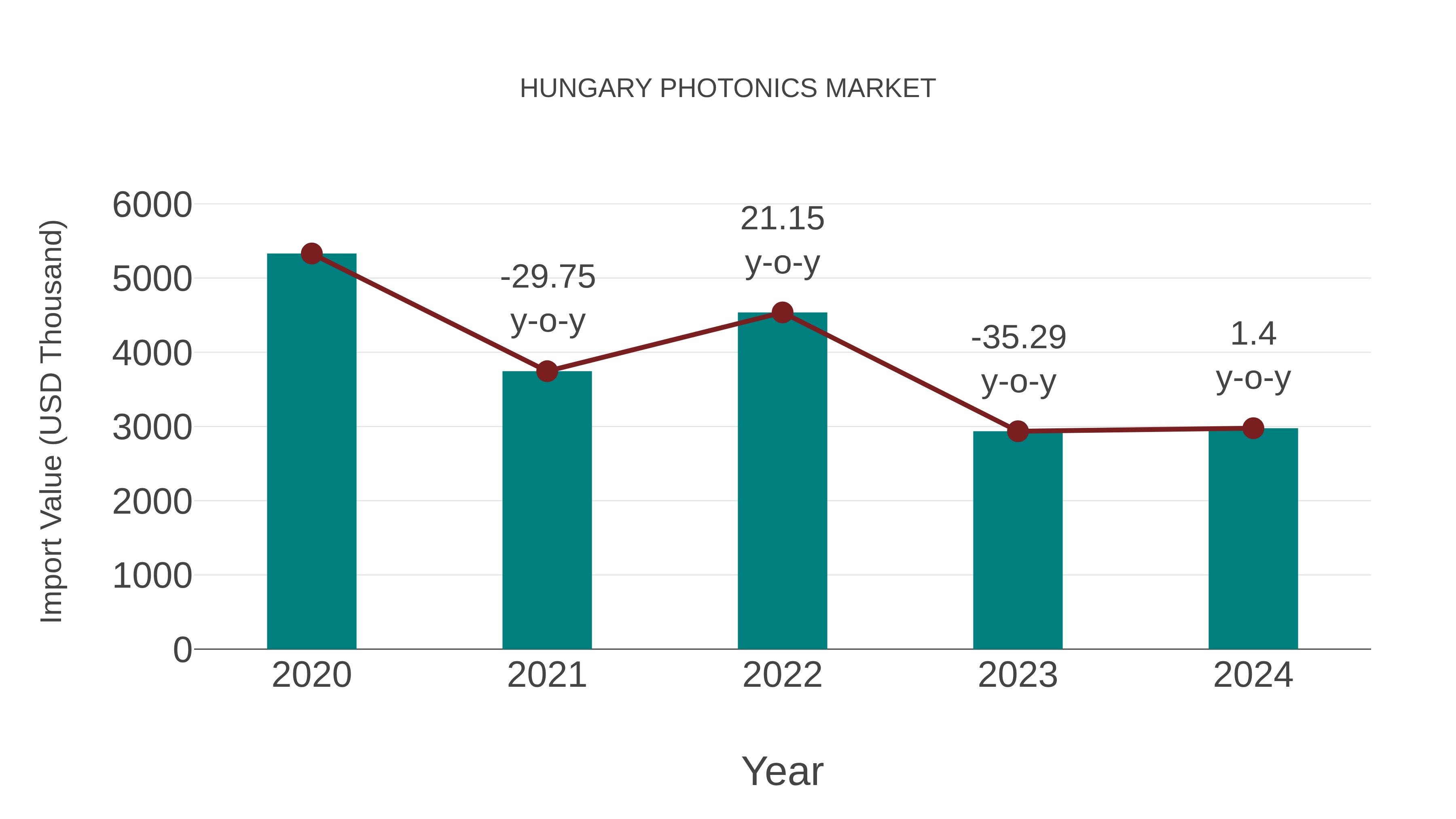
Hungary Photonics Market Overview
The Hungary Photonics Market is experiencing steady growth driven by increasing demand for photonics products across various industries such as healthcare, telecommunications, and manufacturing. The market is characterized by a strong focus on research and development, with key players investing in innovation to develop cutting-edge photonics technologies. Fiber optics, lasers, and imaging systems are among the key products contributing to the market`s growth. The country`s strategic location in Central Europe also positions it as a key player in the photonics industry, attracting foreign investments and collaborations. Government initiatives supporting the development of photonics technologies further fuel market expansion. Overall, the Hungary Photonics Market presents promising opportunities for both domestic and international companies looking to capitalize on the growing demand for advanced photonics solutions.
Hungary Photonics Market Trends and Opportunities
The Hungary Photonics Market is experiencing growth driven by increasing demand for advanced technologies in industries such as healthcare, telecommunications, and manufacturing. Key trends include the development of integrated photonics solutions for improved performance and cost-efficiency, as well as the adoption of photonics in emerging applications like LiDAR and quantum technologies. Opportunities in the market lie in the expansion of research and development efforts, collaboration with international partners to access new markets, and leveraging government initiatives supporting innovation in photonics. The market is also witnessing increased investments in training and education programs to develop a skilled workforce capable of driving further advancements in photonics technologies. Overall, the Hungary Photonics Market presents promising prospects for growth and innovation in the coming years.
Hungary Photonics Market Challenges
One of the key challenges faced in the Hungary Photonics Market is the limited awareness and understanding of photonics technology among potential users and customers. This lack of awareness often leads to difficulties in convincing businesses to adopt photonics solutions, hindering market growth and innovation. Additionally, there is a shortage of skilled professionals with expertise in photonics technology, making it challenging for companies to find qualified employees to drive research and development efforts in this field. Furthermore, access to funding for photonics projects can be limited, particularly for startups and small businesses, restricting their ability to invest in new technologies and expand their operations in the market. Addressing these challenges will be crucial for unlocking the full potential of the Hungary Photonics Market and fostering its growth in the future.
Hungary Photonics Market Drivers
The Hungary Photonics Market is being primarily driven by the increasing demand for advanced technology solutions in various industries such as healthcare, telecommunications, and manufacturing. The growing adoption of photonics technologies for applications like optical communication, imaging, and sensing is fueling market growth. Additionally, government initiatives and investments in research and development of photonics technologies are boosting the market further. The rising awareness about the benefits of photonics in improving efficiency, reducing energy consumption, and enabling innovations is also contributing to the market expansion. Moreover, the presence of key players in the region and collaborations between industry stakeholders and research institutions are driving the development and commercialization of photonics products and services in Hungary.
Hungary Photonics Market Government Policy
The Hungarian government has been actively supporting the development of the photonics market through various policies and initiatives. One key policy is the National Photonics Cluster program, which aims to foster collaboration between industry, research institutions, and government agencies to drive innovation and growth in the sector. The government also provides financial support through grants and funding opportunities for photonics companies to invest in research and development activities. Additionally, there are tax incentives and subsidies available to encourage companies to establish and expand their presence in the Hungarian photonics market. Overall, the government`s policies are focused on creating a conducive environment for the photonics industry to thrive and contribute to the country`s economic development.
Hungary Photonics Market Future Outlook
The future outlook for the Hungary Photonics Market appears promising, driven by increasing demand for advanced technologies in various sectors such as telecommunications, healthcare, and manufacturing. The market is expected to witness significant growth due to the rising adoption of photonics-based products and solutions for applications like optical communication, sensing, and imaging. Additionally, the government`s focus on promoting research and development activities in the photonics industry is likely to further fuel market expansion. With ongoing technological advancements and investments in the sector, Hungary is poised to emerge as a key player in the global photonics market, offering opportunities for companies to innovate and capitalize on the growing demand for cutting-edge photonics technologies.
Key Highlights of the Report:
- Hungary Photonics Market Outlook
- Market Size of Hungary Photonics Market, 2025
- Forecast of Hungary Photonics Market, 2032
- Historical Data and Forecast of Hungary Photonics Revenues & Volume for the Period 2022 - 2032F
- Hungary Photonics Market Trend Evolution
- Hungary Photonics Market Drivers and Challenges
- Hungary Photonics Price Trends
- Hungary Photonics Porter's Five Forces
- Hungary Photonics Industry Life Cycle
- Historical Data and Forecast of Hungary Photonics Market Revenues & Volume By Product for the Period 2022 - 2032F
- Historical Data and Forecast of Hungary Photonics Market Revenues & Volume By Transceivers for the Period 2022 - 2032F
- Historical Data and Forecast of Hungary Photonics Market Revenues & Volume By Variable Optical Attenuators for the Period 2022 - 2032F
- Historical Data and Forecast of Hungary Photonics Market Revenues & Volume By Switches for the Period 2022 - 2032F
- Historical Data and Forecast of Hungary Photonics Market Revenues & Volume By Cables for the Period 2022 - 2032F
- Historical Data and Forecast of Hungary Photonics Market Revenues & Volume By Sensors for the Period 2022 - 2032F
- Historical Data and Forecast of Hungary Photonics Market Revenues & Volume By Component for the Period 2022 - 2032F
- Historical Data and Forecast of Hungary Photonics Market Revenues & Volume By Lasers for the Period 2022 - 2032F
- Historical Data and Forecast of Hungary Photonics Market Revenues & Volume By Modulators for the Period 2022 - 2032F
- Historical Data and Forecast of Hungary Photonics Market Revenues & Volume By Photo Detectors for the Period 2022 - 2032F
- Historical Data and Forecast of Hungary Photonics Market Revenues & Volume By Waveguide for the Period 2022 - 2032F
- Historical Data and Forecast of Hungary Photonics Market Revenues & Volume By 400-1,500 NM for the Period 2022 - 2032F
- Historical Data and Forecast of Hungary Photonics Market Revenues & Volume By 1,310-1,550 NM for the Period 2022 - 2032F
- Historical Data and Forecast of Hungary Photonics Market Revenues & Volume By 900-7000 NM for the Period 2022 - 2032F
- Historical Data and Forecast of Hungary Photonics Market Revenues & Volume By Application for the Period 2022 - 2032F
- Historical Data and Forecast of Hungary Photonics Market Revenues & Volume By Data Centers and High-performance computing for the Period 2022 - 2032F
- Historical Data and Forecast of Hungary Photonics Market Revenues & Volume By Telecommunication for the Period 2022 - 2032F
- Historical Data and Forecast of Hungary Photonics Market Revenues & Volume By Military, Defense and Aerospace for the Period 2022 - 2032F
- Historical Data and Forecast of Hungary Photonics Market Revenues & Volume By Medical and Life Science for the Period 2022 - 2032F
- Historical Data and Forecast of Hungary Photonics Market Revenues & Volume By Other Applications for the Period 2022 - 2032F
- Hungary Photonics Import Export Trade Statistics
- Market Opportunity Assessment By Product
- Market Opportunity Assessment By Component
- Market Opportunity Assessment By Waveguide
- Market Opportunity Assessment By Application
- Hungary Photonics Top Companies Market Share
- Hungary Photonics Competitive Benchmarking By Technical and Operational Parameters
- Hungary Photonics Company Profiles
- Hungary Photonics Key Strategic Recommendations






































