Hungary Plastic Waste Management Market Size, Share & Growth Rate
The Hungary Plastic Waste Management Market was estimated at USD 485 Million in 2025 and is projected to reach USD 685 Million by 2032, growing at a CAGR of 5.1% from 2026 to 2032. This growth trajectory is primarily driven by a rising consciousness about environmental sustainability, coupled with robust government initiatives aimed at enhancing recycling rates. Furthermore, the ongoing shift towards circular economy practices is catalyzing investments in advanced waste management technologies, reinforcing the market's optimistic outlook.
Hungary Plastic Waste Management Market Year-wise Growth Rate and Key Drivers
This graph highlights how the Hungary Plastic Waste Management Market has steadily grown over the years, supported by major growth factors.
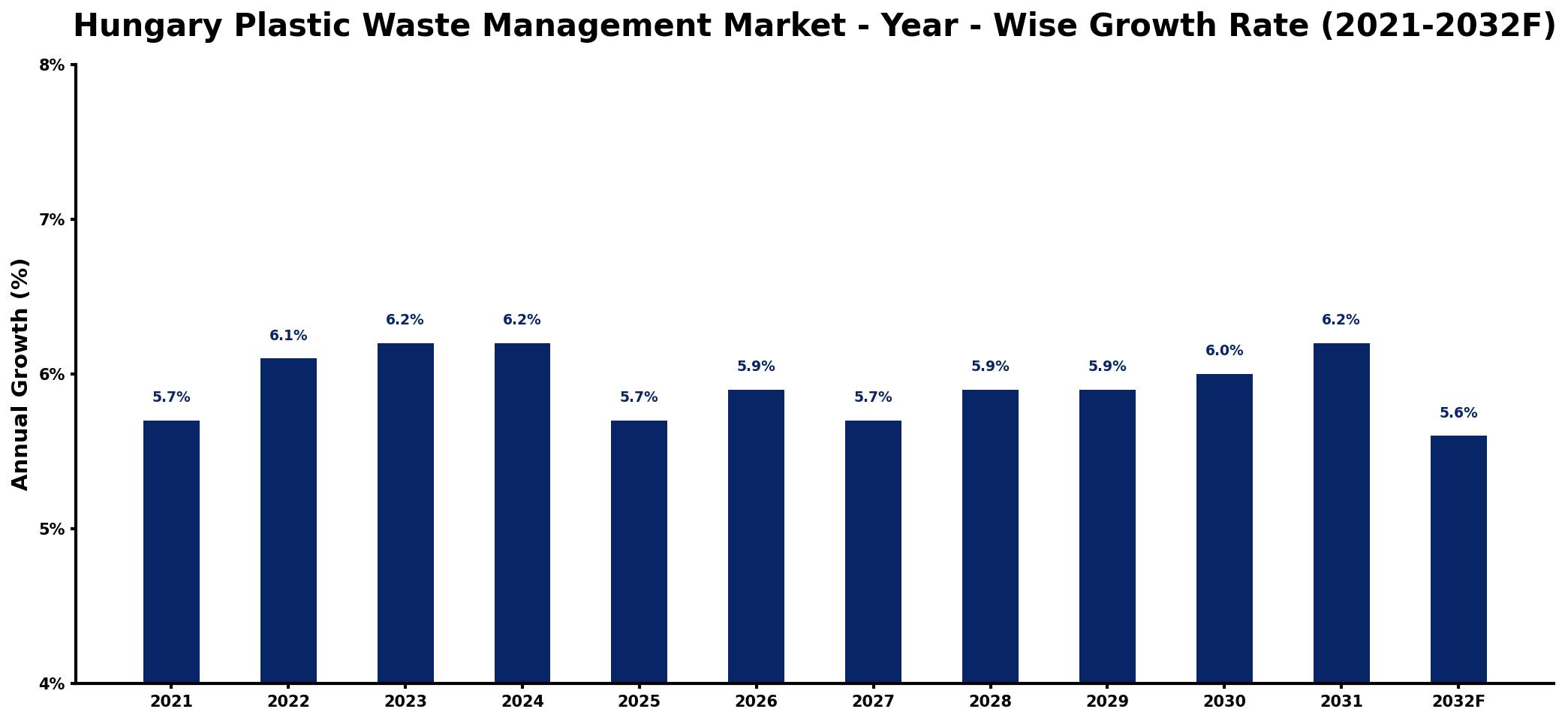
The table below presents the year‑wise growth rates along with the key drivers influencing the market
| Year | Growth Rate | Major Drivers |
| 2021 | 5.7% | Rising environmental sustainability initiatives |
| 2022 | 6.1% | Increased investment in recycling technology |
| 2023 | 6.2% | Growing consumer awareness campaigns |
| 2024 | 6.2% | Expansion of collection infrastructure |
| 2025 | 5.7% | Enhanced regulatory compliance requirements |
| 2026 | 5.9% | Strengthening circular economy practices |
| 2027 | 5.7% | Boost in corporate sustainability commitments |
| 2028 | 5.9% | Higher demand for eco-friendly solutions |
| 2029 | 5.9% | Development of innovative recycling processes |
| 2030 | 6.0% | Surge in governmental support programs |
| 2031 | 6.2% | Increased partnerships with NGOs |
| 2032 | 5.6% | Focus on educational outreach programs |
Note: Market size estimations and growth projections presented in this report are based on 6Wresearch's proprietary forecasting methodology, utilizing the latest available industry data, government publications, and primary research inputs.
Hungary Plastic Waste Management Market Synopsis
The Hungary Plastic Waste Management Market is currently experiencing a pivotal transformation, characterized by heightened public awareness and proactive government measures. As awareness regarding environmental impacts escalates, the demand for sustainable waste management solutions is becoming increasingly pronounced. This evolving landscape suggests a promising future for the market, particularly as stakeholders implement innovative strategies to improve plastic waste handling.
Looking forward, the market is poised for significant expansion, fueled by initiatives such as extended producer responsibility (EPR) schemes and legislative measures aimed at curbing single-use plastics. These developments are attracting investments in recycling infrastructure and technologies, thereby laying the groundwork for a sustainable plastic waste management ecosystem in Hungary.
Hungary Plastic Waste Management Market Key Takeaways
- The market is set for substantial growth, with projected revenues increasing significantly through 2032.
- Government initiatives are playing a critical role in promoting recycling and reducing plastic consumption.
- Technological advancements are enhancing sorting and recycling capabilities within the industry.
- There is a growing emphasis on collaboration among stakeholders to address plastic waste effectively.
- Investment opportunities are emerging in innovative solutions aimed at reducing plastic waste generation.
Evaluation of Restraints in Hungary Plastic Waste Management Market
While the Hungary Plastic Waste Management Market holds significant potential, several restraints impede its growth. A notable limitation is the insufficient infrastructure for effective waste collection and recycling, which hinders the management of plastic waste volumes that continue to rise. Additionally, public awareness remains low, impacting participation in recycling programs and overall effectiveness. Moreover, the presence of unauthorized waste disposal sites reflects a systemic challenge that complicates enforcement of regulations and incentives. Addressing these issues will be crucial to unlocking the markets full potential.
Hungary Plastic Waste Management Market Trends
Key trends shaping the Hungary Plastic Waste Management Market include a strong push towards sustainability and a circular economy. A significant trend is the implementation of stringent regulations that promote recycling and the use of eco-friendly materials. Additionally, there is a marked rise in investments focused on advanced recycling technologies, which facilitate more efficient sorting and processing. The collaboration among industry stakeholders is also becoming increasingly vital, fostering innovation and improving the overall efficacy of waste management strategies.
Hungary Plastic Waste Management Market Opportunities
The Hungary Plastic Waste Management Market presents numerous investment opportunities as the emphasis on sustainability grows. Companies that develop advanced recycling technologies and infrastructure stand to benefit significantly, as they can address the burgeoning plastic waste challenge. Furthermore, investment in businesses that excel in efficient collection, sorting, and recycling processes can yield substantial returns. There is also potential in exploring innovative materials, such as biodegradable plastics, which may significantly reduce overall plastic waste generation. Collaboration with local municipalities to enhance waste management systems is another promising avenue for growth.
Government Initiatives in the Hungary Plastic Waste Management Market
Hungary's government has taken a proactive stance on plastic waste management, implementing policies aimed at reducing consumption and increasing recycling rates. Initiatives include dedicated waste management plans that promote separate collection for plastic waste and encourage the use of biodegradable alternatives. Regulations such as fees on single-use plastics are designed to alter consumer behavior while achieving recycling targets. Public awareness campaigns and partnerships with industry stakeholders are also essential components of Hungary's strategy to drive sustainable practices in plastic waste management.
Future Insights of the Hungary Plastic Waste Management Market
The future of the Hungary Plastic Waste Management Market appears bright, as the nation's commitment to sustainability deepens. With increased regulatory measures and rising public consciousness about the impacts of plastic waste, the market is expected to witness robust growth. The ongoing development of innovative recycling technologies is likely to revolutionize waste management practices, enhancing efficiency and sustainability. As demand for recycled materials grows across various industries, the market will continue to evolve, presenting numerous opportunities for stakeholders invested in creating a more sustainable environment.
Hungary Plastic Waste Management Market Latest Developments (2025 - 2026)
In recent months, the Hungary Plastic Waste Management Market has witnessed a surge in initiatives focused on enhancing recycling infrastructure and public engagement. Various programs aimed at educating citizens about proper waste disposal and recycling practices are being rolled out, reflecting a significant shift in societal attitudes toward plastic waste. Additionally, innovations in sorting and recycling technologies are being explored, showcasing the industry's commitment to improving waste management processes. Collaborative efforts between the government and private sectors are paving the way for sustainable advancements in the market.
Hungary Plastic Waste Management Market - Key Attractiveness of the Report
- 10 Years of Market Numbers
- Historical Data Starting from 2022 to 2025
- Base Year: 2025
- Forecast Data until 2032
- Key Performance Indicators Impacting the Market
- Major Upcoming Developments and Projects
Key Highlights of the Report:
- Hungary Plastic Waste Management Market Outlook
- Market Size of Hungary Plastic Waste Management Market, 2025
- Forecast of Hungary Plastic Waste Management Market, 2032
- Historical Data and Forecast of Hungary Plastic Waste Management Revenues & Volume for the Period 2022-2032F
- Hungary Plastic Waste Management Market Trend Evolution
- Hungary Plastic Waste Management Market Drivers and Challenges
- Hungary Plastic Waste Management Price Trends
- Hungary Plastic Waste Management Porter's Five Forces
- Hungary Plastic Waste Management Industry Life Cycle
- Historical Data and Forecast of Hungary Plastic Waste Management Market Revenues & Volume By Source for the Period 2022-2032F
- Historical Data and Forecast of Hungary Plastic Waste Management Market Revenues & Volume By Industrial Waste for the Period 2022-2032F
- Historical Data and Forecast of Hungary Plastic Waste Management Market Revenues & Volume By Municipal Waste for the Period 2022-2032F
- Historical Data and Forecast of Hungary Plastic Waste Management Market Revenues & Volume By Material for the Period 2022-2032F
- Historical Data and Forecast of Hungary Plastic Waste Management Market Revenues & Volume By Polyethylene for the Period 2022-2032F
- Historical Data and Forecast of Hungary Plastic Waste Management Market Revenues & Volume By Polypropylene for the Period 2022-2032F
- Historical Data and Forecast of Hungary Plastic Waste Management Market Revenues & Volume By Polyethylene Terephthalate for the Period 2022-2032F
- Historical Data and Forecast of Hungary Plastic Waste Management Market Revenues & Volume By Polystyrene for the Period 2022-2032F
- Historical Data and Forecast of Hungary Plastic Waste Management Market Revenues & Volume By Others for the Period 2022-2032F
- Historical Data and Forecast of Hungary Plastic Waste Management Market Revenues & Volume By Product Type for the Period 2022-2032F
- Historical Data and Forecast of Hungary Plastic Waste Management Market Revenues & Volume By Packaging for the Period 2022-2032F
- Historical Data and Forecast of Hungary Plastic Waste Management Market Revenues & Volume By Construction for the Period 2022-2032F
- Historical Data and Forecast of Hungary Plastic Waste Management Market Revenues & Volume By Automotive for the Period 2022-2032F
- Historical Data and Forecast of Hungary Plastic Waste Management Market Revenues & Volume By Electrical & Electronics for the Period 2022-2032F
- Historical Data and Forecast of Hungary Plastic Waste Management Market Revenues & Volume By Others for the Period 2022-2032F
- Historical Data and Forecast of Hungary Plastic Waste Management Market Revenues & Volume By Treatment Method for the Period 2022-2032F
- Historical Data and Forecast of Hungary Plastic Waste Management Market Revenues & Volume By Collection for the Period 2022-2032F
- Historical Data and Forecast of Hungary Plastic Waste Management Market Revenues & Volume By Recycling for the Period 2022-2032F
- Historical Data and Forecast of Hungary Plastic Waste Management Market Revenues & Volume By Disposal for the Period 2022-2032F
- Hungary Plastic Waste Management Import Export Trade Statistics
- Market Opportunity Assessment By Source
- Market Opportunity Assessment By Material
- Market Opportunity Assessment By Product Type
- Market Opportunity Assessment By Treatment Method
- Hungary Plastic Waste Management Top Companies Market Share
- Hungary Plastic Waste Management Competitive Benchmarking By Technical and Operational Parameters
- Hungary Plastic Waste Management Company Profiles
- Hungary Plastic Waste Management Key Strategic Recommendations






































