Hungary Road Safety Market Size (2020-2030)
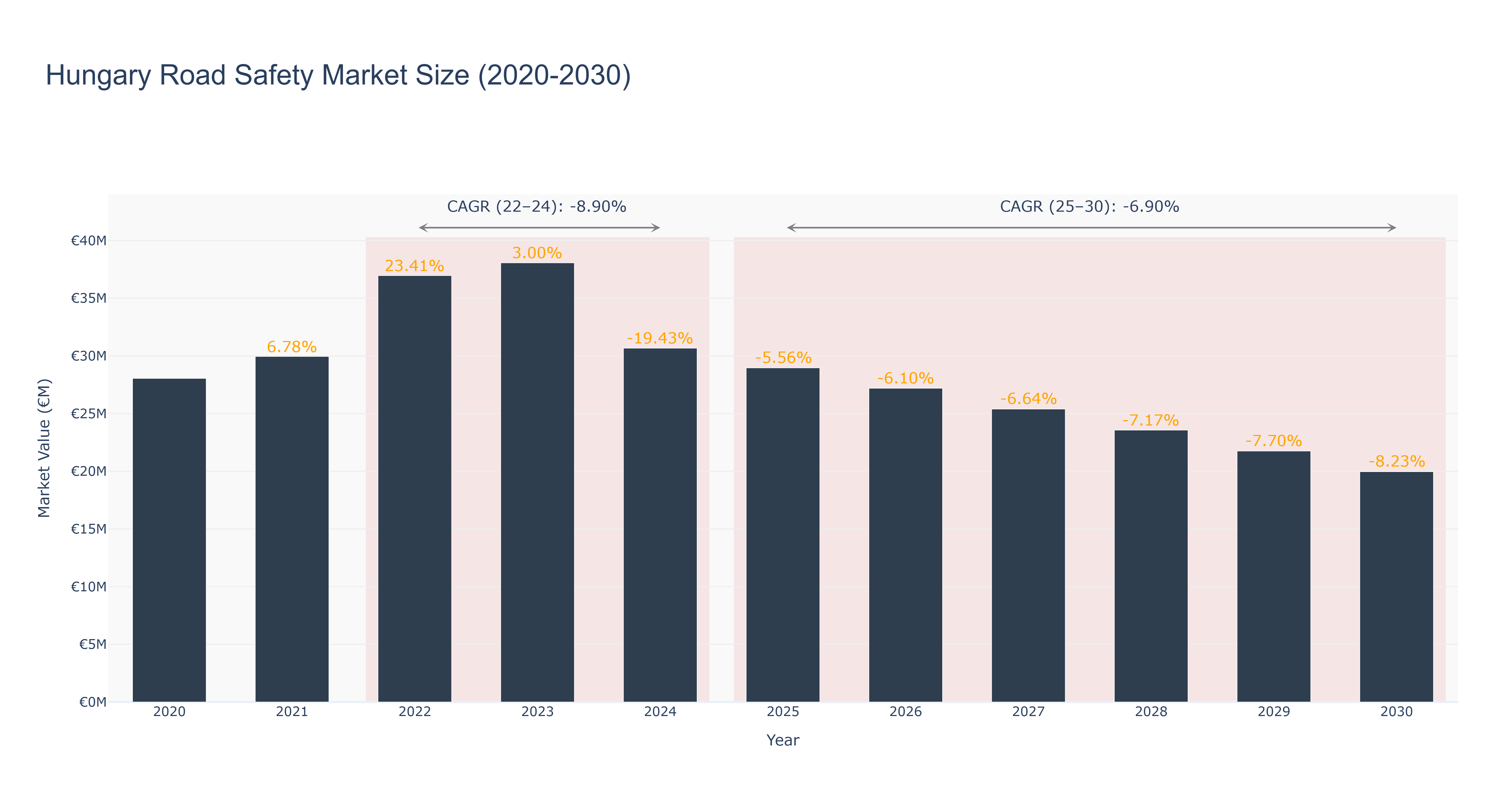
The Hungary Road Safety Market experienced significant growth during the 2022-2024 period, peaking at €36.96 million in 2022, with a remarkable growth rate of 23.41%. However, this positive trend sharply reversed in 2024, resulting in a market size decline to €30.67 million, translating to a CAGR of -8.90% for the actual years from 2022 to 2024. The forecasted period from 2025 to 2030 anticipates continued contraction, with market sizes projected to decrease from €28.97 million in 2025 to €19.97 million by 2030, reflecting a CAGR of -6.90%. This decline can be attributed to reduced government spending on infrastructure and potential economic challenges affecting investments in safety technologies. The outlook remains uncertain, with macroeconomic factors and shifts in consumer behavior likely to influence future developments. Without significant policy changes or major investment projects, the market may struggle to regain its previous growth trajectory.
Hungary Road Safety Market: Production & Trade Performance (2019-2025)
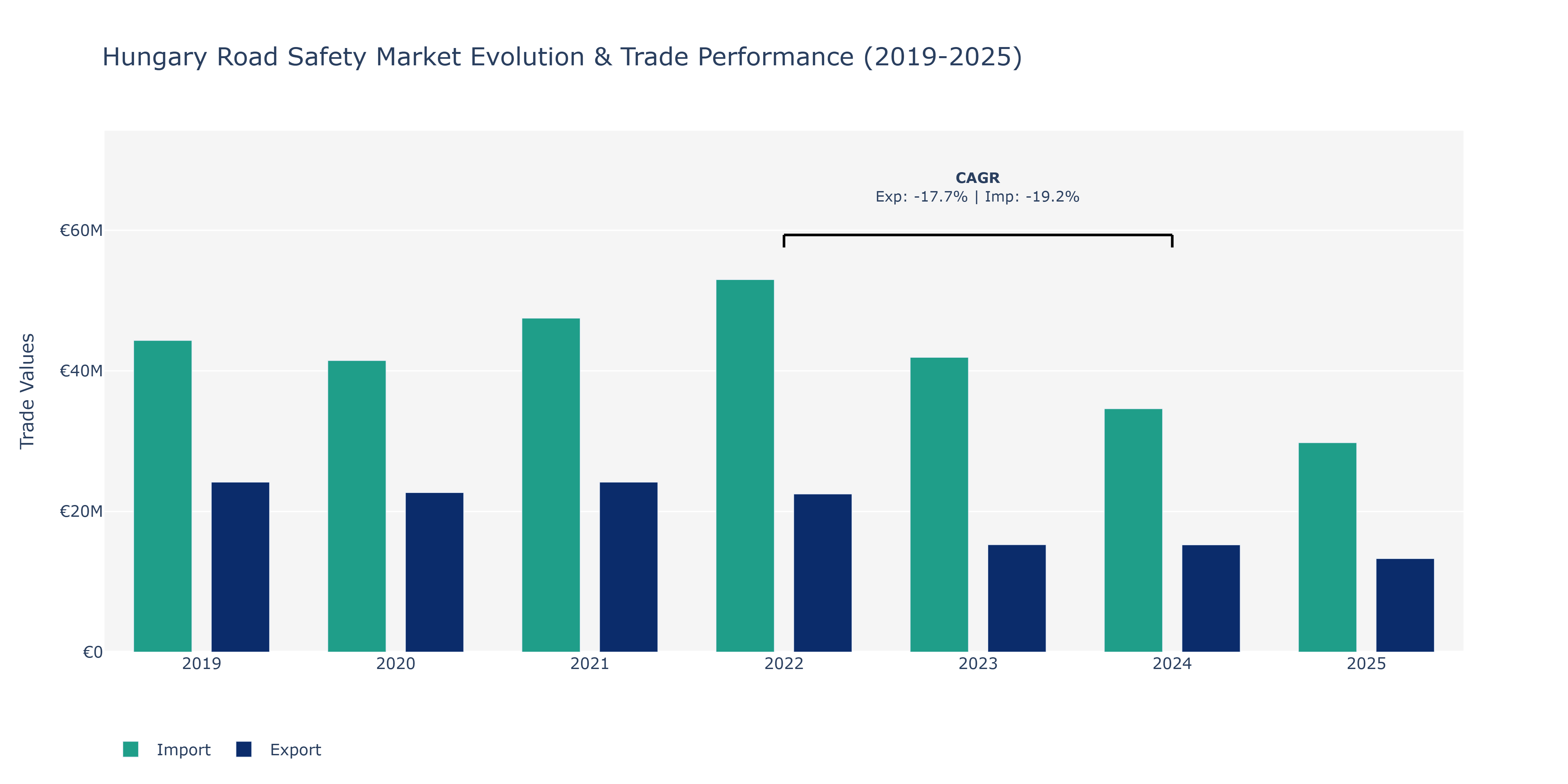
In the Hungary Road Safety Market, exports and imports experienced notable fluctuations from 2019 to 2025. Exports started at €24.17 million in 2019, decreased to €13.3 million in 2025, showing a declining trend over the period. Imports, on the other hand, began at €44.33 million in 2019, rose to €52.98 million in 2022, and then decreased to €29.78 million in 2025. The peak points for exports and imports were in 2019 and 2022, respectively. These fluctuations can be attributed to various factors such as changes in global demand for road safety products, economic conditions affecting trade volumes, and possibly shifts in domestic production capabilities impacting the need for imports. Additionally, considering the negative compound annual growth rates (CAGR) of exports at -17.67% and imports at -19.17% during 2022-2024, it suggests a challenging period for the market, possibly influenced by external factors like trade disputes or shifts in regulatory environments impacting market dynamics. Further research into local and international trade policies could provide additional insights into these fluctuations.
Hungary Road Safety Market Overview
The Hungary Road Safety Market encompasses a range of products and services aimed at improving road safety and reducing accidents on Hungarian roads. This market includes products such as road signs, barriers, traffic lights, speed enforcement equipment, and vehicle safety technologies. Services in this market may include road safety audits, consulting, training programs, and data analysis to identify high-risk areas. The Hungarian government plays a significant role in regulating and promoting road safety initiatives, with a focus on reducing fatalities and injuries. Key players in the Hungary Road Safety Market include both domestic and international companies offering innovative solutions to enhance road safety infrastructure and practices, contributing to a safer and more efficient transportation system in Hungary.
Hungary Road Safety Market Trends
The Hungary Road Safety Market is experiencing a growing emphasis on technology-driven solutions to improve road safety. Key trends include the adoption of advanced driver assistance systems (ADAS) such as lane departure warning systems, automatic emergency braking, and adaptive cruise control to reduce accidents. Additionally, there is a focus on enhancing infrastructure safety through the implementation of intelligent transportation systems (ITS) and road markings. The market is also witnessing an increasing awareness of the importance of road safety among both government authorities and the general public, leading to initiatives aimed at promoting safe driving behaviors and reducing fatalities. Overall, the Hungary Road Safety Market is moving towards a more proactive and technology-oriented approach to address road safety challenges effectively.
Hungary Road Safety Market Challenges
In the Hungary Road Safety Market, challenges include inadequate infrastructure maintenance leading to poor road conditions, lack of enforcement of traffic regulations contributing to high accident rates, and insufficient public awareness campaigns on road safety. Additionally, the presence of outdated vehicles on the roads poses a significant risk, as well as the issue of impaired driving due to factors such as alcohol consumption. These challenges require concerted efforts from government authorities, law enforcement agencies, and relevant stakeholders to address through investments in infrastructure improvements, stricter enforcement measures, educational initiatives, and the promotion of safer driving practices. By tackling these challenges effectively, the Hungary Road Safety Market can work towards reducing the number of road accidents and fatalities, ultimately enhancing overall road safety in the country.
Hungary Road Safety Market Investment Opportunities
In the Hungary Road Safety Market, there are several investment opportunities emerging due to the increasing focus on improving road safety standards and reducing accidents. Investments in technologies such as advanced driver assistance systems (ADAS), intelligent transportation systems (ITS), and vehicle-to-everything (V2X) communication systems offer significant growth potential. Additionally, there is a growing demand for road safety solutions such as traffic management systems, speed enforcement cameras, and road marking materials. Infrastructure development projects, including the construction and maintenance of roads and highways, also present lucrative investment opportunities. With the Hungarian government emphasizing road safety initiatives and regulations, investing in companies involved in providing innovative solutions and services to enhance road safety can be a promising venture in the Hungary market.
Hungary Road Safety Market Government Policy
In Hungary, government policies related to road safety focus on reducing traffic accidents and fatalities through various measures. The government has implemented strict traffic laws, including speed limits, seatbelt requirements, and alcohol limits for drivers. Additionally, there are ongoing campaigns to raise awareness about the importance of road safety and the consequences of reckless driving. The government also invests in infrastructure improvements such as road maintenance and traffic management systems to enhance safety on the roads. Enforcement of these policies is carried out by law enforcement agencies, and there are penalties in place for violators. Overall, the Hungarian government is committed to improving road safety through a combination of legislation, education, and infrastructure development.
Hungary Road Safety Market Future Outlook
The future outlook for the Hungary Road Safety Market is promising, with a growing emphasis on improving traffic safety and reducing accident rates. The government`s initiatives to invest in road infrastructure, implement stricter traffic regulations, and promote public awareness campaigns are expected to drive market growth. Additionally, advancements in technology, such as the adoption of intelligent transportation systems and the development of autonomous vehicles, are likely to further enhance road safety measures in Hungary. As the demand for safer roads continues to rise, there will be increasing opportunities for companies offering road safety solutions, including traffic management systems, speed enforcement devices, and vehicle safety technologies, to expand their presence in the Hungarian market.
Key Highlights of the Report:
- Hungary Road Safety Market Outlook
- Market Size of Hungary Road Safety Market, 2025
- Forecast of Hungary Road Safety Market, 2032
- Historical Data and Forecast of Hungary Road Safety Revenues & Volume for the Period 2022 - 2032F
- Hungary Road Safety Market Trend Evolution
- Hungary Road Safety Market Drivers and Challenges
- Hungary Road Safety Price Trends
- Hungary Road Safety Porter's Five Forces
- Hungary Road Safety Industry Life Cycle
- Historical Data and Forecast of Hungary Road Safety Market Revenues & Volume By Solutions for the Period 2022 - 2032F
- Historical Data and Forecast of Hungary Road Safety Market Revenues & Volume By Red Light for the Period 2022 - 2032F
- Historical Data and Forecast of Hungary Road Safety Market Revenues & Volume By Speed for the Period 2022 - 2032F
- Historical Data and Forecast of Hungary Road Safety Market Revenues & Volume By Bus Lane for the Period 2022 - 2032F
- Historical Data and Forecast of Hungary Road Safety Market Revenues & Volume By Section Enforcement for the Period 2022 - 2032F
- Historical Data and Forecast of Hungary Road Safety Market Revenues & Volume By ALPR/ANPR for the Period 2022 - 2032F
- Historical Data and Forecast of Hungary Road Safety Market Revenues & Volume By Service for the Period 2022 - 2032F
- Historical Data and Forecast of Hungary Road Safety Market Revenues & Volume By Consulting and Training for the Period 2022 - 2032F
- Historical Data and Forecast of Hungary Road Safety Market Revenues & Volume By System Integration and Deployment for the Period 2022 - 2032F
- Historical Data and Forecast of Hungary Road Safety Market Revenues & Volume By Support and Maintenance for the Period 2022 - 2032F
- Hungary Road Safety Import Export Trade Statistics
- Market Opportunity Assessment By Solutions
- Market Opportunity Assessment By Service
- Hungary Road Safety Top Companies Market Share
- Hungary Road Safety Competitive Benchmarking By Technical and Operational Parameters
- Hungary Road Safety Company Profiles
- Hungary Road Safety Key Strategic Recommendations






































