Hungary Stationery Products Market Size (2020-2030)
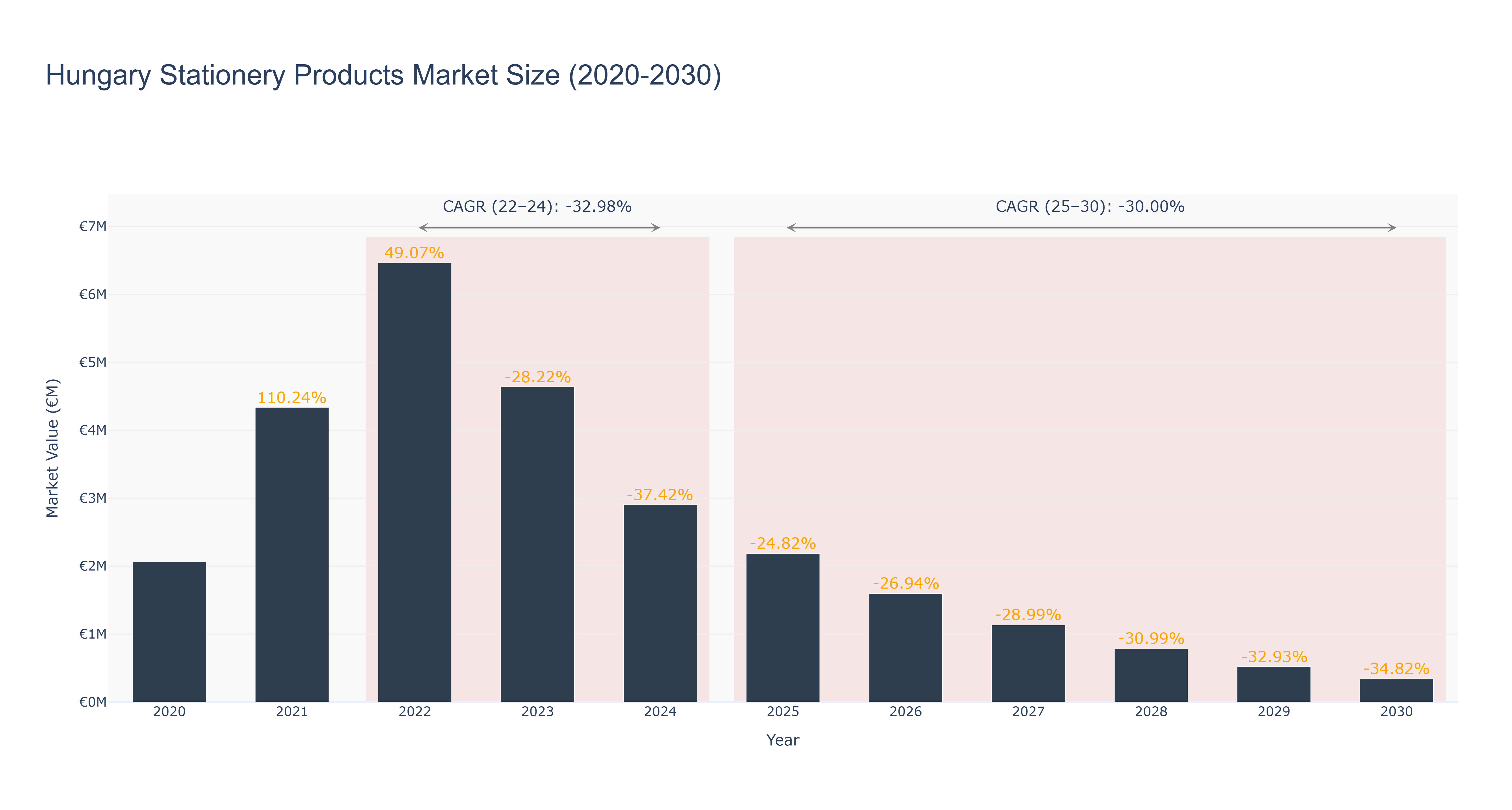
Hungary Stationery Products Market has experienced a notable decline in market size since 2020 when it peaked at €6.46 million. The market size decreased to €2.18 million by 2025, with a negative compound annual growth rate (CAGR) of -24.82%. The downward trend continued to 2026, with the market size now at €1.59 million. The CAGR for the period 2025-2030 is projected to be -30.0%. This decline can be attributed to changing consumer preferences towards digital alternatives and economic uncertainties impacting consumer spending. Despite the current challenges, the market is expected to witness potential growth with the introduction of eco-friendly stationery products and increased focus on online marketing strategies. In the near future, Hungary is planning to launch a national campaign promoting locally made stationery products to boost domestic consumption and support local businesses.
Hungary Stationery Products Market: Production & Trade Performance (2019-2025)
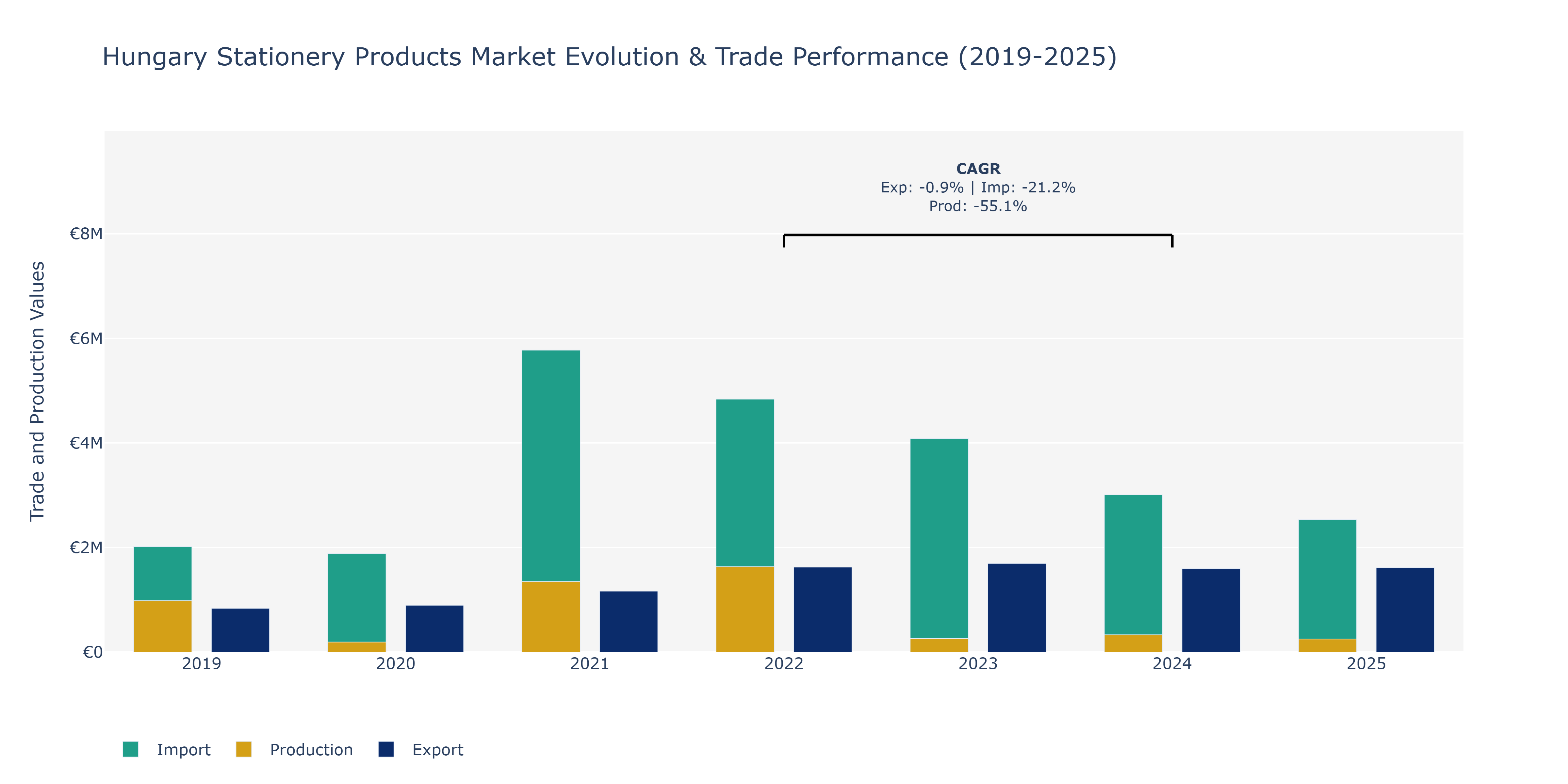
In the Hungary Stationery Products Market, from 2019 to 2025, exports, imports, and production have shown varying trends. Exports increased steadily from €836.65 thousand in 2019 to a peak of €1.69 million in 2023 before slightly declining to €1.62 million in 2024 and then stabilizing around €1.61 million in 2025. Imports experienced fluctuations, decreasing from €2.02 million in 2019 to €3.01 million in 2024, followed by a slight increase to €2.54 million in 2025. Production notably fluctuated, reaching its peak of €1.35 million in 2021 before dropping to €190.57 thousand in 2020 and gradually recovering to €247.69 thousand in 2025. These fluctuations in production could be attributed to supply chain disruptions, changing consumer preferences towards eco-friendly products, and digitalization impacting traditional stationery consumption. To sustain growth, market players could focus on product innovation, online sales channels, and sustainable practices in line with global trends in the stationery industry.
Hungary Stationery Products Market Synopsis
The Hungary Stationery Products Market is characterized by a diverse range of products including writing instruments, paper products, office supplies, art supplies, and school supplies. The market is driven by factors such as increasing demand for trendy and innovative stationery products, growth in the education sector, rising disposable income levels, and a growing trend towards personalized and customized stationery items. Key players in the market include both domestic manufacturers and international brands, offering a wide variety of products to cater to different consumer preferences. E-commerce channels have also played a significant role in expanding the reach of stationery products to a larger customer base. Overall, the market is expected to continue its growth trajectory driven by evolving consumer preferences and increased focus on creativity and personalization in stationery products.
Hungary Stationery Products Market Trends
The Hungary Stationery Products Market is witnessing several key trends. Firstly, there is a growing demand for eco-friendly and sustainable stationery products, driven by an increasing awareness of environmental issues among consumers. This has led to a surge in the availability of products such as recycled paper, biodegradable pens, and eco-friendly notebooks. Secondly, customization and personalization are becoming more popular, with consumers seeking unique and individualized stationery items. This trend has led to the rise of personalized stationery services and products. Additionally, digitalization has impacted the market, with a shift towards digital stationery products and tools. Overall, the Hungary Stationery Products Market is evolving to cater to the changing preferences and demands of consumers for more sustainable, personalized, and technologically advanced products.
Hungary Stationery Products Market Challenges
In the Hungary Stationery Products Market, some challenges include intense competition from both domestic and international players, leading to price wars and margin pressures. Additionally, the market is influenced by changing consumer preferences and advancements in technology, resulting in a shift towards digital alternatives and decreased demand for traditional stationery items. Economic uncertainties and fluctuations in currency exchange rates also impact the market, affecting import costs and pricing strategies. Moreover, regulatory changes and compliance requirements pose challenges for businesses operating in the stationery industry, adding complexity to operations and distribution channels. Overall, companies in the Hungary Stationery Products Market need to adapt to these challenges by focusing on innovation, market differentiation, and strategic partnerships to sustain growth and profitability.
Hungary Stationery Products Market Investment Opportunities
In the Hungary Stationery Products Market, there are several investment opportunities worth considering. The market for eco-friendly and sustainable stationery products is growing, driven by increasing environmental awareness among consumers. Investing in the development and production of recycled paper, biodegradable pens, and other sustainable stationery items could be a profitable venture. Additionally, there is a growing demand for personalized and customizable stationery products, presenting an opportunity for investment in technology and processes that enable mass customization. Furthermore, with the rise of e-commerce, investing in online retail platforms specializing in stationery products could also be a lucrative option. Overall, the Hungary Stationery Products Market offers diverse investment opportunities catering to both consumer preferences and market trends.
Hungary Stationery Products Market Future Outlook
The Hungary stationery products market is poised for steady growth in the coming years, driven by factors such as increasing emphasis on education, rise in the number of students, and growing demand for innovative and sustainable stationery products. The market is expected to witness a shift towards eco-friendly and customizable stationery items, as consumers become more conscious of environmental issues and seek personalized products. Additionally, the rise of e-commerce platforms and online shopping convenience will further boost market accessibility and sales. Overall, the Hungary stationery products market is likely to experience a positive trajectory with opportunities for product innovation and expansion into new consumer segments, making it an attractive space for both domestic and international manufacturers and retailers.
Key Highlights of the Report:
- Hungary Stationery Products Market Outlook
- Market Size of Hungary Stationery Products Market, 2021
- Forecast of Hungary Stationery Products Market, 2031
- Historical Data and Forecast of Hungary Stationery Products Revenues & Volume for the Period 2018 - 2031
- Hungary Stationery Products Market Trend Evolution
- Hungary Stationery Products Market Drivers and Challenges
- Hungary Stationery Products Price Trends
- Hungary Stationery Products Porter's Five Forces
- Hungary Stationery Products Industry Life Cycle
- Historical Data and Forecast of Hungary Stationery Products Market Revenues & Volume By Product for the Period 2018 - 2031
- Historical Data and Forecast of Hungary Stationery Products Market Revenues & Volume By Paper Based for the Period 2018 - 2031
- Historical Data and Forecast of Hungary Stationery Products Market Revenues & Volume By Ink Based for the Period 2018 - 2031
- Historical Data and Forecast of Hungary Stationery Products Market Revenues & Volume By Art Based for the Period 2018 - 2031
- Historical Data and Forecast of Hungary Stationery Products Market Revenues & Volume By Others for the Period 2018 - 2031
- Historical Data and Forecast of Hungary Paper Based Stationery Products Market Revenues & Volume By Materials for the Period 2018 - 2031
- Historical Data and Forecast of Hungary Stationery Products Market Revenues & Volume By Application for the Period 2018 - 2031
- Historical Data and Forecast of Hungary Stationery Products Market Revenues & Volume By Educational Institutes for the Period 2018 - 2031
- Historical Data and Forecast of Hungary Stationery Products Market Revenues & Volume By Corporates for the Period 2018 - 2031
- Historical Data and Forecast of Hungary Stationery Products Market Revenues & Volume By Others for the Period 2018 - 2031
- Historical Data and Forecast of Hungary Stationery Products Market Revenues & Volume By Type for the Period 2018 - 2031
- Historical Data and Forecast of Hungary Stationery Products Market Revenues & Volume By Application for the Period 2018 - 2031
- Hungary Stationery Products Import Export Trade Statistics
- Market Opportunity Assessment By Product
- Market Opportunity Assessment By Application
- Hungary Stationery Products Top Companies Market Share
- Hungary Stationery Products Competitive Benchmarking By Technical and Operational Parameters
- Hungary Stationery Products Company Profiles
- Hungary Stationery Products Key Strategic Recommendations






































