Hungary Sulfuric Acid Market: Import Trend Analysis
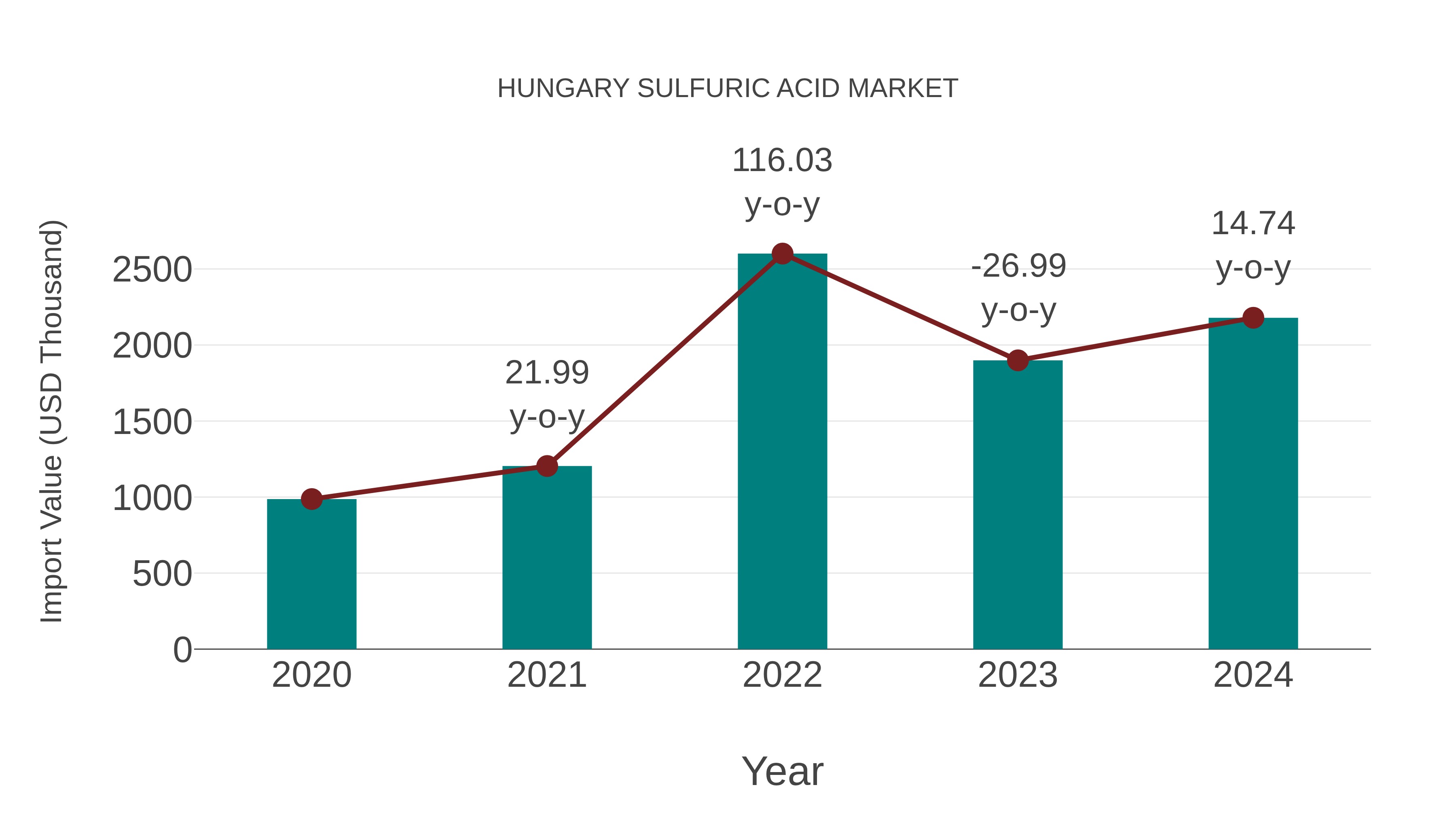
In the Hungary sulfuric acid market, the import trend saw significant growth from 2023 to 2024, with a growth rate of 14.74%. The compound annual growth rate (CAGR) for imports between 2020 and 2024 stood at 21.89%. This surge in import momentum can be attributed to increased industrial activities and a shift in demand towards chemical manufacturing sectors, indicating a positive market stability during this period.
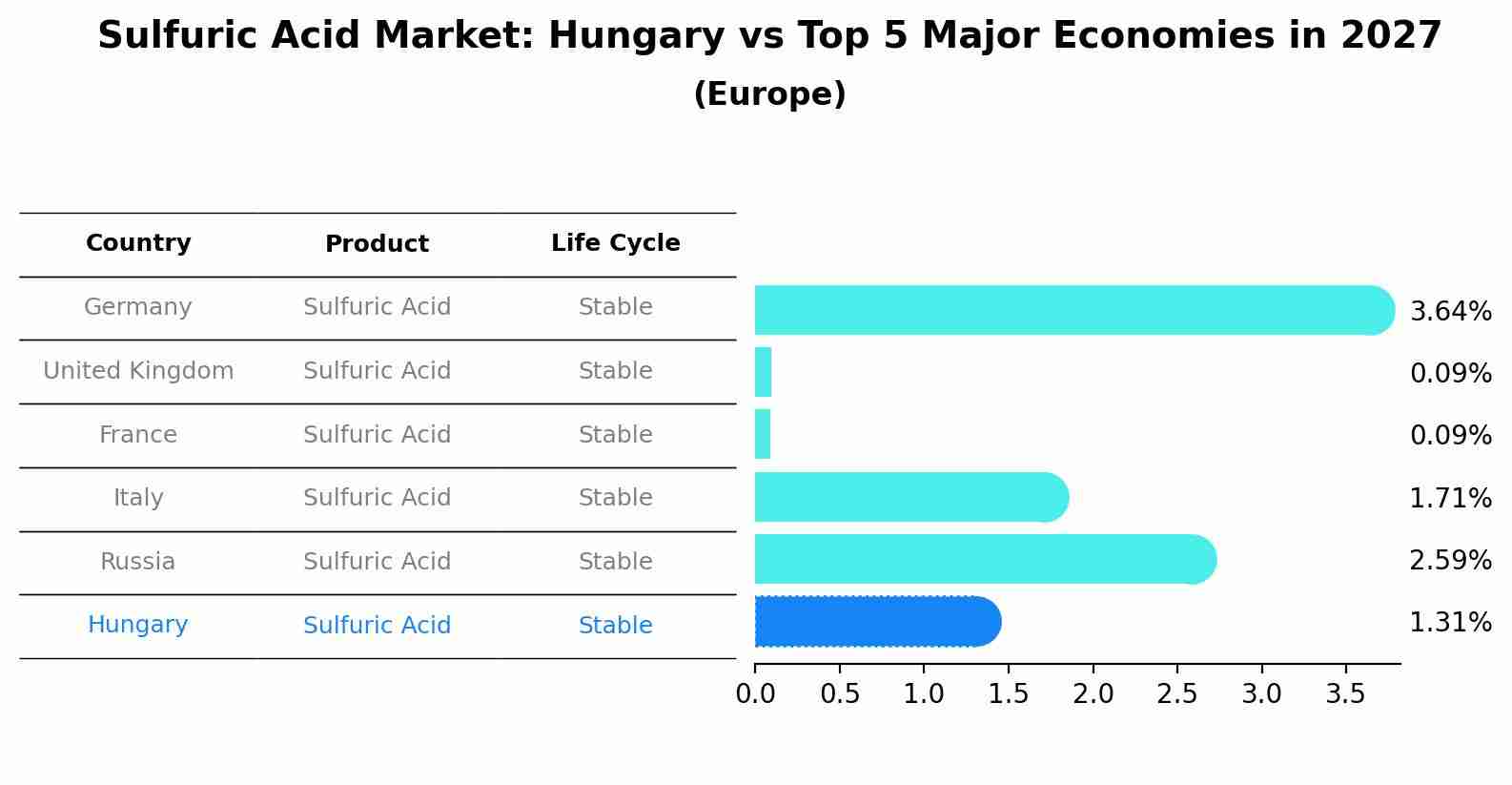
Sulfuric Acid Market: Hungary vs Top 5 Major Economies in 2027 (Europe)
By 2027, Hungary's Sulfuric Acid market is forecasted to achieve a stable growth rate of 1.31%, with Germany leading the Europe region, followed by United Kingdom, France, Italy and Russia.
Hungary Sulfuric Acid Market Overview
The Hungary sulfuric acid market is experiencing steady growth driven by the increasing demand from various industries such as agriculture, chemicals, and mining. Sulfuric acid is a key chemical used in the production of fertilizers, detergents, and industrial chemicals, which contributes to its high demand in the country. The market is also influenced by the growing trend of sustainable practices, leading to the adoption of sulfuric acid in wastewater treatment and battery recycling processes. Key players in the Hungary sulfuric acid market include MOL Group, BorsodChem, and Pannonia Ethanol, among others. The market is expected to continue its growth trajectory in the coming years, supported by the expanding industrial sector and the increasing emphasis on environmental sustainability.
Hungary Sulfuric Acid Market Trends
The Hungary Sulfuric Acid Market is currently experiencing steady growth, driven by diverse industrial applications such as fertilizers, chemicals, and metal processing. With an increasing focus on environmental sustainability, there is a growing demand for sulfuric acid as a key component in waste treatment and emissions control processes. Additionally, the agriculture sector in Hungary is fueling demand for sulfuric acid due to its use in the production of phosphoric acid-based fertilizers. The market is also witnessing a shift towards the adoption of cleaner production methods and technologies to reduce emissions and comply with stringent environmental regulations. Overall, the Hungary Sulfuric Acid Market is expected to continue its upward trajectory in the coming years, driven by industrial expansion and environmental consciousness.
Hungary Sulfuric Acid Market Challenges
In the Hungary sulfuric acid market, some key challenges include fluctuations in raw material prices, environmental regulations concerning emissions and waste disposal, and competition from imported sulfuric acid. The volatility of raw material prices, such as sulfur and natural gas, can impact production costs and ultimately affect pricing strategies. Strict environmental regulations require companies to invest in sustainable practices and technology to minimize emissions and manage waste effectively, adding to operational costs. Moreover, the presence of imported sulfuric acid in the market poses a challenge to domestic producers in terms of pricing competitiveness and market share. To navigate these challenges successfully, companies in the Hungary sulfuric acid market need to focus on operational efficiency, innovation, and compliance with environmental standards.
Hungary Sulfuric Acid Market Investment Opportunities
In the Hungary Sulfuric Acid Market, opportunities exist for investors in the areas of production capacity expansion, technological advancements, and sustainability initiatives. With increasing industrial activities driving the demand for sulfuric acid in various sectors such as chemicals, mining, and agriculture, investing in expanding production facilities can lead to significant growth prospects. Additionally, implementing advanced technologies for efficient sulfuric acid production processes can enhance competitiveness and profitability. Furthermore, there is a growing focus on sustainability in the chemical industry, presenting opportunities for investments in eco-friendly sulfuric acid production methods and recycling initiatives. Overall, investing in the Hungary Sulfuric Acid Market offers opportunities for growth and innovation in line with market trends and environmental considerations.
Hungary Sulfuric Acid Market Government Policy
The Hungary government has implemented policies to regulate the sulfuric acid market, with a focus on environmental protection and industrial safety. The country has set limits on sulfur dioxide emissions from sulfuric acid production facilities to reduce air pollution and minimize the impact on public health. Additionally, regulations are in place to ensure proper handling and disposal of sulfuric acid waste to prevent environmental contamination. The government also enforces safety measures to protect workers in sulfuric acid production plants. Overall, these policies aim to balance the economic benefits of the sulfuric acid industry with environmental sustainability and public health concerns in Hungary.
Hungary Sulfuric Acid Market Future Outlook
The future outlook for the Hungary Sulfuric Acid Market appears positive, driven by increasing industrial activities and demand from sectors such as chemicals, agriculture, and mining. The market is expected to witness steady growth due to expanding applications of sulfuric acid in various industries, particularly in fertilizer production and metal processing. Additionally, government initiatives to promote domestic production and reduce import dependence are likely to further boost market growth. Technological advancements and innovations in sulfuric acid production processes are also anticipated to enhance market efficiency and sustainability. Overall, the Hungary Sulfuric Acid Market is poised for growth in the coming years, with opportunities for market players to capitalize on the increasing demand and emerging trends.
Key Highlights of the Report:
- Hungary Sulfuric Acid Market Outlook
- Market Size of Hungary Sulfuric Acid Market, 2021
- Forecast of Hungary Sulfuric Acid Market, 2031
- Historical Data and Forecast of Hungary Sulfuric Acid Revenues & Volume for the Period 2018 - 2031
- Hungary Sulfuric Acid Market Trend Evolution
- Hungary Sulfuric Acid Market Drivers and Challenges
- Hungary Sulfuric Acid Price Trends
- Hungary Sulfuric Acid Porter's Five Forces
- Hungary Sulfuric Acid Industry Life Cycle
- Historical Data and Forecast of Hungary Sulfuric Acid Market Revenues & Volume By Raw Material Type for the Period 2018 - 2031
- Historical Data and Forecast of Hungary Sulfuric Acid Market Revenues & Volume By Elemental Sulfur for the Period 2018 - 2031
- Historical Data and Forecast of Hungary Sulfuric Acid Market Revenues & Volume By Pyrite Ore for the Period 2018 - 2031
- Historical Data and Forecast of Hungary Sulfuric Acid Market Revenues & Volume By Other Raw Materials (Base Metal Smelters) for the Period 2018 - 2031
- Historical Data and Forecast of Hungary Sulfuric Acid Market Revenues & Volume By End-user Industry for the Period 2018 - 2031
- Historical Data and Forecast of Hungary Sulfuric Acid Market Revenues & Volume By Fertilizer for the Period 2018 - 2031
- Historical Data and Forecast of Hungary Sulfuric Acid Market Revenues & Volume By Chemical & Pharmaceutical for the Period 2018 - 2031
- Historical Data and Forecast of Hungary Sulfuric Acid Market Revenues & Volume By Automotive for the Period 2018 - 2031
- Historical Data and Forecast of Hungary Sulfuric Acid Market Revenues & Volume By Petroleum Refining for the Period 2018 - 2031
- Historical Data and Forecast of Hungary Sulfuric Acid Market Revenues & Volume By Other End-user Industries (Pulp & Paper, Metal Processing) for the Period 2018 - 2031
- Hungary Sulfuric Acid Import Export Trade Statistics
- Market Opportunity Assessment By Raw Material Type
- Market Opportunity Assessment By End-user Industry
- Hungary Sulfuric Acid Top Companies Market Share
- Hungary Sulfuric Acid Competitive Benchmarking By Technical and Operational Parameters
- Hungary Sulfuric Acid Company Profiles
- Hungary Sulfuric Acid Key Strategic Recommendations






































