Hungary Telemedicine Market Size, Share & Growth Rate
The Hungary Telemedicine Market was estimated at USD 183 Million in 2025 and is projected to reach USD 253 Million by 2032, growing at a CAGR of 4.7% from 2026 to 2032. This robust growth trajectory is propelled by the increasing adoption of digital health technologies, rising healthcare costs, and a significant demand for improved access to healthcare services, particularly in rural settings. Furthermore, the ongoing integration of advanced technologies, including mobile health applications and telehealth platforms, underlines the market's positive outlook.
Hungary Telemedicine Market Year-wise Growth Rate and Key Drivers
This graph highlights how the Hungary Telemedicine Market has steadily grown over the years, supported by major growth factors.
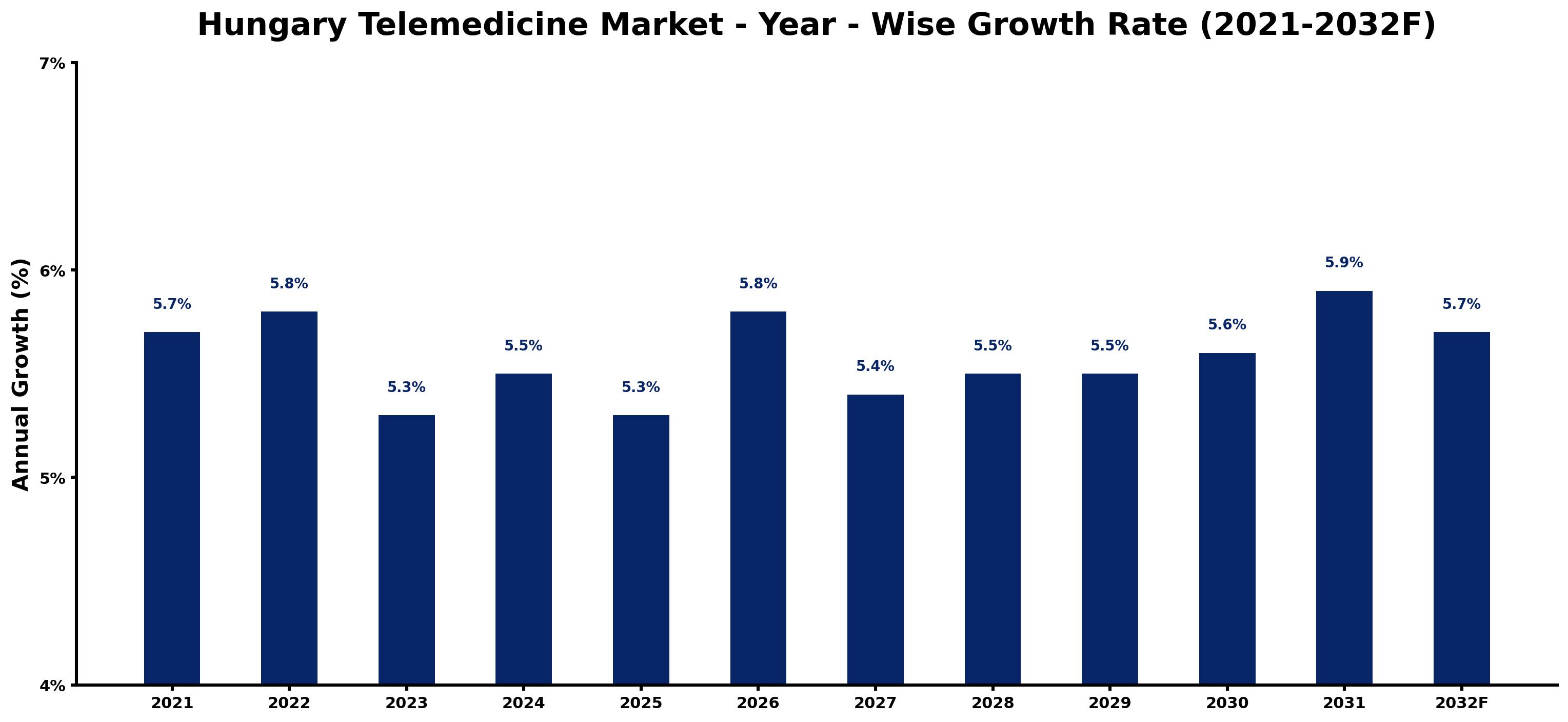
The table below presents the year‑wise growth rates along with the key drivers influencing the market
| Year | Growth Rate | Major Drivers |
| 2021 | 5.7% | Expansion of commercial construction activities |
| 2022 | 5.8% | Expansion of manufacturing activities |
| 2023 | 5.3% | Increasing industrial automation investments |
| 2024 | 5.5% | Increasing adoption of advanced technologies |
| 2025 | 5.3% | Expansion of transportation and logistics networks |
| 2026 | 5.8% | Growing renewable energy integration projects |
| 2027 | 5.4% | Increasing industrial infrastructure investments |
| 2028 | 5.5% | Growing urbanization and commercial development |
| 2029 | 5.5% | Growing renewable energy integration projects |
| 2030 | 5.6% | Increasing adoption of advanced technologies |
| 2031 | 5.9% | Increasing smart city development projects |
| 2032 | 5.7% | Increasing adoption of advanced technologies |
Note - Market size estimations and growth projections presented in this report are based on 6Wresearch's advanced forecasting approach, validated with industry datasets as of June 2026.
Hungary Telemedicine Market Synopsis
In recent years, the Hungary Telemedicine Market has gained momentum, especially in response to the COVID-19 pandemic, which accelerated the shift towards remote healthcare services. As patients increasingly seek safer alternatives for medical consultations, telemedicine has emerged as a viable solution that enhances accessibility and efficiency.
Looking forward, the market is poised for sustained growth, driven by continued advancements in technology and a supportive regulatory environment. As the geriatric population expands and the demand for remote care solutions rises, telemedicine is set to play a crucial role in shaping the future of healthcare delivery in Hungary.
Hungary Telemedicine Market Key Takeaways
- The Hungary Telemedicine Market is forecasted to expand significantly, reflecting the growing reliance on digital health solutions.
- Government initiatives play a pivotal role in facilitating telemedicine adoption across the country.
- The COVID-19 pandemic has markedly shifted patient preferences towards remote healthcare services.
- Technological innovations, particularly in AI and data analytics, are transforming personalized healthcare delivery.
- Investment opportunities abound in teleconsultation platforms, remote monitoring devices, and infrastructure improvements.
Evaluation of Restraints in Hungary Telemedicine Market
Despite the promising growth, the Hungary Telemedicine Market faces several constraints that could impede its full potential. Regulatory hurdles and a lack of standardized guidelines for telemedicine practices present significant challenges. Traditional healthcare providers may exhibit resistance to adopting telemedicine technologies due to concerns surrounding patient privacy and data security. Additionally, inadequate access to high-speed internet in some rural regions remains a significant barrier. Moreover, there is a pressing need for enhanced education and awareness among healthcare providers and patients regarding the benefits of telemedicine.
Hungary Telemedicine Market Trends
Current trends in the Hungary Telemedicine Market include the expansion of teleconsultation services, which allow patients to consult healthcare providers remotely. The integration of remote patient monitoring solutions is on the rise, enabling continuous health tracking and timely intervention. Furthermore, artificial intelligence and data analytics are increasingly being employed to enhance personalized healthcare experiences. Government support for telehealth initiatives and the adoption of mobile health applications are also shaping the market landscape.
Hungary Telemedicine Market Opportunities
With the demand for remote healthcare services escalating, significant investment opportunities are emerging in the Hungary Telemedicine Market. Key areas ripe for investment include teleconsultation platforms that facilitate seamless patient-provider interactions, advanced remote patient monitoring devices, and software development tailored to telemedicine needs. Additionally, enhancing telehealth infrastructure presents a lucrative opportunity for both existing players and new entrants. Collaborations with healthcare providers and telecommunications firms can further stimulate innovation and growth within this dynamic market.
Government Initiatives in the Hungary Telemedicine Market
The Hungarian government has proactively supported the integration of telemedicine into the healthcare system, primarily focusing on enhancing accessibility and efficiency. Telemedicine services are covered by the National Health Insurance Fund, enabling patients to access remote consultations without financial barriers. Furthermore, government policies aim to regulate telemedicine practices, ensuring the privacy of patient data and the maintenance of high-quality care standards. Initiatives like the National eHealth Infrastructure Development Project underscore the commitment to bolster the technological backbone of telemedicine services across the nation.
Future Insights of the Hungary Telemedicine Market
The future of the Hungary Telemedicine Market appears robust, fueled by increasing digital technology adoption and evolving healthcare needs. As the aging population necessitates more accessible healthcare solutions, telemedicine is likely to gain further traction. The continuation of government support for telehealth services, combined with advancements in telecommunication infrastructure, will further propel market growth. As healthcare disparities diminish and patient access improves, telemedicine could fundamentally transform the healthcare landscape in Hungary, leading to innovative care delivery models.
Hungary Telemedicine Market Latest Developments (May 2025 - June 2026)
Recent developments in the Hungary Telemedicine Market have highlighted a significant uptick in the adoption of remote healthcare services. Various initiatives have been launched to enhance the regulatory framework surrounding telemedicine, ensuring better patient data security and care quality. Additionally, advancements in technology are paving the way for more integrated telehealth solutions, aligning with the broader trend of increased healthcare digitalization across the region.
Hungary Telemedicine Market - Key Attractiveness of the Report
- 10 Years of Market Numbers
- Historical Data Starting from 2022 to 2025
- Base Year: 2025
- Forecast Data until 2032
- Key Performance Indicators Impacting the Market
- Major Upcoming Developments and Projects
Key Highlights of the Report:
- Hungary Telemedicine Market Outlook
- Market Size of Hungary Telemedicine Market, 2025
- Forecast of Hungary Telemedicine Market, 2032
- Historical Data and Forecast of Hungary Telemedicine Revenues & Volume for the Period 2022-2032F
- Hungary Telemedicine Market Trend Evolution
- Hungary Telemedicine Market Drivers and Challenges
- Hungary Telemedicine Price Trends
- Hungary Telemedicine Porter's Five Forces
- Hungary Telemedicine Industry Life Cycle
- Historical Data and Forecast of Hungary Telemedicine Market Revenues & Volume By Types for the Period 2022-2032F
- Historical Data and Forecast of Hungary Telemedicine Market Revenues & Volume By Tele Hospitals for the Period 2022-2032F
- Historical Data and Forecast of Hungary Telemedicine Market Revenues & Volume By Tele Homes for the Period 2022-2032F
- Historical Data and Forecast of Hungary Telemedicine Market Revenues & Volume By mHealth (Mobile Health) for the Period 2022-2032F
- Historical Data and Forecast of Hungary Telemedicine Market Revenues & Volume By Component for the Period 2022-2032F
- Historical Data and Forecast of Hungary Telemedicine Market Revenues & Volume By Product for the Period 2022-2032F
- Historical Data and Forecast of Hungary Telemedicine Market Revenues & Volume By Services for the Period 2022-2032F
- Hungary Telemedicine Import Export Trade Statistics
- Market Opportunity Assessment By Types
- Market Opportunity Assessment By Component
- Hungary Telemedicine Top Companies Market Share
- Hungary Telemedicine Competitive Benchmarking By Technical and Operational Parameters
- Hungary Telemedicine Company Profiles
- Hungary Telemedicine Key Strategic Recommendations






































