Hungary Vinyl Records Market Size, Share & Growth Rate
The Hungary Vinyl Records Market was estimated at USD 403 Million in 2025 and is projected to reach USD 527 Million by 2032, growing at a CAGR of 3.9% from 2026 to 2032. This trajectory is primarily driven by the nostalgia surrounding physical music formats and a growing preference for the analog sound quality that vinyl offers. As younger generations increasingly gravitate toward unique and tactile music experiences, vinyl records are positioned to flourish within Hungary's music retail landscape.
Hungary Vinyl Records Market Growth Rate Analysis (2021-2032)
The Hungary vinyl records market has showcased stable growth, with an annual increase of 4.6% in 2021 and a slight dip to 4.5% in 2022. However, demand surged to 4.8% in 2023, driven by a revival in consumer interest for analog music formats, influenced by nostalgia and the unique sound quality of vinyl. The trend continued, peaking again at 4.8% in 2027, as investments in local pressing plants improved supply chain resilience. Fluctuations, including a minor slowdown to 4.4% in 2029, reflect challenges in global vinyl production and rising material costs. Nevertheless, by 2032, the market is expected to stabilize at 4.7%, fueled by evolving consumer preferences and digitalization enhancing distribution channels.
Hungary Vinyl Records Market Year-wise Growth Rate and Key Drivers
This graph highlights how the Hungary Vinyl Records Market has steadily grown over the past five years, supported by major growth factors.
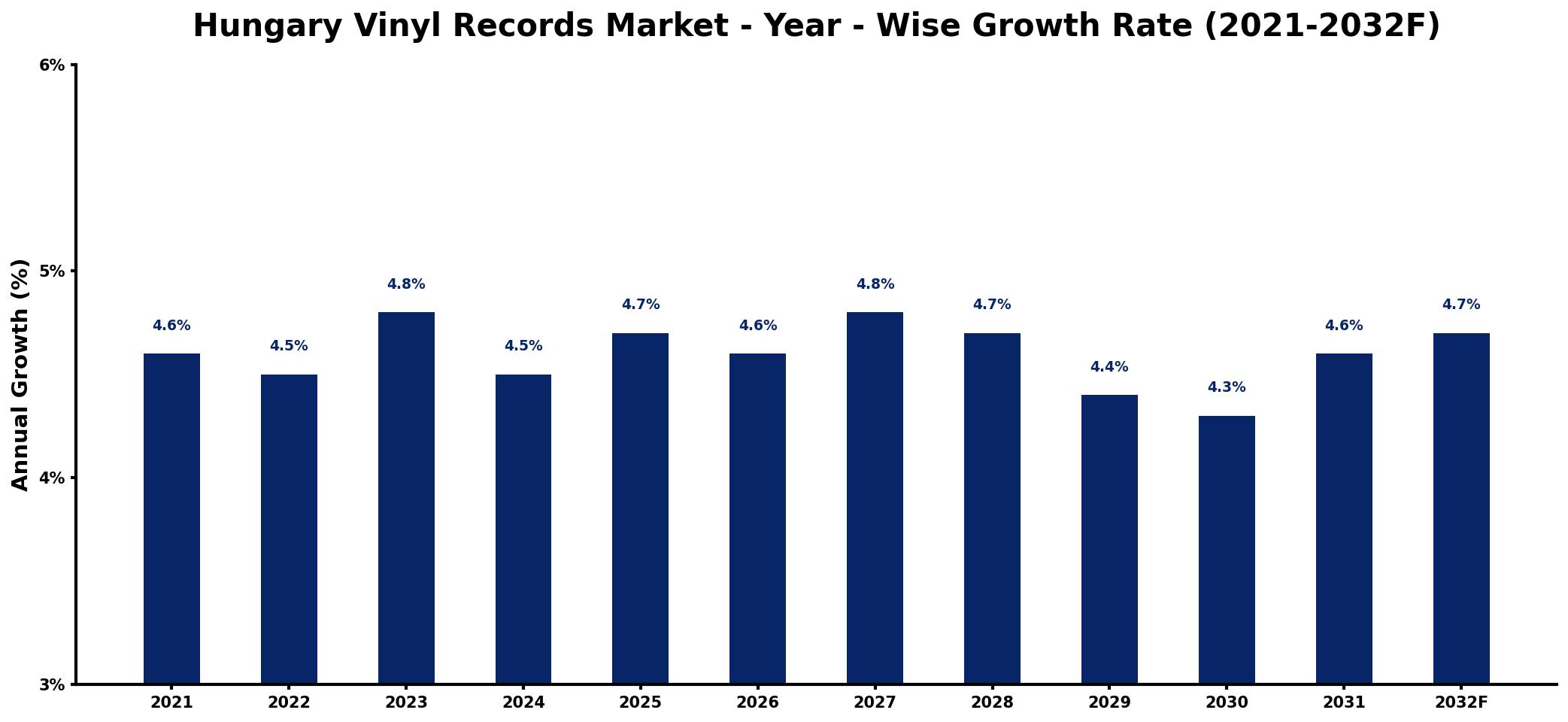
The table below presents the year‑wise growth rates along with the key drivers influencing the market
| Year | Growth Rate | Major Drivers |
| 2021 | 4.6% | Rising interest in analog music |
| 2022 | 4.5% | Increased collector community engagement |
| 2023 | 4.8% | New pressing plant investments |
| 2024 | 4.5% | Growing popularity of nostalgia |
| 2025 | 4.7% | Expansion of music festivals |
| 2026 | 4.6% | Enhanced streaming service partnerships |
| 2027 | 4.8% | Emergence of boutique labels |
| 2028 | 4.7% | Increase in music education programs |
| 2029 | 4.4% | Boost in home listening experiences |
| 2030 | 4.3% | Growth of online sales platforms |
| 2031 | 4.6% | Strengthened cultural heritage initiatives |
| 2032 | 4.7% | Surge in vintage style trends |
Note: Market size estimations and growth projections presented in this report are based on 6Wresearch's proprietary forecasting methodology, utilizing the latest available industry data, government publications, and primary research inputs.
Hungary Vinyl Records Market Synopsis
The resurgence of vinyl records in Hungary reflects a noteworthy trend among local music enthusiasts, particularly among audiophiles who appreciate the rich sound profiles unique to analog recordings. Independent record shops across the country are responding to this demand by curating diverse collections, including limited edition releases that appeal to avid collectors.
In addition to traditional sales channels, online platforms are gaining traction, providing easy access to both new and vintage records. Events like vinyl listening parties and record fairs further enrich the cultural fabric surrounding vinyl, making it a social experience that attracts a dedicated following.
Hungary Vinyl Records Market Key Takeaways
- Steady growth in vinyl sales fueled by nostalgia and a preference for analog sound quality.
- Increasing popularity among younger demographics seeking unique and tactile music experiences.
- Independent record stores and online platforms play a vital role in market distribution.
- Collectors are driving demand for limited edition and unique vinyl releases.
- Government initiatives aim to support local vinyl production and cultural heritage.
Evaluation of Restraints in Hungary Vinyl Records Market
Despite the positive growth trajectory, the Hungary Vinyl Records Market faces notable restraints. The limited availability of pressing plants poses a significant barrier to increasing local production, often resulting in longer lead times for new releases. Furthermore, the market remains small compared to other European countries, making it challenging for independent shops to cultivate a consistent customer base. Additionally, competition from digital streaming services, which provide a convenient and cost-effective alternative to physical formats, continues to pose a challenge for vinyl retailers in Hungary.
Hungary Vinyl Records Market Trends
Emerging trends in the Hungary Vinyl Records Market include a marked preference for limited edition releases and special packaging, as collectors seek unique items that stand out in their collections. Vinyl listening events are becoming more common, fostering community engagement and enhancing the overall experience of music consumption. Moreover, there is a growing trend of pairing vinyl purchases with digital downloads, allowing consumers to enjoy the best of both worlds. The integration of online sales with traditional retail channels is also evolving, providing a more robust market presence.
Hungary Vinyl Records Market Opportunities
Investors looking into the Hungary Vinyl Records Market can find promising opportunities, particularly in production and distribution. The resurgence of interest in physical music formats suggests a potential for significant returns. By leveraging digital platforms for marketing and sales, businesses can enhance their reach to new audiences. Additionally, exploring collaborations with local artists and niche labels could create unique offerings that attract collectors and casual listeners alike, tapping into Hungary's rich musical heritage.
Government Initiatives in the Hungary Vinyl Records Market
The Hungarian government has actively implemented policies to support the vinyl records market, recognizing its cultural significance. Various initiatives include financial aid for local vinyl manufacturers and incentives aimed at fostering creativity and artistic expression. Programs promoting the export of Hungarian vinyl records also seek to enhance international market access. By facilitating infrastructure development for vinyl production, these government measures aim to stimulate growth within the industry, ensuring its sustainability in the coming years.
Future Insights of the Hungary Vinyl Records Market
Looking ahead to 2026-2032, the Hungary Vinyl Records Market is poised for continued expansion. The ongoing appreciation for the unique sound quality of vinyl, coupled with a cultural shift towards physical music formats, is expected to sustain demand. Furthermore, the strengthening of distribution channels and increasing engagement through events will likely enhance consumer interest. As more local artists release their music on vinyl, the market will benefit from a diverse range of offerings that cater to the evolving preferences of music enthusiasts.
Hungary Vinyl Records Market Latest Developments (2025 - 2026)
In recent months, the Hungary Vinyl Records Market has witnessed a surge in local artists embracing vinyl as a primary medium for album releases, reflecting the format's growing cultural relevance. Record fairs and listening events have seen increased attendance, signaling a vibrant community of collectors and music lovers. Additionally, advancements in online sales platforms have improved accessibility, allowing consumers to discover and purchase vinyl records more easily. Local producers are exploring innovative pressing techniques to meet rising demand while maintaining sound quality.
Hungary Vinyl Records Market - Key Attractiveness of the Report
- 10 Years of Market Numbers
- Historical Data Starting from 2022 to 2025
- Base Year: 2025
- Forecast Data until 2032
- Key Performance Indicators Impacting the Market
- Major Upcoming Developments and Projects
Key Highlights of the Report:
- Hungary Vinyl Records Market Outlook
- Market Size of Hungary Vinyl Records Market, 2025
- Forecast of Hungary Vinyl Records Market, 2032
- Historical Data and Forecast of Hungary Vinyl Records Revenues & Volume for the Period 2022-2032F
- Hungary Vinyl Records Market Trend Evolution
- Hungary Vinyl Records Market Drivers and Challenges
- Hungary Vinyl Records Price Trends
- Hungary Vinyl Records Porter's Five Forces
- Hungary Vinyl Records Industry Life Cycle
- Historical Data and Forecast of Hungary Vinyl Records Market Revenues & Volume By Product Type for the Period 2022-2032F
- Historical Data and Forecast of Hungary Vinyl Records Market Revenues & Volume By Long Play (LP) Vinyl Records for the Period 2022-2032F
- Historical Data and Forecast of Hungary Vinyl Records Market Revenues & Volume By Singles Vinyl Records for the Period 2022-2032F
- Historical Data and Forecast of Hungary Vinyl Records Market Revenues & Volume By Others for the Period 2022-2032F
- Historical Data and Forecast of Hungary Vinyl Records Market Revenues & Volume By Distribution Channel for the Period 2022-2032F
- Historical Data and Forecast of Hungary Vinyl Records Market Revenues & Volume By Online for the Period 2022-2032F
- Historical Data and Forecast of Hungary Vinyl Records Market Revenues & Volume By Offline for the Period 2022-2032F
- Hungary Vinyl Records Import Export Trade Statistics
- Market Opportunity Assessment By Product Type
- Market Opportunity Assessment By Distribution Channel
- Hungary Vinyl Records Top Companies Market Share
- Hungary Vinyl Records Competitive Benchmarking By Technical and Operational Parameters
- Hungary Vinyl Records Company Profiles
- Hungary Vinyl Records Key Strategic Recommendations






































