Hungary Wax Market Size (2020-2030)
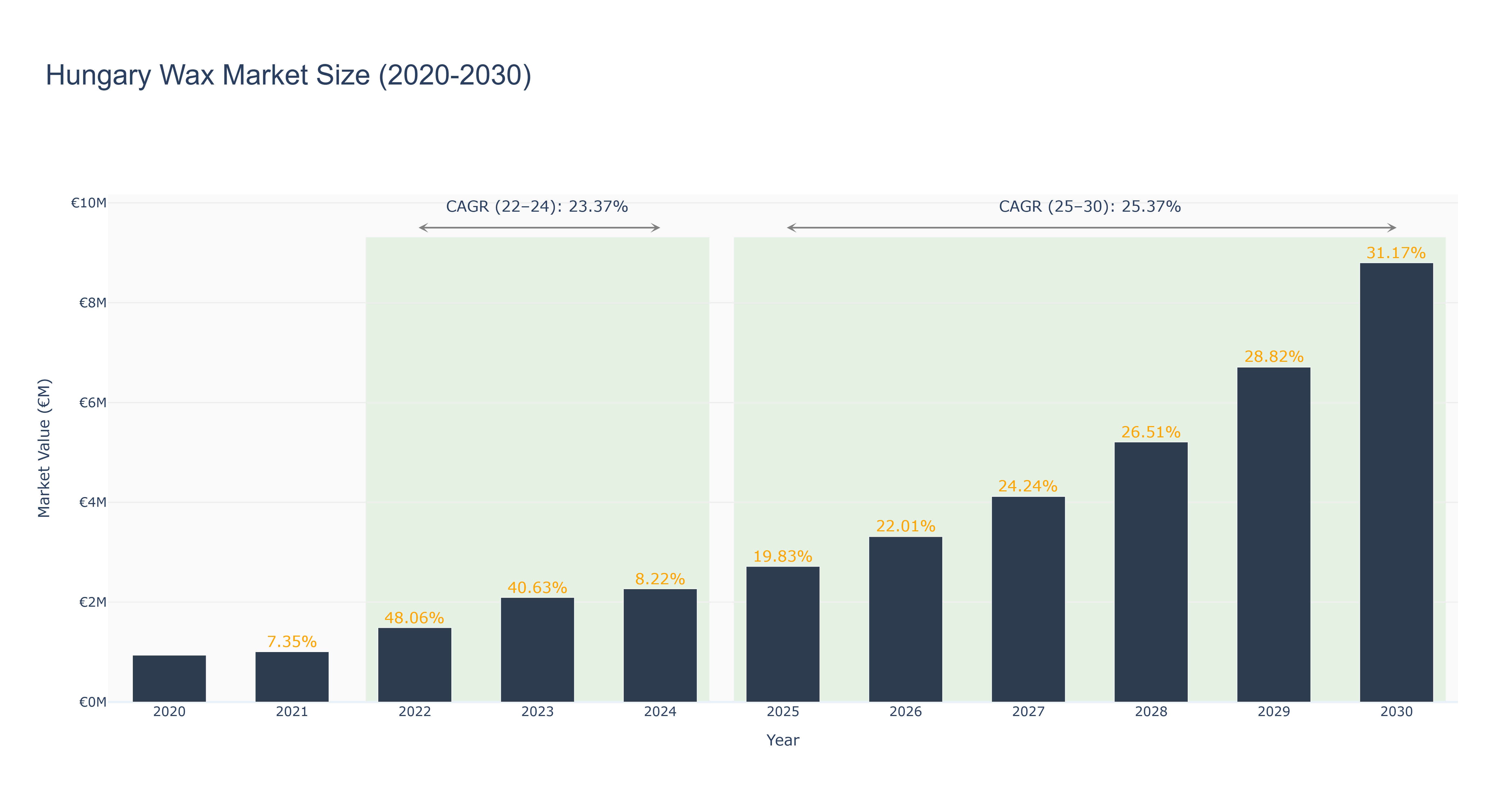
Hungary Wax Market has shown a significant growth trend over the years. The peak market size was €8.80 million in 2030, with a steady increase from €0.94 million in 2020. The market experienced a notable surge in 2022 to €1.49 million, attributed to increased demand for wax products in various industries. The forecasted market size from 2025 to 2030 is expected to continue growing steadily, with a CAGR of 25.37%. The market's growth can be attributed to factors such as the expanding cosmetics and pharmaceutical sectors, driving the demand for wax-based products. Recent developments in Hungary's wax market include investments in research and development for eco-friendly wax alternatives to meet sustainability demands in the industry. Industry drivers such as technological advancements in wax production processes and the growing trend of natural and organic products are expected to propel the market forward. As the market continues to evolve, collaborations with key industry players and government initiatives to promote the use of domestically sourced waxes are anticipated to further boost market growth.
Hungary Wax Market: Production & Trade Performance (2019-2025)
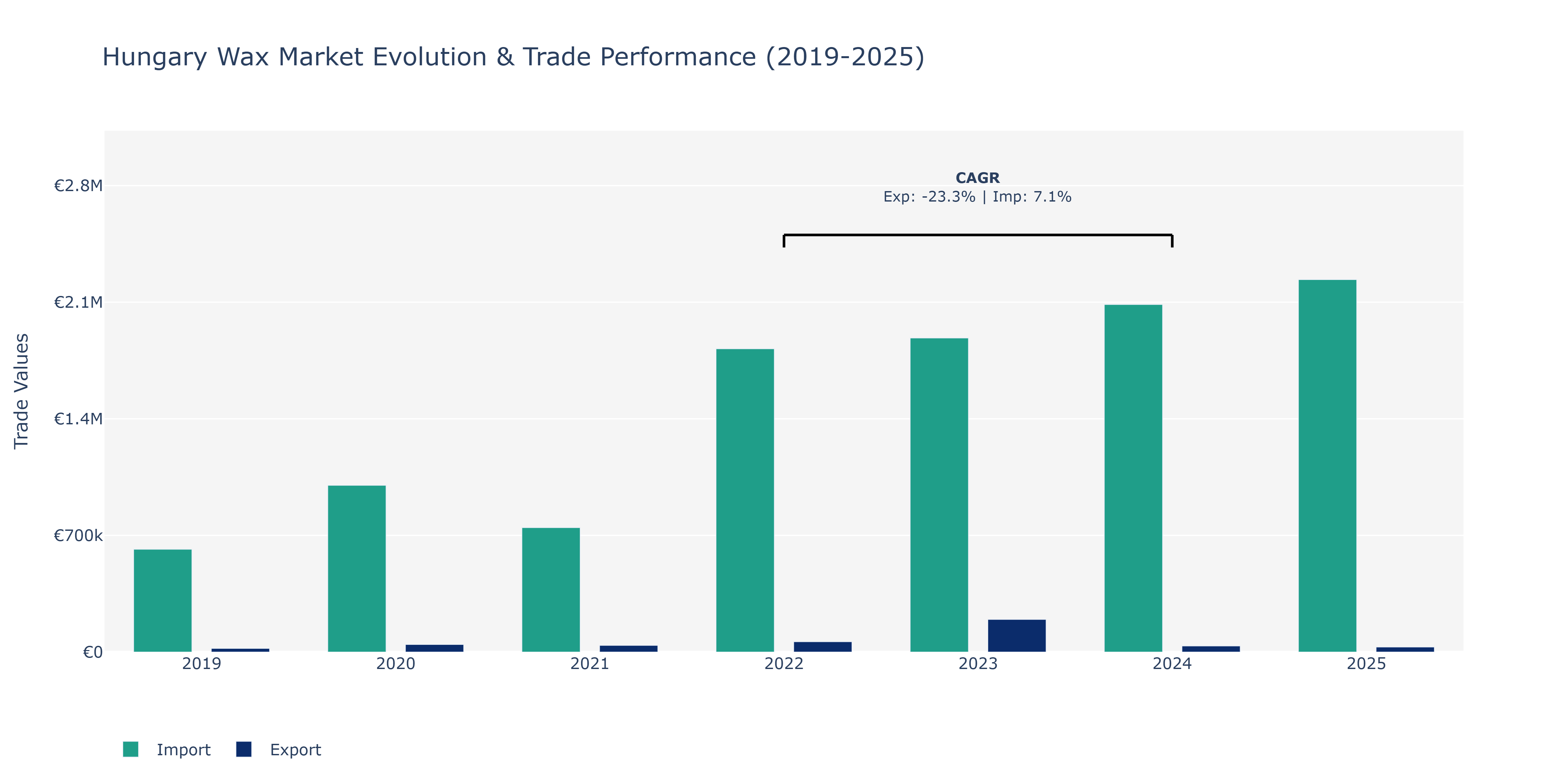
Between 2019 and 2025, Hungary's Wax Market saw noticeable fluctuations in both Exports and Imports. Exports started at €21.46 thousand in 2019, surged to €195.75 thousand in 2023, then declined to €30.02 thousand by 2025. This peak and subsequent decrease could be attributed to shifts in global demand for wax products, potentially impacted by changing consumer preferences towards sustainable alternatives. In contrast, Imports escalated from €616.52 thousand in 2019 to €2.23 million in 2025, reflecting a steady upward trajectory driven by Hungary's growing manufacturing sector requiring raw materials. The significant increase in Imports might be a result of the country's expanding industrial base and increased reliance on imported wax for various applications. These trends emphasize the industry's sensitivity to market dynamics and underline the importance of strategic planning to navigate fluctuations effectively.
Hungary Wax Market Overview
The Hungary Wax Market encompasses natural and synthetic waxes used in various industries and applications such as candles, packaging, coatings, cosmetics, pharmaceuticals, and food processing. Waxes provide properties such as lubricity, water resistance, adhesion, and thermal stability, serving as raw materials, additives, or processing aids in manufacturing processes and end products. This market is influenced by factors such as industrial production, consumer preferences, and regulatory requirements governing wax usage in different sectors.
Drivers of the market
The Hungary Wax Market is experiencing growth driven by several factors. Firstly, the diverse applications of wax across industries such as cosmetics, packaging, pharmaceuticals, and candles are driving market demand. Secondly, technological advancements in wax production and processing techniques are expanding the market by improving product quality and enabling the development of innovative wax-based products. Additionally, the growing trend towards natural and sustainable ingredients in consumer products is driving demand for natural waxes such as beeswax and soy wax, further fueling market growth.
Challenges of the market
Challenges include ensuring a stable and sustainable supply of wax raw materials, addressing concerns related to wax quality and purity, and differentiating wax products in a competitive market.
Government Policy of the market
Government policies in Hungary focus on promoting sustainable practices in the wax industry, encouraging the use of natural and renewable sources. Regulations address quality control measures to ensure consumer safety and promote competitiveness in the global market.
Key Highlights of the Report:
- Hungary Wax Market Outlook
- Market Size of Hungary Wax Market, 2019
- Forecast of Hungary Wax Market, 2026
- Historical Data and Forecast of Hungary Wax Revenues & Volume for the Period 2016 - 2026
- Hungary Wax Market Trend Evolution
- Hungary Wax Market Drivers and Challenges
- Hungary Wax Price Trends
- Hungary Wax Porter's Five Forces
- Hungary Wax Industry Life Cycle
- Historical Data and Forecast of Hungary Wax Market Revenues & Volume By Product for the Period 2016 - 2026
- Historical Data and Forecast of Hungary Wax Market Revenues & Volume By Mineral for the Period 2016 - 2026
- Historical Data and Forecast of Hungary Wax Market Revenues & Volume By Synthetic for the Period 2016 - 2026
- Historical Data and Forecast of Hungary Wax Market Revenues & Volume By Natural for the Period 2016 - 2026
- Historical Data and Forecast of Hungary Wax Market Revenues & Volume By Applications for the Period 2016 - 2026
- Historical Data and Forecast of Hungary Wax Market Revenues & Volume By Candles for the Period 2016 - 2026
- Historical Data and Forecast of Hungary Wax Market Revenues & Volume By Packaging for the Period 2016 - 2026
- Historical Data and Forecast of Hungary Wax Market Revenues & Volume By Plastic & Rubber for the Period 2016 - 2026
- Historical Data and Forecast of Hungary Wax Market Revenues & Volume By Cosmetics & Toiletries for the Period 2016 - 2026
- Historical Data and Forecast of Hungary Wax Market Revenues & Volume By Fire Logs for the Period 2016 - 2026
- Historical Data and Forecast of Hungary Wax Market Revenues & Volume By Adhesives for the Period 2016 - 2026
- Historical Data and Forecast of Hungary Wax Market Revenues & Volume By Others for the Period 2016 - 2026
- Hungary Wax Import Export Trade Statistics
- Market Opportunity Assessment By Product
- Market Opportunity Assessment By Applications
- Hungary Wax Top Companies Market Share
- Hungary Wax Competitive Benchmarking By Technical and Operational Parameters
- Hungary Wax Company Profiles
- Hungary Wax Key Strategic Recommendations






































