Iceland Rolling Mill Components and Ancillary Equipment Market Growth Rate Analysis (2025 - 2031)
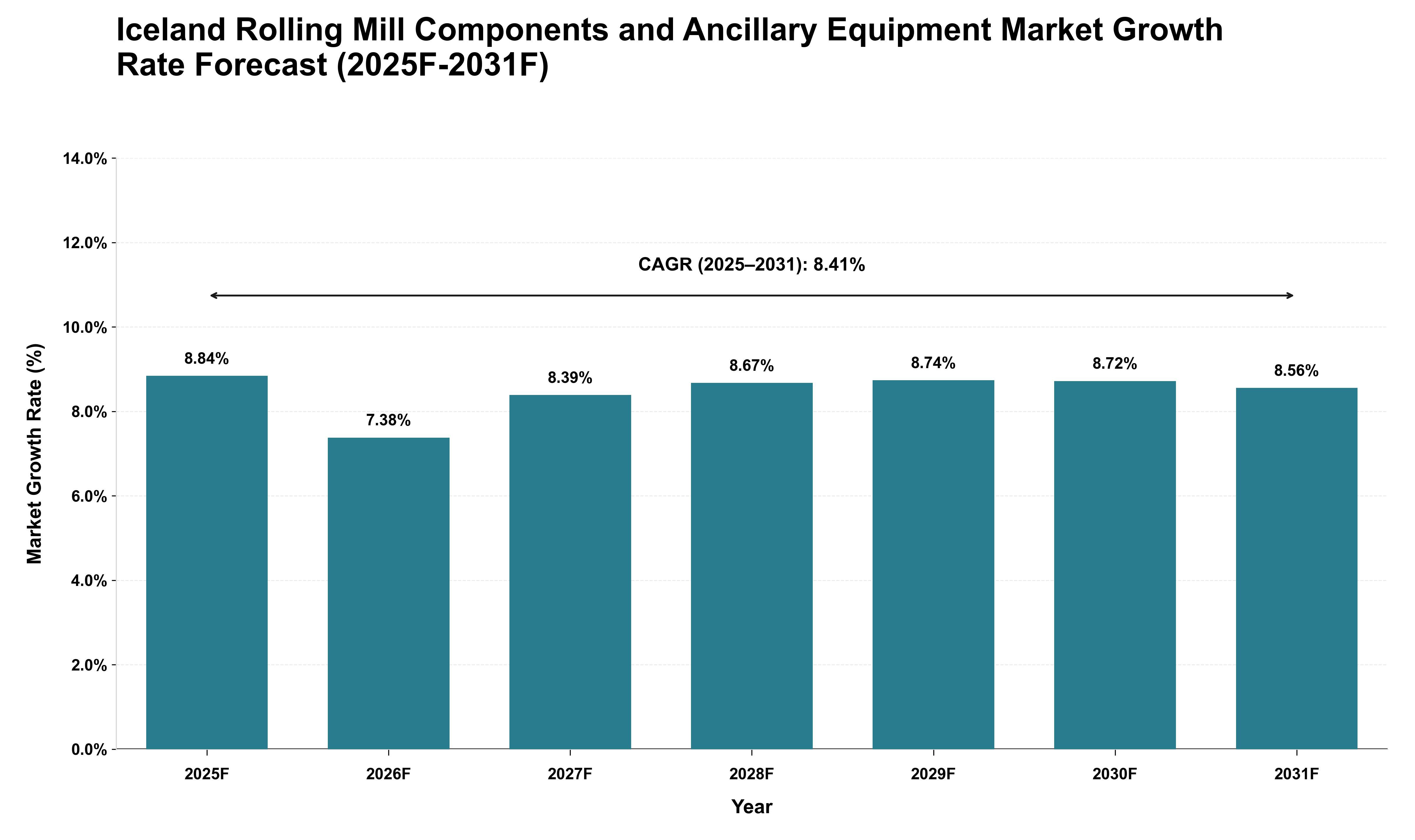
The Iceland Rolling Mill Components and Ancillary Equipment Market will experience a robust growth trajectory driven by technological advancements and product substitution dynamics. As manufacturers increasingly adopt automation and smart technologies, the demand for advanced rolling mill components will rise, reflecting an annual growth rate peaking at 8.84% in 2025 before stabilizing around 8.56% by 2031. This trend will be supported by a shift towards more efficient production processes, necessitating the replacement of older equipment with innovative solutions that enhance productivity and reduce operational costs. Additionally, import dependencies on specialized components will likely influence market dynamics, as global supply chain adjustments occur in response to evolving manufacturing standards. The cyclical nature of industrial demand will further contribute to fluctuations within this forecast period, ensuring sustained investment in high-performance equipment that aligns with emerging industry requirements.
Key Highlights of the Report:
- Iceland Rolling Mill Components and Ancillary Equipment Market Outlook
- Market Size of Iceland Rolling Mill Components and Ancillary Equipment Market, 2024
- Forecast of Iceland Rolling Mill Components and Ancillary Equipment Market, 2031
- Historical Data and Forecast of Iceland Rolling Mill Components and Ancillary Equipment Revenues & Volume for the Period 2021-2031
- Iceland Rolling Mill Components and Ancillary Equipment Market Trend Evolution
- Iceland Rolling Mill Components and Ancillary Equipment Market Drivers and Challenges
- Iceland Rolling Mill Components and Ancillary Equipment Price Trends
- Iceland Rolling Mill Components and Ancillary Equipment Porter`s Five Forces
- Iceland Rolling Mill Components and Ancillary Equipment Industry Life Cycle
- Historical Data and Forecast of Iceland Rolling Mill Components and Ancillary Equipment Market Revenues & Volume By Product for the Period 2021-2031
- Historical Data and Forecast of Iceland Rolling Mill Components and Ancillary Equipment Market Revenues & Volume By Iron Rolls for the Period 2021-2031
- Historical Data and Forecast of Iceland Rolling Mill Components and Ancillary Equipment Market Revenues & Volume By Steel Rolls for the Period 2021-2031
- Historical Data and Forecast of Iceland Rolling Mill Components and Ancillary Equipment Market Revenues & Volume By Others for the Period 2021-2031
- Historical Data and Forecast of Iceland Rolling Mill Components and Ancillary Equipment Market Revenues & Volume By End User for the Period 2021-2031
- Historical Data and Forecast of Iceland Rolling Mill Components and Ancillary Equipment Market Revenues & Volume By Oil & Gas for the Period 2021-2031
- Historical Data and Forecast of Iceland Rolling Mill Components and Ancillary Equipment Market Revenues & Volume By Industrial for the Period 2021-2031
- Historical Data and Forecast of Iceland Rolling Mill Components and Ancillary Equipment Market Revenues & Volume By Automotive for the Period 2021-2031
- Historical Data and Forecast of Iceland Rolling Mill Components and Ancillary Equipment Market Revenues & Volume By Mining for the Period 2021-2031
- Historical Data and Forecast of Iceland Rolling Mill Components and Ancillary Equipment Market Revenues & Volume By Others for the Period 2021-2031
- Iceland Rolling Mill Components and Ancillary Equipment Import Export Trade Statistics
- Market Opportunity Assessment By Product
- Market Opportunity Assessment By End User
- Iceland Rolling Mill Components and Ancillary Equipment Top Companies Market Share
- Iceland Rolling Mill Components and Ancillary Equipment Competitive Benchmarking By Technical and Operational Parameters
- Iceland Rolling Mill Components and Ancillary Equipment Company Profiles
- Iceland Rolling Mill Components and Ancillary Equipment Key Strategic Recommendations






































