India 3D Eye Tracking Software Market (2026-2032) | Companies, Growth, Trends, Outlook, Competitive, Drivers, Industry, Strategy, Share, Segmentation, Forecast, Size, Revenue, Segments, Supply, Value, Opportunities, Consumer Insights, Challenges, Demand, Strategic Insights, Investment Trends, Pricing Analysis, Analysis, Restraints, Competition
Market Forecast By Product Type (Software, Hardware), By Application (Healthcare, Automotive, Gaming), By Technology (AI-Integrated, Non-AI Based), By End user (Research, Commercial) And Competitive Landscape
| Product Code: ETC11485326 | Publication Date: Apr 2025 | Updated Date: Jun 2026 | Product Type: Market Research Report | |
| Publisher: 6Wresearch | Author: Bhawna Singh | No. of Pages: 65 | No. of Figures: 34 | No. of Tables: 19 |
India 3D Eye Tracking Software Market Growth Rate
According to 6Wresearch internal database and industry insights, India 3D Eye Tracking Software Market is expected to grow at a compound annual growth rate (CAGR) of 15.1% during the forecast period (2026-2032).
India 3D Eye Tracking Software Market Year-wise Growth Rate and Key Drivers
This graph highlights how the India 3D Eye Tracking Software Market has steadily grown over the past five years, supported by major growth factors.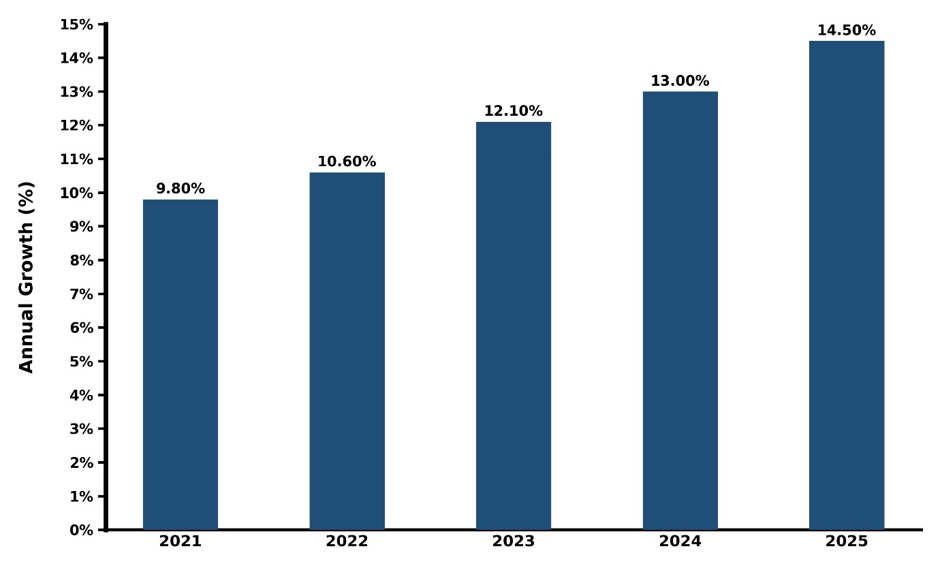
The table below highlights the year-wise growth rate of the India 3D Eye Tracking Software Industry along with key drivers:
| Year | Est. Annual Growth (%) | Growth Drivers |
| 2021 | 9.8% | Early adoption of 3D eye tracking software in research institutions, and rising interest in human-computer interaction technologies. |
| 2022 | 10.6% | Expansion of AR/VR applications, and growing use in academic, and cognitive research. |
| 2023 | 12.1% | Increased use of advanced eye tracking software solution in fatigue detection, and driver monitoring systems. |
| 2024 | 13% | Increase in demand for simulation training and UX testing technologies. |
| 2025 | 14.5% | Integration with AI-driven analytics, and increased enterprise adoption for behavioural insights. |
Topics Covered in the India 3D Eye Tracking Software Market Report
The India 3D Eye Tracking Software Market report primarily covers the market by product type, application, technology, and end user. The report provides a detailed analysis of ongoing market trends, opportunities/high-growth areas, and market drivers that will help stakeholders align strategies based on current and future market dynamics.
India 3D Eye Tracking Software Market Highlights
| Report Name |
India 3D Eye Tracking Software Market |
| Forecast period | 2026-2032 |
| CAGR | 15.1% |
| Market Size |
Gaming & AR/VR sector |
India 3D Eye Tracking Software Market Synopsis
The India 3D Eye Tracking Software Market is projected to grow significantly owing to rapid advancements in computer vision, immersive technologies, and artificial intelligence. Rising adoption of healthcare diagnostics, defence simulation, consumer electronics, and automotive safety systems is fuelling the market expansion. The rising penetration of AR/VR platforms in gaming, enterprise training, and education is further accelerating the demand for eye tracking solutions.
Evaluation of Growth Drivers in India 3D Eye Tracking Software Market
Below are some major drivers and their influence on the market dynamics:
| Drivers | Primary Segment Affected | Why It Matters (Evidence) |
| Growth of AR/VR Ecosystem | Gaming, Training, Simulation | Expanding use of immersive technologies increase demand for real-time eye tracking inputs. |
| Adoption in Automotive Safety Systems | Driver Monitoring Systems | Eye tracking improves fatigue detection, and enhances road safety features. |
| Advancements in AI & Computer Vision | Software Platforms | AI integration improves accuracy, and real-time behavioural analytics. |
| Rising Demand in Healthcare Research | Neurology, Psychology | Eye tracking software is used for cognitive studies, patient behaviour tracking, and diagnosis support. |
| Expansion of UX/UI Optimization Tools | IT & Digital Enterprises | Helps companies to analyse user attention, and improve the interface design. |
The India 3D Eye Tracking Software Market is expected to grow at a CAGR of 15.1% during 2026-2032, supported by the demand for intelligent human behaviour analysis tools, and increasing technological adoption. Moreover, integration of 3D eye tracking software with AI-based behavioural analytics is enabling more accurate user experience, insights, and predictive modelling.
Evaluation of Restraints in India 3D Eye Tracking Software Market
Below are some major restraints and their influence on the market dynamics:
| Restraints | Primary Segment Affected | What This Means (Evidence) |
| High Cost of Advanced Systems | SMEs, Research Labs | High implementation costs of advanced eye tracking software may limit the adoption among small organizations. |
| Technical Complexity | Software Integration | Requires specialized expertise for deployment, and calibration. |
| Data Privacy Concerns | Behavioral Analytics | Collection of sensitive user behaviour data raises privacy issues. |
| Limited Awareness in Emerging Sectors | Industrial Adoption | Many industries are still unfamiliar with use cases, and benefits of advanced eye tracking software. |
| Hardware Dependency | AR/VR & Automotive | 3D eye tracking software requires specialized sensors, and hardware integration for full functionality. |
India 3D Eye Tracking Software Market Challenges
Although India 3D Eye Tracking Software Market has shown strong growth potential, it is still facing challenges such as high deployment costs, limited awareness across industries, and lack of skilled professionals. Furthermore, data privacy concerns, and dependency on advanced hardware systems may slow the adoption of 3D eye tracking software in cost-sensitive sectors. However, these challenges can be tackled by increasing investments in R&D, organising awareness programs, improving integration of AI-driven eye tracking platforms, and cost-effective SaaS-based solutions.
India 3D Eye Tracking Software Market Trends
Listed below are some of the major trends in India 3D Eye Tracking Software Market:
- Rising Adoption of AR/VR: Eye tracking is increasingly integrated into AR/VR platforms for training, simulations, and gaming enhancing user interaction, immersion, and real-time behavioural feedback across applications.
- Integration with AI and ML: AI-powered analytics are improving accuracy in gaze prediction, behavioural insights, and attention tracking enabling smart decision-making in UX design, healthcare research, and automotive safety systems.
- Growth in Automotive Driver Monitoring Systems: Automotive manufacturers are adopting eye tracking for fatigue detection, and driver attention monitoring, thus, improving road safety, and supporting advanced driver assistance systems.
- Expansion in Healthcare and Cognitive Research: Eye tracking is gaining traction in neurological studies, rehabilitation, and psychology helping researchers analyse visual behaviour patterns, diagnose cognitive, and attention-related disorders.
Investment Opportunities in the India 3D Eye Tracking Software Market
Given below are the investment opportunities available in India 3D Eye Tracking Software Market:
- AI-Powered Eye Tracking Platforms: Investing made in AI-driven eye tracking software offers strong potential, as demand grows for real-time gaze analytics in healthcare diagnostics, behavioural intelligence solutions, and UX research.
- AR/VR Integration Solutions: Investment opportunities exist in developing eye tracking modules for AR/VR devices, enhancing user interaction, and enterprise training applications across education, gaming, and simulation sectors.
- Automotive Driver Monitoring Systems: Investment in eye tracking-based ADAS solutions is promising, especially for fatigue detection, and safety enhancement in passenger, and commercial vehicles.
- Healthcare and Neurotechnology Applications: Growing scope of investment exists in medical diagnostics, and cognitive research tools using eye tracking to support neurological assessments, and rehabilitation therapies.
Top 5 Leading Players in India 3D Eye Tracking Software Market
Stated below are some of the leading companies holding majority of India 3D Eye Tracking Software Market Shares:
1. Tobii AB
| Company Name | Tobii AB |
|---|---|
| Established Year | 2001 |
| Headquarters | Stockholm (Danderyd), Sweden |
| Official Website | Click Here |
Tobii AB is a global leader in eye tracking solutions, used in AR/VR, automotive ADAS, healthcare, and UX research due to its advanced software-hardware integration, and strong AI-driven analytics capabilities. It is relevant in India through partnerships in automotive R&D, gaming peripherals, and academic neuroscience research.
2. Smart Eye AB
| Company Name | Smart Eye AB |
|---|---|
| Established Year | 1999 |
| Headquarters | Gothenburg, Sweden |
| Official Website | Click Here |
Smart Eye AB specializes in driver monitoring systems, and automotive safety applications, and has a strong presence in ADAS solutions, making it a key player in fatigue, and distraction detection technologies in India.
3. Pupil Labs
| Company Name | Pupil Labs |
|---|---|
| Established Year | 2014 |
| Headquarters | Berlin, Germany |
| Official Website | Click Here |
Pupil Labs is known for flexible, research-grade eye tracking hardware, and software used in academic research, UX testing, and human-computer interaction experiments. It is adopted by universities, design institutes, and neuroscience labs in India for low-cost research-grade eye tracking.
4. SR Research Ltd. (EyeLink)
| Company Name | SR Research Ltd. (EyeLink) |
|---|---|
| Established Year | 1994 |
| Headquarters | Mississauga, Ontario, Canada |
| Official Website | Click Here |
SR Research Ltd. is regarded as a gold-standard provider for academic, and neuroscience research eye tracking systems. The company has a strong presence in neuroscience labs, clinical research, and is known for ultra-high sampling speed, and accuracy. It dominates high-precision neuroscience, and cognitive psychology research in India.
5. Eyeware Tech SA
| Company Name | Eyeware Tech SA |
|---|---|
| Established Year | 2016 |
| Headquarters | Martigny, Switzerland |
| Official Website | Click Here |
Eyeware Tech SA is a deep-tech startup focused on 3D sensor eye tracking software, using AI computer vision instead of traditional IR hardware systems. Eyeware Tech focuses on low-cost solutions, making it highly relevant for India’s gaming, streaming, and accessibility technology market.
Government Initiatives being implemented in the India 3D Eye Tracking Software Market
According to Indian government data, the authorities have introduced initiatives to support the 3D eye tracking software market, particularly under Digital India ecosystem. Key examples include the IndiaAI Mission for AI innovation, and compute infrastructure, and MeitY’s support for AR/VR Centres of Excellence, such as VARCoE at IIT Bhubaneswar, promoting immersive technologies used in eye tracking applications. The government has launched Digital Gaming Research Initiative to advance AR/VR-based systems, and indigenous platforms. Additionally, the National Strategy for Artificial Intelligence promotes AI adoption in mobility, healthcare, and education sectors.
VARCoE at IIT Bhubaneswar:
Digital Gaming Research Initiative (DST–INAE):
https://dst.gov.in/serb-inae-conclave-serb-digital-gaming-research-initiative
Future Insights of the India 3D Eye Tracking Software Market
The India 3D Eye Tracking Software Market is expected to witness strong expansion due to rapid growth in AR/VR, automotive safety systems, and AI-driven analytics. Future demand of advanced tracking software will be driven by increasing use in cognitive research, healthcare diagnostics, and immersive training solutions. Advancements in machine learning, and computer vision will enhance accuracy, and real-time tracking capabilities. Rising enterprise focus on user experience optimization, and behavioural analytics will further accelerate the adoption across multiple industries.
Market Segmentation Analysis
The report offers a comprehensive study of the following market segments and their leading categories in India 3D Eye Tracking Software Market:
By Product Type - Software Dominates the Market
According to Sachin, Senior Research Analyst, 6Wresearch, software segment dominates due to rising demand for AI-driven analytics platforms, behavioural tracking solutions, and UX research tools. Software is cost-effective, more scalable, and widely adopted across industries compared to expensive hardware systems.
By Application - Gaming to Lead the Market
The gaming segment leads the market driven by rapid AR/VR adoption, immersive gameplay experiences, and integration of eye tracking in consumer devices. Additionally, rising demand for real-time user engagement analytics is further strengthening its dominance in the market.
By Technology - AI-Integrated Dominates the Market
The AI-Integrated segment dominates the market as it enables real-time gaze prediction, advanced behavioural insights, and improved accuracy. Increasing use of machine learning in analytics, and automation further strengthens its adoption.
By End User - Commercial to Lead the Market
The Commercial segment dominates due to its widespread adoption in enterprises for UX optimization, automotive systems, healthcare applications, and advertising analytics compared to limited academic, and experimental use in research institutions.
Key Attractiveness of the Report:
- 10 Years of Market Numbers
- Historical Data Starting from 2022 to 2025
- Base Year: 2025
- Forecast Data until 2032
- Key Performance Indicators Impacting the Market
- Major Upcoming Developments and Projects
Key Highlights of the Report:
- India 3D Eye Tracking Software Market Outlook
- Market Size of India 3D Eye Tracking Software Market, 2025
- Forecast of India 3D Eye Tracking Software Market, 2032
- Historical Data and Forecast of India 3D Eye Tracking Software Revenues & Volume for the Period 2022-2032
- India 3D Eye Tracking Software Market Trend Evolution
- India 3D Eye Tracking Software Market Drivers and Challenges
- India 3D Eye Tracking Software Price Trends
- India 3D Eye Tracking Software Porter's Five Forces
- India 3D Eye Tracking Software Industry Life Cycle
- Historical Data and Forecast of India 3D Eye Tracking Software Market Revenues & Volume By Product Type for the Period 2022-2032
- Historical Data and Forecast of India 3D Eye Tracking Software Market Revenues & Volume By Software for the Period 2022-2032
- Historical Data and Forecast of India 3D Eye Tracking Software Market Revenues & Volume By Hardware for the Period 2022-2032
- Historical Data and Forecast of India 3D Eye Tracking Software Market Revenues & Volume By Application for the Period 2022-2032
- Historical Data and Forecast of India 3D Eye Tracking Software Market Revenues & Volume By Healthcare for the Period 2022-2032
- Historical Data and Forecast of India 3D Eye Tracking Software Market Revenues & Volume By Automotive for the Period 2022-2032
- Historical Data and Forecast of India 3D Eye Tracking Software Market Revenues & Volume By Gaming for the Period 2022-2032
- Historical Data and Forecast of India 3D Eye Tracking Software Market Revenues & Volume By Technology for the Period 2022-2032
- Historical Data and Forecast of India 3D Eye Tracking Software Market Revenues & Volume By AI-Integrated for the Period 2022-2032
- Historical Data and Forecast of India 3D Eye Tracking Software Market Revenues & Volume By Non-AI Based for the Period 2022-2032
- Historical Data and Forecast of India 3D Eye Tracking Software Market Revenues & Volume By End user for the Period 2022-2032
- Historical Data and Forecast of India 3D Eye Tracking Software Market Revenues & Volume By Research for the Period 2022-2032
- Historical Data and Forecast of India 3D Eye Tracking Software Market Revenues & Volume By Commercial for the Period 2022-2032
- India 3D Eye Tracking Software Import Export Trade Statistics
- Market Opportunity Assessment By Product Type
- Market Opportunity Assessment By Application
- Market Opportunity Assessment By Technology
- Market Opportunity Assessment By End user
- India 3D Eye Tracking Software Top Companies Market Share
- India 3D Eye Tracking Software Competitive Benchmarking By Technical and Operational Parameters
- India 3D Eye Tracking Software Company Profiles
- India 3D Eye Tracking Software Key Strategic Recommendations
Market Covered
The report offers an extensive study of the following market segments:
By Product Type
- Software
- Hardware
By Application
- Healthcare
- Automotive
- Gaming
By Technology
- AI-Integrated
- Non-AI Based
By End user
- Research
- Commercial
India 3D Eye Tracking Software Market (2026-2032): FAQs
India 3D Eye Tracking Software Market is anticipated to grow at the compound annual growth rate (CAGR) of 15.1% during the forecast period (2026-2032).
India 3D Eye Tracking Software Market faces challenges including high costs, data privacy concerns, skill shortages, hardware dependency, and low awareness.
India 3D Eye Tracking Software Market is set for robust growth on account of AR/VR expansion, computer vision advancements, and rising adoption of advanced tracking software across sectors.
Some of the leading players in India 3D Eye Tracking Software Market are Tobii AB, Pupil Labs, SR Research Ltd. (EyeLink) Smart Eye AB, and Eyeware Tech SA.
6Wresearch actively monitors the India 3D Eye Tracking Software Market and publishes its comprehensive annual report, highlighting emerging trends, growth drivers, revenue analysis, and forecast outlook. Our insights help businesses to make data-backed strategic decisions with ongoing market dynamics. Our analysts track relevent industries related to the India 3D Eye Tracking Software Market, allowing our clients with actionable intelligence and reliable forecasts tailored to emerging regional needs.
Yes, we provide customisation as per your requirements. To learn more, feel free to contact us on sales@6wresearch.com
Global Go To Market Strategy - 2030
Export potential enables firms to identify high-growth global markets with greater confidence by combining advanced trade intelligence with a structured quantitative methodology. The framework analyzes emerging demand trends and country-level import patterns while integrating macroeconomic and trade datasets such as GDP and population forecasts, bilateral import–export flows, tariff structures, elasticity differentials between developed and developing economies, geographic distance, and import demand projections. Using weighted trade values from 2020–2024 as the base period to project country-to-country export potential for 2030, these inputs are operationalized through calculated drivers such as gravity model parameters, tariff impact factors, and projected GDP per-capita growth. Through an analysis of hidden potentials, demand hotspots, and market conditions that are most favorable to success, this method enables firms to focus on target countries, maximize returns, and global expansion with data, backed by accuracy.
By factoring in the projected importer demand gap that is currently unmet and could be potential opportunity, it identifies the potential for the Exporter (Country) among 190 countries, against the general trade analysis, which identifies the biggest importer or exporter.
To discover high-growth global markets and optimize your business strategy:
Click Here
Pricing
- Single User License$ 1,995
- Department License$ 2,400
- Site License$ 3,120
- Global License$ 3,795

Leadership Perspectives from Industry Events
Search
Thought Leadership and Analyst Meet





Our Clients








6WResearch In News
- Doha a strategic location for EV manufacturing hub: IPA Qatar
- Demand for luxury TVs surging in the GCC, says Samsung
- Empowering Growth: The Thriving Journey of Bangladesh’s Cable Industry
- Demand for luxury TVs surging in the GCC, says Samsung
- Video call with a traditional healer? Once unthinkable, it’s now common in South Africa
- Intelligent Buildings To Smooth GCC’s Path To Net Zero
Latest Reports
- Taiwan Airport Wireless Infrastructure Market (2026-2032)
- Vietnam Airport Wireless Infrastructure Market (2026-2032)
- Thailand Airport Wireless Infrastructure Market (2026-2032)
- South Korea Airport Wireless Infrastructure Market (2026-2032)
- Romania Airport Wireless Infrastructure Market (2026-2032)
- Qatar Airport Wireless Infrastructure Market (2026-2032)
- Philippines Airport Wireless Infrastructure Market (2026-2032)
- Japan Airport Wireless Infrastructure Market (2026-2032)
- Taiwan Airport Winter Services Market (2026-2032)
- Vietnam Airport Winter Services Market (2026-2032)
Industry Events and Analyst Meet

HIMTEX 2026

India Refining Summit 2026

India EV Show 2026

EV tech India Expo 2026

Auto Tech Asia 2026
Whitepaper
- Middle East & Africa Commercial Security Market Click here to view more.
- Middle East & Africa Fire Safety Systems & Equipment Market Click here to view more.
- GCC Drone Market Click here to view more.
- Middle East Lighting Fixture Market Click here to view more.
- GCC Physical & Perimeter Security Market Click here to view more.


