India Biosimilars Market Size, Share & Growth Rate
The India Biosimilars Market was estimated at USD 1010 Million in 2025 and is projected to reach USD 1442 Million by 2032, growing at a CAGR of 5.2% from 2026 to 2032. This robust growth trajectory is largely driven by increasing government initiatives aimed at enhancing access to affordable healthcare, particularly for chronic diseases that afflict millions across the nation. As the prevalence of conditions like cancer and diabetes rises, the demand for biosimilars—especially monoclonal antibodies and recombinant proteins—continues to gain momentum, creating a favorable environment for market expansion.
India Biosimilars Market Year-wise Growth Rate and Key Drivers
This graph highlights how the India Biosimilars Market has steadily grown over the years, supported by major growth factors.
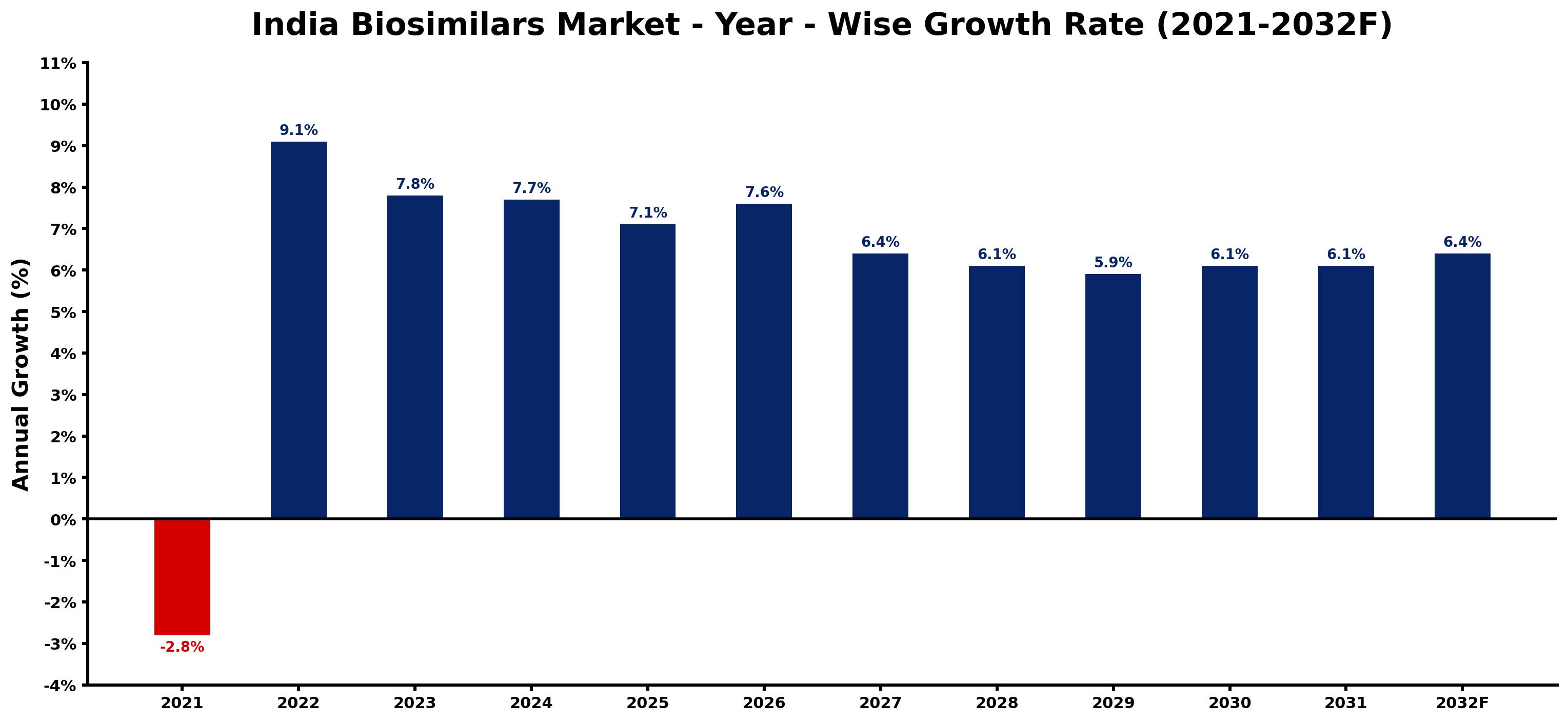
The table below presents the year‑wise growth rates along with the key drivers influencing the market
| Year | Growth Rate | Major Drivers |
| 2021 | -2.8% | Growing renewable energy integration projects |
| 2022 | 9.1% | Expansion of transportation and logistics networks |
| 2023 | 7.8% | Expansion of transportation and logistics networks |
| 2024 | 7.7% | Increasing adoption of advanced technologies |
| 2025 | 7.1% | Expansion of transportation and logistics networks |
| 2026 | 7.6% | Increasing industrial infrastructure investments |
| 2027 | 6.4% | Government infrastructure modernization initiatives |
| 2028 | 6.1% | Expansion of manufacturing activities |
| 2029 | 5.9% | Increasing smart city development projects |
| 2030 | 6.1% | Expansion of transportation and logistics networks |
| 2031 | 6.1% | Expansion of manufacturing activities |
| 2032 | 6.4% | Growing urbanization and commercial development |
Note - Market size estimations and growth projections presented in this report are based on 6Wresearch's advanced forecasting approach, validated with industry datasets as of June 2026.
India Biosimilars Market Synopsis
The most significant force currently shaping the India Biosimilars Market is the growing prevalence of chronic diseases. With lifestyle changes and aging populations contributing to higher incidence rates, the demand for effective and affordable biological therapies is accelerating, leading to an increasing acceptance of biosimilars among healthcare providers.
Government support mechanisms, including initiatives like the Drug Pricing Control Order (DPCO) and the Make in India program, are pivotal in this landscape. These programs facilitate not only reduced drug prices but also enhance the local manufacturing capabilities of biosimilars, ensuring better availability and accessibility across the healthcare spectrum.
India Biosimilars Market Key Takeaways
- The market is projected to see a CAGR of 5.2% from 2026 to 2032, driven by rising chronic disease rates.
- Government initiatives play a crucial role in enhancing affordability and access to biosimilars.
- Technological advancements are bolstering the confidence of medical professionals in adopting biosimilars.
- There is increasing integration of biosimilars into treatment protocols for chronic diseases.
- Regulatory support is streamlining processes for biosimilars' market entry and development.
Evaluation of Restraints in India Biosimilars Market
Despite the promising growth prospects, several restraints hold back the India Biosimilars Market. One significant barrier is the hesitance among some healthcare professionals regarding the efficacy and safety profiles of biosimilars compared to their branded counterparts. Furthermore, the market still grapples with a lack of widespread awareness and understanding of biosimilars among patients, which can hinder adoption. Intellectual property issues and the complex regulatory landscape further complicate product development and market entry for new biosimilars, creating additional hurdles for potential investors and manufacturers.
India Biosimilars Market Trends
The India Biosimilars Market is currently witnessing several key trends that are shaping its future. Increasing research and development activities are leading to the emergence of novel biosimilars targeting a wider range of diseases. The integration of artificial intelligence and machine learning in drug development processes is enabling faster and more efficient biosimilar production. Furthermore, there's a noticeable shift towards personalized medicine approaches, which is encouraging the development of biosimilars tailored to individual patient profiles. Enhanced collaborations between public and private sectors are also becoming increasingly common, fostering innovation and boosting market growth.
India Biosimilars Market Opportunities
The market for biosimilars in India presents abundant growth opportunities, particularly for companies that can navigate the regulatory landscape effectively. The surge in chronic disease prevalence offers a ripe environment for introducing new biosimilars that can provide affordable treatment alternatives. Investment in local production facilities can reduce costs and improve supply chain efficiencies, ultimately enhancing market competitiveness. Additionally, partnerships with healthcare providers to promote the benefits of biosimilars could significantly elevate market penetration and acceptance.
Government Initiatives in the India Biosimilars Market
The Indian government has implemented various initiatives aimed at bolstering the biosimilars market. Programs like the Pradhan Mantri Jan Aushadhi Yojana (PMJAY) are designed to enhance access to quality medicines at low costs, which includes biosimilars. Regulatory bodies such as the Central Drugs Standard Control Organization (CDSCO) are continually working to simplify the registration process for biosimilars, promoting innovation while ensuring that safety and efficacy standards are met. These initiatives signify the government's commitment to making healthcare more affordable and accessible for the population.
Future Insights of the India Biosimilars Market
Looking ahead to 2026-2032, the India Biosimilars Market is poised for substantial growth, driven by continuous advancements in biotechnology and supportive governmental policies. As awareness regarding the benefits of biosimilars increases among both healthcare providers and patients, the adoption rates are expected to rise. The expansion of manufacturing capabilities and the introduction of innovative biosimilars targeting a diverse range of diseases will further support this growth. Overall, the landscape indicates a transformation toward a more sustainable and accessible healthcare model in India.
India Biosimilars Market Latest Developments (May 2025 - June 2026)
Recent developments in the India Biosimilars Market have showcased a focus on enhancing production capacities and innovation. Companies are increasingly investing in state-of-the-art manufacturing technologies to improve the efficiency and quality of biosimilars. The regulatory environment is becoming more favorable, with recent guidelines aimed at expediting the approval processes for biosimilars. Additionally, strategic collaborations between industry players and research institutions are rising, emphasizing the importance of innovation in staying competitive within this evolving market.
India Biosimilars Market - Key Attractiveness of the Report
- 10 Years of Market Numbers
- Historical Data Starting from 2022 to 2025
- Base Year: 2025
- Forecast Data until 2032
- Key Performance Indicators Impacting the Market
- Major Upcoming Developments and Projects
Key Highlights of the Report:
- India Biosimilars Market Outlook
- Market Size of India Biosimilars Market, 2025
- Forecast of India Biosimilars Market, 2032
- Historical Data and Forecast of India Biosimilars Revenues & Volume for the Period 2022-2032F
- India Biosimilars Market Trend Evolution
- India Biosimilars Market Drivers and Challenges
- India Biosimilars Price Trends
- India Biosimilars Porter's Five Forces
- India Biosimilars Industry Life Cycle
- Historical Data and Forecast of India Biosimilars Market Revenues & Volume By Product for the Period 2022-2032F
- Historical Data and Forecast of India Biosimilars Market Revenues & Volume By Insulin for the Period 2022-2032F
- Historical Data and Forecast of India Biosimilars Market Revenues & Volume By Follitropin for the Period 2022-2032F
- Historical Data and Forecast of India Biosimilars Market Revenues & Volume By Calcitonin for the Period 2022-2032F
- Historical Data and Forecast of India Biosimilars Market Revenues & Volume By Glucagon for the Period 2022-2032F
- Historical Data and Forecast of India Biosimilars Market Revenues & Volume By Teriparatide for the Period 2022-2032F
- Historical Data and Forecast of India Biosimilars Market Revenues & Volume By Others for the Period 2022-2032F
- Historical Data and Forecast of India Biosimilars Market Revenues & Volume By Indication for the Period 2022-2032F
- Historical Data and Forecast of India Biosimilars Market Revenues & Volume By Oncology for the Period 2022-2032F
- Historical Data and Forecast of India Biosimilars Market Revenues & Volume By Offsite Treatment for the Period 2022-2032F
- Historical Data and Forecast of India Biosimilars Market Revenues & Volume By Chronic Disorders for the Period 2022-2032F
- Historical Data and Forecast of India Biosimilars Market Revenues & Volume By Blood Disorders for the Period 2022-2032F
- Historical Data and Forecast of India Biosimilars Market Revenues & Volume By Infectious Diseases for the Period 2022-2032F
- Historical Data and Forecast of India Biosimilars Market Revenues & Volume By Others for the Period 2022-2032F
- Historical Data and Forecast of India Biosimilars Market Revenues & Volume By Manufacturing for the Period 2022-2032F
- Historical Data and Forecast of India Biosimilars Market Revenues & Volume By Outsourced for the Period 2022-2032F
- Historical Data and Forecast of India Biosimilars Market Revenues & Volume By In-house for the Period 2022-2032F
- India Biosimilars Import Export Trade Statistics
- Market Opportunity Assessment By Product
- Market Opportunity Assessment By Indication
- Market Opportunity Assessment By Manufacturing
- India Biosimilars Top Companies Market Share
- India Biosimilars Competitive Benchmarking By Technical and Operational Parameters
- India Biosimilars Company Profiles
- India Biosimilars Key Strategic Recommendations






































